A complete issue · 36 pages · 1931
Life — January 23, 1931
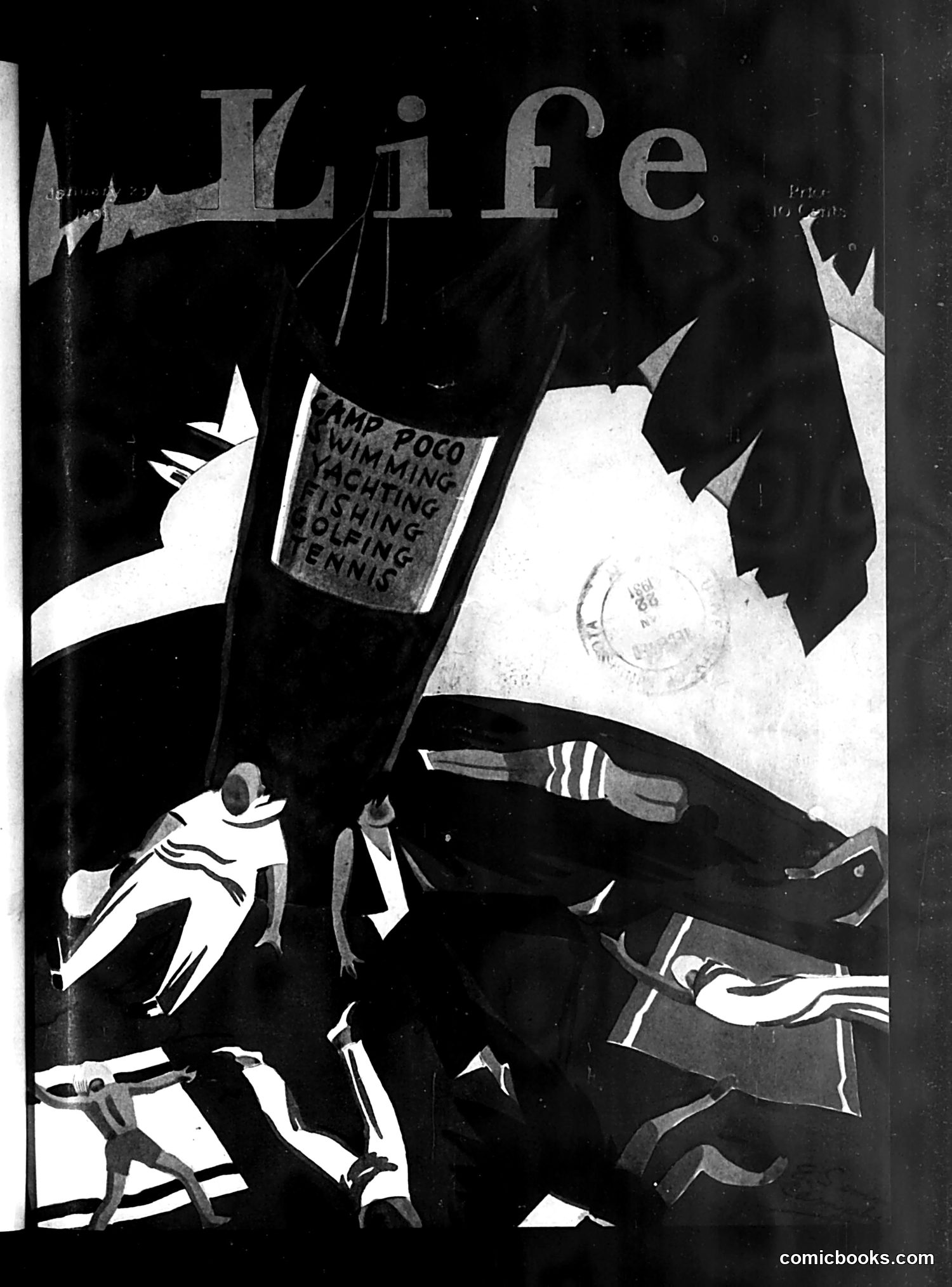
# Analysis of Life Magazine Page This appears to be a cover or advertisement page from Life magazine featuring the word "Life" prominently at the top. The illustration depicts stylized figures engaged in recreational activities listed on a banner: "SWIMMING, YACHTING, FISHING, GOLFING, TENNIS." The artwork shows people in period bathing suits and athletic wear enjoying leisure pursuits, rendered in a bold, high-contrast Art Deco or modernist style typical of early-to-mid 20th century design. The composition satirizes or celebrates leisure culture and upper-class recreational pursuits of the era. Without additional context or readable captions, the specific satirical message remains unclear, though the juxtaposition of "Life" with affluent leisure activities suggests commentary on American lifestyle, wealth, or social class of that period.
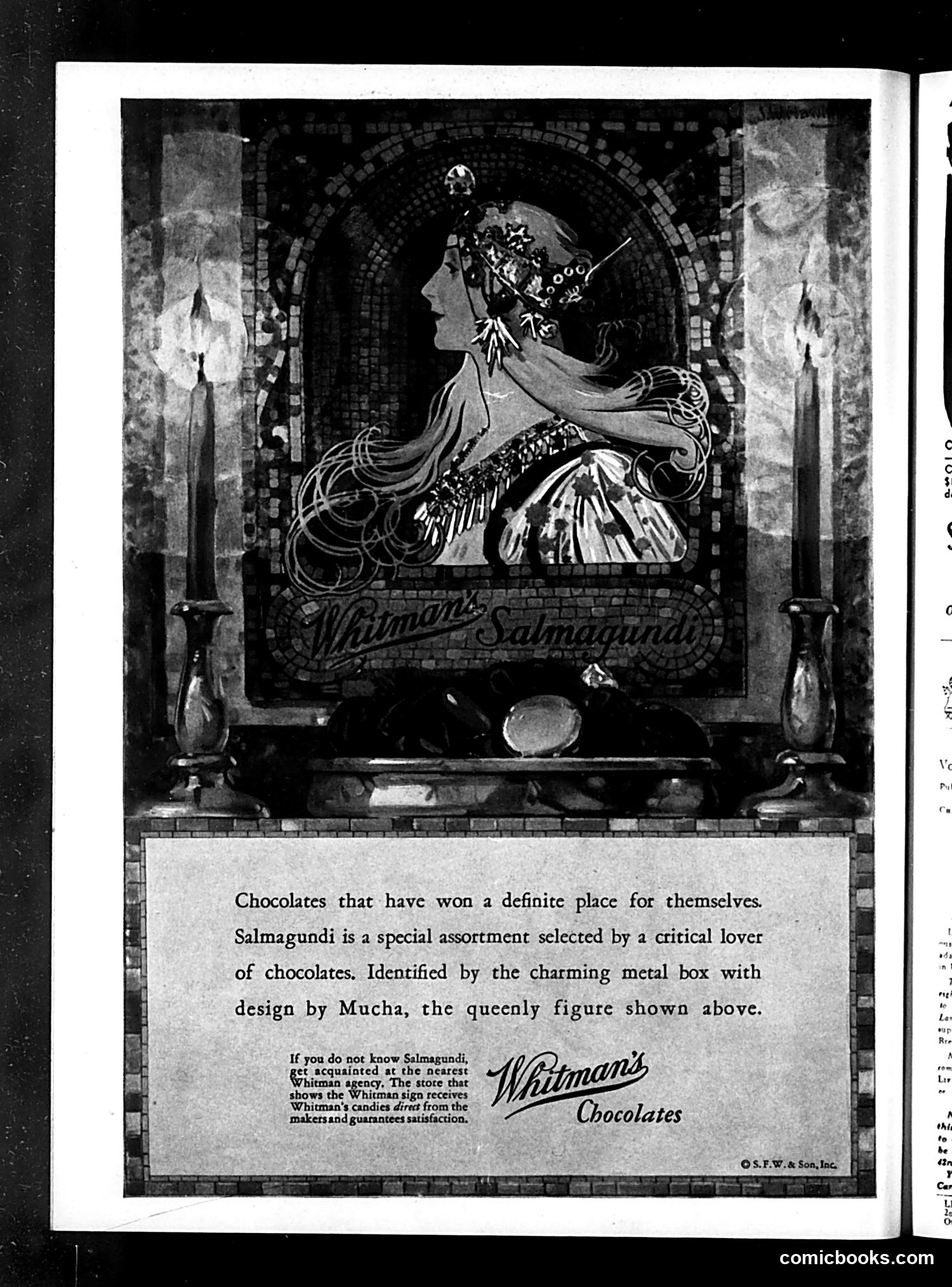
# Advertisement Analysis This is a **Whitman's Chocolates advertisement**, not political satire. The page features an Art Nouveau-style illustration by Mucha showing an elegantly dressed woman in profile, wearing ornate jewelry and a feathered garment, framed by a decorative mosaic arch with candelabras. The ad promotes "Salmagundi," a special chocolate assortment in a decorative metal box. The text emphasizes that these are "chocolates that have won a definite place for themselves," positioning Salmagundi as a premium product selected by discerning chocolate lovers. The advertisement instructs consumers to find Salmagundi at "Whitman agency" stores displaying the Whitman sign, which "guarantees satisfaction." This is pure commercial marketing using artistic design to convey luxury and refinement.
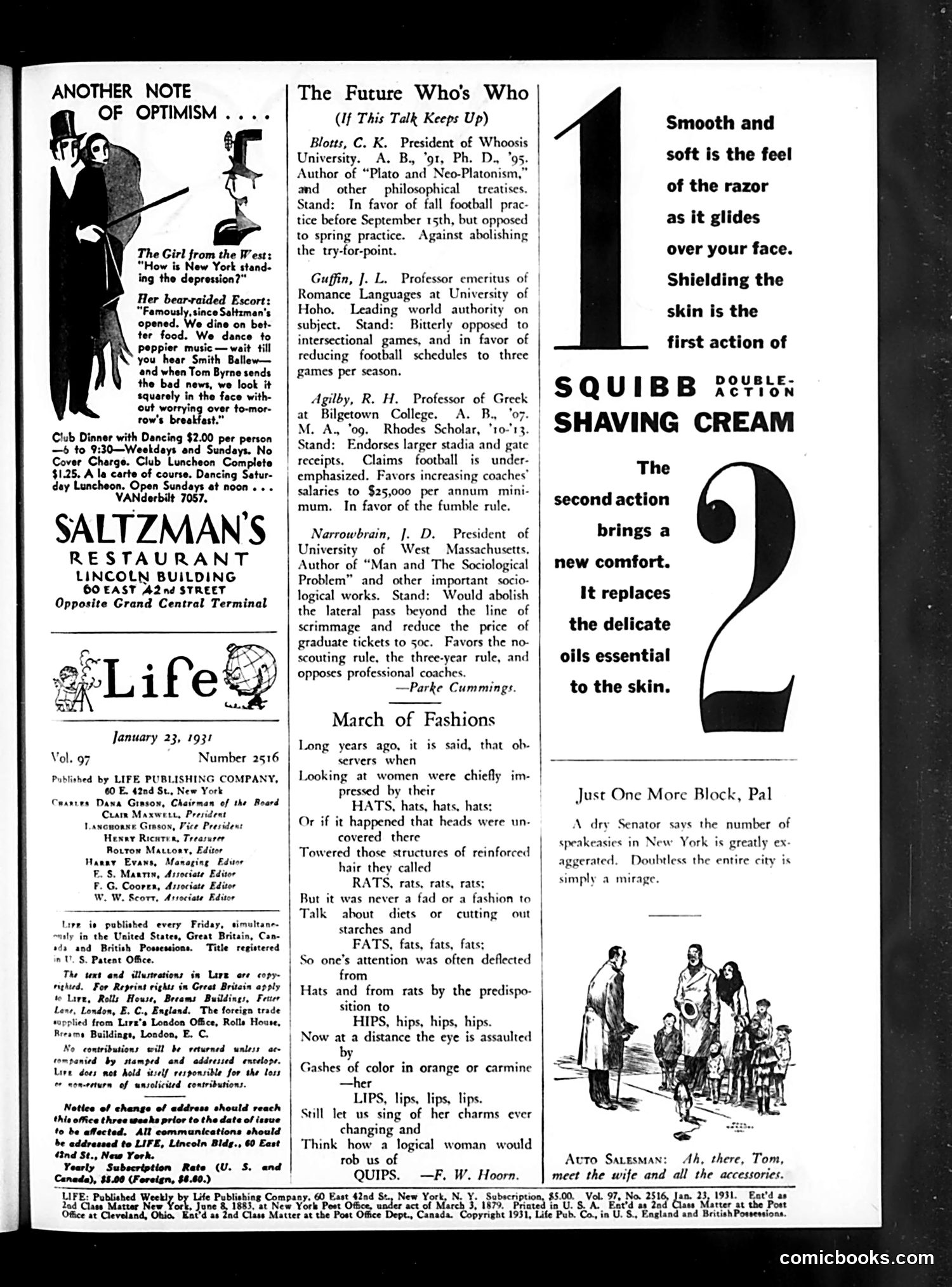
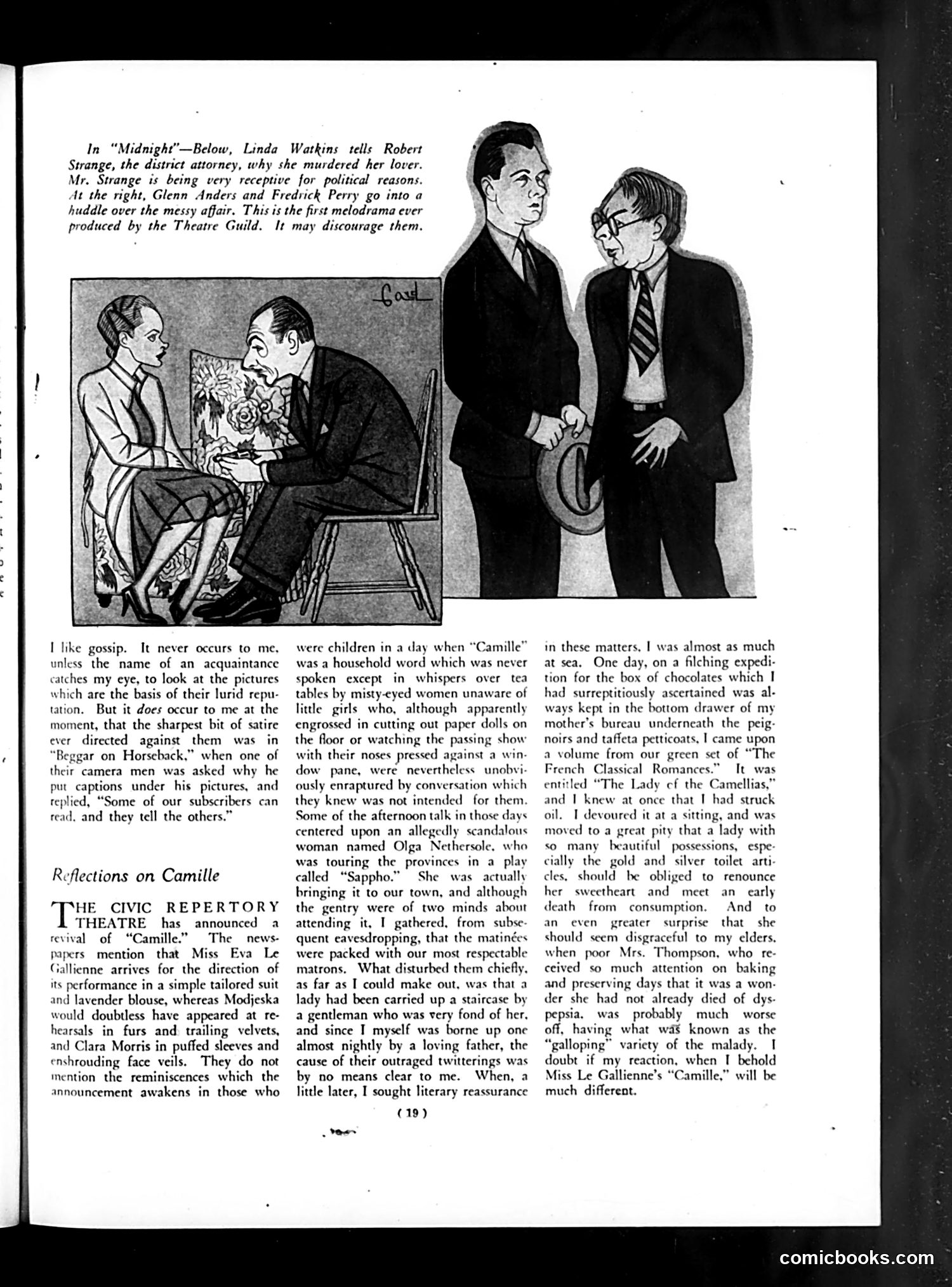
# "Another Note of Optimism" Cartoon Analysis This cartoon depicts a well-dressed man in a top hat appearing to juggle or balance precariously while looking distressed. The caption references "The Girl from the West" saying "How is Now York standing the depression?" and her boyfriend's response about dancing to "pepper music" while worrying about food. The satire targets the contrast between outward appearances of normalcy and the underlying anxiety of the Great Depression (the page is dated January 23, 1932—deep in the crisis). The title "Another Note of Optimism" is ironic: despite economic collapse, people maintain social routines and pretend everything is manageable, even as they worry privately about basic necessities. The unsteady juggling posture visually reinforces this precarious balancing act.
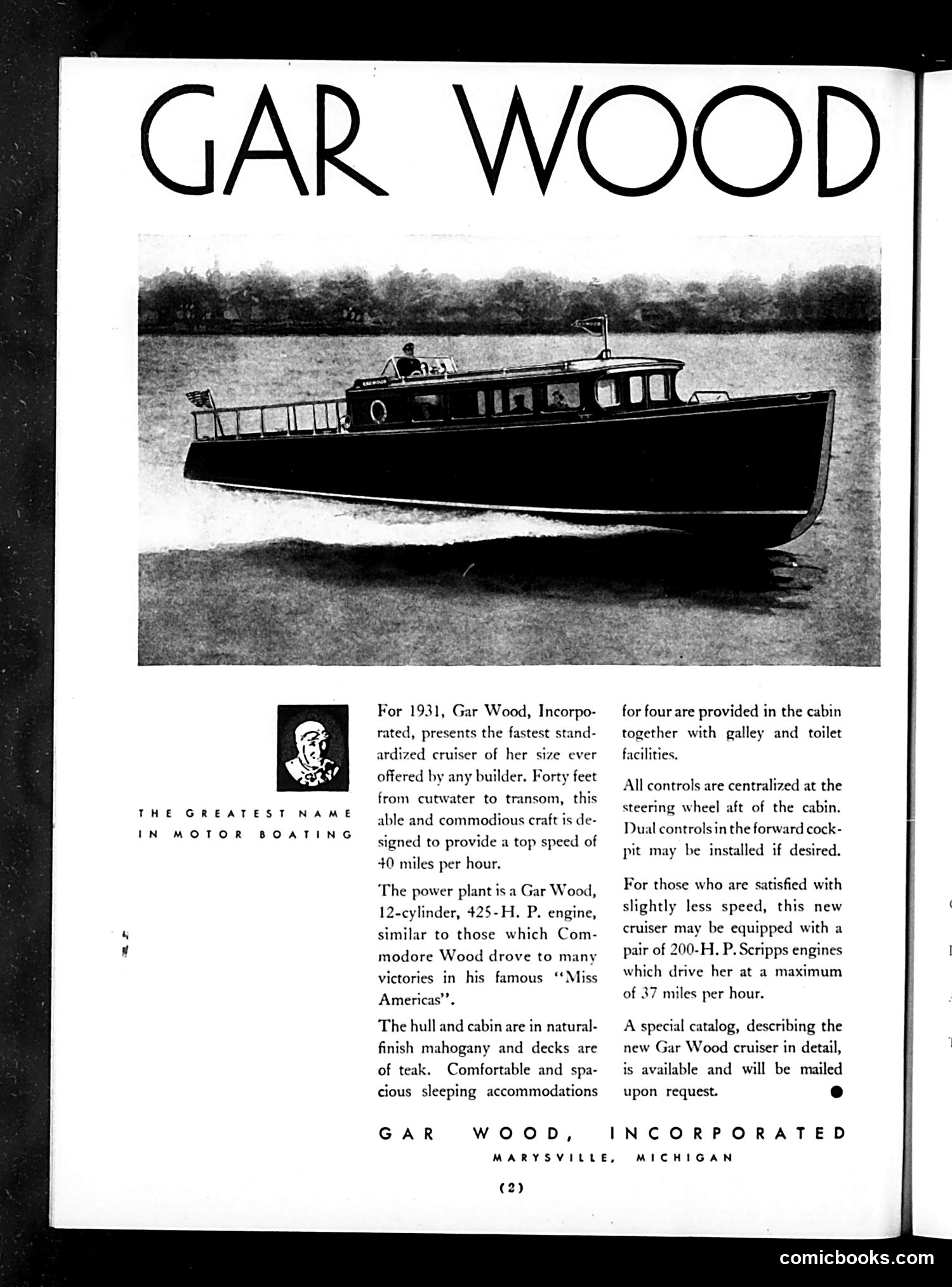
# Analysis This is a **product advertisement**, not political satire or a cartoon. It promotes the Gar Wood speedboat cruiser for 1931, manufactured in Marysville, Michigan. The small illustration in the left margin appears to be a generic mascot or brand emblem (a face in a circle), labeled "The Greatest Name in Motor Boating." The advertisement emphasizes the boat's speed (40 mph maximum with its 12-cylinder engine), luxury features (mahogany hull, teak decks, sleeping accommodations), and customization options. It references Commodore Wood's "Miss America" racing victories to establish brand prestige. There is **no satire or political content**—this is straightforward 1931 commercial advertising highlighting engineering and leisure lifestyle appeal to wealthy consumers during the Depression era.
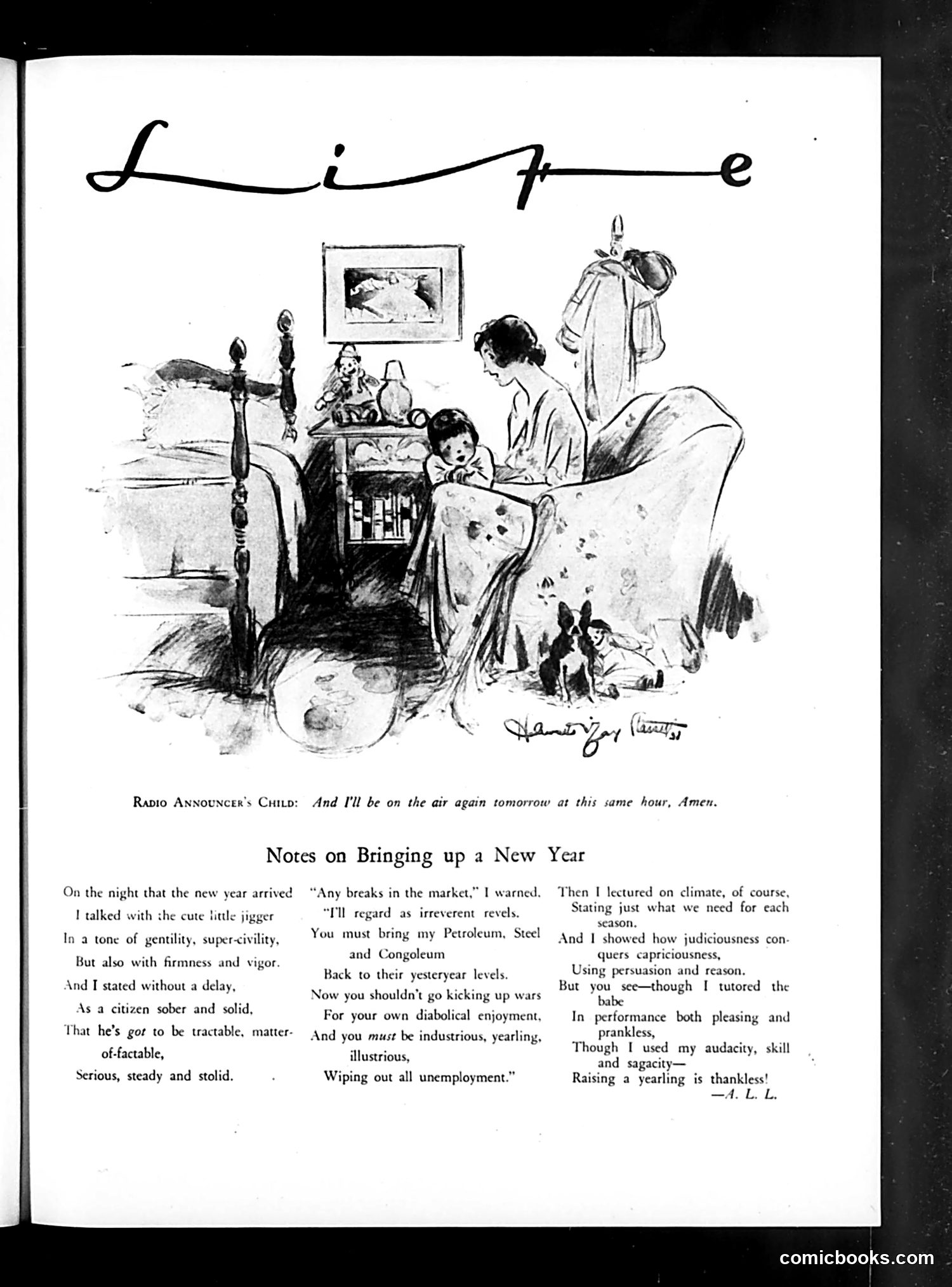
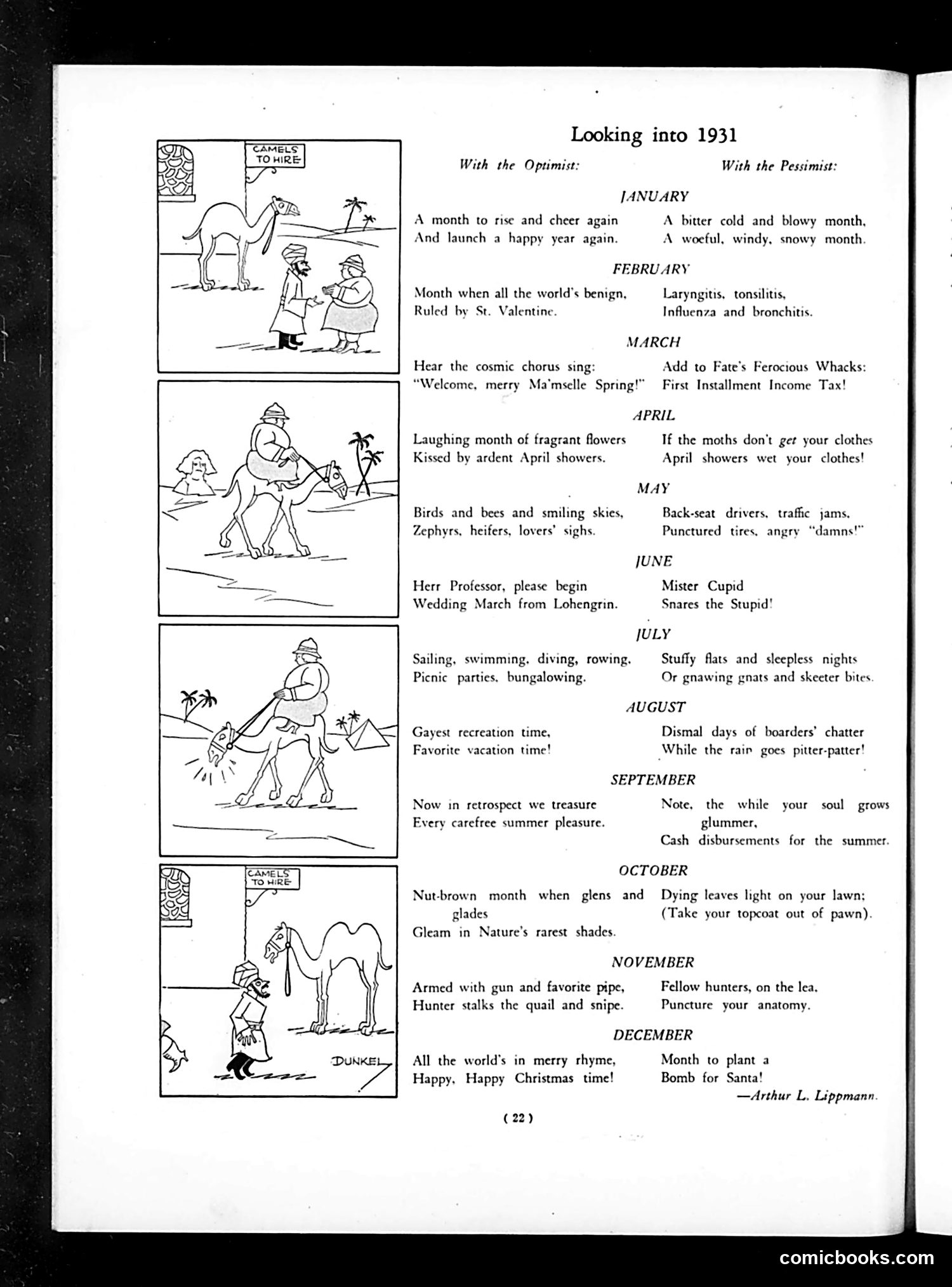
# Analysis This page from *Life* magazine features a satirical poem titled "Notes on Bringing up a New Year." The illustration shows a mother with children in a domestic interior, likely representing the "New Year" as a child being raised. The poem humorously presents advice for training the incoming year like a disciplined child—keeping it "tractable, matter-of-factable, / Serious, steady and solid." The speaker warns against economic instability ("breaks in the market"), unemployment, and war, advocating instead for industrial productivity and virtuous behavior. The satire mocks the optimistic notion that one can simply "raise" a new year properly through moral instruction, ignoring larger economic and political forces. It reflects anxiety about post-war economic conditions and social stability during the early 1920s.
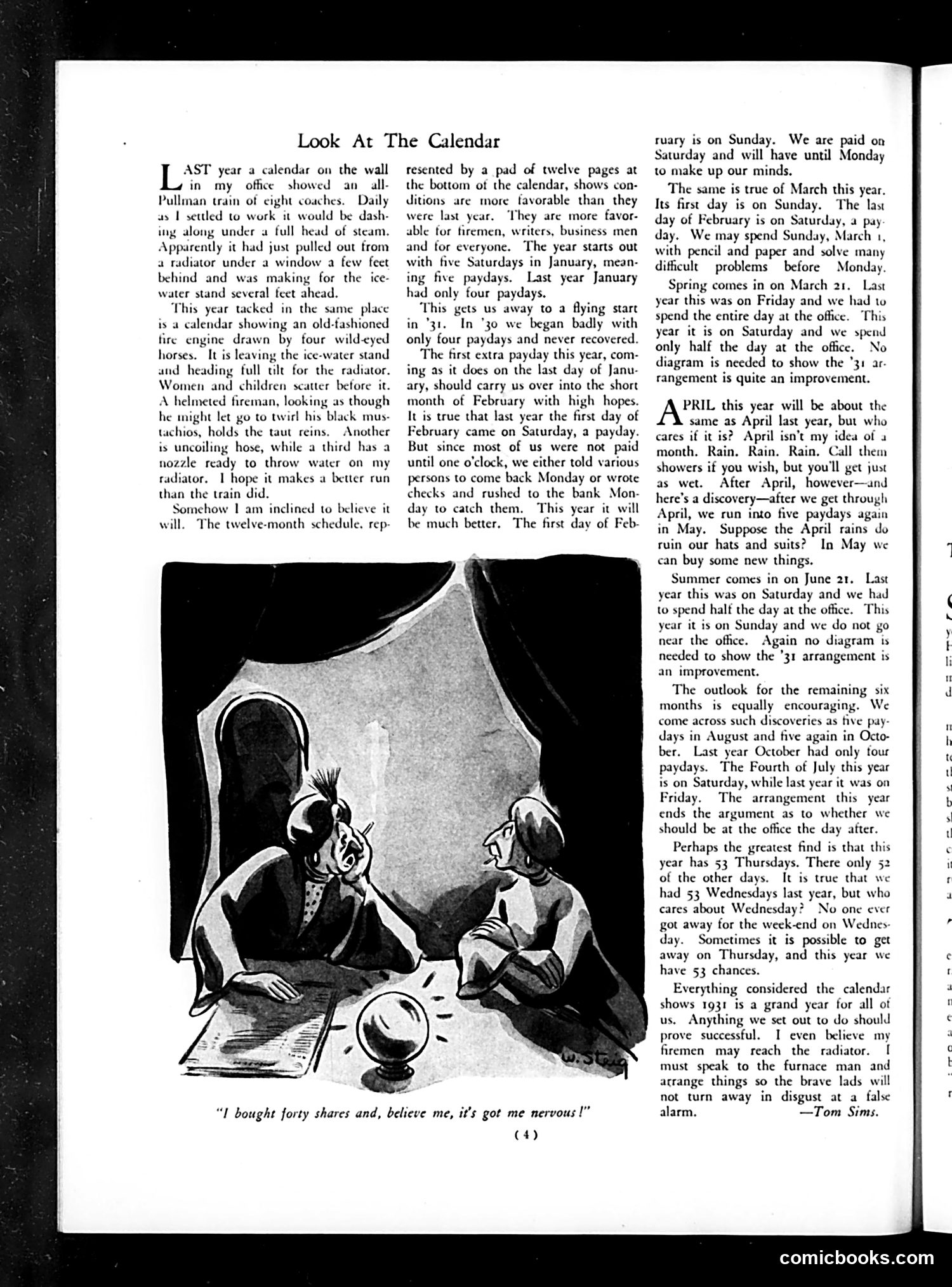
# Analysis This page is a humorous essay titled "Look At The Calendar" about how the calendar year 1931 affects office workers' schedules and paydays. The accompanying cartoon illustrates two office workers examining a calendar with concern, with one saying "I bought forty shares and, believe me, it's got me nervous!" The satire plays on the 1931 context: this was during the Great Depression following the 1929 stock market crash. The cartoon jokes about how ordinary workers became amateur stock investors, hoping to recoup losses or build wealth, only to find their nervousness about stock performance now tied to calendar quirks affecting their actual paychecks. The essay's focus on "five paydays" versus "four paydays" in different months reflects the financial anxiety of Depression-era workers managing tight budgets where even one missing paycheck mattered significantly.
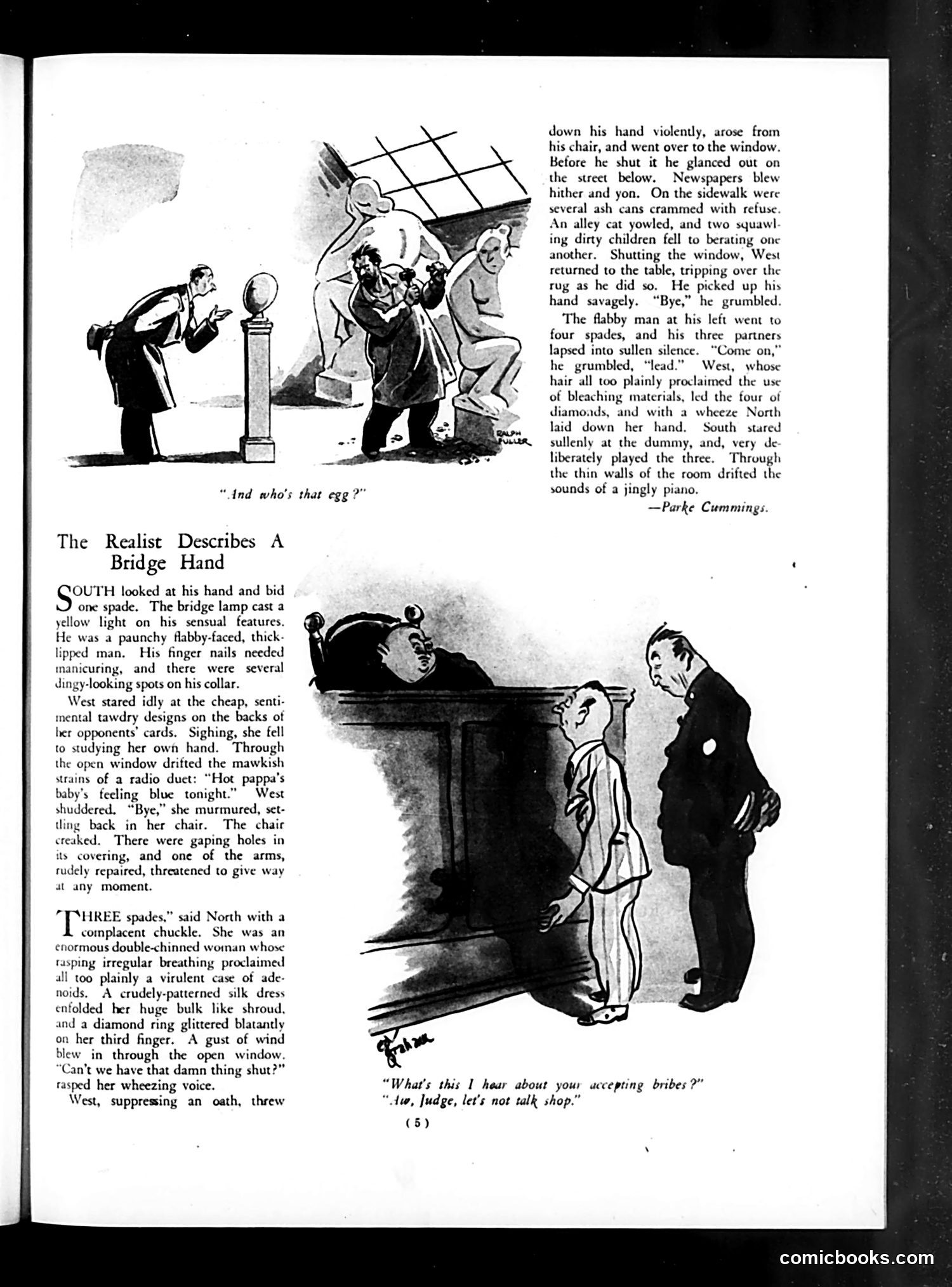
# "The Realist Describes A Bridge Hand" This page depicts a bridge card game scene. The narrative describes South examining his hand while West observes the cheap, sentimental card designs. The story emphasizes physical details—South's "paunchy flabby-faced" appearance, his dirty fingernails, West's bleached hair—all rendered unsympathetically. The cartoons illustrate bridge players in unflattering circumstances: one shows a man outside with an ash can, another depicts what appears to be a bribe-related conversation ("What's this I hear about your accepting bribes?"). The satire targets the pretensions of bridge as a "refined" game while depicting its actual players as working-class, morally compromised individuals. By focusing on physical ugliness and corruption, the piece mocks the gap between bridge's genteel reputation and the rough reality of those who play it.
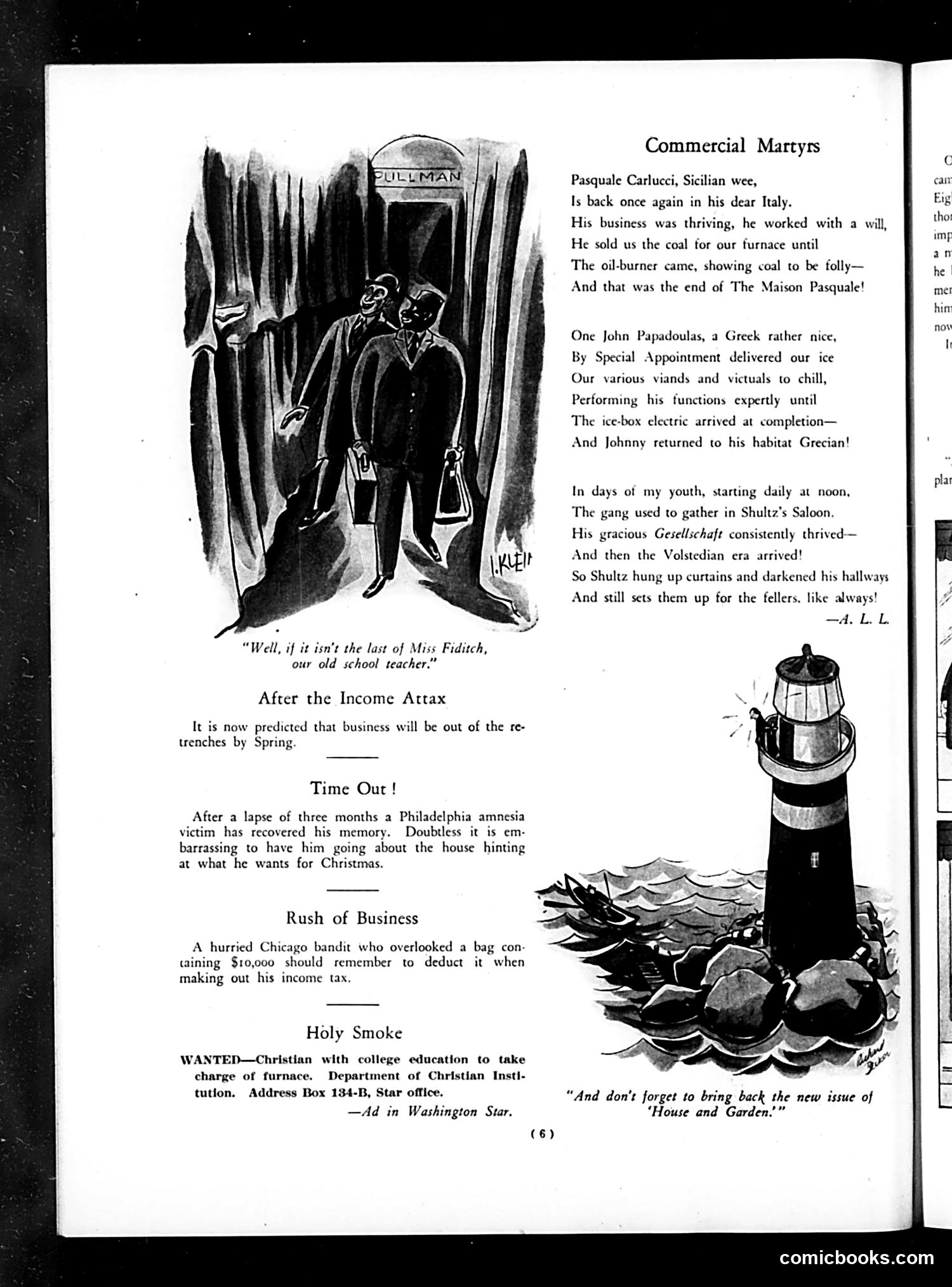
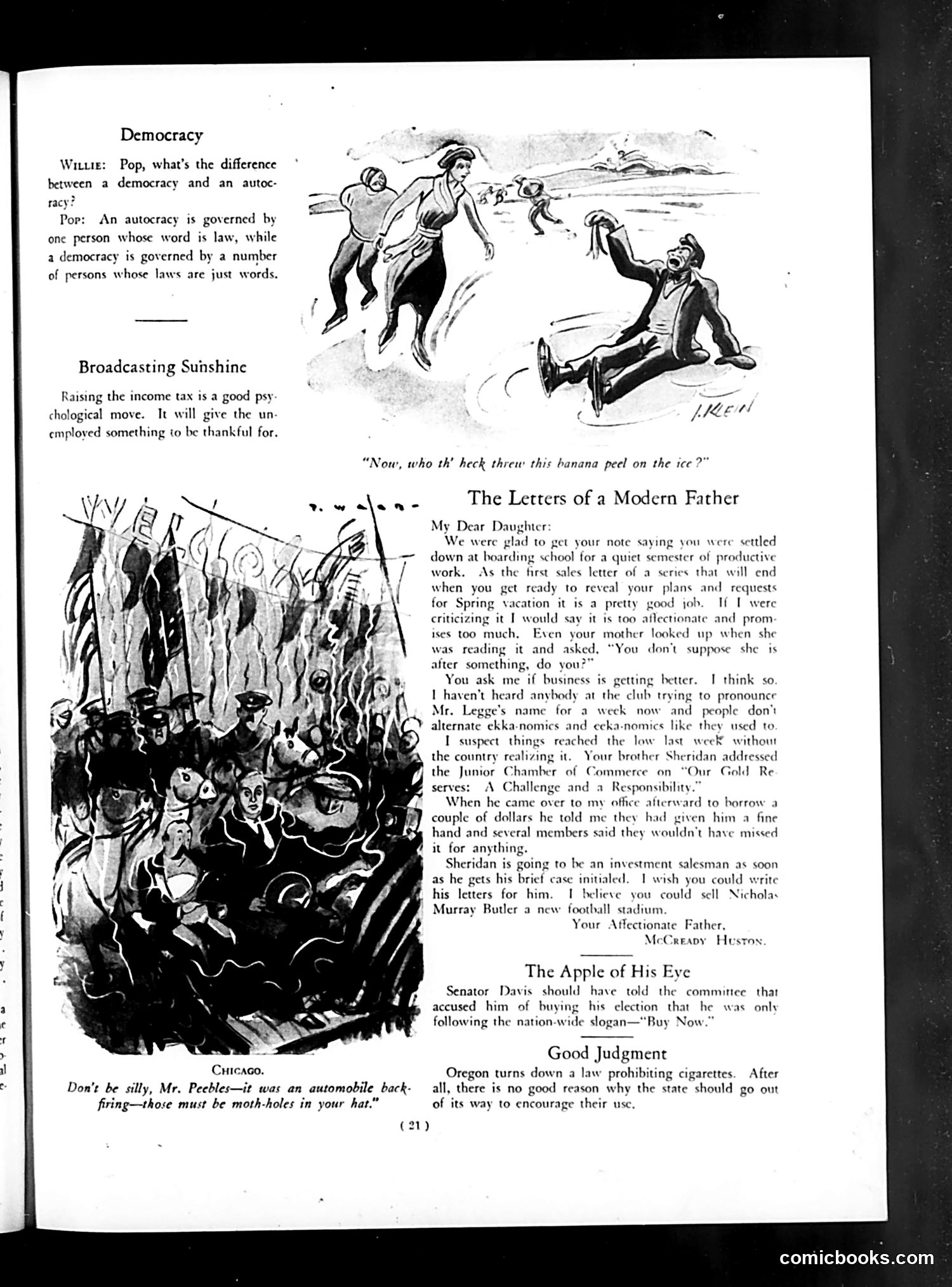
# Analysis of Life Magazine Page This page contains humorous short pieces and an advertisement rather than a unified political cartoon. The main illustrated item, "Commercial Martyrs," features a sketch of men in an elevator labeled "Pullman." The poem mocks various tradesmen—an Italian coal seller (Pasquale Carlucci), a Greek ice-box delivery man (John Papadoulas), and a saloon keeper (Schultz)—whose businesses have failed or been disrupted, likely due to Prohibition or economic changes. The other brief items ("After the Income Attax," "Time Out," "Rush of Business," "Holy Smoke") are satirical one-liners about contemporary urban life—income taxes, amnesia, Chicago crime, and religious institutions seeking workers. The page reflects early 20th-century American immigrant commerce and social anxieties.
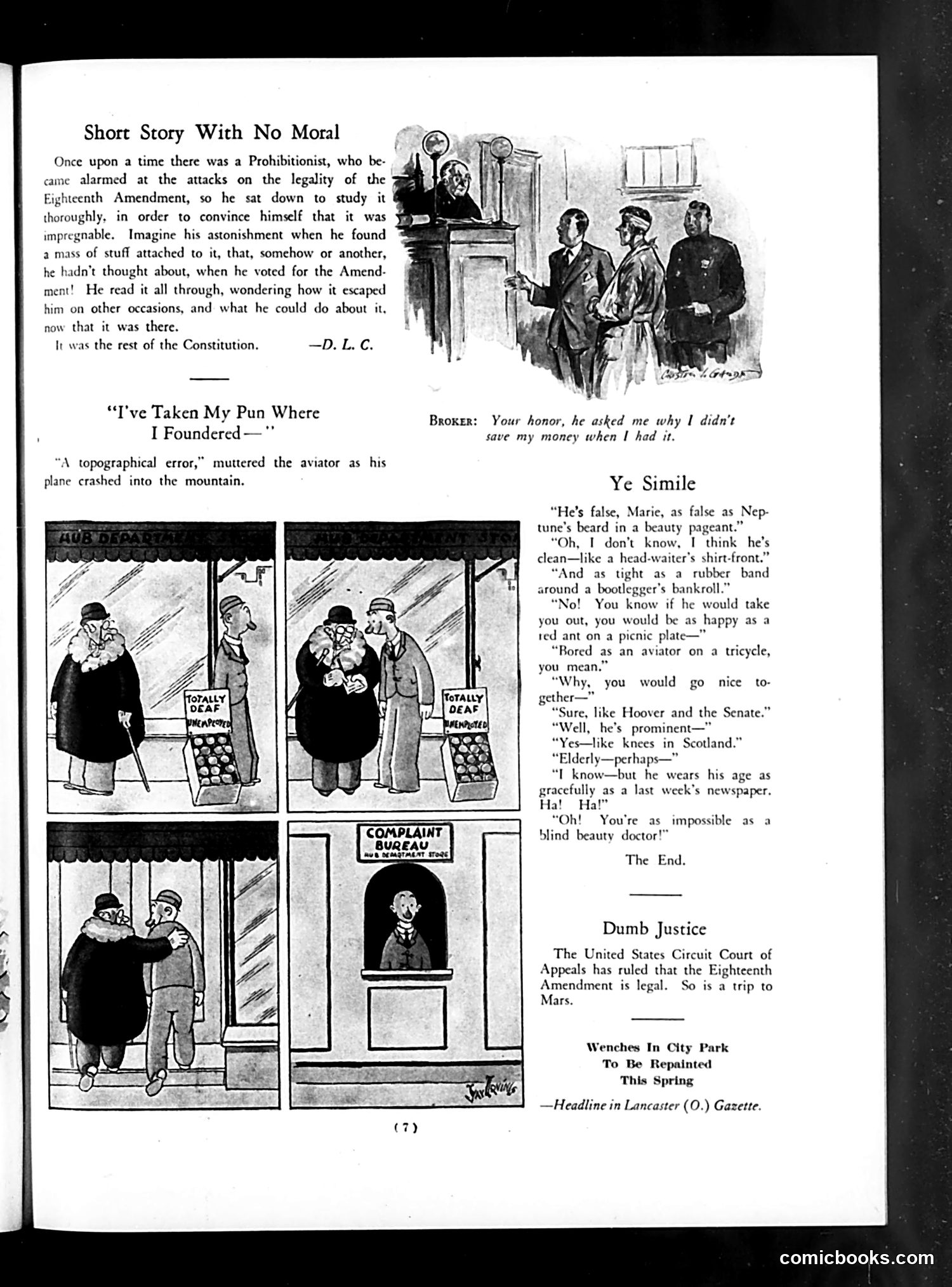
# Political Satire from Life Magazine This page contains several short satirical pieces from a Prohibition-era Life magazine. **"Short Story With No Moral"** mocks a Prohibitionist who discovers the Eighteenth Amendment has loopholes—satirizing the difficulty of enforcing alcohol bans. **"I've Taken My Pun Where I Foundered"** shows a four-panel comic about a deaf man repeatedly visiting a complaint bureau, likely satirizing bureaucratic incompetence and the absurdity of deaf individuals filing complaints they cannot hear responses to. **"Ye Simile"** uses comparative descriptions (false as Neptune's beard, tight as a bootlegger's bankroll) to humorously characterize someone, referencing bootleggers—illegal alcohol distributors during Prohibition. **"Dumb Justice"** briefly notes a court ruling that the Eighteenth Amendment is legal, sarcastically calling it "a trip to Mars."
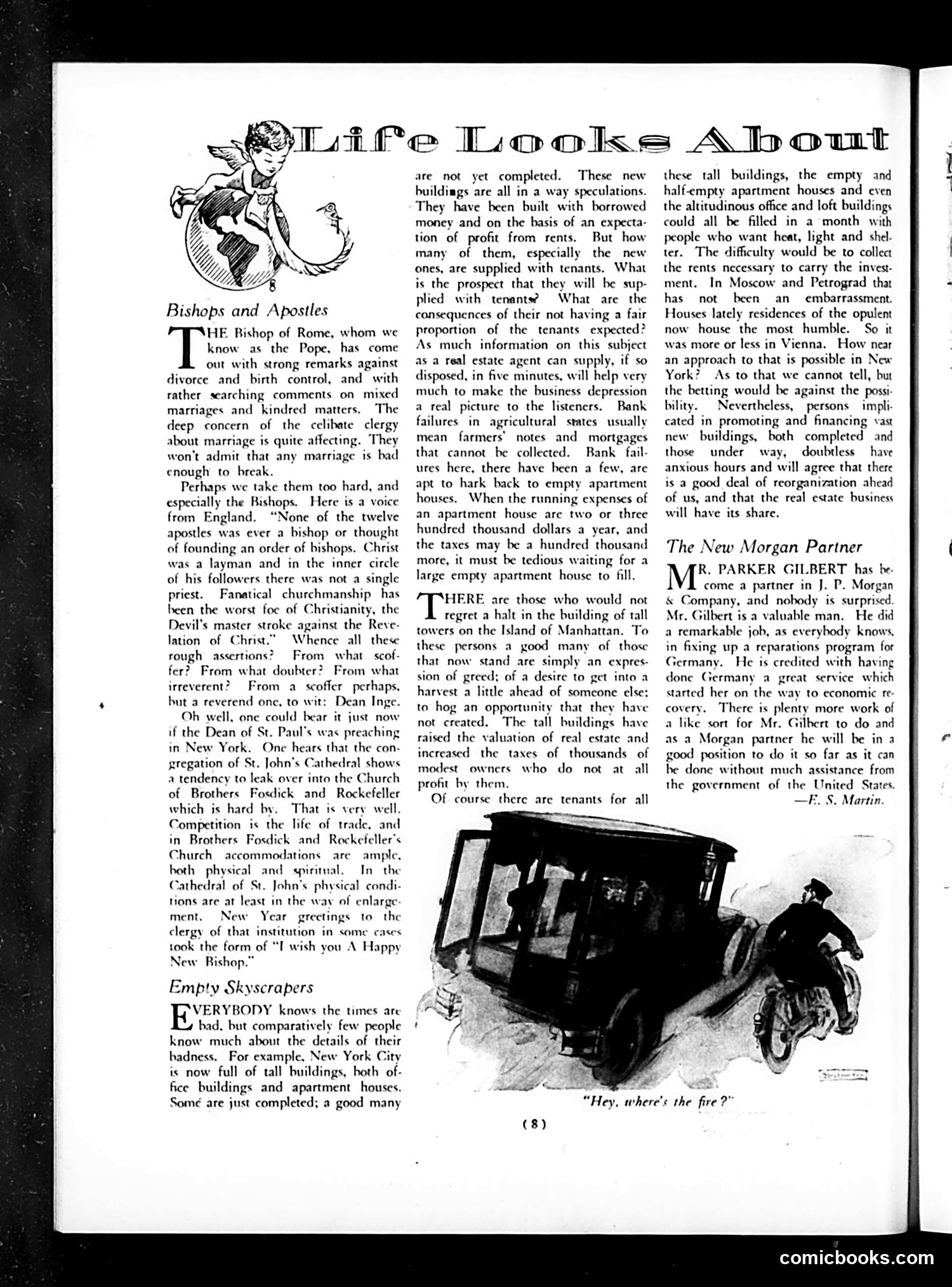
# Analysis of Life Magazine Page This page contains satirical commentary on 1920s American issues rather than political cartoons. **"Bishops and Apostles"** critiques clerical hypocrisy regarding marriage and divorce, likely referencing the Bishop of Rome's strong anti-divorce stance while acknowledging real-world difficulties of failed marriages. **"Empty Skyscrapers"** discusses New York City's real estate crisis—numerous tall buildings standing partially vacant or incomplete due to over-speculation and difficulty filling them with tenants. The text notes banks have failed on agricultural properties and apartment buildings remain unfilled despite high operating costs. **"The New Morgan Partner"** announces Parker Gilbert joining J.P. Morgan & Company to oversee reparations work in post-WWI Germany. The illustration captioned **"Hey, where's the fire?"** depicts someone on a motorcycle, likely satirizing reckless driving behavior.
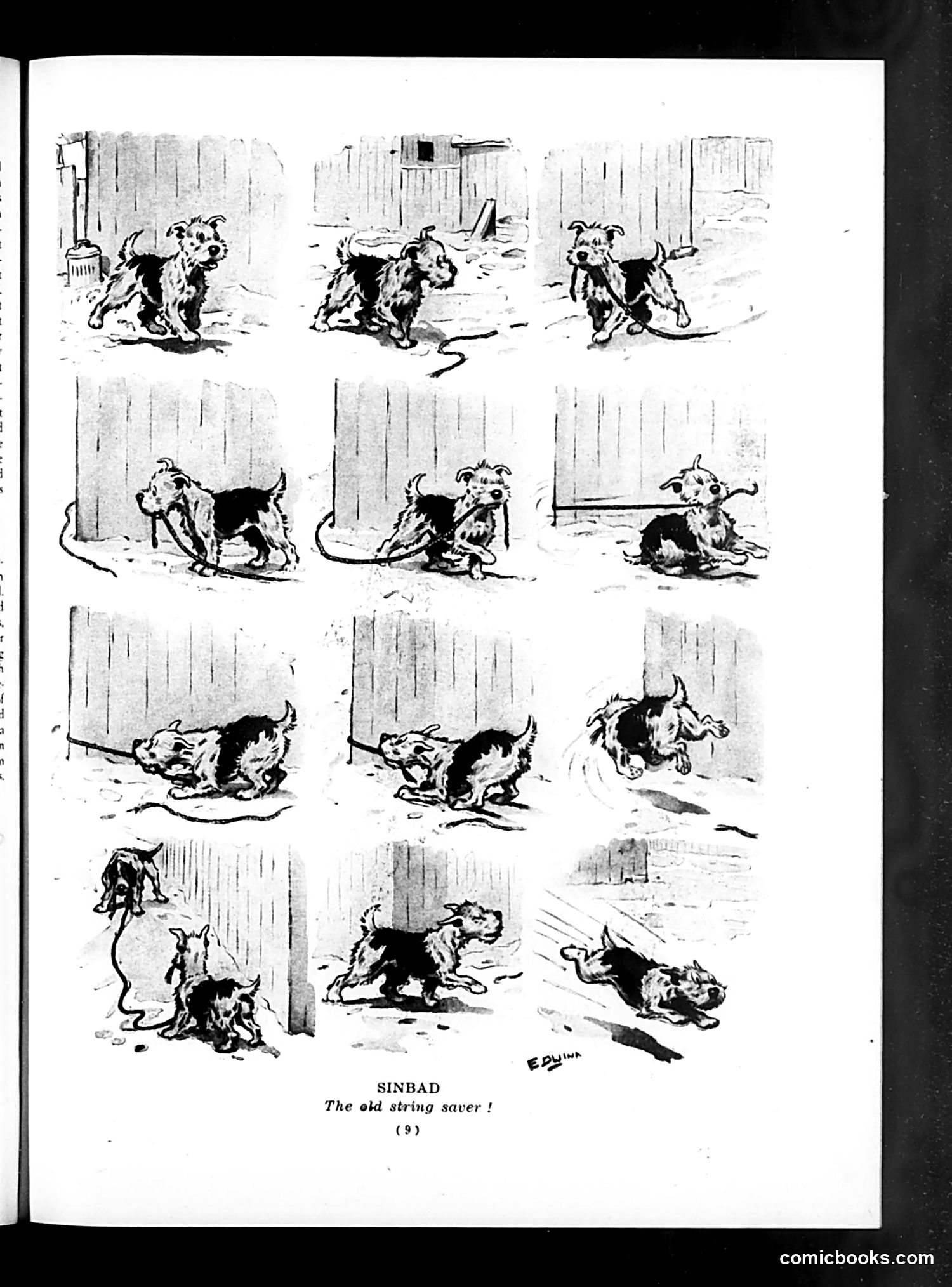
# "Sinbad: The Old String Saver" This is a humorous illustrated sequence by E. Shinn showing a dog discovering and repeatedly playing with an old piece of string. The comic follows the dog through twelve panels as it finds the string, chases it, tangles with it, and continues entertaining itself with it in various ways around a wooden-fenced yard. The joke plays on the relatable observation that dogs often derive endless amusement from simple, worthless objects—in this case, just an old string—rather than fancy toys. The title "The Old String Saver" appears to reference the dog's resourcefulness in making entertainment from discarded materials. It's gentle, observational humor about animal behavior that would appeal to any pet owner.
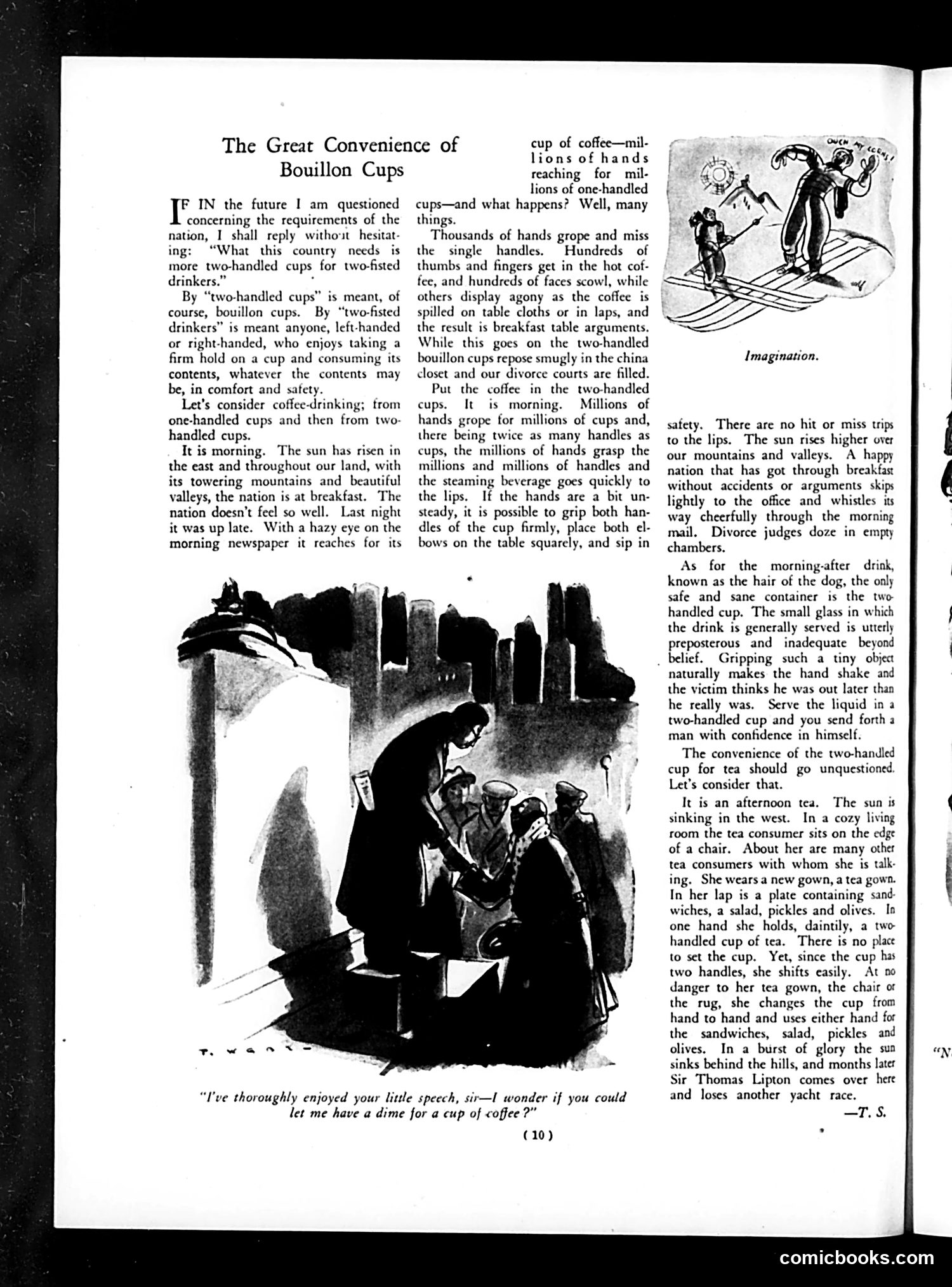
# "The Great Convenience of Bouillon Cups" This is a humorous satirical essay arguing for two-handled cups as a practical solution to everyday problems. The author uses exaggerated examples to mock social inconvenience: coffee drinkers missing single handles, spilled beverages causing "breakfast table arguments," and divorce court cases allegedly resulting from such accidents. The cartoon illustrations show crowded urban scenes—likely New York City given the skyline—depicting the chaos of one-handed cup drinking. The essay then extends the joke to afternoon tea, describing how a two-handled cup would allow women to eat finger foods while drinking without risk to their clothing. The satire gently mocks both the triviality of modern inconveniences and the earnestness with which people debate domestic solutions. The byline indicates this is by T.S. (author unclear).