A complete issue · 37 pages · 1931
Life — January 2, 1931
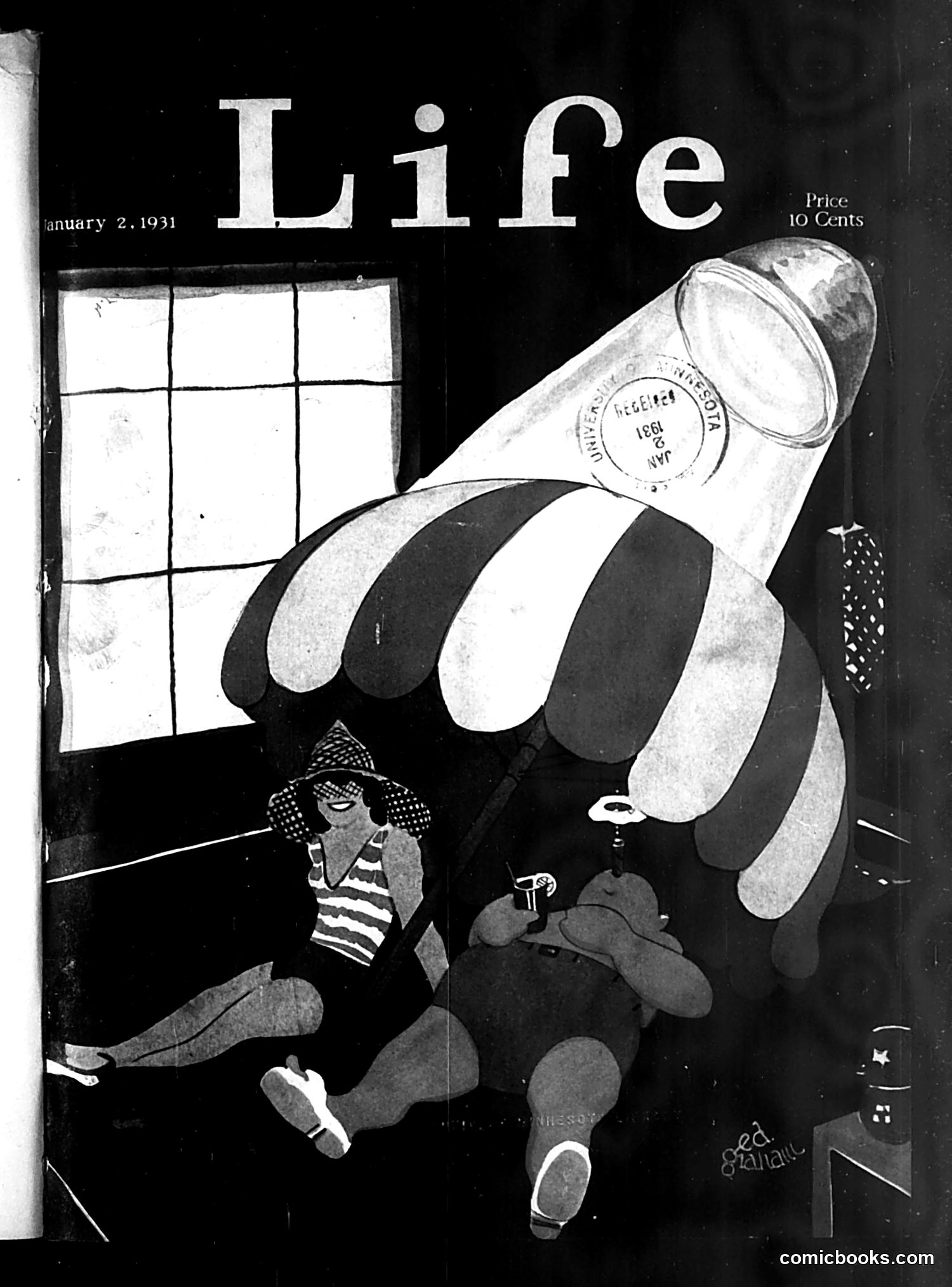
# Life Magazine Cover Analysis (January 2, 1931) This is a Life magazine cover from early 1931, during the Great Depression. The illustration shows a large striped hot-air balloon descending toward a window where a woman in a hat sits below. The balloon appears to represent inflated economic optimism or speculation—a common metaphor during this period of financial crisis. The satire likely critiques either false hopes about economic recovery or the disconnect between wealthy speculators and ordinary citizens suffering during the Depression. The woman's positioned below, watching the balloon descend, suggests ordinary people witnessing the collapse of inflated financial schemes or promises. The 10-cent price reflects Depression-era affordability for this satirical weekly magazine.
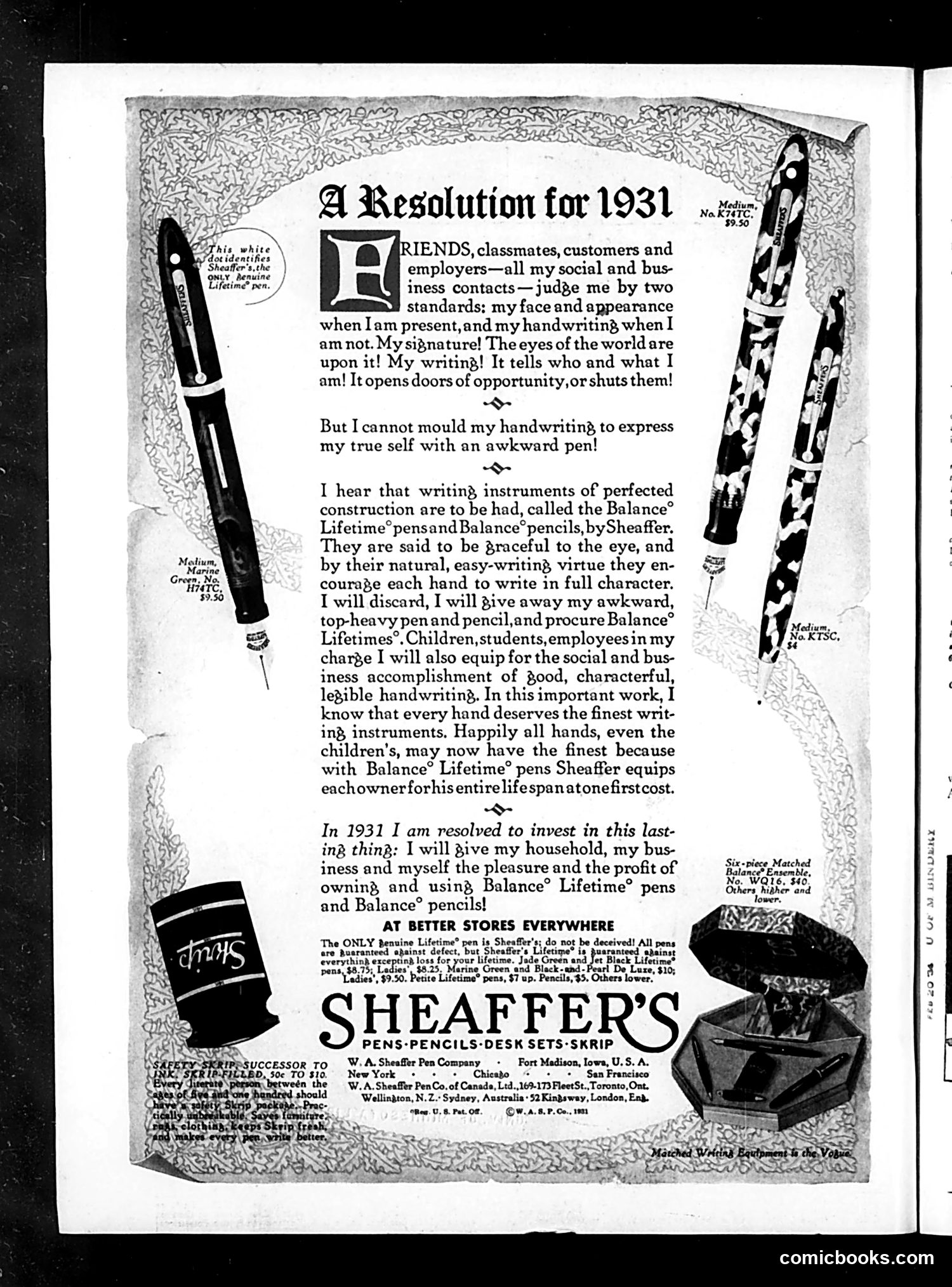
# Analysis This is **not a political cartoon or satire**—it's a **full-page advertisement** for Sheaffer fountain pens and pencils, presented as a "Resolution for 1931." The ad uses a first-person narrative where someone pledges to improve their handwriting and professional appearance by using Sheaffer's "Balance Lifetime" writing instruments. The text argues that handwriting reflects character and opens doors professionally, so investing in quality pens is worthwhile. The decorative borders, ornate pen illustrations, and earnest tone are typical of 1930s advertising designed to appeal to middle-class aspirations about self-improvement and social mobility during the Depression era. There is no political content or satire—simply commercial persuasion framed as a New Year's resolution.
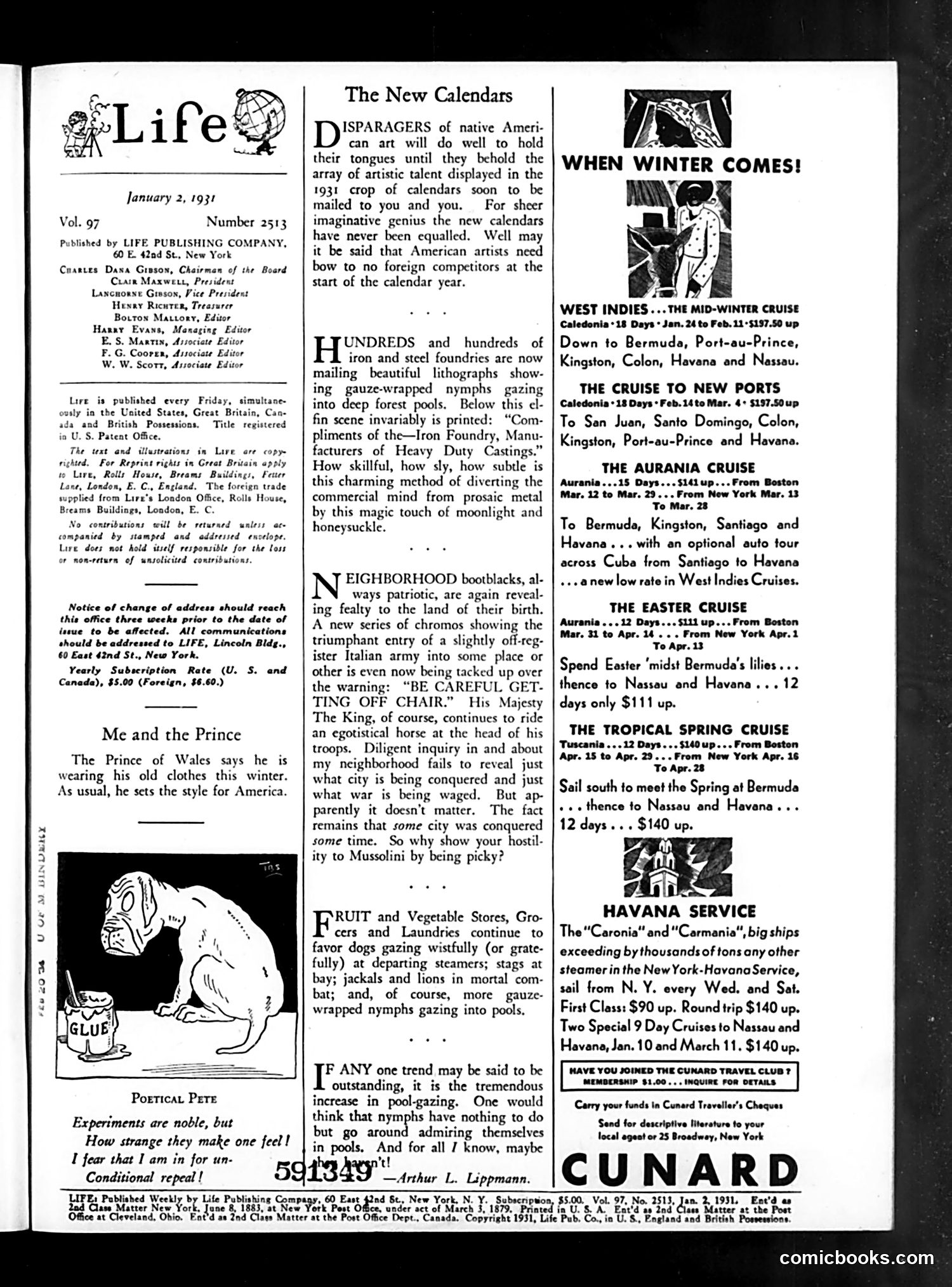
# Political Cartoon Analysis: "Poetical Pete" This cartoon depicts a figure labeled "Poetical Pete" sitting beside a waste bucket, appearing disheveled and distressed. The accompanying caption reads: "Experiments are noble, but / How strange they make one feel! / I fear that I am fit for / Conditional repeal!" The satire targets someone—likely a public figure of 1931—who engages in social "experiments" (possibly referencing Prohibition or economic policies of the Depression era). The joke plays on the figure's pretentious language ("poetical") contrasted with their undignified, deteriorated condition, suggesting their noble ideals have failed miserably in practice. The reference to "conditional repeal" hints at reversing failed policies, while the waste bucket emphasizes the messy, unsuccessful outcome of their experimental approach to governance or social reform.
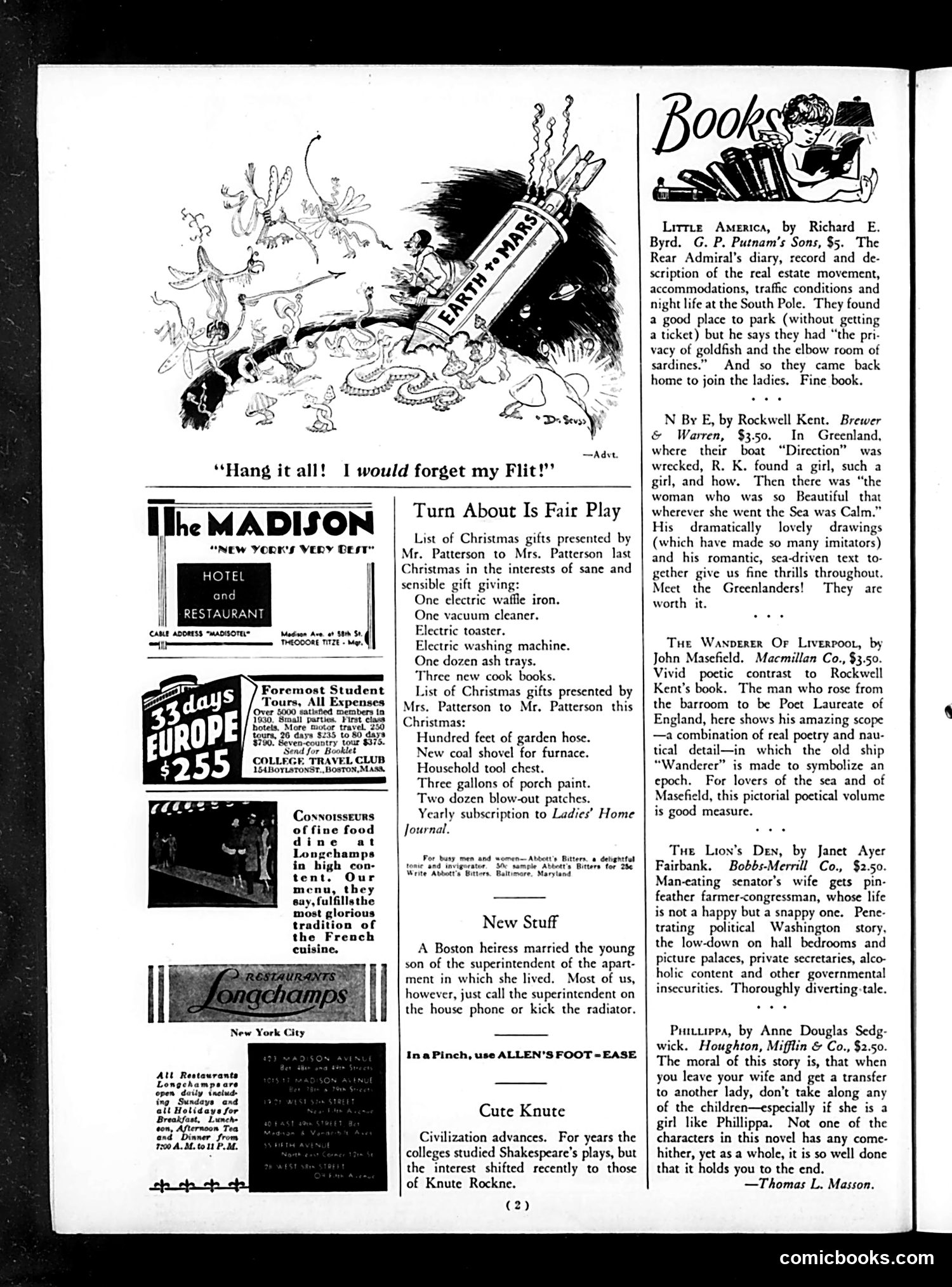
# Political Cartoon Analysis The main cartoon shows a figure labeled "EARTH BOUND" being struck by or colliding with what appears to be a large explosive device or firecracker. The character appears distressed, with the caption "Hang it all! I would forget my Flit!" This is a satirical reference to Flit insecticide, a popular commercial product of the era. The joke plays on the contrast between mundane consumer concerns (remembering to buy bug spray) and catastrophic events (the "Earth Bound" explosion). It's social satire mocking how advertising had conditioned Americans to prioritize commercial products even in absurd scenarios. The cartoon satirizes consumerism and the pervasiveness of advertising in American life during this period.
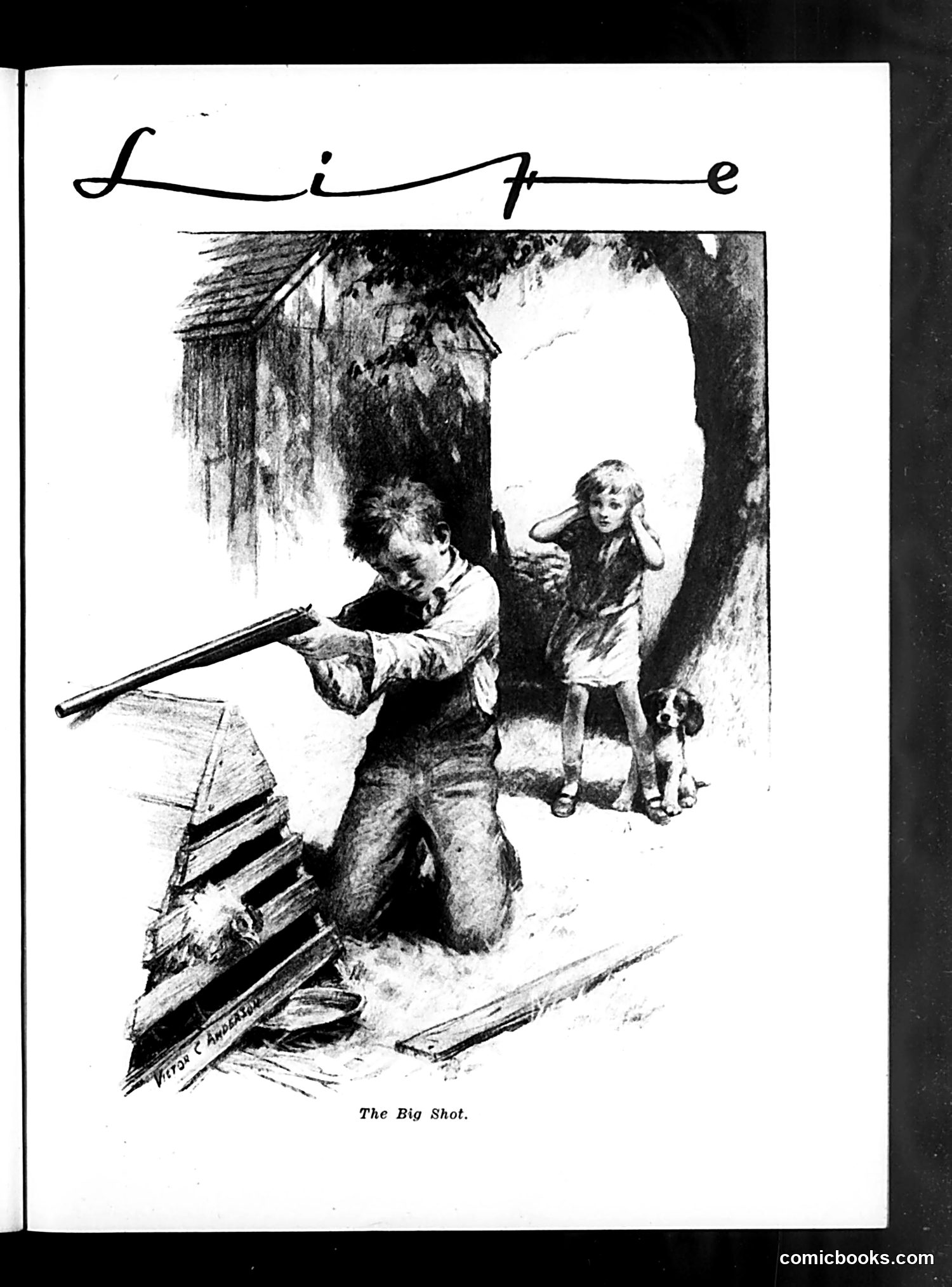
# "The Big Shot" This illustration shows a man kneeling and aiming a rifle through what appears to be a tunnel or archway, while a child stands nearby observing. The title "The Big Shot" is ironic—the man appears to be taking aim at something with great effort and ceremony, suggesting he considers himself important or dangerous. The satire likely mocks someone who imagines himself more powerful or significant than he actually is. The child's presence and casual observation underscore this: what the man treats as a momentous "big shot" is merely a curiosity to an innocent bystander. Without additional context or visible attribution, the specific political figure or event referenced is unclear, but the overall message critiques inflated self-importance or false bravado.
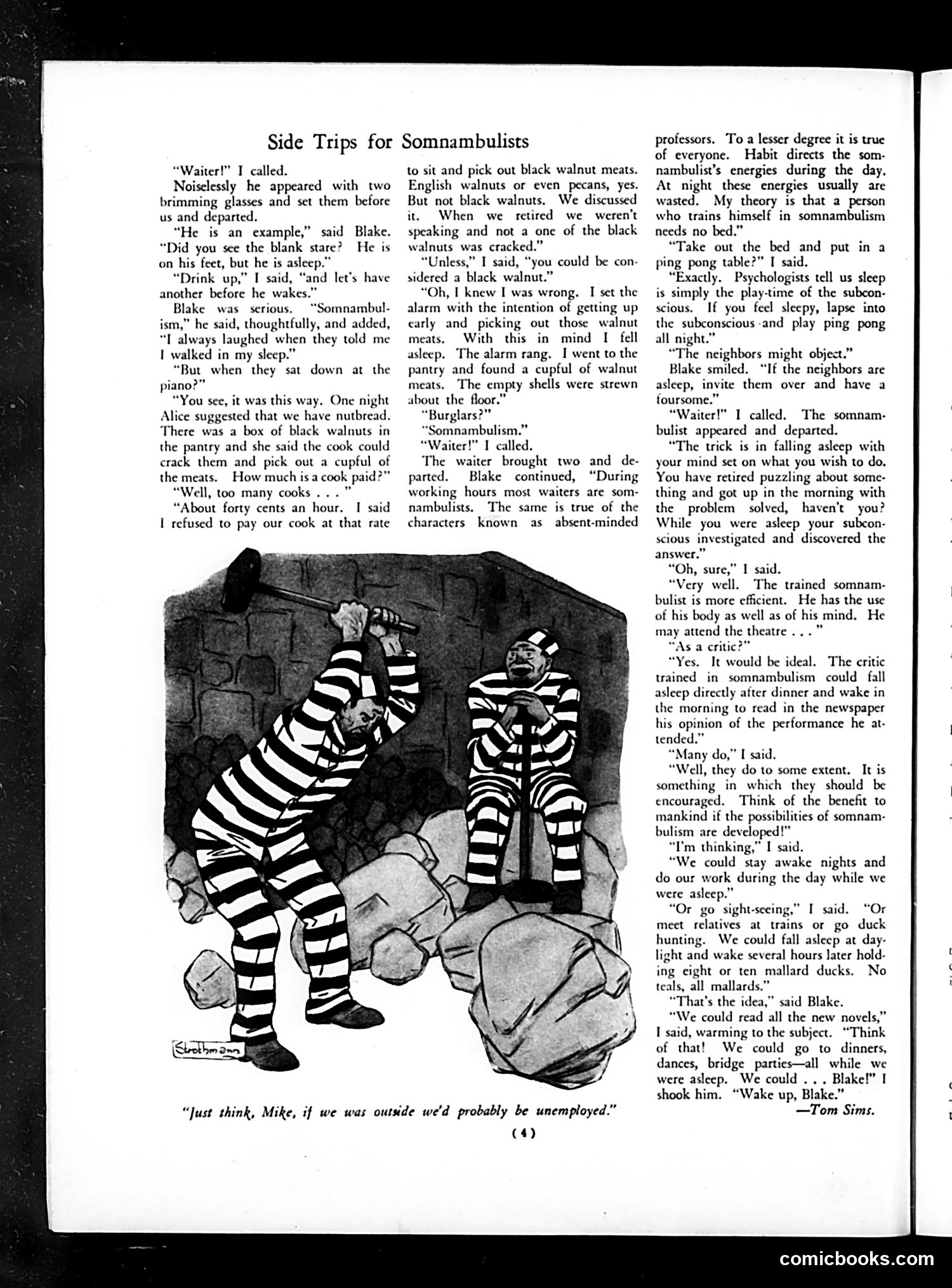
# "Side Trips for Somnambulists" This is a humorous short story by Tom Sims about two men (Blake and the narrator) discussing the theoretical benefits of somnambulism—sleepwalking. They propose absurd "side trips" one could take while asleep: picking walnuts, attending theater, going duck hunting, reading novels, or dining and dancing. The accompanying illustration shows two striped-pajama-clad figures sleepwalking, with the caption: "Just think, Mike, if we was outside we'd probably be unemployed." The satire mocks both pseudo-intellectual discussions of habit and productivity, and contemporary economic anxiety—suggesting that even sleeping people could lose their jobs during what appears to be an economic downturn. The joke relies on Depression-era unemployment fears.
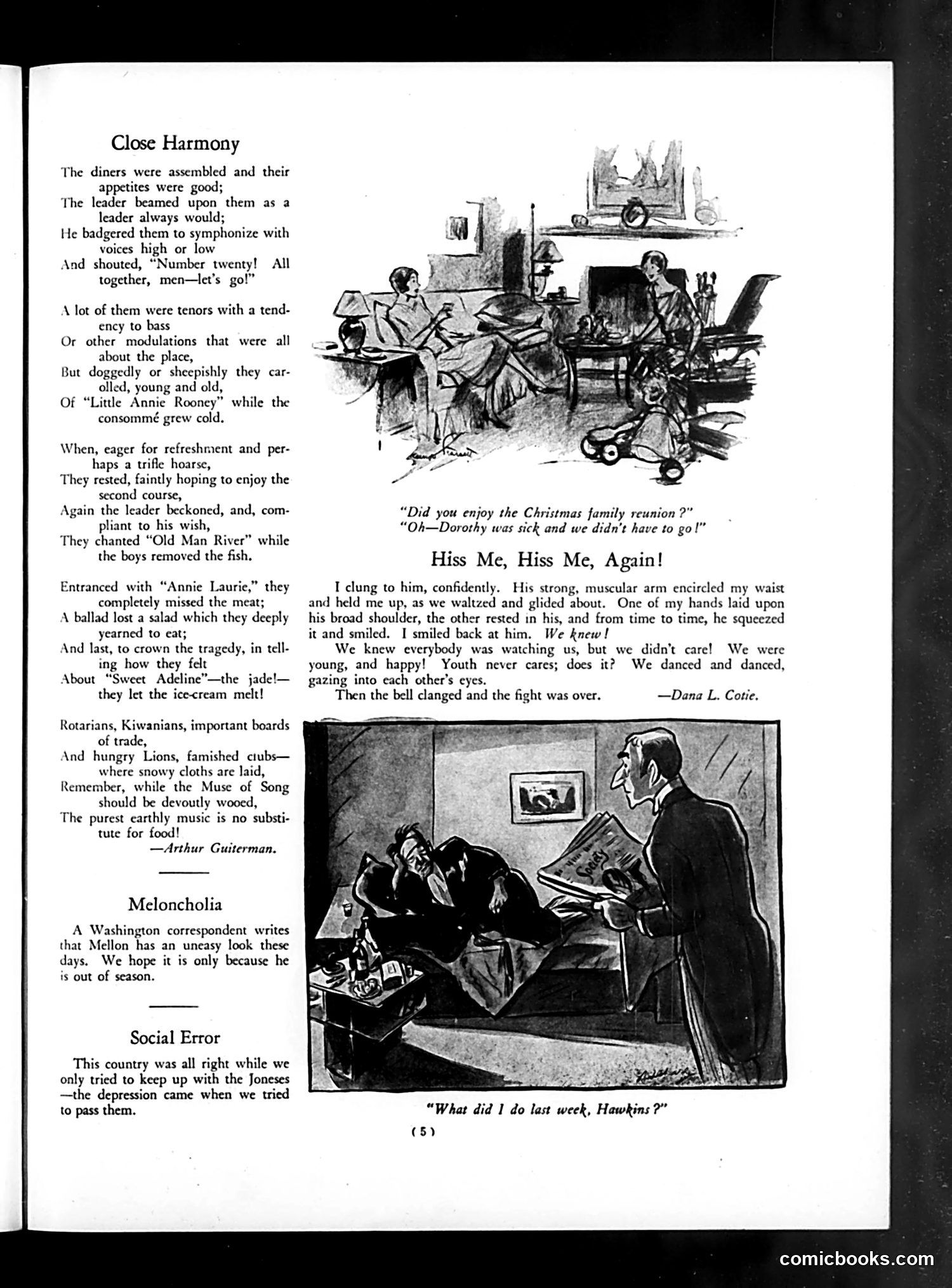
# Page Analysis: Life Magazine This page contains three separate pieces of social commentary: 1. **"Close Harmony"** (poem by Arthur Guiterman): A nostalgic critique of a formal dinner where diners sang together—songs like "Little Annie Rooney" and "Old Man River." The satire targets how such gatherings attempted forced conviviality among social clubs (Rotarians, Kivanians, Lions) despite their fundamentally commercial nature. 2. **"Hiss Me, Miss Me, Again!"** (Dana L. Cotte): A romantic vignette about young people at a dance, celebrating youthful passion and freedom from social observation. 3. **"Meloncholia"**: A brief note suggesting Washington, D.C. appears melancholic because melons are out of season—a mild, absurdist joke. 4. **"Social Error"**: Commentary on economic anxiety; the country "worked" during prosperity but depression followed attempts to "keep up."
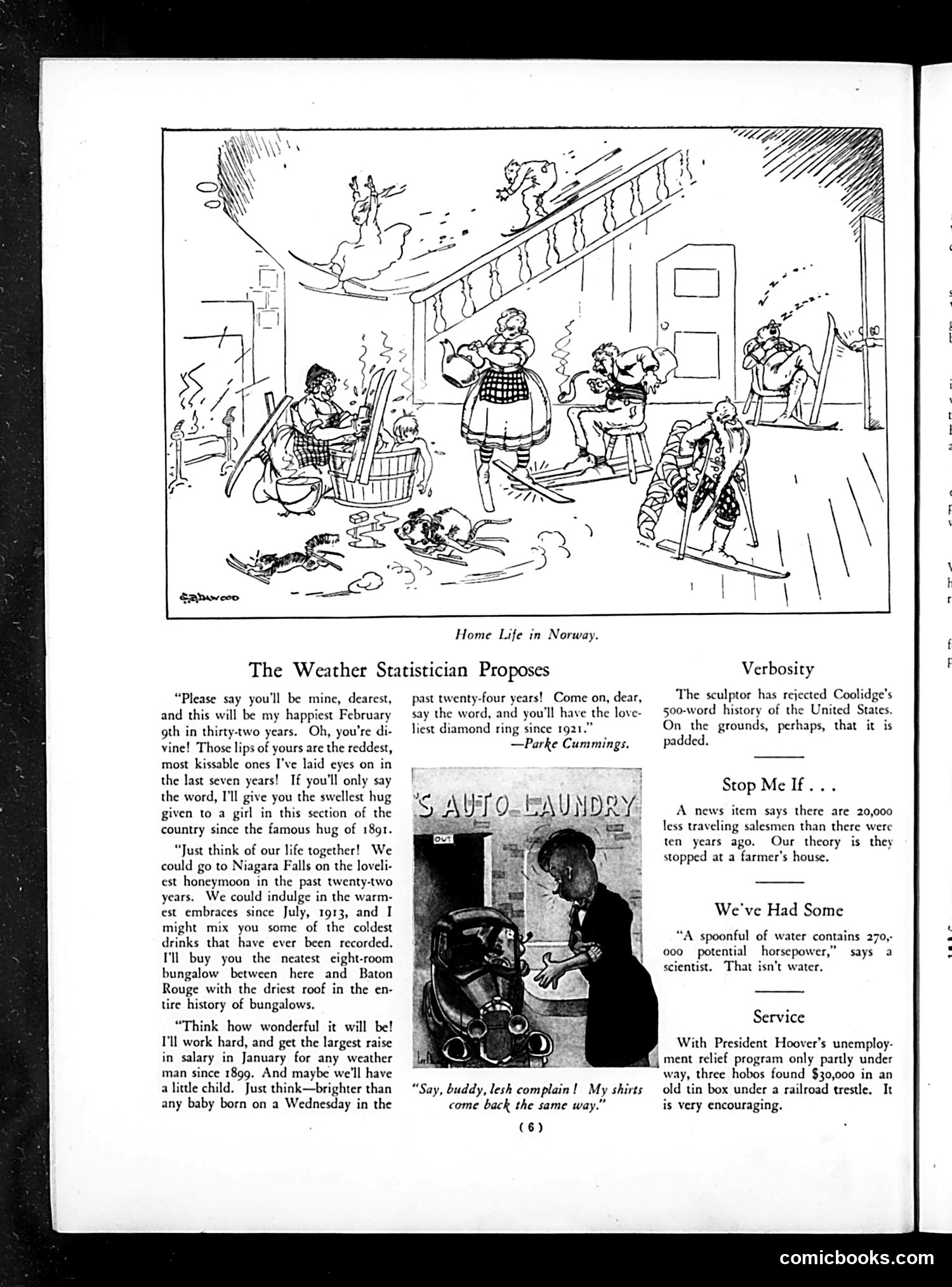
# Analysis The top cartoon depicts "Home Life in Norway" and illustrates a humorous domestic scene with skiers, though the specific satirical point isn't entirely clear from the image alone. The main text feature is "The Weather Statistician Proposes"—a comic monologue where a weather official proposes marriage to his sweetheart, using meteorological metaphors and promises. He references his anticipated salary increase and career success, offering romantic inducements like Niagara Falls and a bungalow. Below are several brief humor snippets under headings like "Verbosity," "Stop Me If...," and "We've Had Some," typical of Life magazine's satirical format—short jokes poking fun at contemporary absurdities, including a jab at President Hoover's unemployment relief efforts. The "Auto-Laundry" illustration shows a laundry service interaction, captioned with dialogue about shirt cleaning.
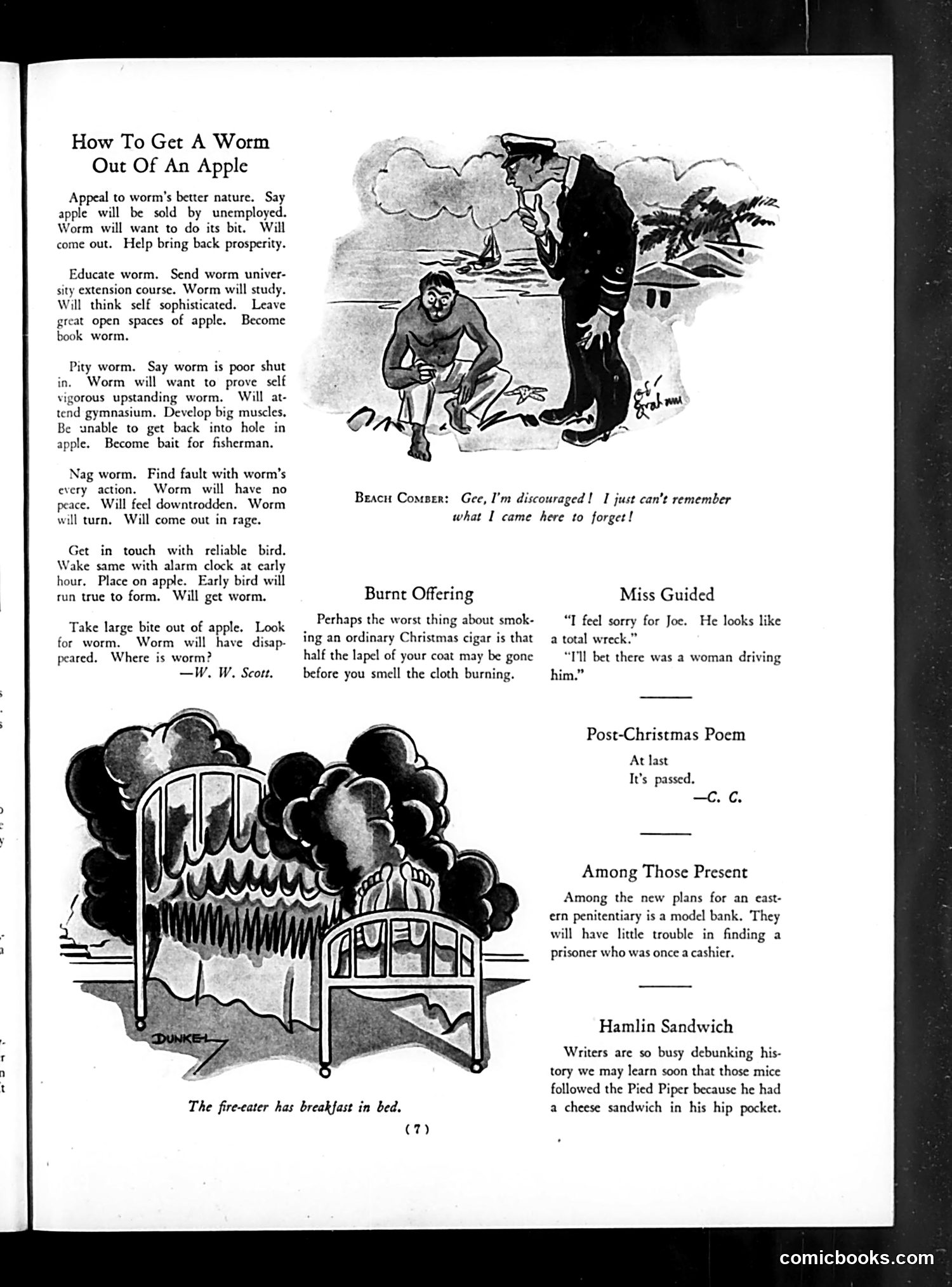
# Page 7 Analysis: Life Magazine Humor Section This page contains several short satirical pieces and cartoons typical of Life's humor section. **"How To Get A Worm Out Of An Apple"** offers absurdist advice (appeal to the worm's nature, educate it, pity it, nag it, etc.). The accompanying cartoon shows a well-dressed man and small figure, likely depicting the humorous futility of the elaborate schemes described. **"The fire-eater has breakfast in bed"** cartoon shows a figure in bed surrounded by flames—a visual pun on the term "fire-eater," likely mocking someone stubborn or quarrelsome. The other brief items—"Beach Comber," "Burnt Offering," "Miss Guided," "Post-Christmas Poem," "Among Those Present," and "Hamlin Sandwich"—are short witty observations or one-liners on contemporary social situations, typical of the magazine's satirical format.
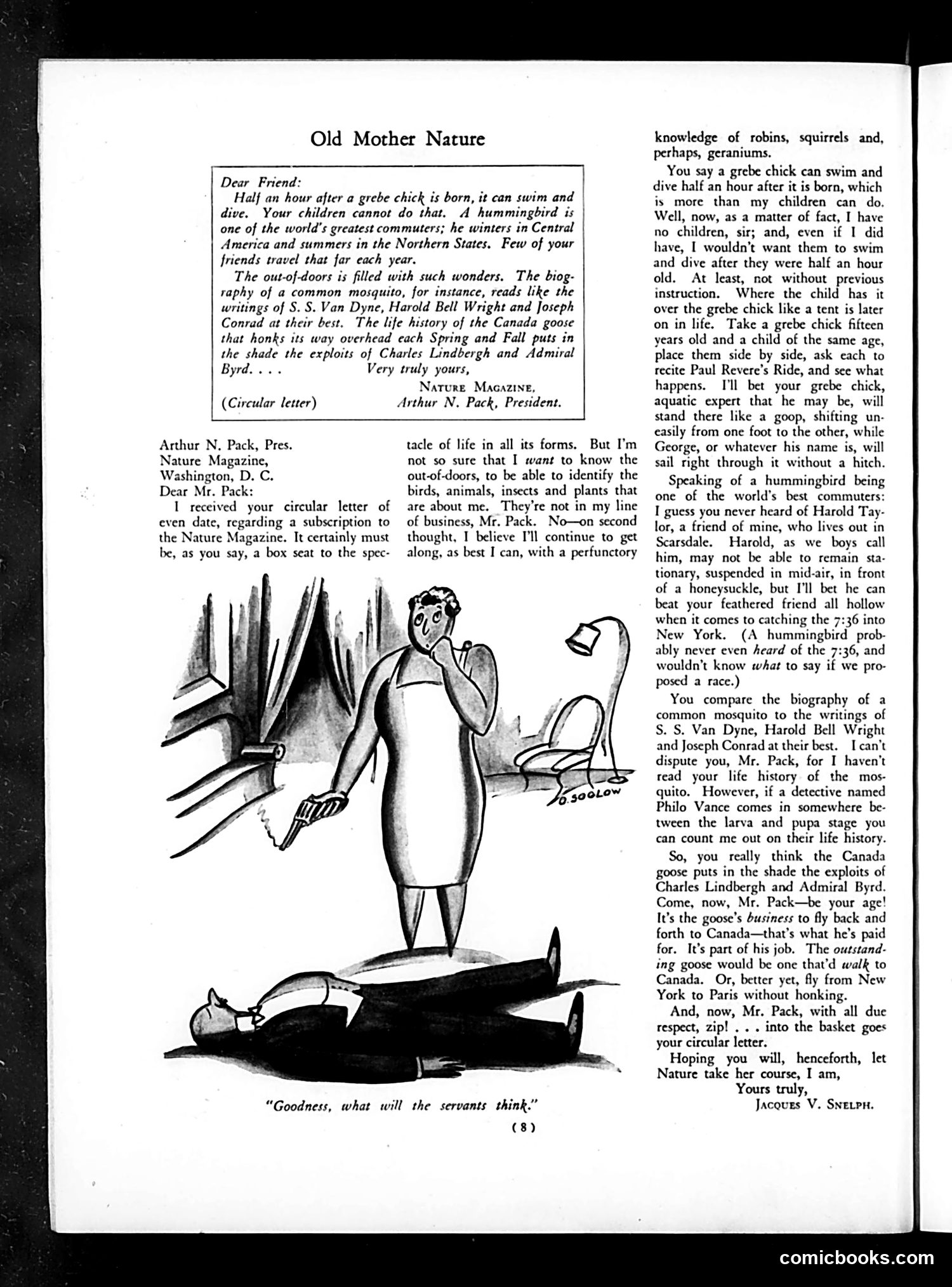
# Analysis This page from *Life* magazine presents a satirical exchange about nature observation. Arthur N. Pack, president of Nature Magazine, writes a circular letter praising nature study, claiming children can identify birds and learn outdoors. Jacques V. Snelph responds with pointed sarcasm. The cartoon shows a bewildered figure surrounded by nature while holding what appears to be a guidebook—illustrating Snelph's central joke: that Pack romanticizes nature knowledge while ordinary people struggle to identify basic wildlife. Snelph mocks Pack's lofty claims by comparing a mosquito's biography to famous naturalists' works, and sarcastically suggests Canada geese should "fly back and forth to Canada" as their job. The satire targets the gap between idealistic nature-study propaganda and reality—the messiness and difficulty of actual outdoor observation.
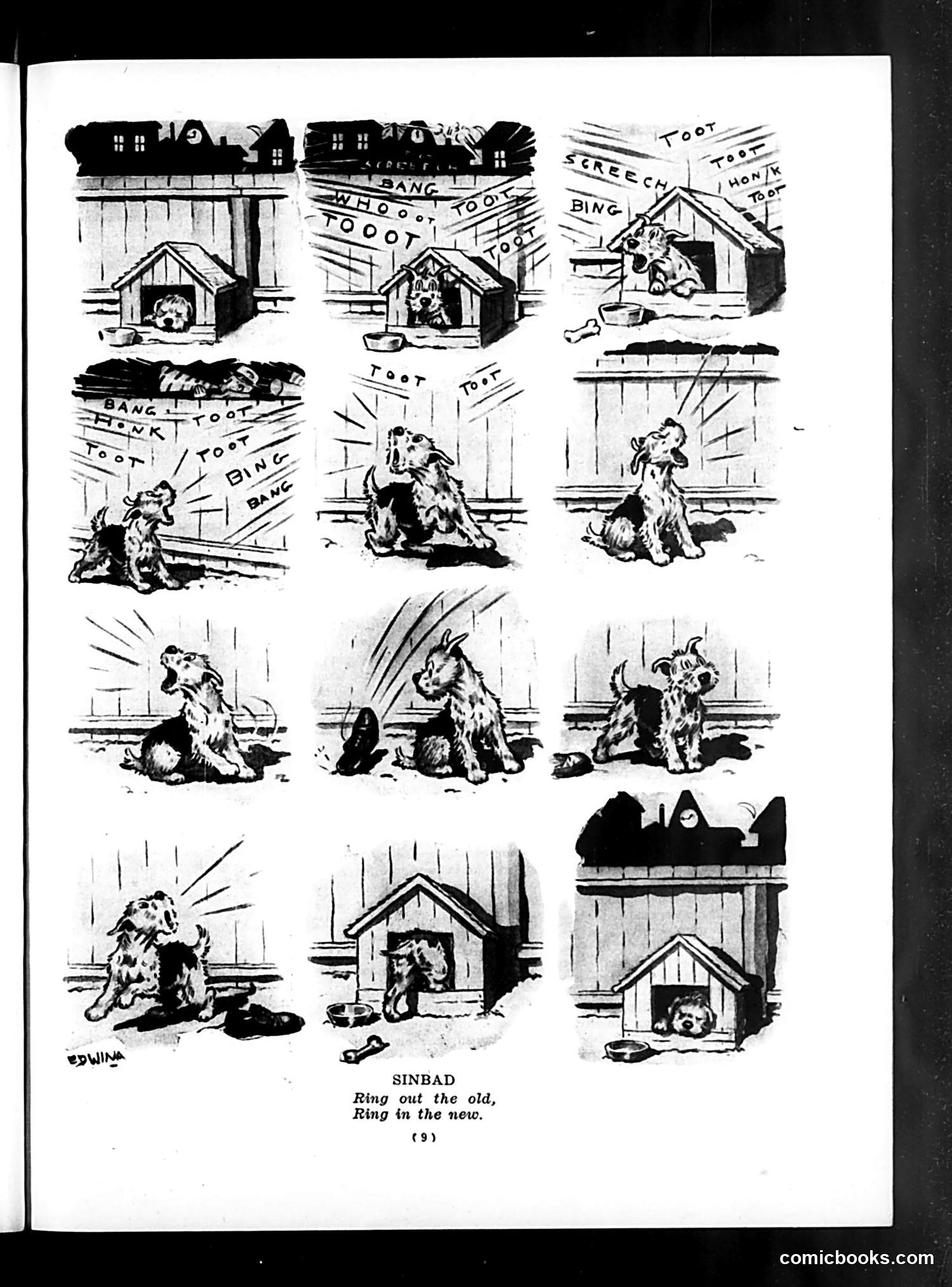
# Analysis of "Sinbad" Comic Strip This comic strip depicts a dog named Sinbad in various scenes around kennels and doghouses, with sound effects like "TOOT," "WHOOO," "HONK," "BANG," and "SCREECH" accompanying the action. The caption reads: "Ring out the old, / Ring in the new." This appears to be a New Year's-themed satire using the dog as a central figure. The repetitive barking and noise-making likely represents the loud, chaotic celebration associated with New Year's Eve and the transition between years. The various kennel scenes suggest domestic life disrupted by celebratory commotion. The humor derives from depicting the dog's bewildered reactions to the cacophony of holiday noise-making, a relatable experience for readers anticipating year-end festivities.
# "Life Looks About" - Page Analysis This page contains three opinion essays rather than political cartoons. The masthead illustration shows a cherub or cupid figure, decorative rather than satirical. The essays discuss: 1. **"Alarums and Excursions"** - Criticizes the Manning-Lindsey controversy (an altercation between two clergy members) as unhelpful public distraction. The author argues such disputes distract from substantive issues and that the Bishop of New York's involvement was an inappropriate intrusion into ecclesiastical matters. 2. **Sinclair Lewis's remarks** - Notes Lewis's Stockholm address about American novel-reading habits since 1914, mentioning his Nobel Prize. 3. **"Education, Catch-as-catch-can"** - Discusses contemporary education criticism, referencing Abraham Flexner's educational reforms and autobiographies by Churchill and Balfour as examples of practical versus institutional education. This is opinion journalism, not satire or cartooning.