A complete issue · 37 pages · 1930
Life — September 5, 1930
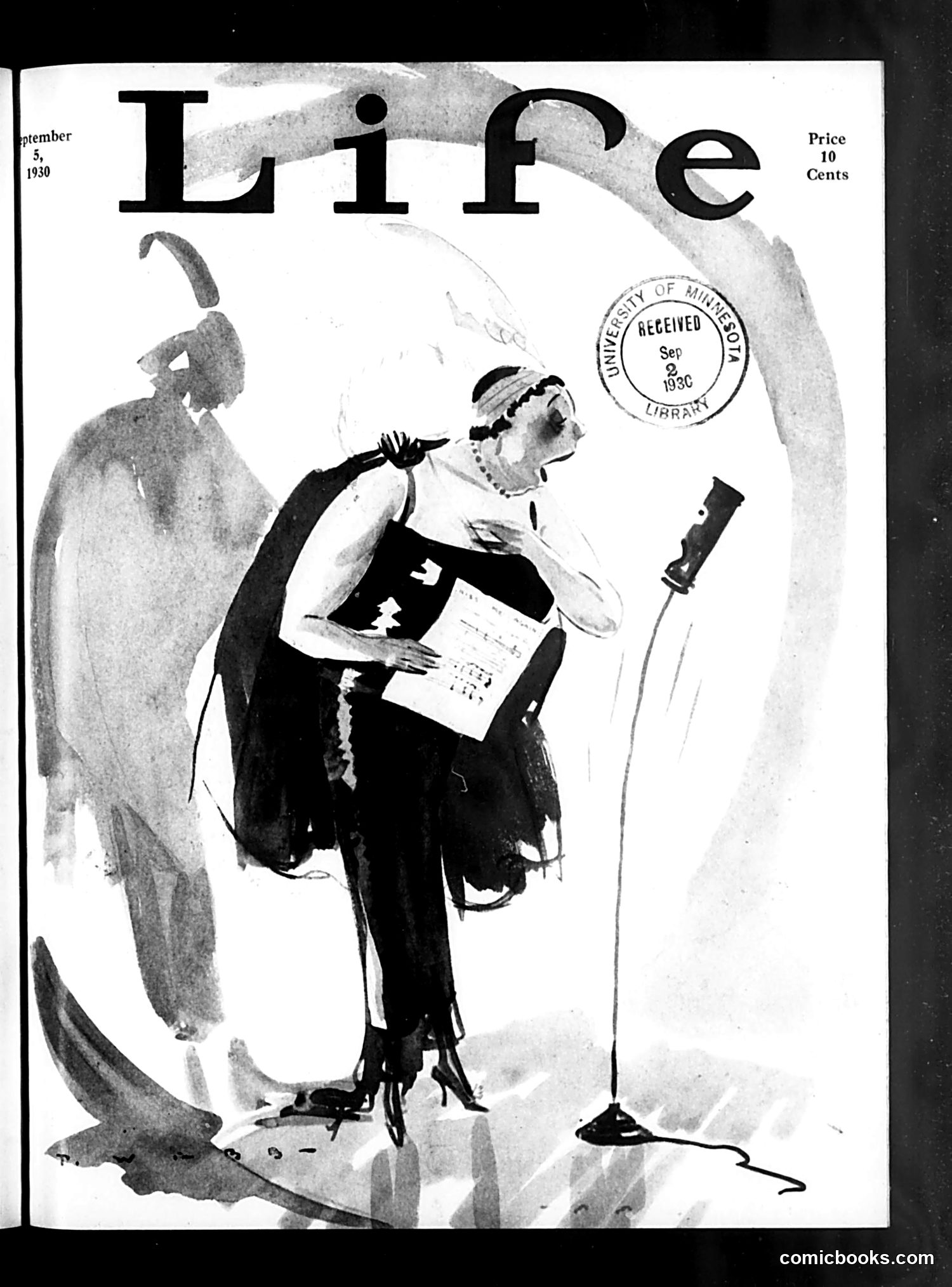
# Life Magazine Cover - September 5, 1930 This cover illustration satirizes **radio broadcasting and performance**. A caricatured male performer holds a microphone, mouth agape mid-speech or song, while clutching what appears to be sheet music or script. He wears formal attire with a headband, suggesting theatrical or vaudeville styling. The ghostly figures behind him—appearing demonic or supernatural—likely represent the **unseen radio audience** or the ethereal nature of broadcast transmission itself. The shark at his feet is unclear but may suggest danger or predatory competition in the entertainment industry. The satire appears to mock the artificiality and performative nature of radio entertainment, or perhaps the anxiety performers felt about reaching invisible audiences through this then-novel technology. The 10-cent price reflects Depression-era affordability.
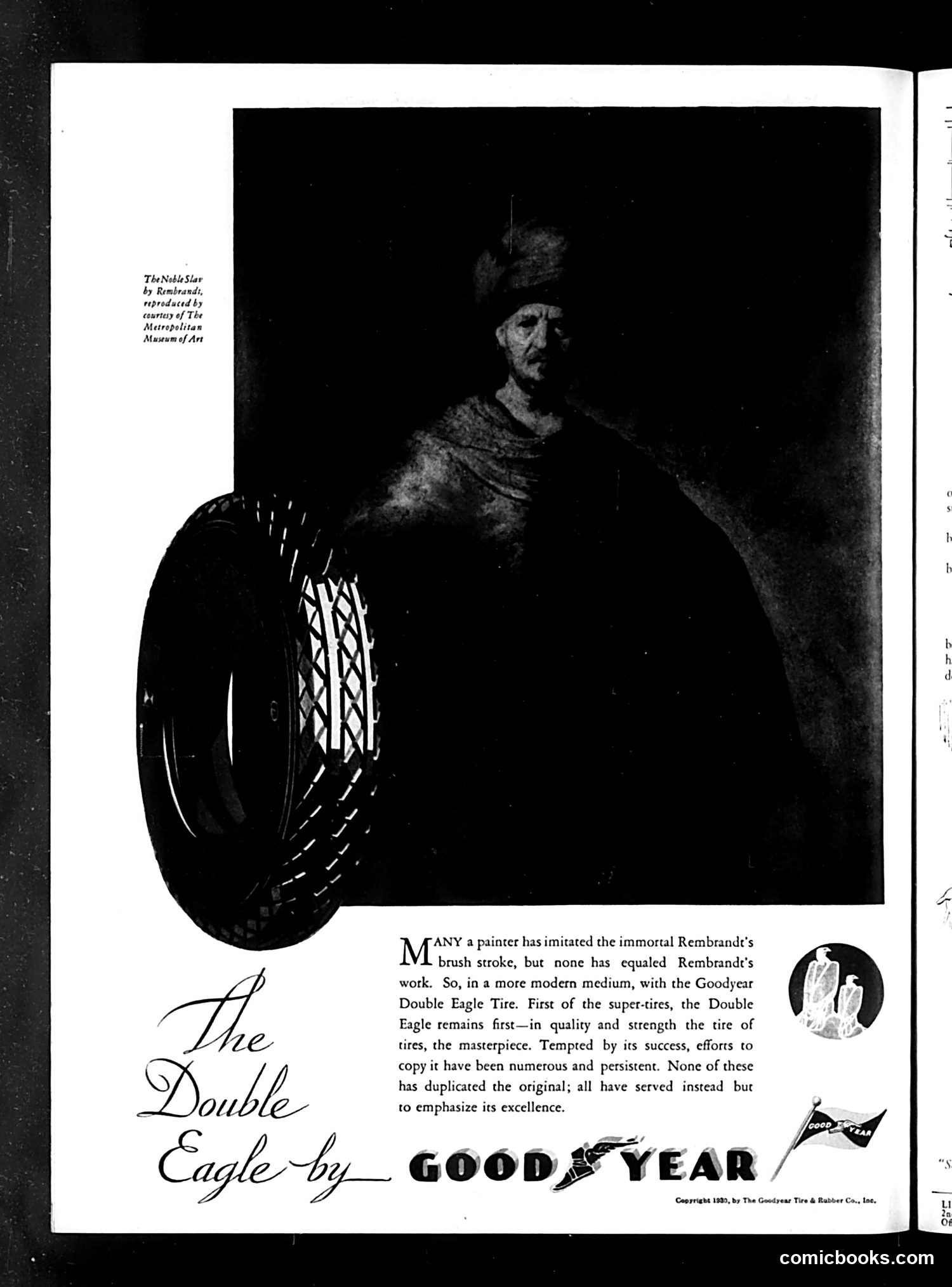
# Analysis This is a **Goodyear tire advertisement**, not a political cartoon. The page uses a famous artwork reference to sell products. The ad compares Goodyear's "Double Eagle" tire to Rembrandt's masterful brushwork. The image shows a Rembrandt painting (reproduced "by courtesy of The Metropolitan Museum of Art") depicting a figure in period dress, with a large tire positioned prominently in the lower left. The advertisement's argument: just as many painters have imitated Rembrandt without matching his genius, competitors have attempted to copy the Double Eagle tire's success without achieving its quality. The tire is presented as "the masterpiece" — superior in "quality and strength" to imitations. This is **brand-building through artistic comparison**, positioning a commercial product alongside High Art to suggest unmatched excellence and authenticity.
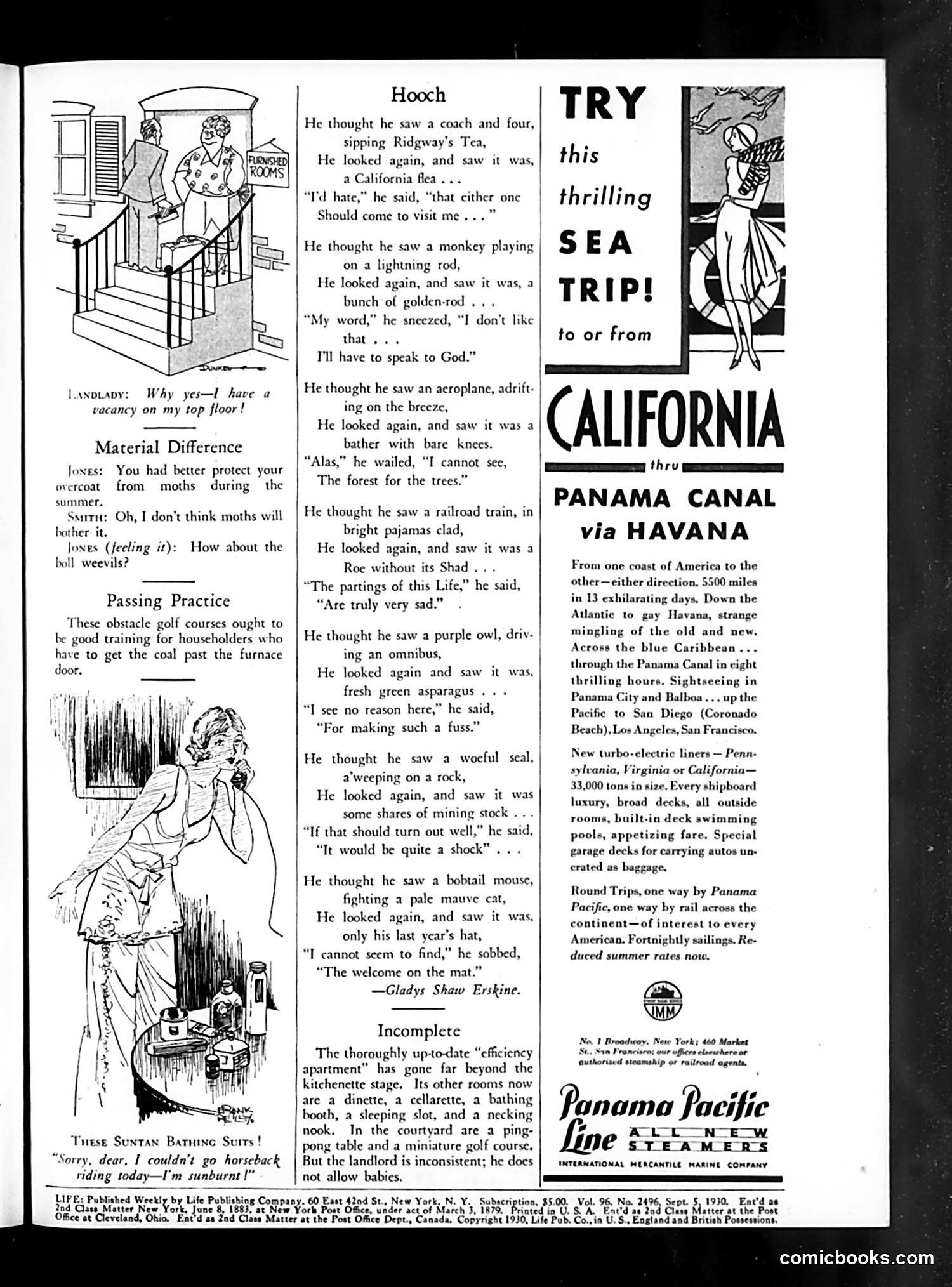
# Explanation for Modern Readers This page contains humor and advertising rather than political satire. The "Hooch" poem by Gladys Shaw Erskine satirizes a man's alcohol-induced hallucinations—he mistakes ordinary objects (a flea, monkey, airplane, train, owl, asparagus, seal, mining stock, bobtail mouse) for fantastical things. This likely references Prohibition-era drinking, when illegal alcohol consumption was widespread. The jokes "Material Difference" and "Passing Practice" are light comedic sketches about everyday absurdities. The dominant content is a Panama Pacific Line advertisement promoting luxury ocean travel to California via Havana and the Panama Canal—emphasizing modern "turbo-electric liners" and reduced summer rates. The small illustration shows a woman sunburned after refusing to wear protective clothing, another mild joke about summer vanity.
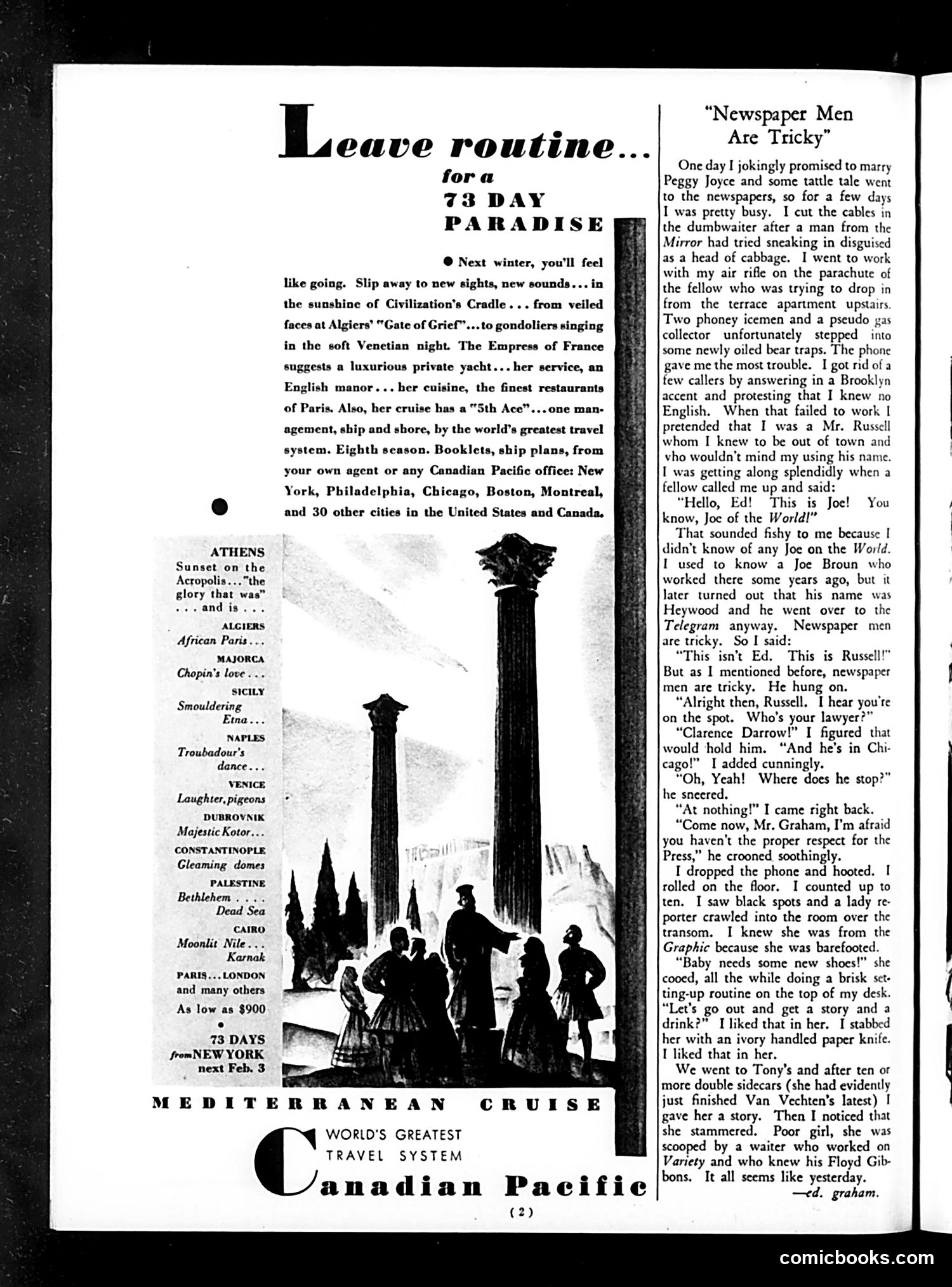
# Page Analysis This page is **primarily advertising** for Canadian Pacific's Mediterranean cruise line (73 days, departing Feb. 3), featuring a silhouetted illustration of tourists at classical ruins. The right column contains a humorous essay titled **"Newspaper Men Are Tricky,"** authored by "ed. graham." It's a satirical anecdote about the author's chaotic experience attempting to place a wedding announcement in newspapers while dealing with reporters. The humor centers on newspaper staff's unprofessionalism: phony callers, a "pseudo gas collector," incorrect names (confusing "Russell" with "Joe"), and ultimately the author being scooped by a *Graphic* reporter at a restaurant who obtained the story. The satire mocks both newspaper culture's competitiveness and the chaos of urban journalism circa the 1920s-30s.
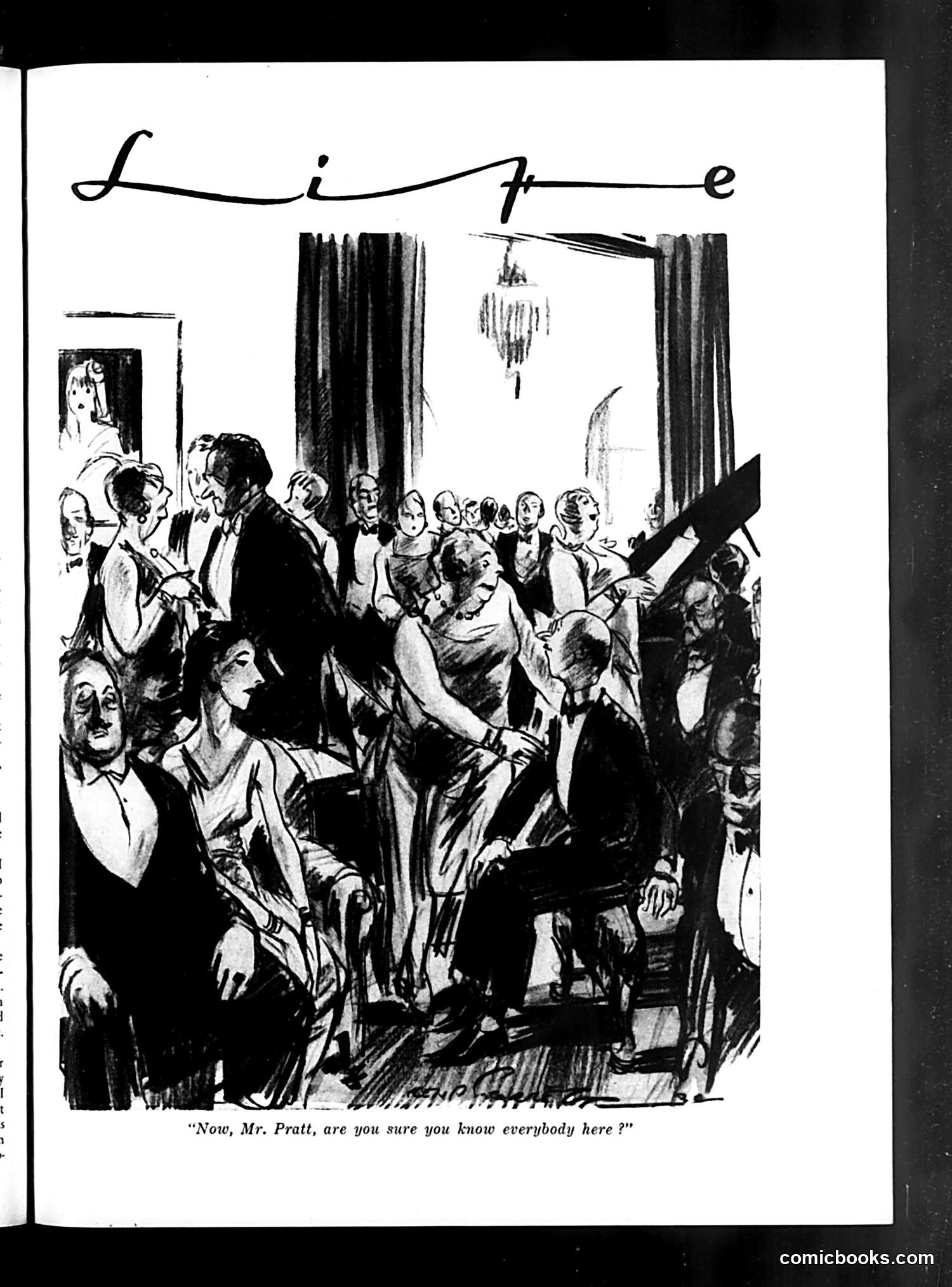
# Analysis This is a single-panel cartoon from *Life* magazine titled "Life" (visible at top). The sketch depicts a crowded formal social gathering—appearing to be a high-society event or party with well-dressed attendees in evening wear. The caption reads: "Now, Mr. Pratt, are you sure you know everybody here?" The humor appears to satirize social pretension and the awkwardness of formal gatherings. Mr. Pratt (likely a recognizable public figure of the era, though unclear to modern readers) is being questioned about whether he truly knows all the guests present—suggesting either that he's claimed familiarity with everyone or that the questioner doubts his social connections. The cartoon mocks the performative nature of high-society events and the sometimes dubious claims people make about their social standing and acquaintances.
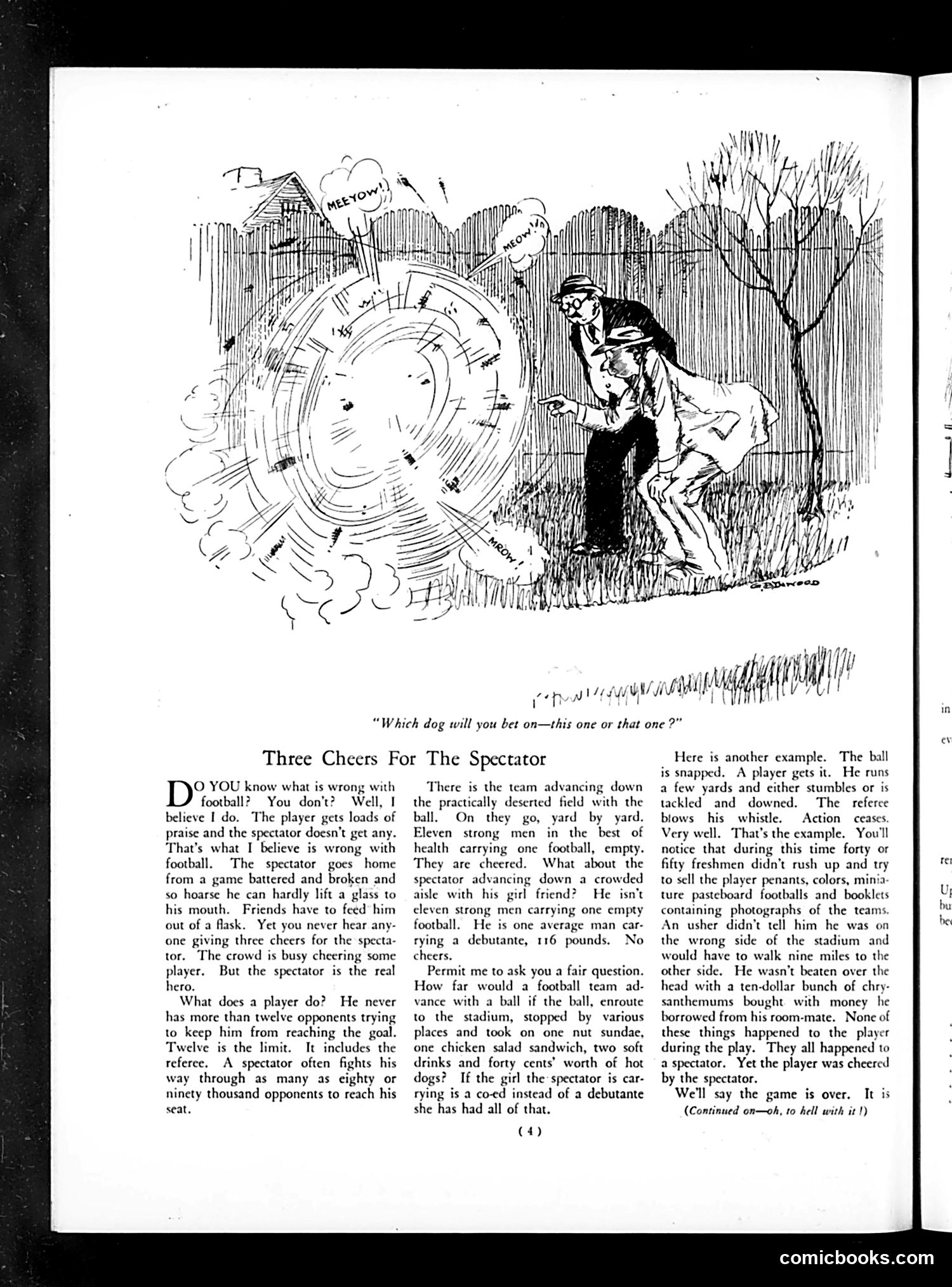
# "Three Cheers For The Spectator" This satirical piece critiques how football spectators behave. The cartoon shows two men watching a game, with speech bubbles saying "MEEYOW" and "MEOW" — suggesting fans making animal-like noises. The accompanying article humorously questions what spectators actually contribute to football. The author notes that while players do the work, spectators get hoarse cheering and may spend considerable money attending games (travel, food, merchandise). He sarcastically asks whether the spectator's role is truly heroic, given that fans mainly consume the experience without performing meaningful action. The joke's target: the gap between spectators' emotional investment and their actual participation—they cheer loudly but accomplish nothing materially, like animals making noise.
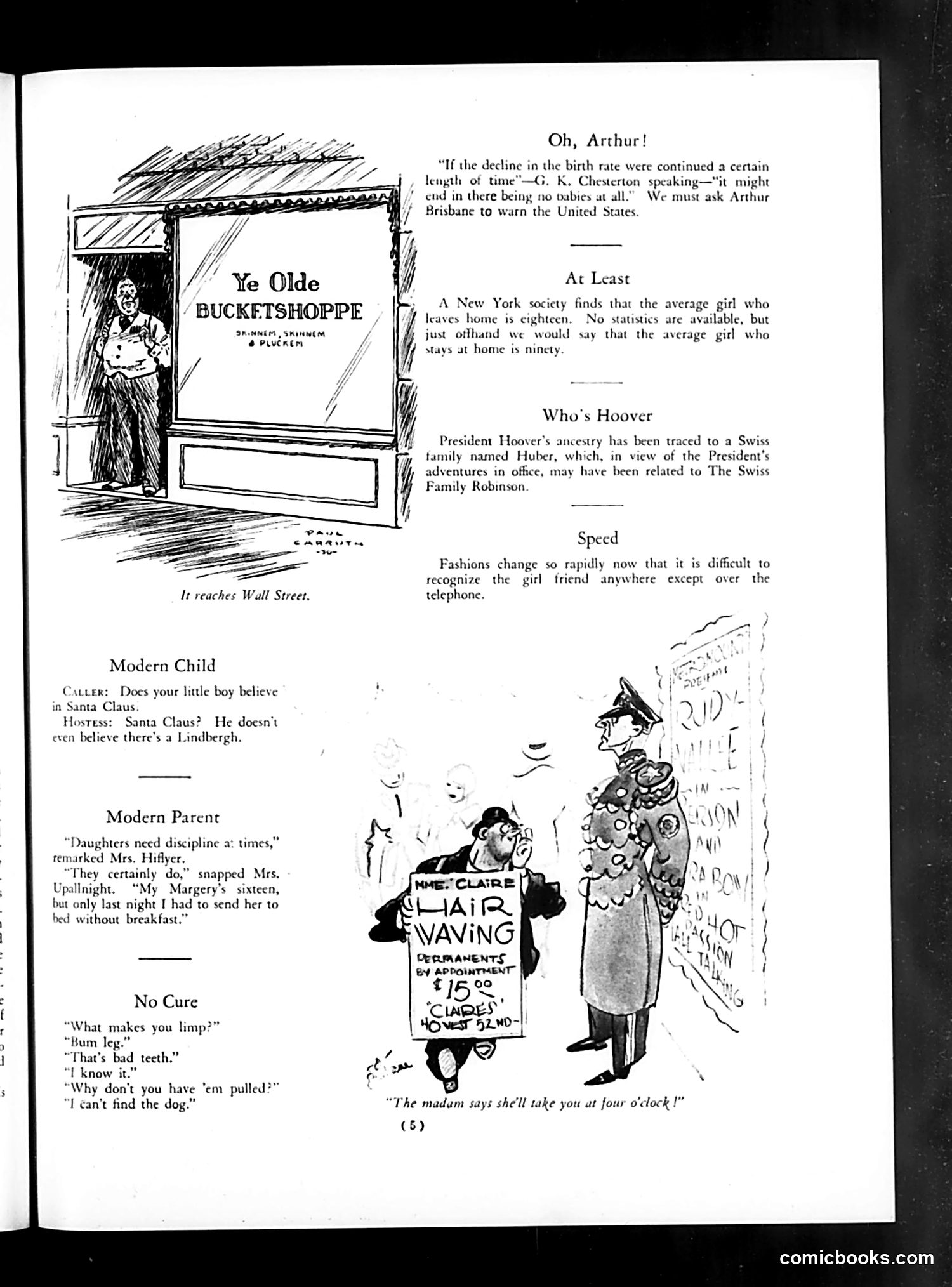
# Analysis of Life Magazine Page This page contains several short humor pieces and a cartoon satirizing 1920s social trends: **"Ye Olde Bucketshoppe"** shows a storefront reaching Wall Street, mocking get-rich-quick investment schemes that proliferated before the 1929 crash. **"Oh, Arthur!"** and **"At Least"** make light commentary on birth rates and young women staying home—likely responding to post-WWI demographic anxieties. **"Who's Hoover"** references President Hoover's Swiss ancestry, a topical joke. **"Speed"** quips that fashion changes so rapidly girls become unrecognizable except by telephone. The large **cartoon** depicts "Mme. Claire Hair Waving"—a beauty salon hawking $15 permanent waves ($9.50 upstairs)—illustrating the commercialization of women's appearance and the pressure to maintain fashionable hairstyles.
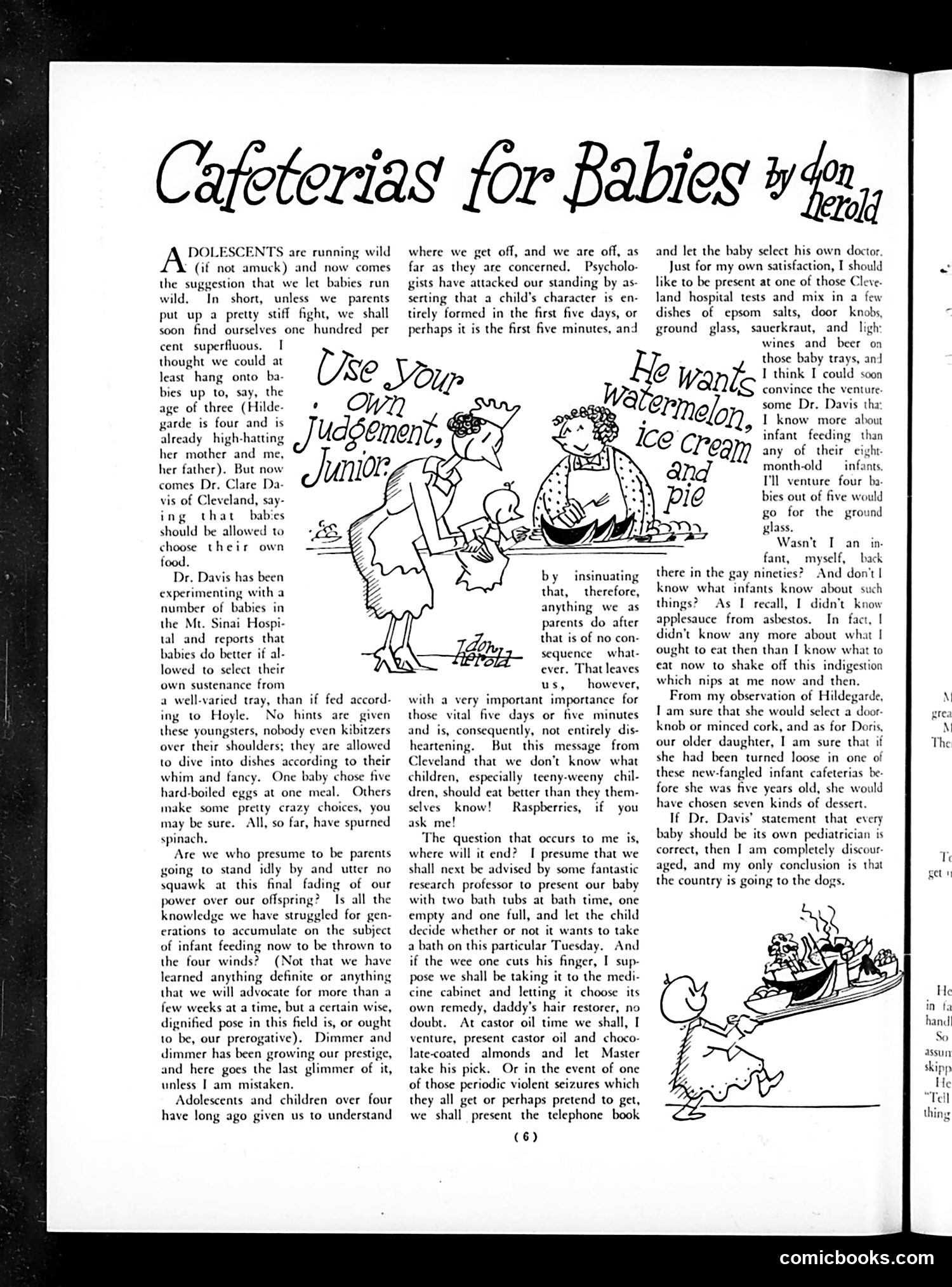
# "Cafeterias for Babies" by Don Herold This satirical article mocks the early 20th-century trend of applying scientific "modern" parenting methods to infants. The author ridicules Dr. Davis's suggestion that babies should select their own food and doctors, rather than following parental guidance. The cartoon illustrations show absurd scenarios: a baby choosing between watermelon, ice cream, and pie; another selecting from various undesirable items (ground glass, door knobs, wines). Herold argues this philosophy is ridiculous—infants lack judgment and knowledge. The satire targets the era's faith in "scientific" child-rearing that strips parental authority and common sense. His point: not everything modern is an improvement; babies need guidance, not independence in crucial health decisions.
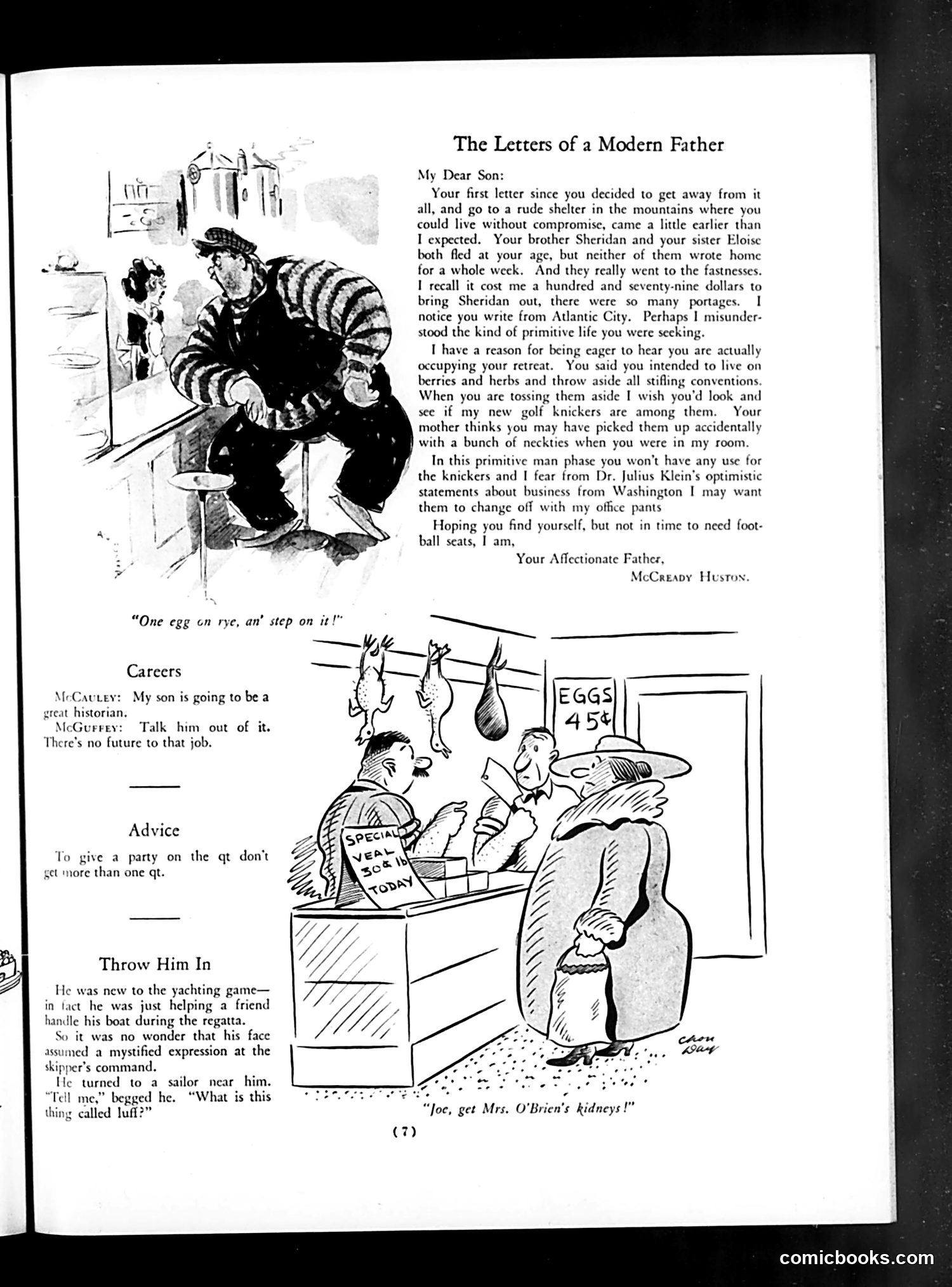
# Analysis of "The Letters of a Modern Father" Page This page contains satirical commentary on 1920s youth culture and parenting. The main letter depicts a father's bemused disapproval of his son's bohemian retreat to the mountains, where he plans to live primitively on "berries and herbs" while rejecting "stifling conventions." The father notes the boy's golf knicks are present—suggesting the retreat is less authentic than claimed. The accompanying cartoons mock contemporary concerns: one jokes about pricing eggs at 45¢, another satirizes giving parties with limited alcohol ("qt" = quart), and a final scene shows a novice yachtsman's confusion about nautical terminology ("luff"). The overall satire targets both rebellious youth and parental bewilderment during the Jazz Age, when younger generations openly rejected Victorian values.
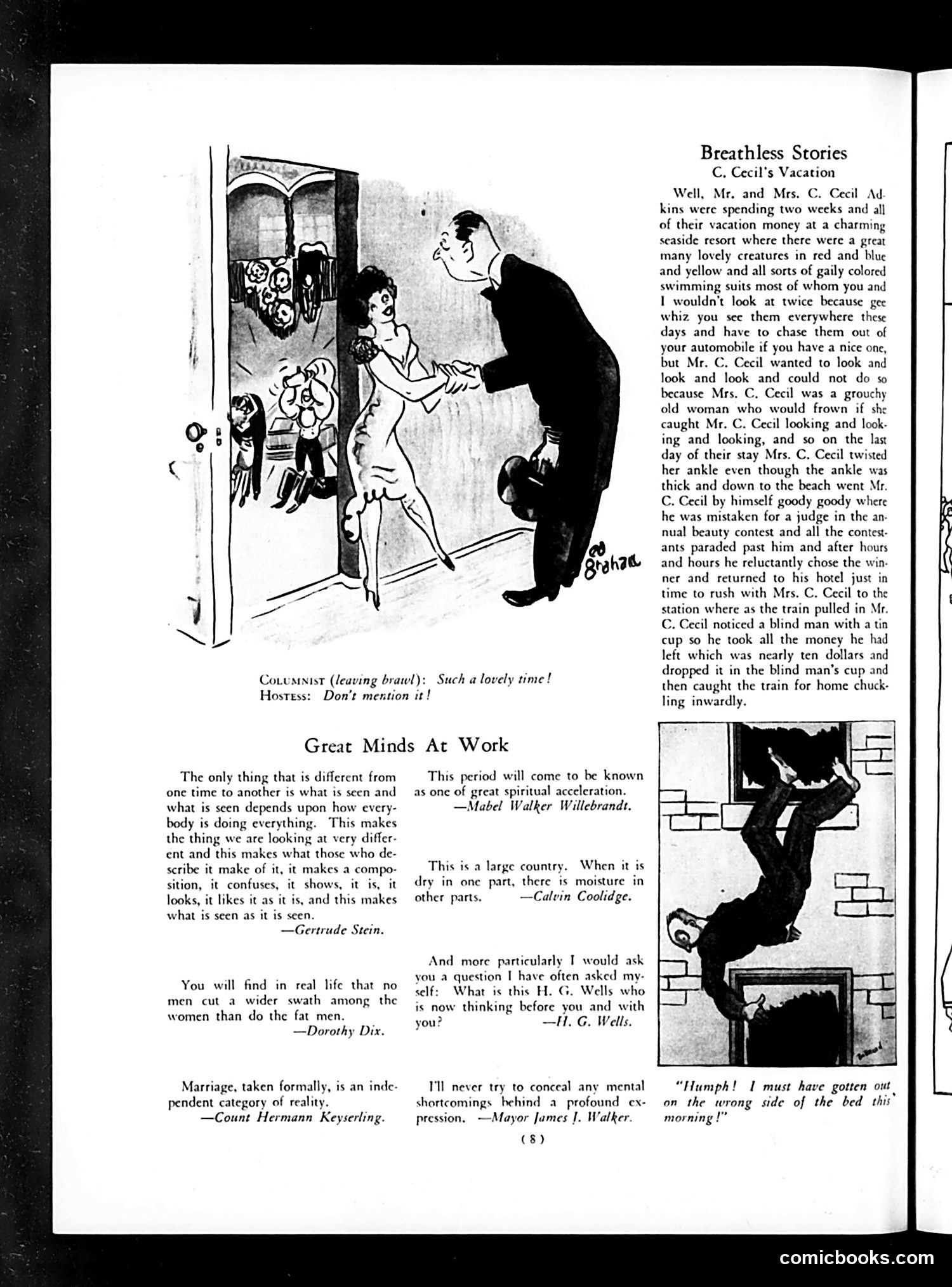
# Analysis of Life Magazine Page The page contains two distinct sections: **"Breathless Stories: C. Cecil's Vacation"** (right column) is a humorous short story about a married couple at a seaside resort. The joke centers on Mr. C. Cecil's inability to look at attractive women in swimsuits due to his jealous wife's vigilance. The ironic payoff: while avoiding temptation at the beach, he impulsively gives nearly ten dollars to a blind beggar at the train station—money he'd saved from his vacation, then feels guilty about the deception. **"Great Minds at Work"** (lower section) features philosophical quotations from notable figures like Gertrude Stein, Dorothy Dis, and H.G. Wells. It's a intellectual humor section showcasing clever observations on perception, spirituality, and marriage. The cartoon above the story depicts a man ogling women entering an elevator—typical period satire about male behavior and leisure.
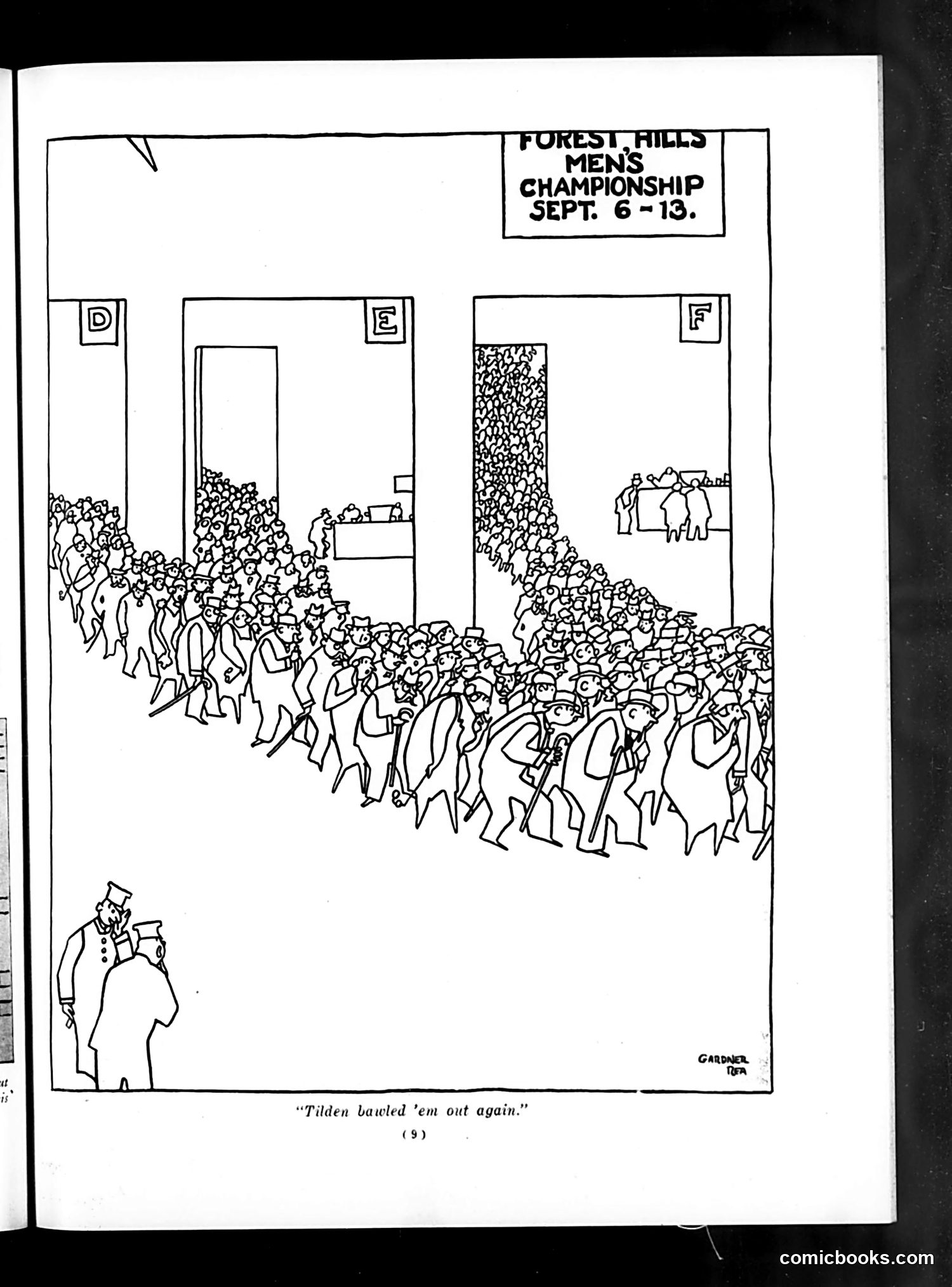
# Political Cartoon Analysis This cartoon satirizes **William Howard Taft** (the figure labeled "Tilden" in the caption, though this appears to be an error or reference to another political figure). The image shows massive crowds being physically ejected from what appears to be the **Forest Hills Men's Championship** (September 6-13), a prestigious tennis tournament. The satire critiques Taft's handling of large public gatherings or crowd management during his presidency. The caption "Tilden bawled 'em out again" suggests repeated instances of crowds being forcibly removed or dispersed. The cartoon employs exaggeration—depicting enormous throngs being cleared—to mock either Taft's unpopularity, his administrative decisions affecting public events, or his heavy-handed approach to managing public spaces. The specific tennis championship reference adds ironic social commentary about access and exclusion.
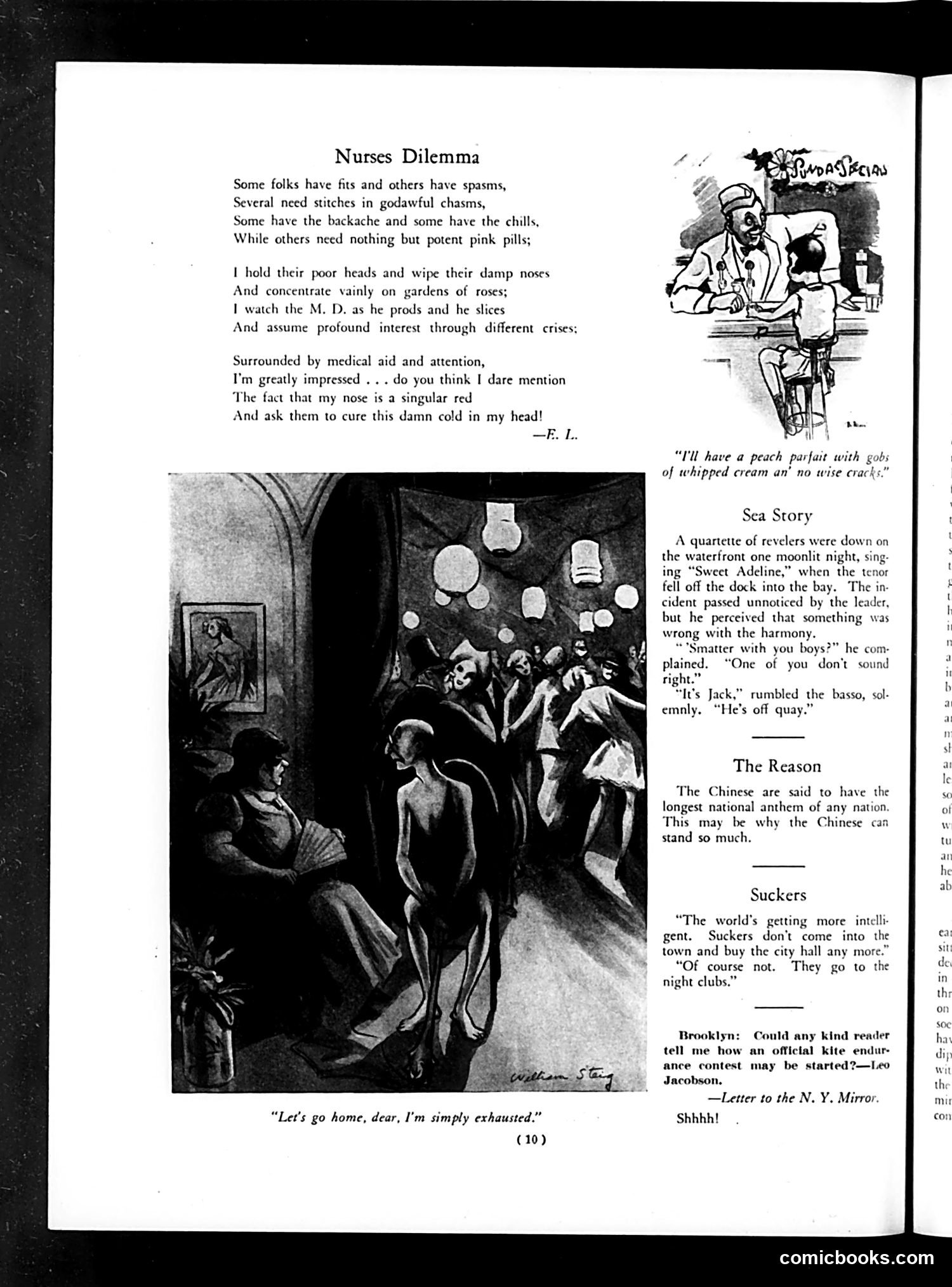
# Analysis of Life Magazine Page This page contains several humor pieces targeting early 20th-century American society. **"Nurses Dilemma"** (top left): A poem by E.L. satirizing nurses' frustrations—they manage patients with various ailments while doctors receive credit. The nurse speaker complains her red nose goes uncured despite surrounding medical attention, poking fun at medical hierarchy and gender dynamics. **The large illustration** depicts an indoor social gathering, likely mocking Victorian-era decorum or possibly wartime social constraints (based on the formal dress and formal setting). **"Sea Story," "The Reason," and "Suckers"** are brief humorous anecdotes mocking human behavior: sailors' discord, Chinese national pride, and urban gullibility respectively. The overall tone is light satirical commentary on contemporary social behaviors and professional frustrations, typical of Life magazine's approach during this period.