A complete issue · 36 pages · 1930
Life — August 29, 1930
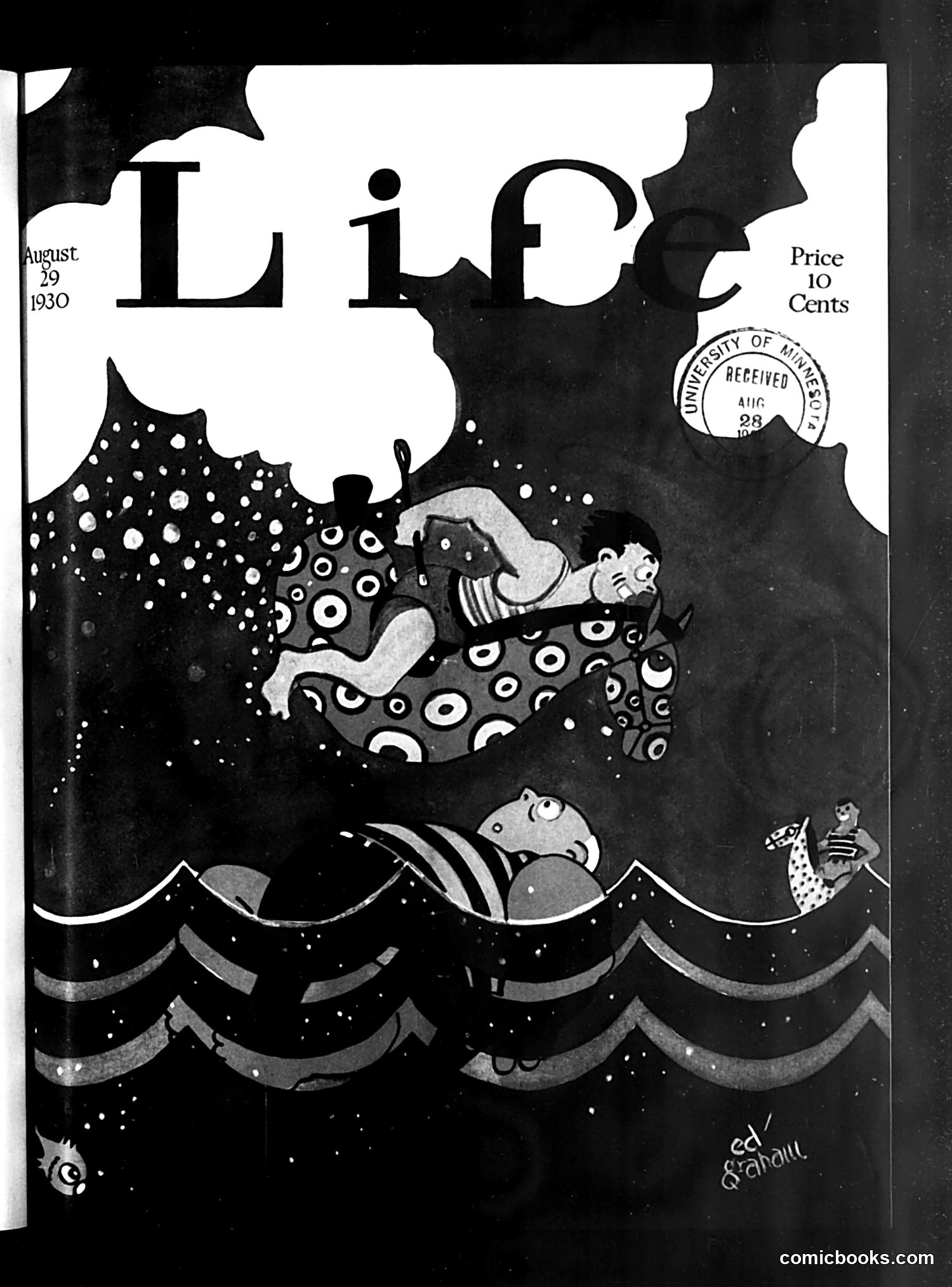
# Life Magazine Cover Analysis (August 29, 1930) This cover depicts an underwater fantasy scene with surreal imagery. A figure reclines on an ornate sea creature or fantastical beast decorated with circles and patterns. Below, fish with exaggerated features swim in stylized waves. The composition is dreamlike and whimsical rather than explicitly political. Given Life's 1930 satirical focus, the cartoon likely comments on escapism during the Great Depression—the wealthy or privileged retreating into fantasy while ordinary citizens struggled. The elaborate, decorative sea-world contrasts with harsh economic reality above the surface. The artist signature appears to be "ed Grabill" (or similar). Without clearer contemporary context, the specific satirical target remains unclear, though the escapist theme fits the era's social commentary.
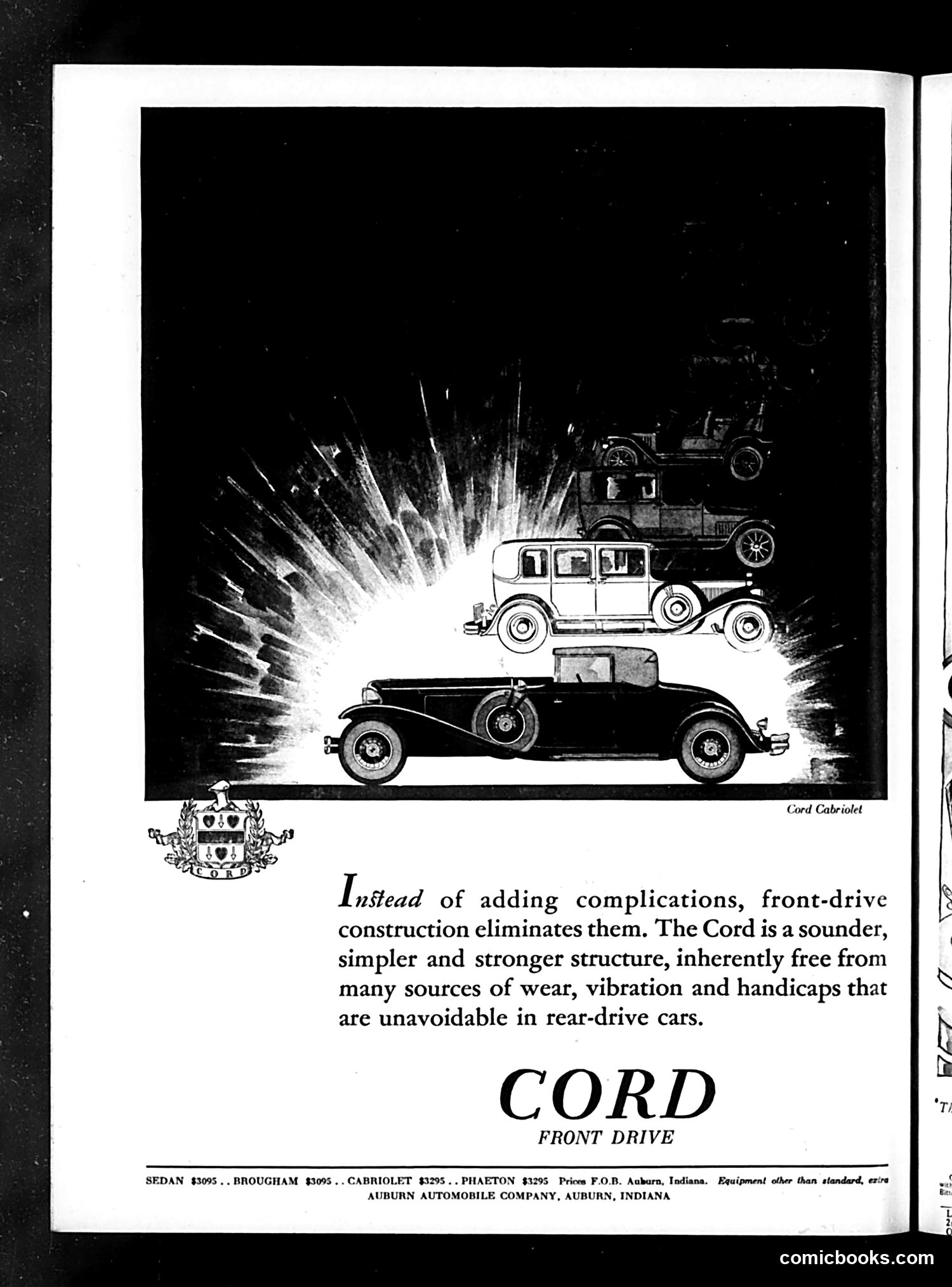
This page is an advertisement for Cord automobiles, not political satire. The image shows four cars stacked vertically with a dramatic radiating light burst behind them, emphasizing their superiority. The ad argues that Cord's front-drive construction is mechanically superior to rear-drive vehicles used by competitors—simpler, stronger, and free from vibration and wear issues. The text claims front-drive "eliminates complications" inherent to rear-drive cars. This reflects genuine 1920s-30s automotive engineering debates about drivetrain design. The stacked vehicles suggest a hierarchy, with the sleek Cord at bottom positioned as the most advanced model, contrasting with older-looking trucks and cars above it. The Auburn Automobile Company manufactured Cord vehicles in Indiana.
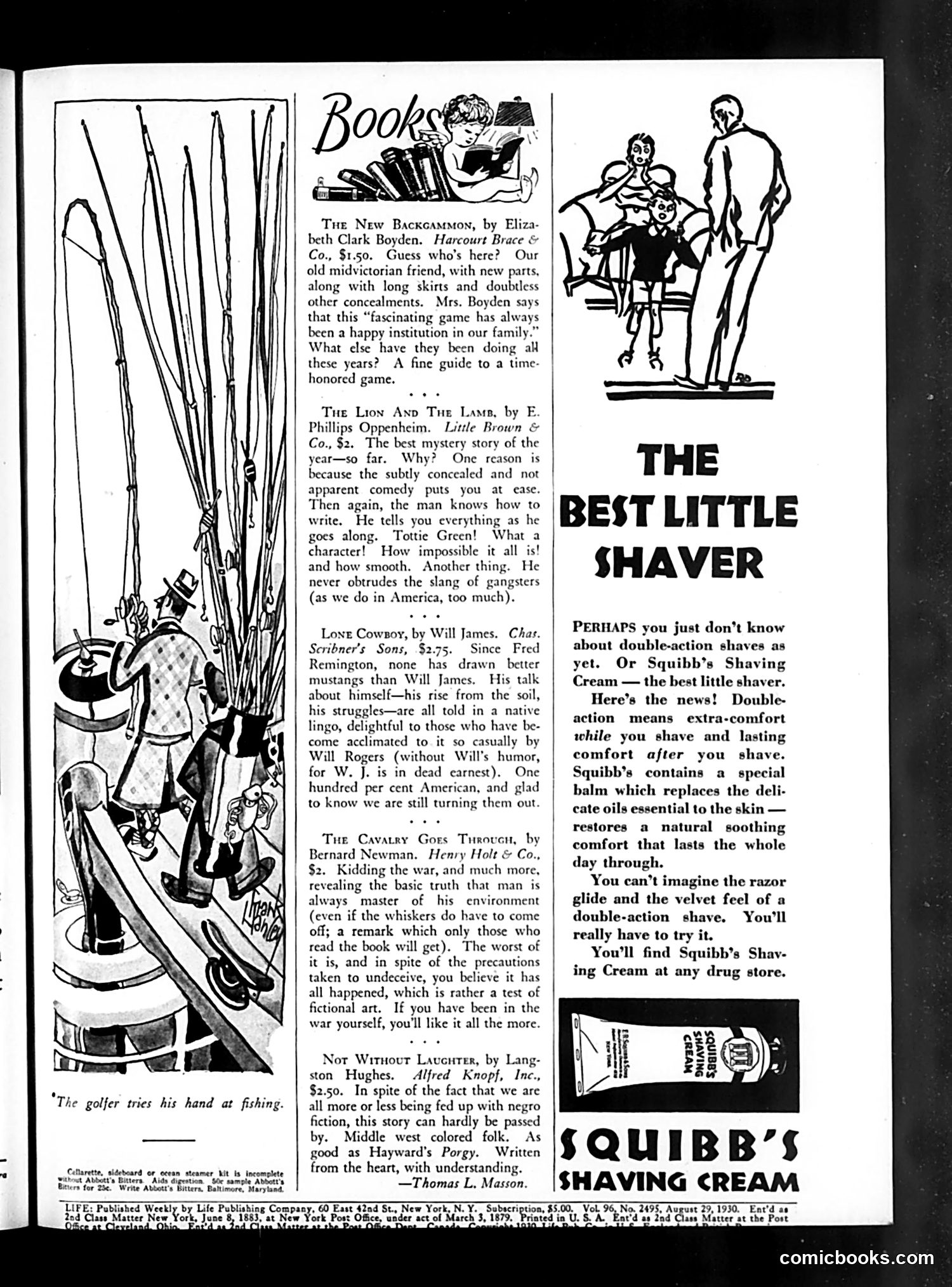
# Page Analysis This page is primarily **book reviews and advertising** rather than political satire. The left column reviews four books, including titles about backgammon, mystery fiction, and the American West. The main illustration—"The golfer tries his hand at fishing"—is a humorous **cartoon about leisure activities**, showing a man in golfing attire attempting to fish among cattails, suggesting the awkwardness of applying one sport's techniques to another. The right side features a **full-page advertisement for Squibb's Shaving Cream**, emphasizing its "double-action" formula that provides comfort during and after shaving. The ad includes an illustration of a man shaving and product imagery. This is a typical **1930 magazine layout** mixing literary content with consumer advertising.
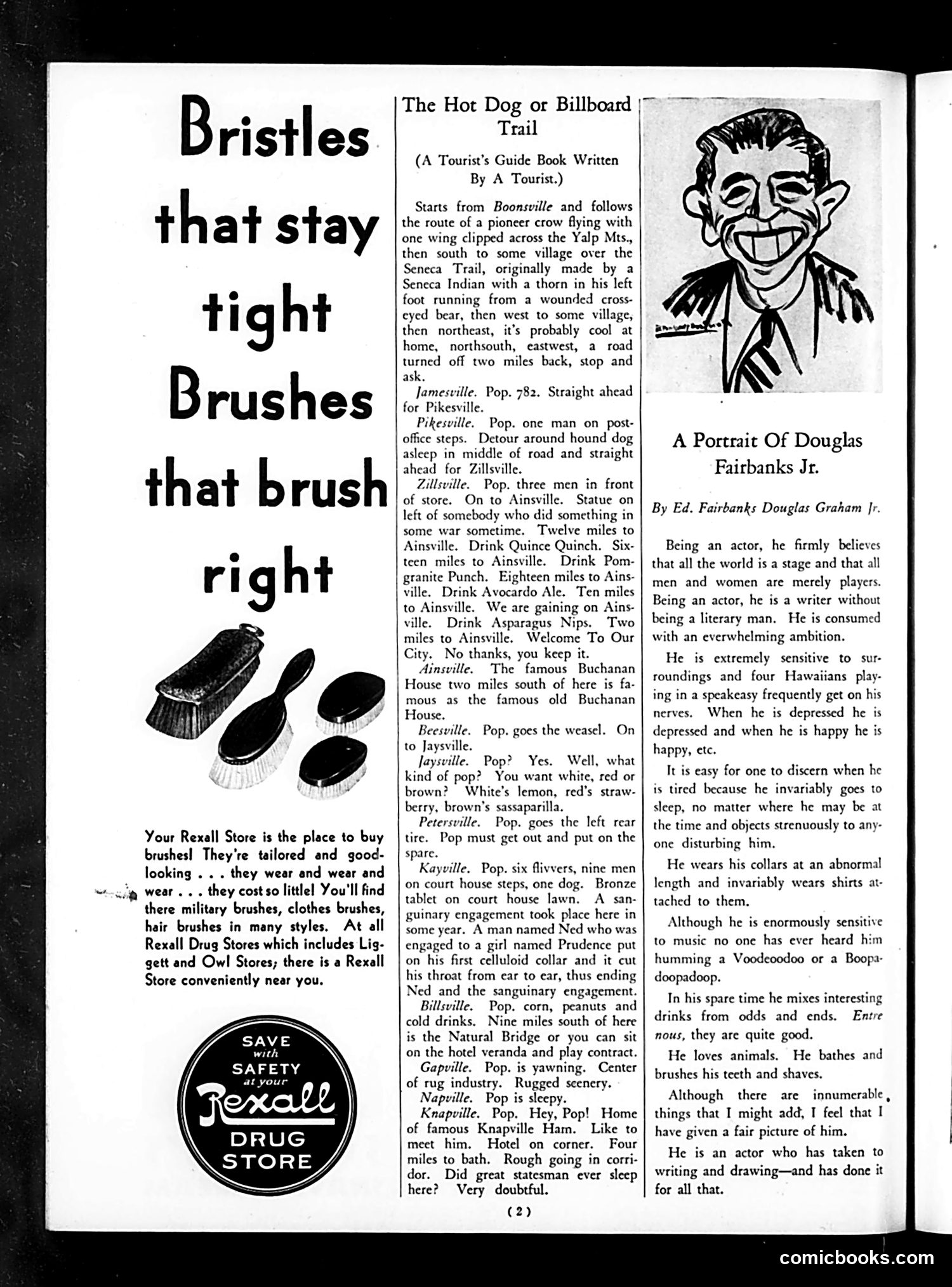
# Page Analysis: Life Magazine This page contains primarily **advertising and a biographical profile**, not political satire. The left side advertises **Rexall Drug Store brushes** with product illustrations and a store locator. The center and right feature **"The Hot Dog or Billboard Trail,"** a humorous tourist guide parodying travel literature by listing small towns with absurd, exaggerated descriptions (e.g., "Pop goes the weasel," "Pop is sleepy"). This satirizes both overwrought travel guides and America's proliferation of roadside attractions and billboards during the automobile era. The right column profiles **Douglas Fairbanks Jr.** (identified in text), describing him as an actor-turned-writer who is sensitive, drinks unusual cocktails, and is meticulous about appearance. This appears a lighthearted celebrity profile rather than political commentary.
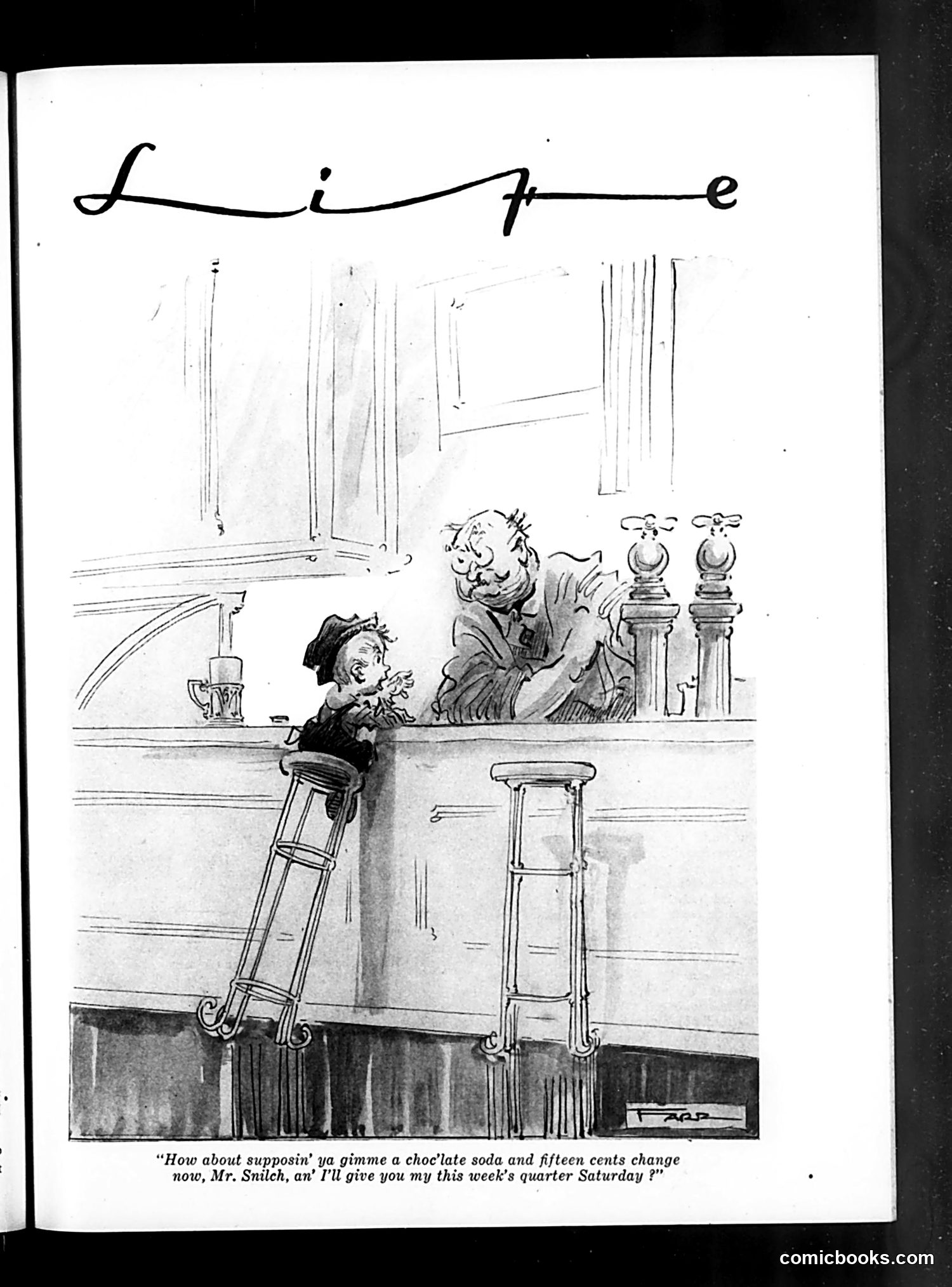
# "Life" Cartoon Analysis This cartoon depicts a child standing on a stool at what appears to be a soda fountain counter, addressing an adult male proprietor named "Mr. Smilch." The child proposes a transaction: trading a chocolate soda and fifteen cents in change for his weekly allowance quarter (25 cents) due on Saturday. The joke reflects early 20th-century economics and childhood dynamics. The child is attempting to negotiate an unfavorable deal—essentially borrowing against future earnings at a loss. The humor lies in the child's brazen negotiation attempt with an adult shopkeeper, and the satirical commentary on consumer temptation (soda fountains were popular social gathering spots) overriding financial prudence. The title "Life" suggests this captures a universal human tendency toward immediate gratification.
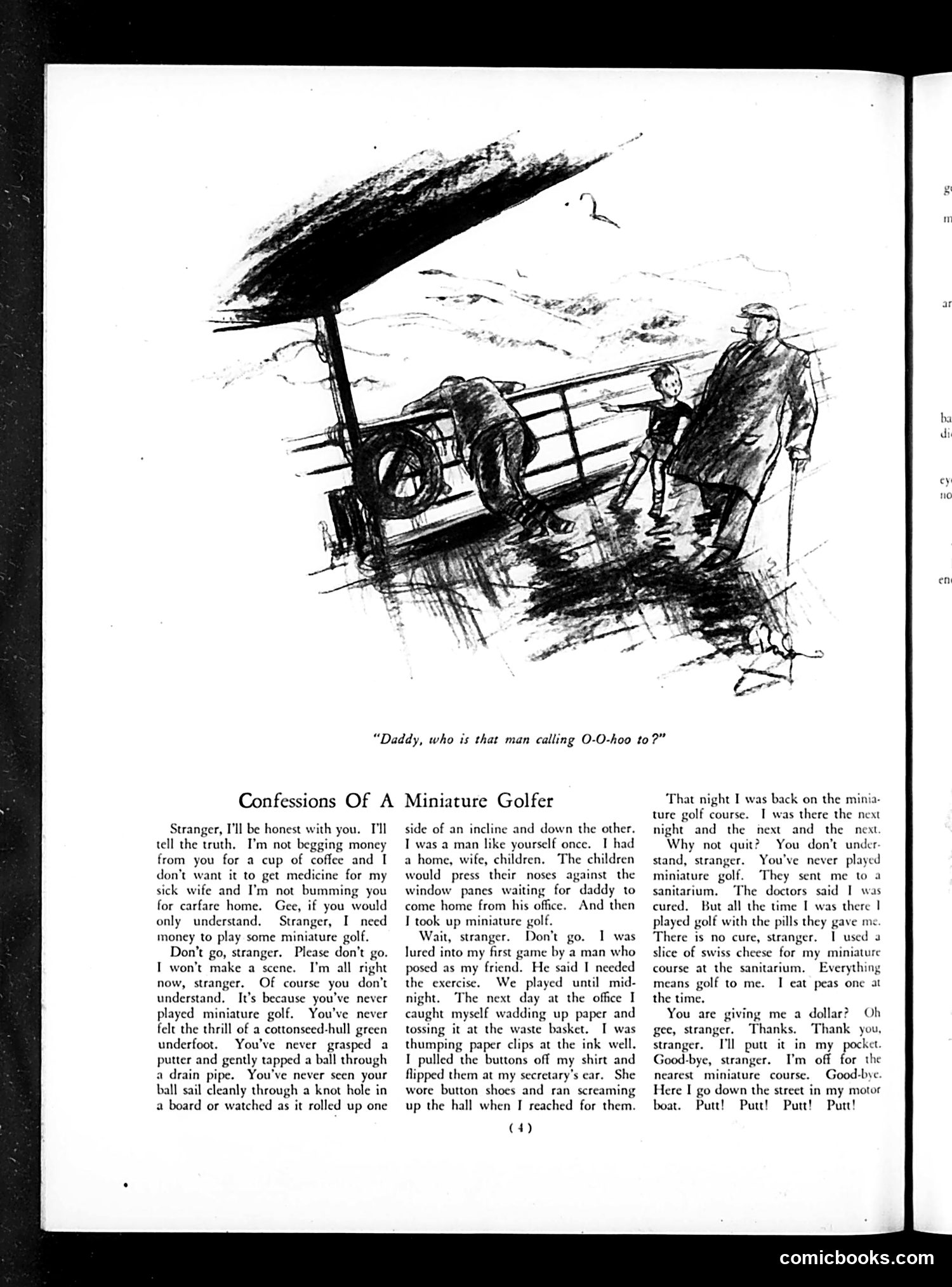
# Analysis This page contains an illustration and short story titled "Confessions of a Miniature Golfer." The cartoon shows three figures on what appears to be a miniature golf course, with a child asking his father "Daddy, who is that man calling O-O-hoo to?" The accompanying text is a humorous first-person confession from an adult man describing his obsession with miniature golf. He explains how he was initially skeptical but became addicted to the hobby, even describing embarrassing incidents (like pulling buttons off his secretary's shoes while reaching for lost golf balls). The humor derives from satirizing how grown men could become so invested in this trivial recreational activity. It's a gentle mockery of adult vanity and the way leisure pursuits can consume people's attention and dignity.
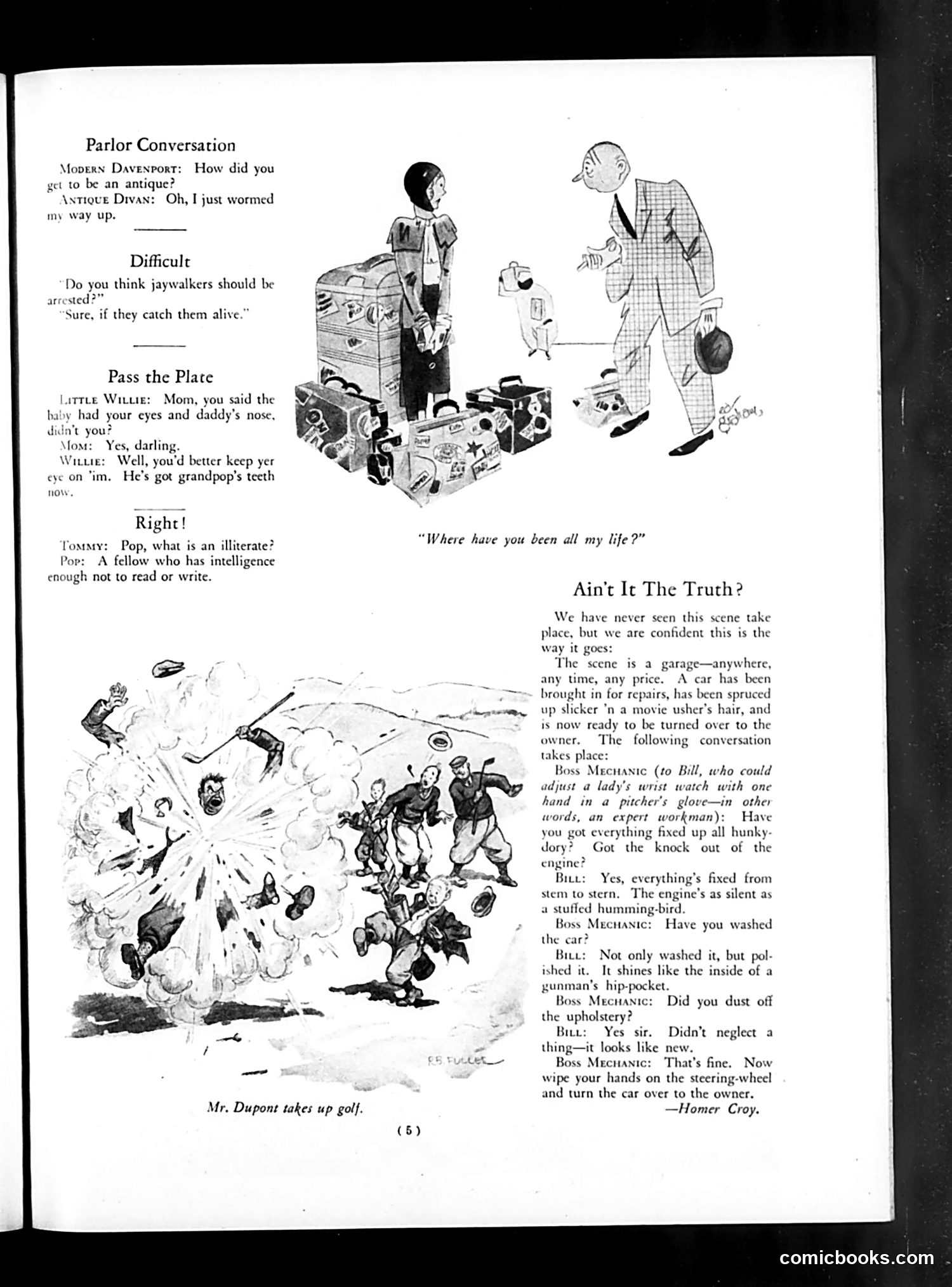
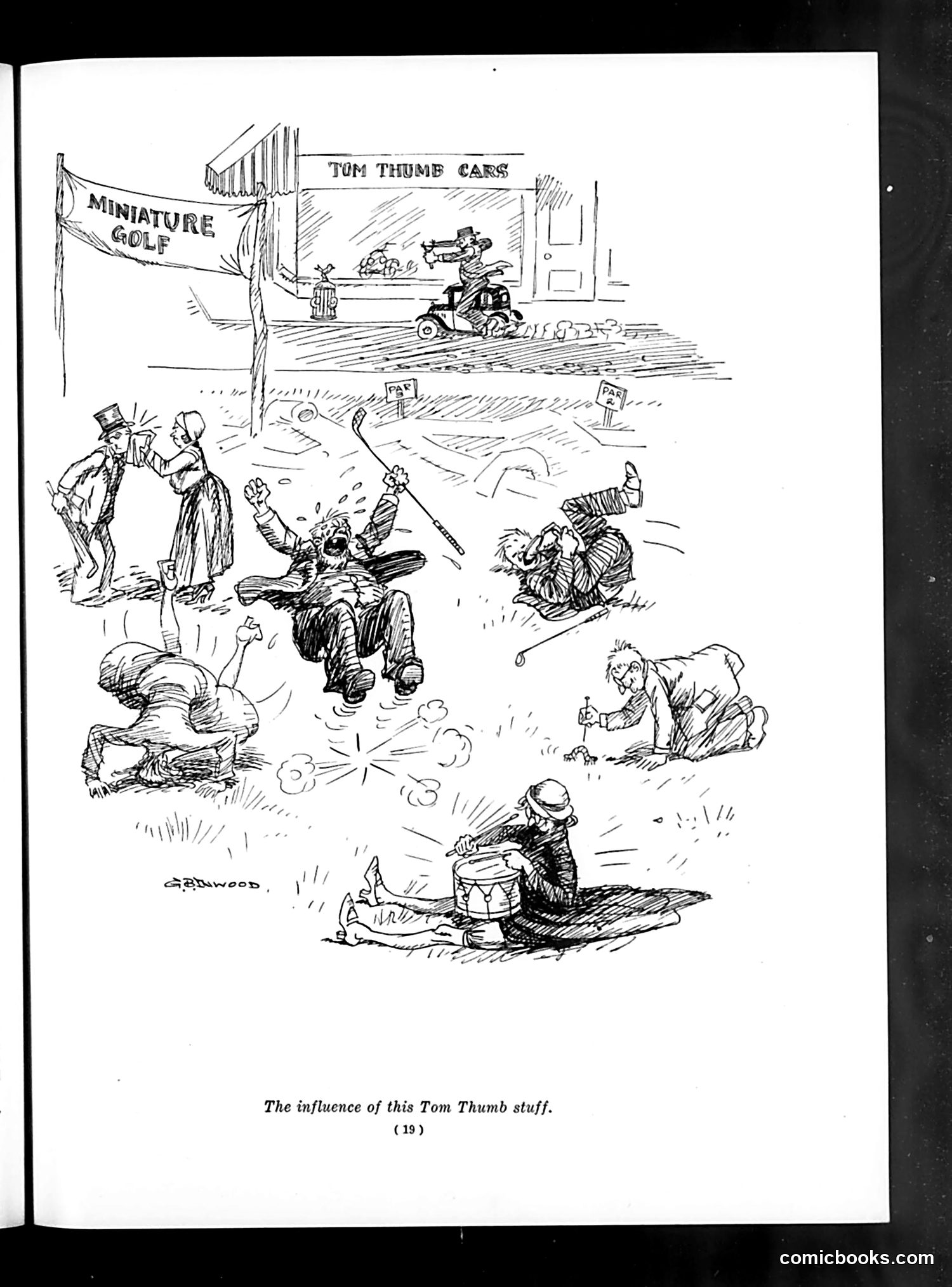
# Analysis of Life Magazine Page This page contains several humor pieces targeting early 20th-century social behavior and gender relations: **"Parlor Conversation"** mocks how men court women by exaggerating their artificiality—the "Modern Davenport" character boasts of being an "antique divan," suggesting men fabricate their backgrounds. **"Pass the Plate"** satirizes parental hypocrisy: a mother tells her son to observe his father's appearance, but then admits father now wears grandfather's dentures—undermining her advice about honesty. **"Right!"** jokes about defining illiteracy as having intelligence enough *not* to read or write—absurdist humor questioning education's value. **"Ain't It The Truth?"** depicts a car mechanic's conversation with a customer (Bill), satirizing mechanic dishonesty and the performative politeness of service transactions—the mechanic's overly thorough inspection likely hides unnecessary upselling. The "Mr. Dupont takes up golf" cartoon illustrates an explosion, apparently satirizing wealthy amateur golfers' incompetence.
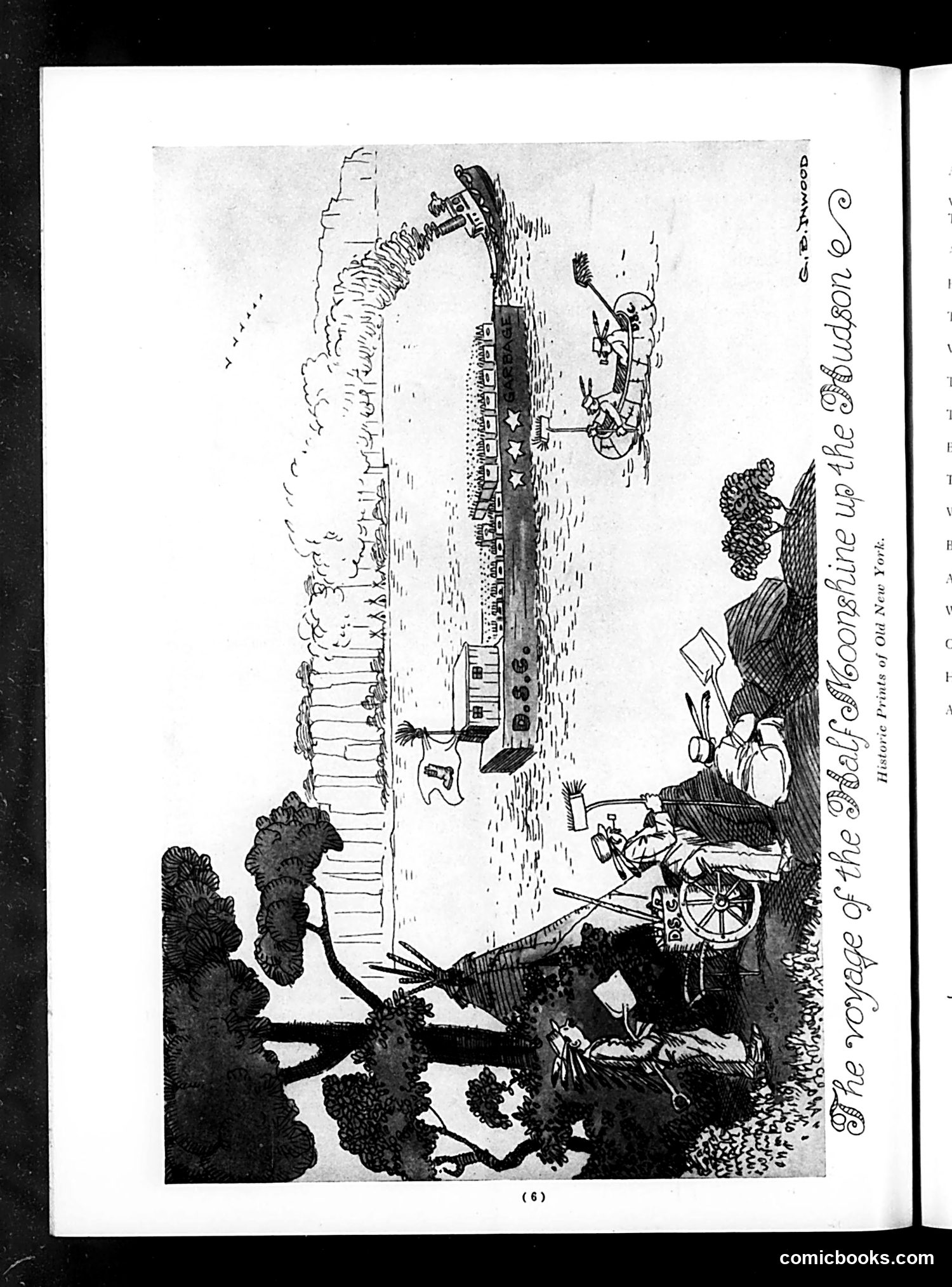
# Analysis This page shows "The voyage of the Burlesque," a satirical illustration that appears to be rotated 90 degrees. The engraving depicts a steamboat traveling along what seems to be the Hudson River or similar American waterway, with passengers aboard and various figures along the shoreline. The title references "burlesque," suggesting satirical commentary on contemporary society or politics. The detailed engraving style is typical of 19th-century Life magazine illustrations. However, without clearer visibility of specific caricatured figures or readable text identifying particular political targets, I cannot definitively identify which specific events, politicians, or social movements this cartoon mocks. The boat's journey appears to be the vehicle for social satire, a common Life magazine format.
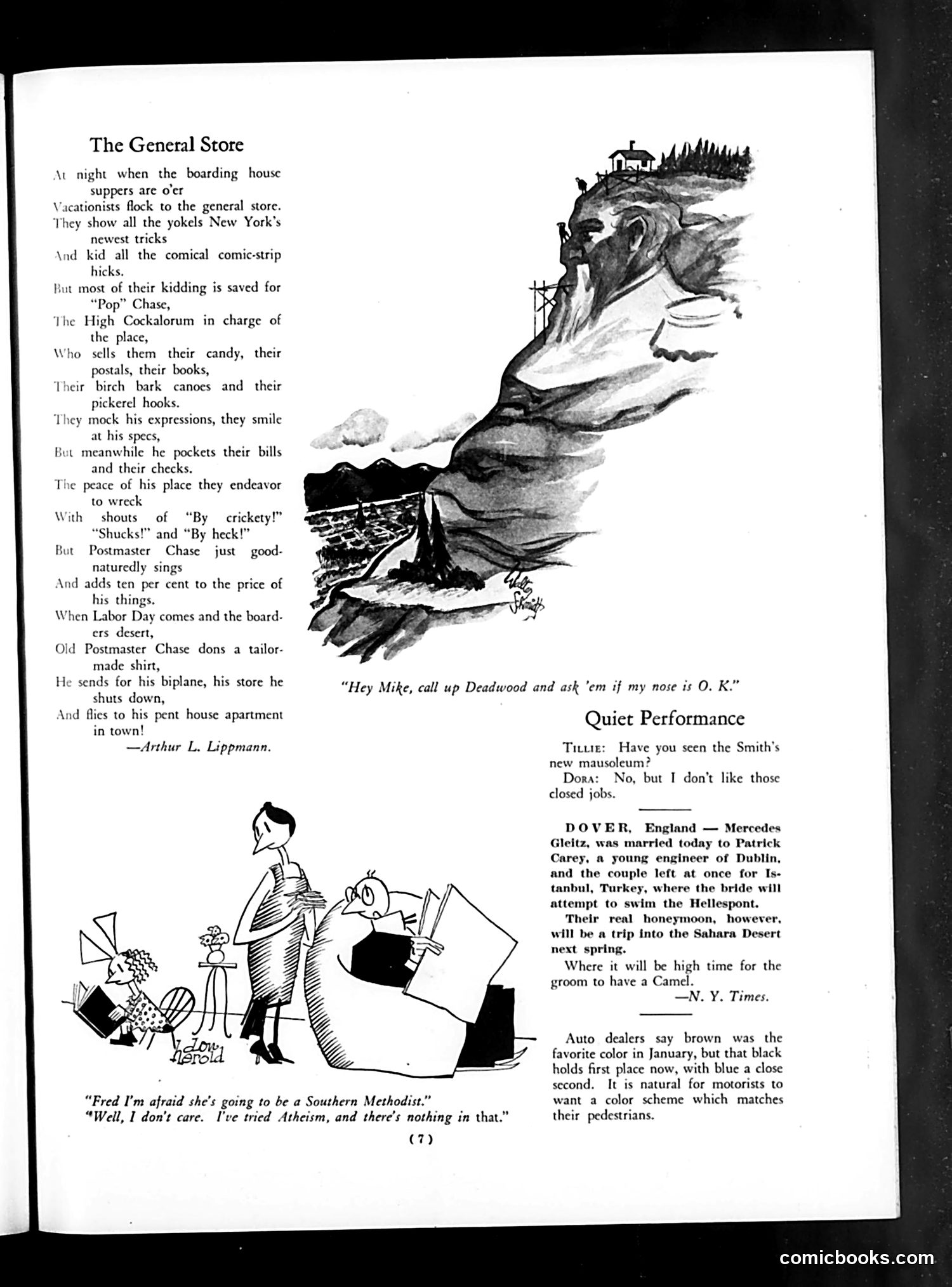
# Analysis of Life Magazine Page This page contains three satirical pieces: 1. **"The General Store"** (poem by Arthur L. Lippmann): Mocks "Postmaster Chase," the High Cockalorum running a general store at a vacation spot. Vacationers mock him, buy cheap goods, create havoc with shouts of "By cricket!" and "Shucks!" The satire targets his self-importance and gullibility—he's easily manipulated by tourists who disrupt his business while he profits minimally. 2. **Lower cartoon**: Shows a domestic dispute about religion. A woman fears her husband will become a "Southern Methodist"; he replies he's tried atheism with no results, suggesting cynical indifference to both positions. 3. **"Quiet Performance"**: Brief gossip items about social news (marriages, color preferences in automobiles). The humor relies on early-20th-century American social conventions and class anxieties.
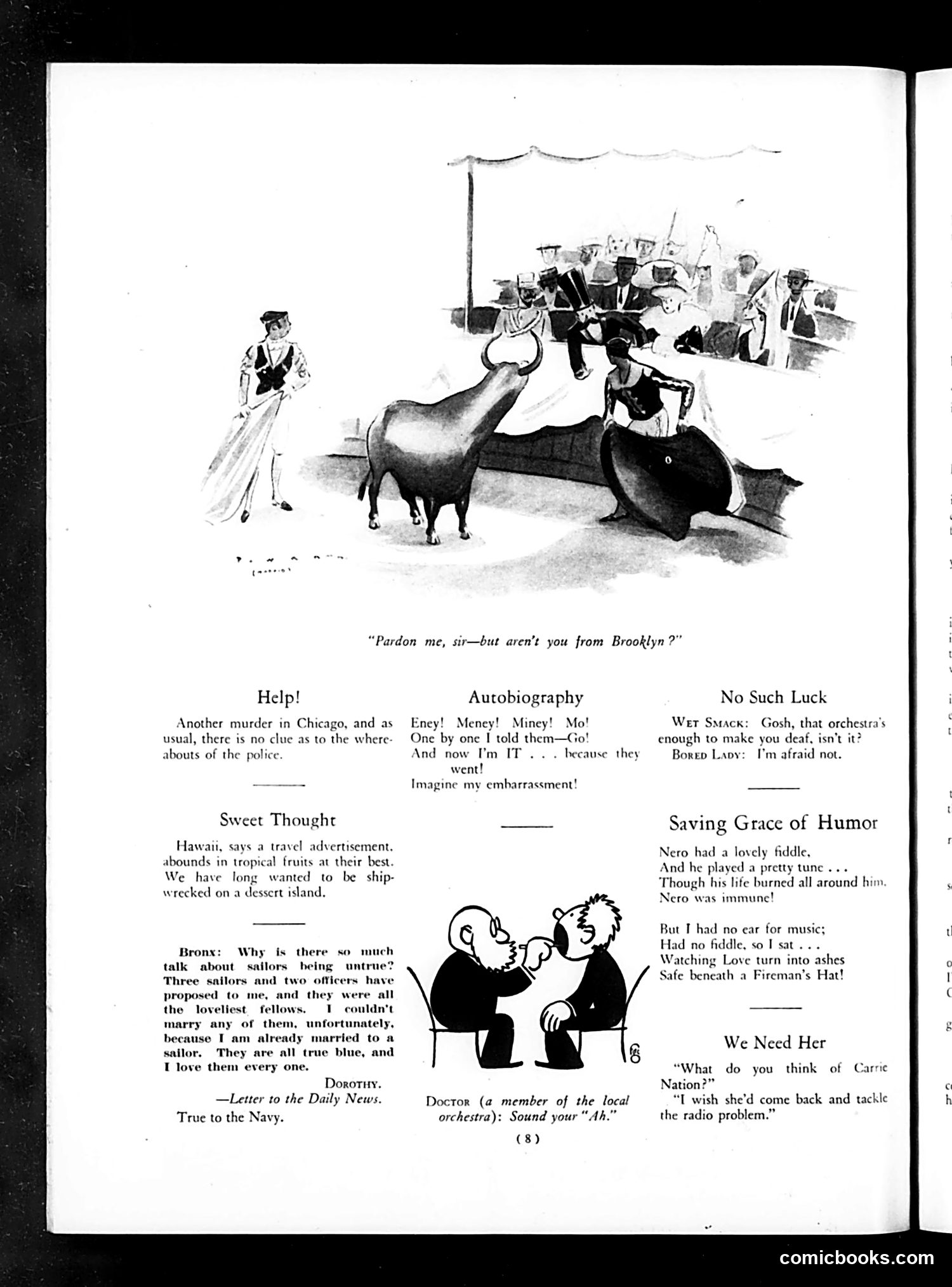
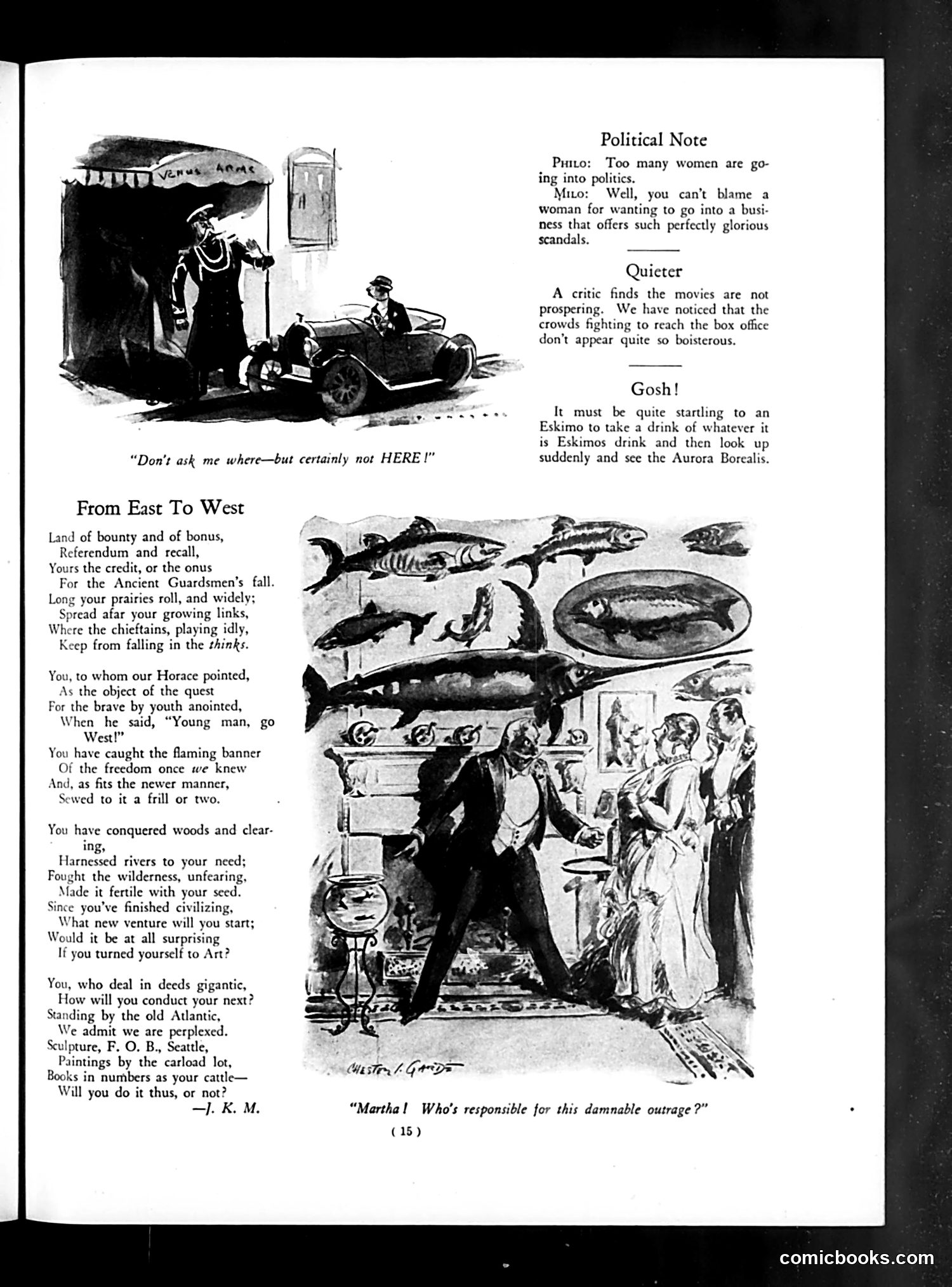
# Analysis This page from *Life* magazine contains humorous short pieces and one cartoon. The main illustration at top shows a bullfight scene with a woman in a flapper dress on the left, and spectators watching a bull gore a matador. The caption reads: "Pardon me, sir—but aren't you from Brooklyn?" The joke plays on 1920s stereotypes: a Brooklyn-accented man is so unsophisticated that he'd attend a bullfight dressed formally but act obliviously American, needing to be "pardoned" for his crude behavior in a Spanish cultural setting. The remaining text consists of brief humorous anecdotes and jokes about various topics—Chicago crime, naval romance, Hawaii travel, and orchestra members—typical of *Life*'s light satirical humor of the era. These mock everyday American social situations and provincial attitudes.
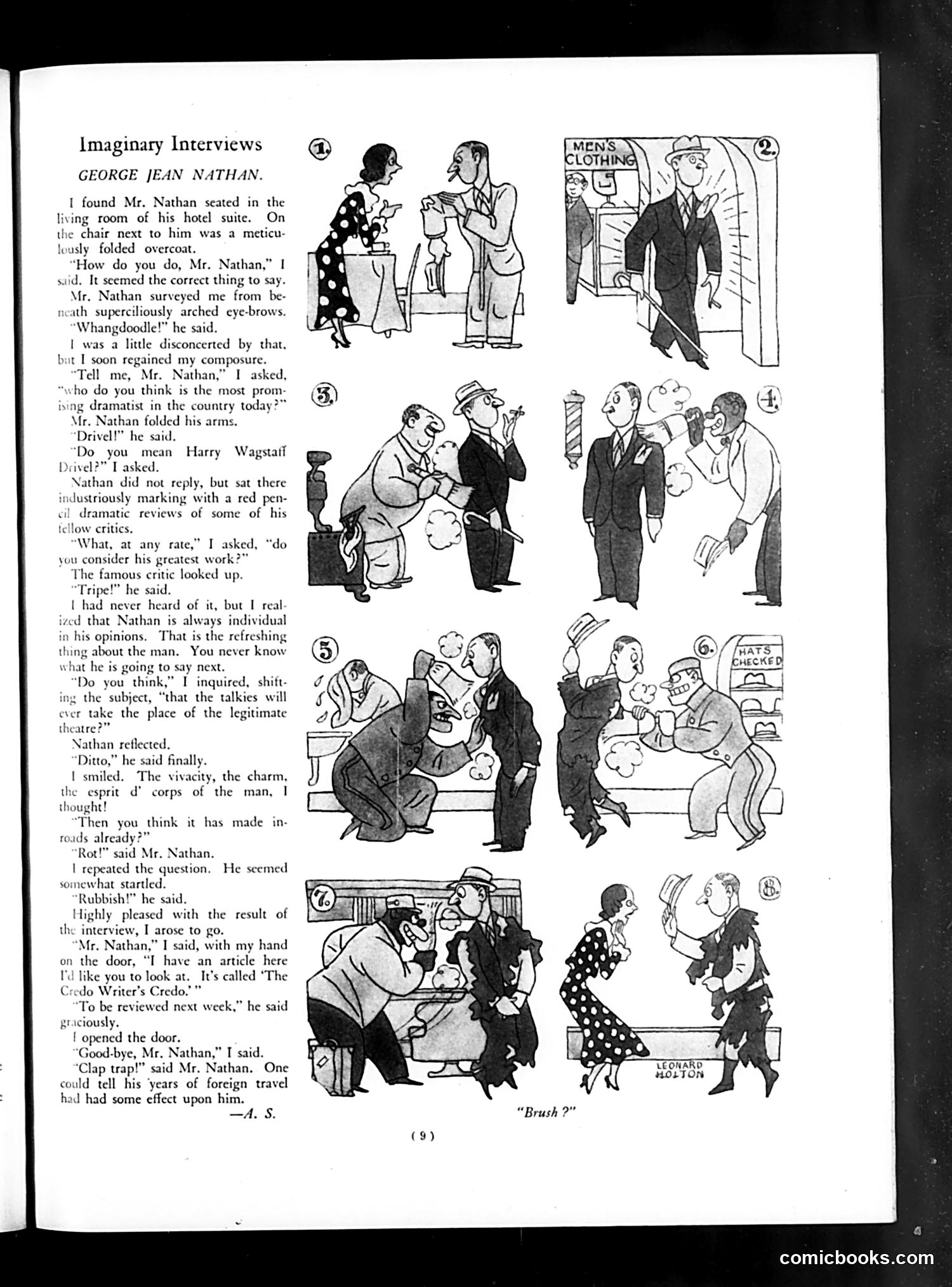
# Imaginary Interviews: George Jean Nathan This page features a satirical interview with **George Jean Nathan**, a prominent theater critic of the early 20th century. The text humorously depicts Nathan as an arrogant, dismissive critic who considers Harry Wagstaff himself "Tripe!" and believes talkies (early talking films) will never replace legitimate theater. The accompanying comic strip illustrations (numbered 1-8) show Nathan in various scenarios—shopping, dining, and socializing—where he maintains his supercilious attitude. The final panel, titled "Brush?", appears to joke about his pretentious demeanor. The satire targets Nathan's notorious snobbery about entertainment media and his refusal to acknowledge changing cultural tastes. It's a period piece mocking a real critic's dismissiveness toward emerging technologies like sound film.
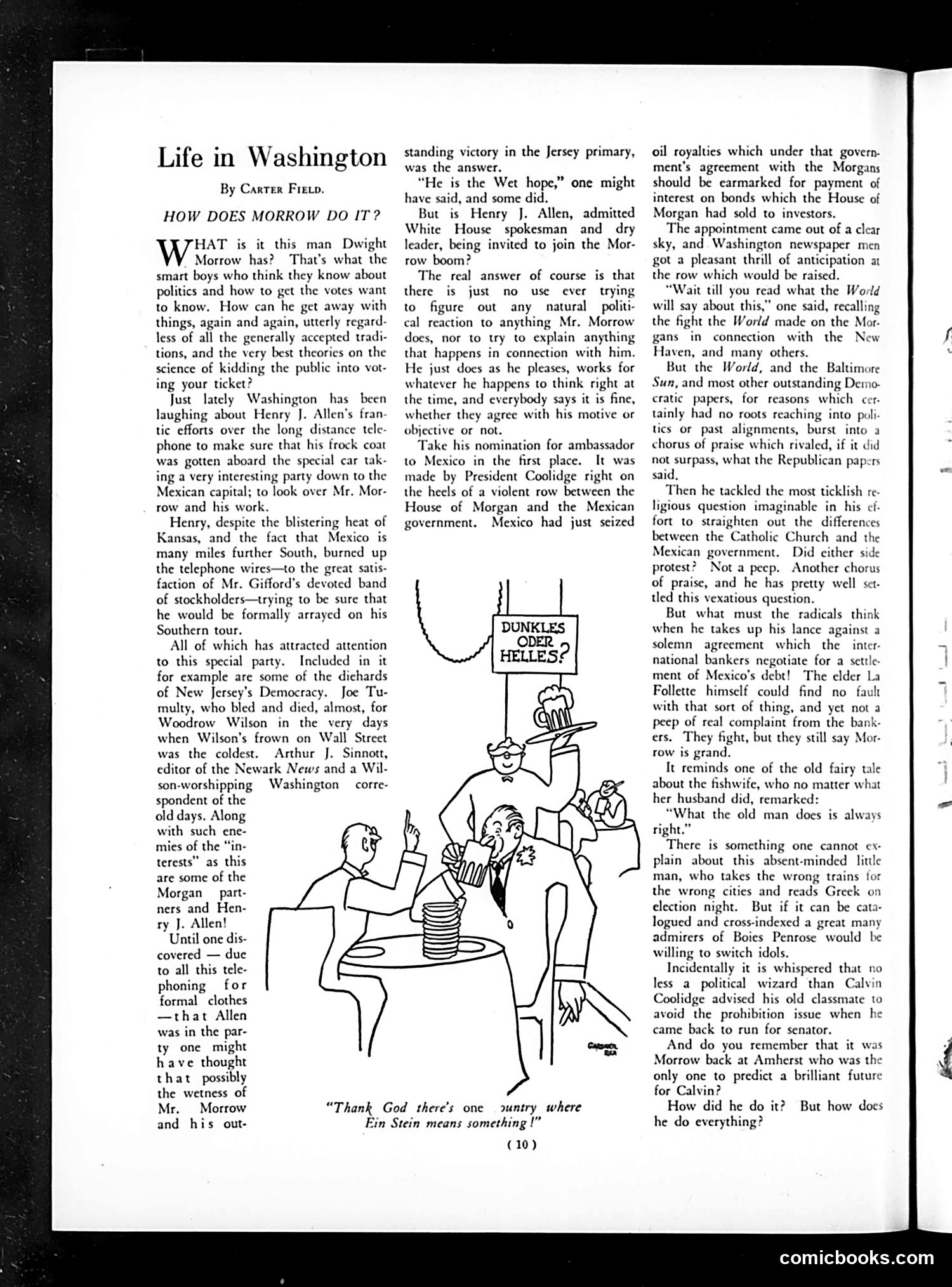
# Analysis: "Life in Washington" by Carter Field This satirical piece critiques **Dwight Morrow's** political maneuvering and influence. The cartoon shows figures around a table with a sign reading "DUNKLES ODER HELLES?" (German for "dark or light beer"), captioned: "Thank God there's one country where Ein Stein means something!" The article mocks Morrow's role in **Henry J. Allen's** failed political efforts, suggesting Morrow operates behind the scenes without accountability—he "just does as he pleases, works for whoever he happens to think right at the time." The satire targets his **ambassador nomination to Mexico**, his involvement in the **Morgan financial interests**, and his influence over Calvin Coolidge. The German beer reference appears to mock immigrant or foreign policy connections, suggesting Morrow's shadowy influence extends across borders while remaining mysteriously effective in American politics.