A complete issue · 36 pages · 1930
Life — August 1, 1930
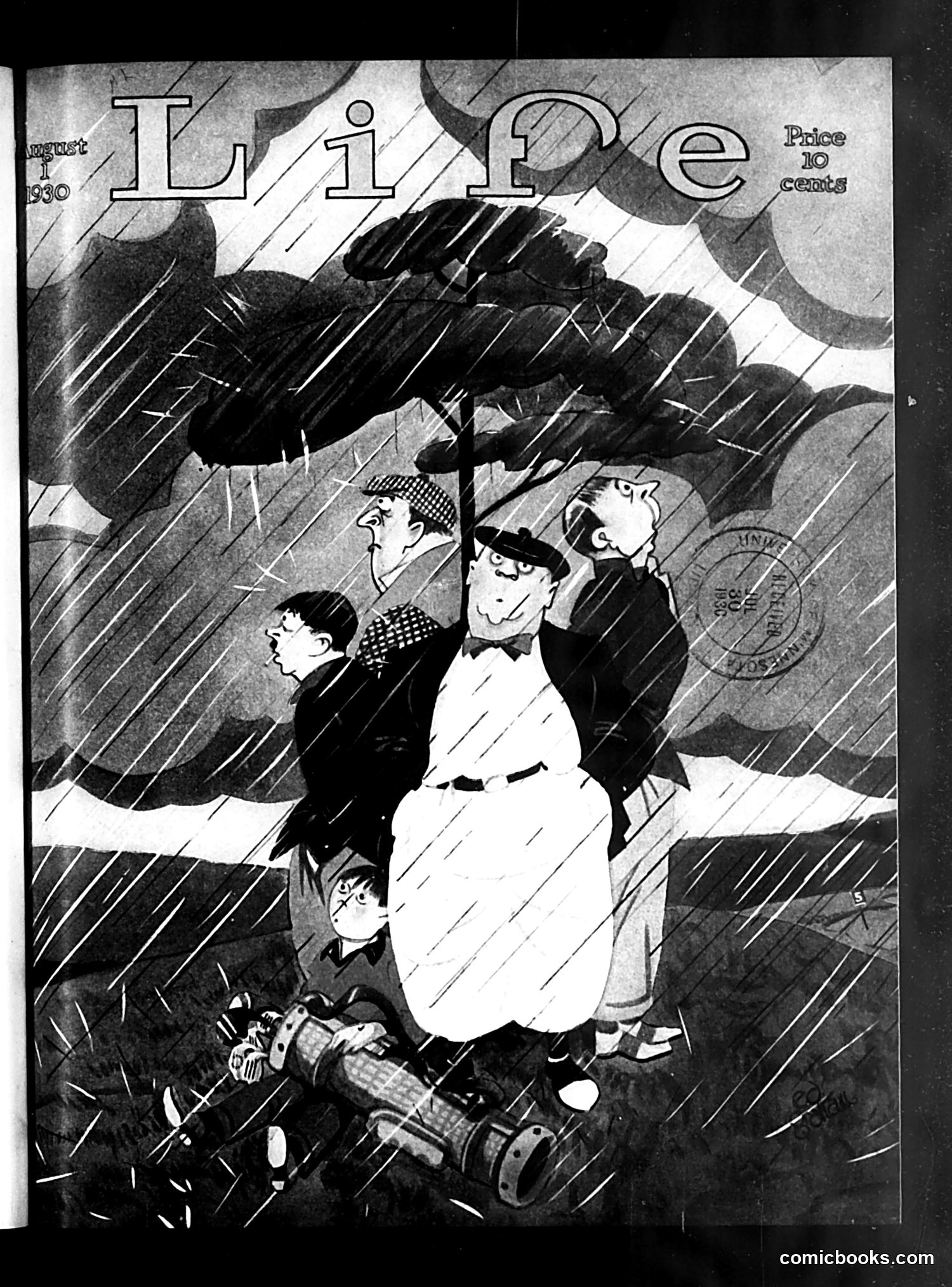
# Life Magazine Cover Analysis This appears to be a **Life magazine cover from August 1, 1930** (visible in top left corner). The illustration depicts four men huddled together under an umbrella during heavy rain, rendered in black and white caricature style typical of 1930s satirical art. The figures appear to represent **different social classes or types** seeking shelter together—a commentary likely addressing **economic hardship during the Great Depression era**. The contrast between formal dress (top hat, bow tie) and working-class clothing suggests satire about how financial crisis affected people across social strata equally. The rain serves as a metaphor for the economic "storm." Without identifying specific individuals, the image's message appears to be that shared misfortune transcends class boundaries—a common Depression-era theme emphasizing collective suffering.
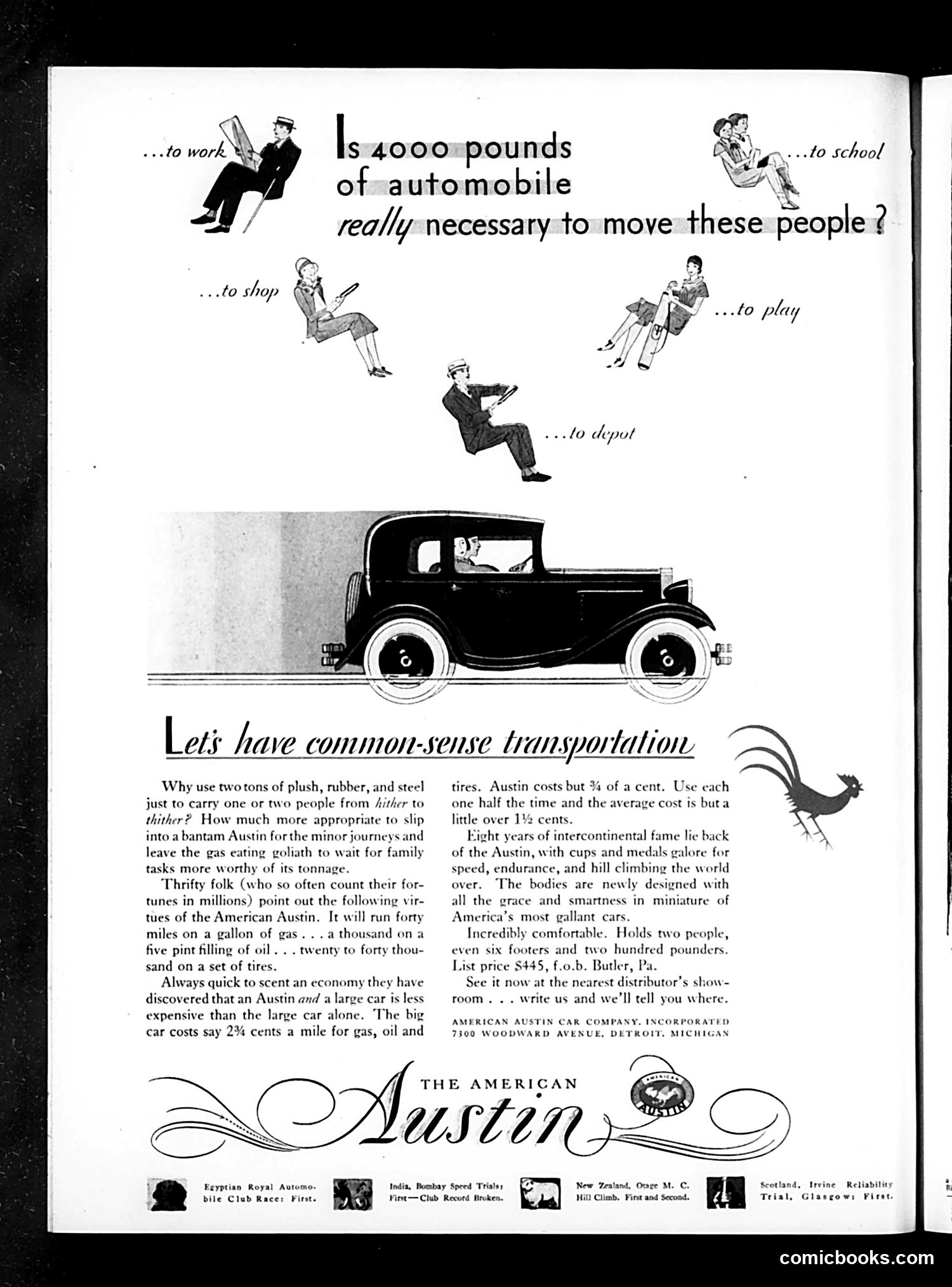
# Analysis This is primarily an **automobile advertisement** for the American Austin car, disguised as social satire. The top half presents a rhetorical question with illustrated figures—a man going to work, a child to school, a woman shopping, a man at a depot, and children playing—each labeled with destinations. The satirical point: these everyday trips don't actually require a large, heavy automobile (4000 pounds). The Austin company argues that a small, lightweight car is more practical and economical for typical short-distance travel. The text emphasizes the Austin's efficiency: it costs only ¾ of a cent per mile to operate, runs forty miles on a gallon of gas, and can carry two people plus modest cargo. The advertisement positions the Austin as "common-sense transportation"—challenging the era's preference for larger vehicles for routine errands.
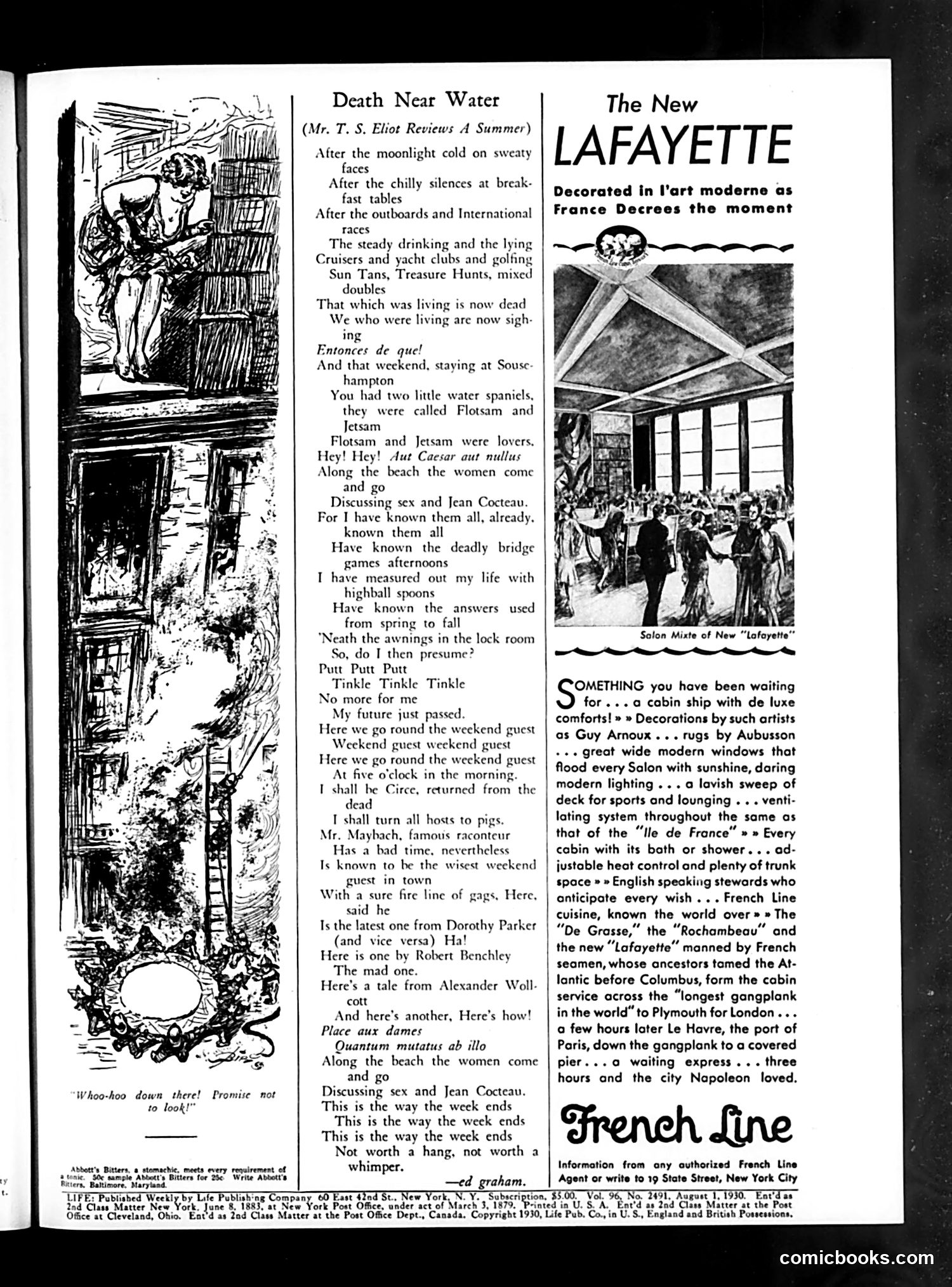
# "Death Near Water" - Analysis This page contains T.S. Eliot's poem "Death Near Water" (reviewing "A Summer"), paired with an advertisement for French Line cruises featuring the new Lafayette ship. **The Poem's Content:** Eliot's dark, modernist verse catalogs the leisure activities of the wealthy at seaside resorts—racing, drinking, golf, yacht clubs. The repeated refrain "This is the way the week ends / Not worth a hang, not worth a whimper" suggests satirical despair at vacuous upper-class life. References to "deadly bridge games" and shallow social discourse mock the emptiness of this world. **The Irony:** The juxtaposition with the glamorous Lafayette advertisement—emphasizing luxurious cabins, French cuisine, and elegant deck sports—creates sharp satire. Eliot's poem mocks precisely the leisure lifestyle the ad promotes, exposing the spiritual hollowness beneath such indulgence.
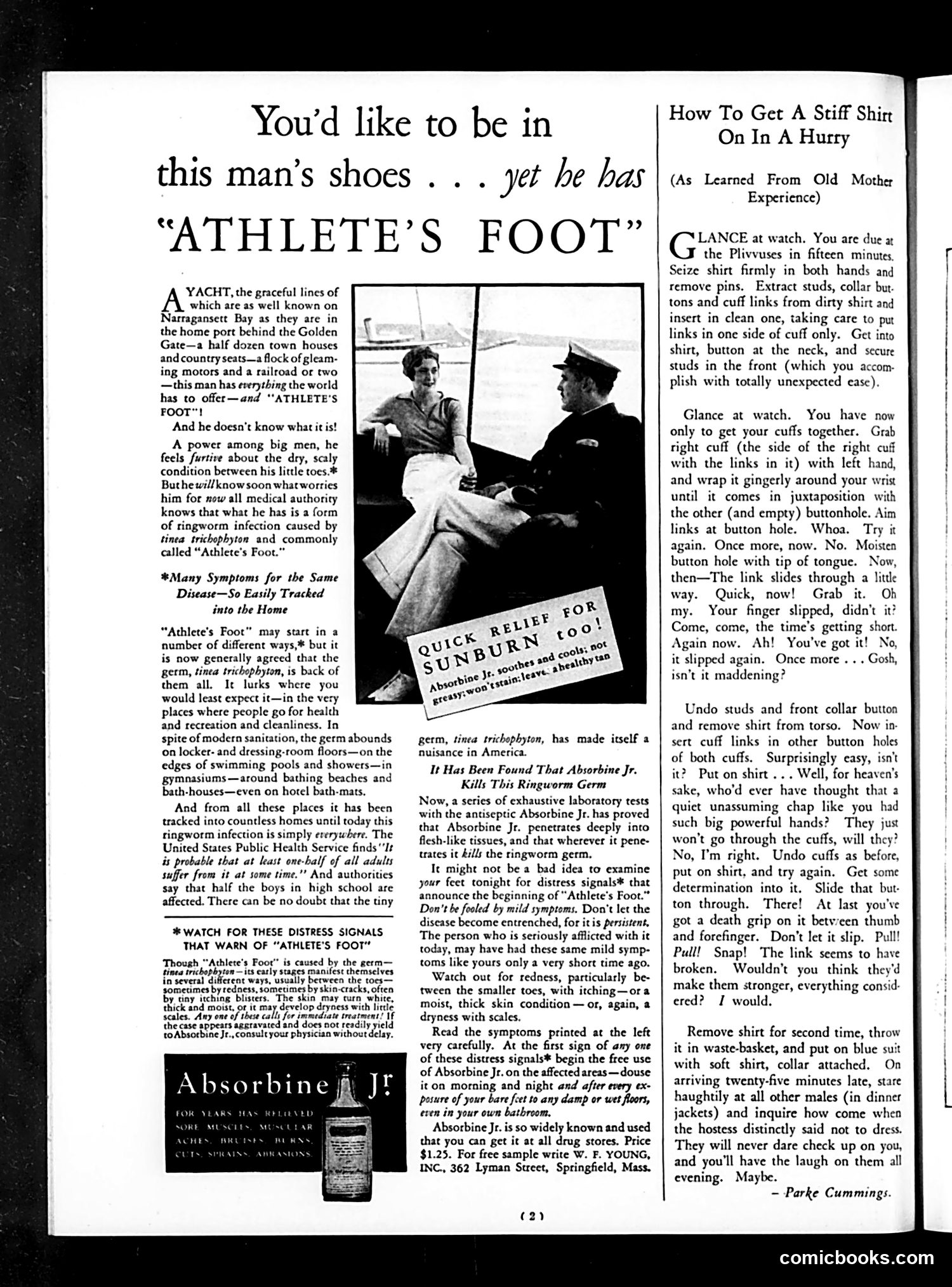
This page contains two separate pieces: a satirical advertisement for Absorbine Jr. (a liniment product) and a humorous advice column. The main advertisement uses dark humor about "Athlete's Foot"—a common fungal infection—playing on the phrase "You'd like to be in this man's shoes... yet be has 'Athlete's Foot.'" The accompanying photograph shows two men on a yacht, with the afflicted man's bare foot prominently displayed. The satire suggests that even wealthy leisure (yacht ownership, Narragansett Bay) cannot protect one from this embarrassing medical condition. The right column offers comic instructions on rapidly dressing a shirt for an urgent social engagement, using exaggerated, breathless language to describe the frantic process of inserting studs and cufflinks. Both pieces employ comedic exaggeration typical of Life magazine's satirical style, targeting mundane social anxieties and bodily embarrassments.
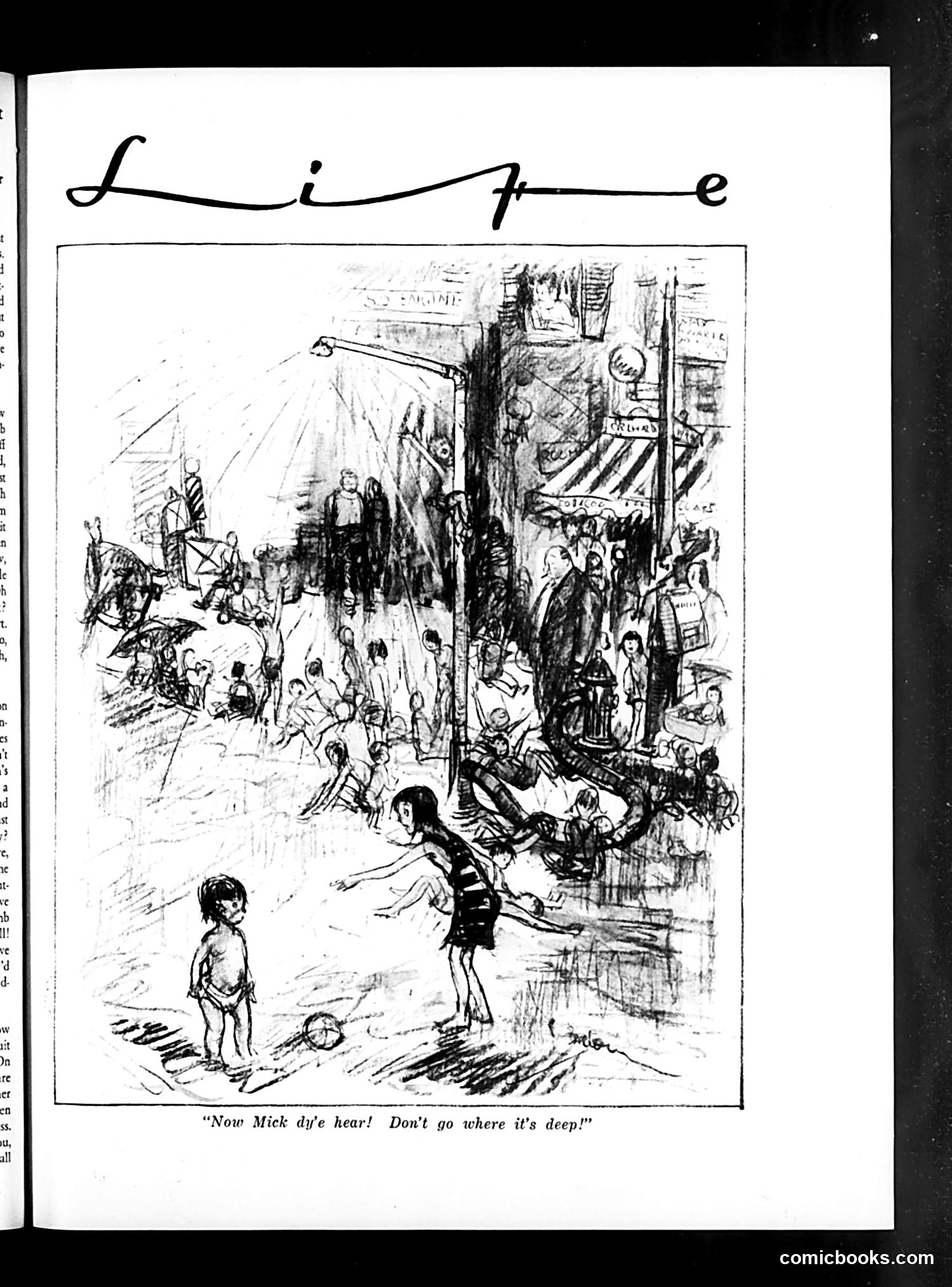
# Analysis This appears to be a sketch from *Life* magazine showing a street scene titled "Now Mick d'ye hear! Don't go where it's deep!" The cartoon depicts children playing in what seems to be a poor urban neighborhood, with a densely packed street scene including tenement buildings and various figures. The warning in the caption suggests an adult cautioning a child (apparently named Mick) about water depth—likely referencing a dangerous situation like a flooded area or polluted waterway. The sketch style and Irish name "Mick" suggest this addresses immigrant life and urban poverty in early 20th-century America. The satire appears to critique unsafe living conditions in crowded tenement districts where children faced hazards from poor sanitation and infrastructure. The casual, dark humor typical of *Life*'s social commentary is evident in treating a potentially dangerous situation as material for satire.
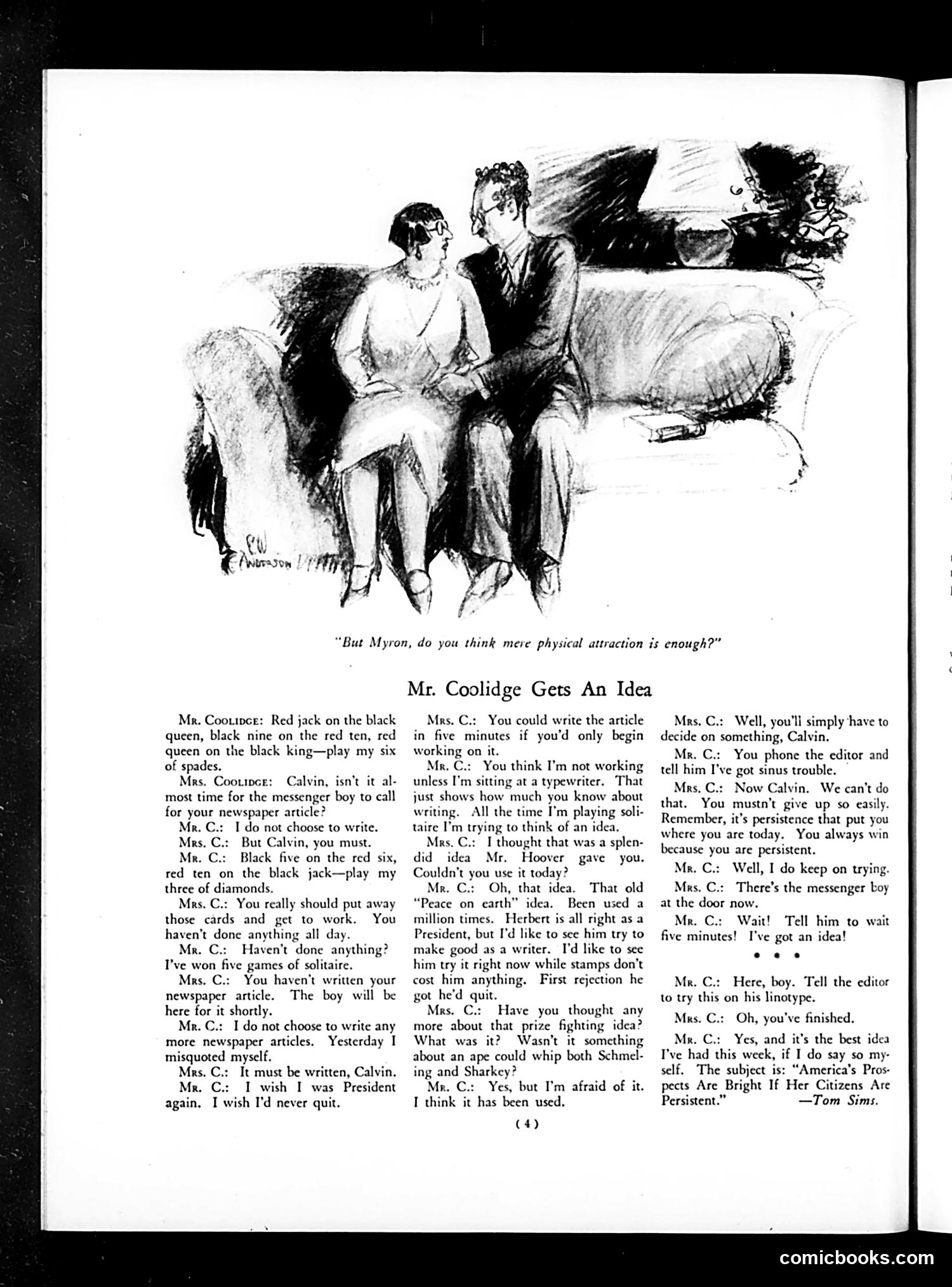
# "Mr. Coolidge Gets An Idea" This is a satirical sketch showing a man and woman on a couch with the caption "But Myron, do you think mere physical attraction is enough?" The dialogue below reveals the joke: Mr. Coolidge (the man) is a newspaper writer struggling with laziness and lack of ideas. His wife Mrs. C. persistently nags him to write his overdue newspaper article. When she suggests he phone the editor, Coolidge suddenly claims to have an idea—"America's Prospects Are Bright If Her Citizens Are Persistent"—which he admits is recycled from Herbert Hoover. The satire mocks Coolidge's laziness, his wife's nagging persistence, and the banality of his "original" idea. The humor lies in how he only produces work under pressure and then recycles old material as his own.
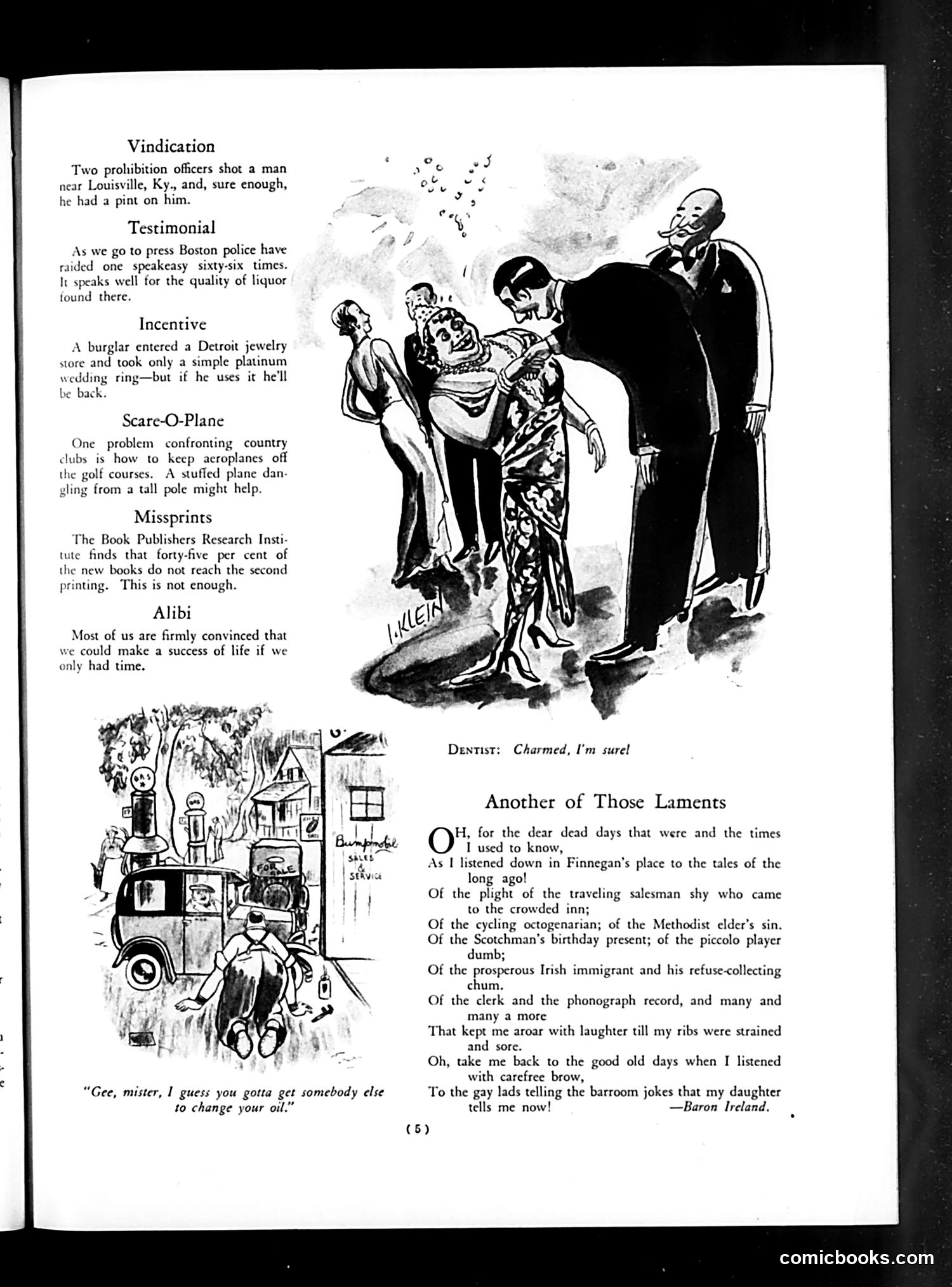
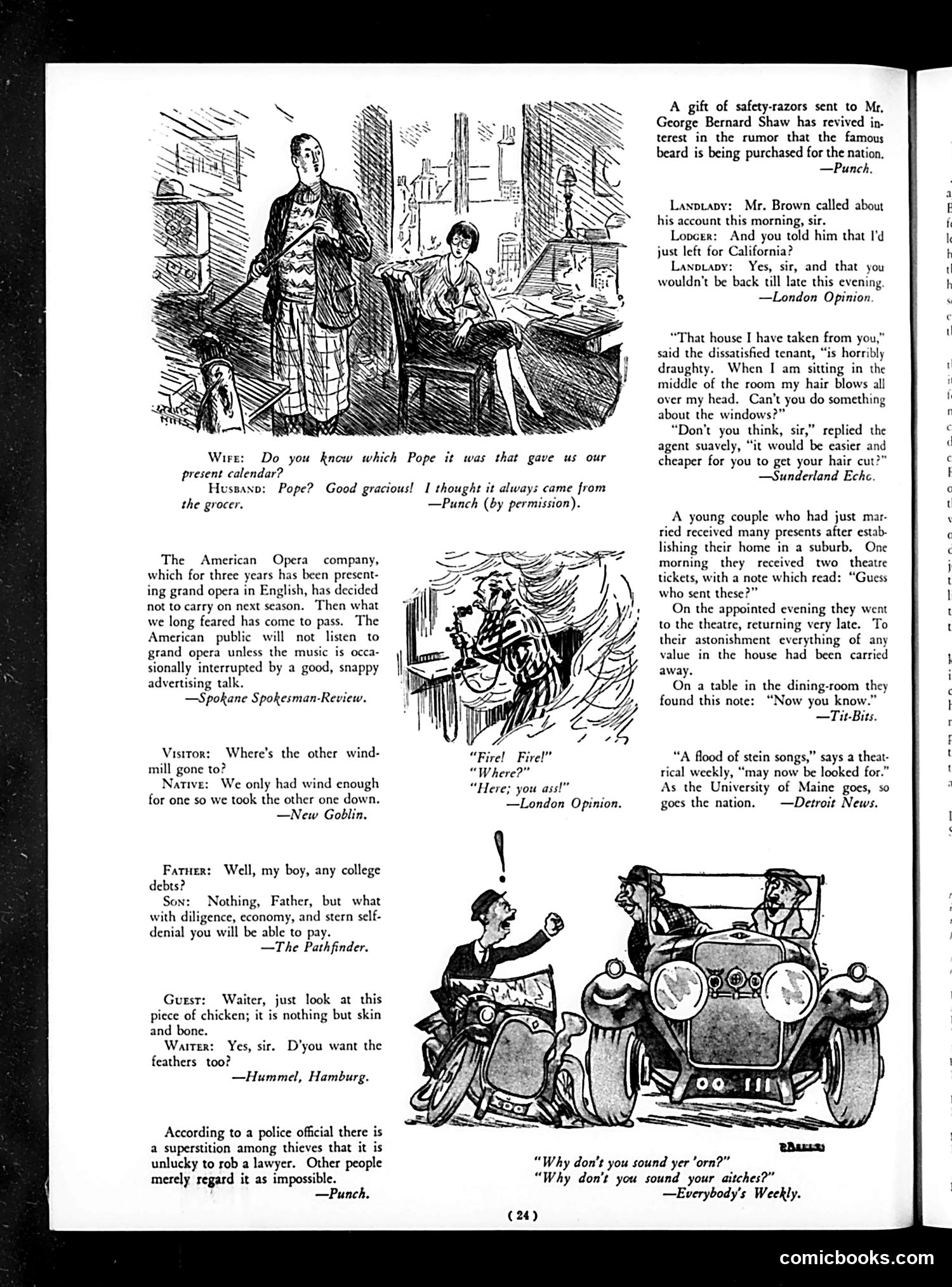
# Page Analysis This page from *Life* magazine contains several short humorous items and illustrations typical of the era's satirical format. The top section includes brief jokes about Prohibition enforcement ("Two prohibition officers shot a man near Louisville, Ky., and, sure enough, he had a pint on him"), police speakeasies in Boston, a Detroit jewelry burglar, and other contemporary social issues. The main illustration shows a tall man in formal dress confronting a woman holding a baby, with other figures present—likely depicting a domestic or social scandal scenario, though the specific reference is unclear from the image alone. The bottom illustration depicts a crowded street scene with a taxi, apparently humorously captioned about needing someone to change oil. The page concludes with a nostalgic poem titled "Another of Those Laments" by Baron Ireland, yearning for older Irish immigrant culture and entertainment traditions.
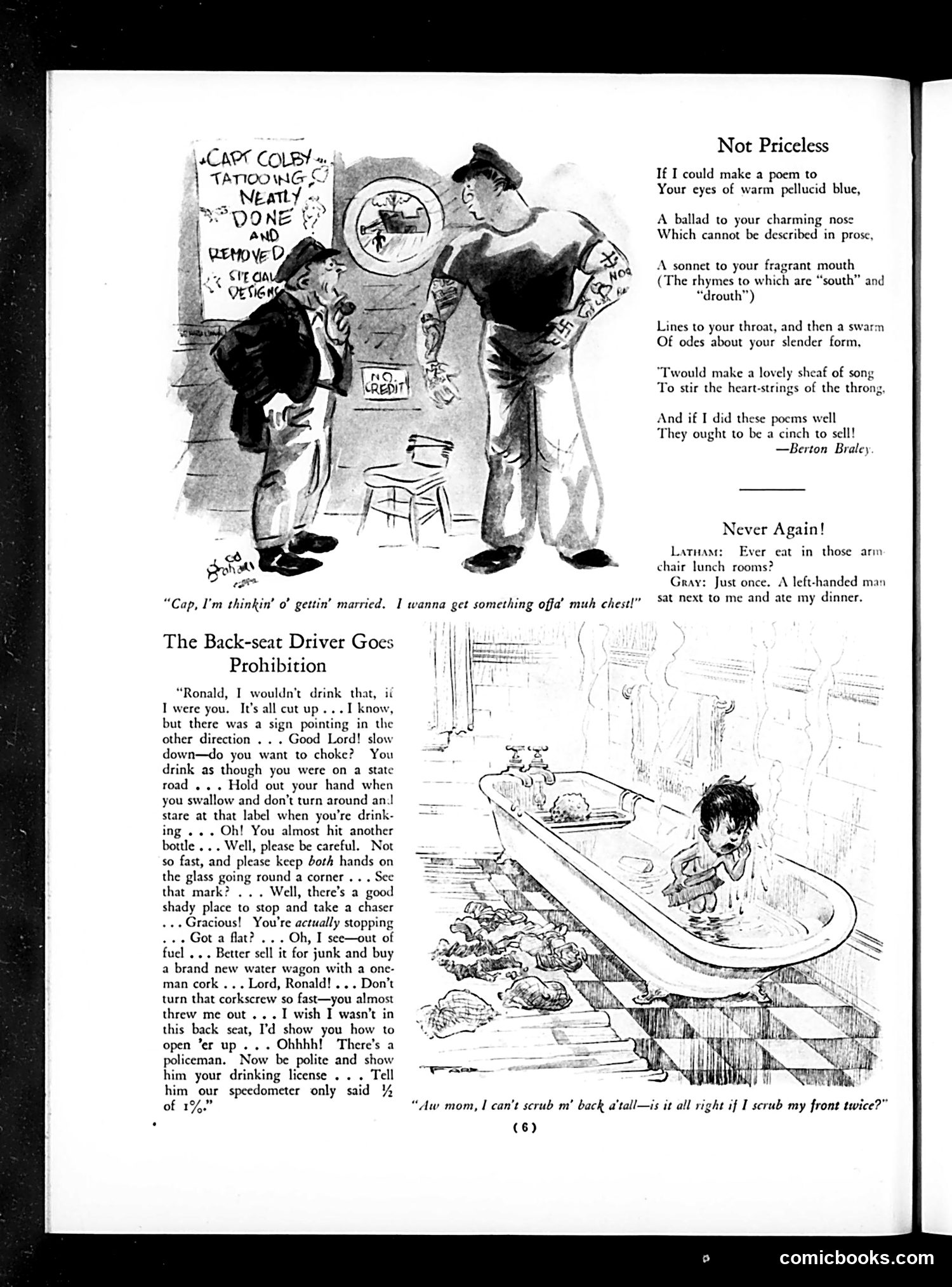
# Analysis of Life Magazine Page This page contains three distinct pieces of humor: 1. **"Not Priceless"** — A poem by Berton Braley mocking flowery romantic verse, suggesting poetry about a woman's features would be worthless ("ought to be a cinch to sell"). 2. **"Never Again!"** — A brief joke about a left-handed man at an arm-chair lunch room who ate the narrator's dinner, a play on awkward shared dining spaces. 3. **"The Back-seat Driver Goes Prohibition"** — The main cartoon satirizes drinking and driving safety. A back-seat passenger delivers an absurdly long, paranoid monologue warning the driver against alcohol, ironically advising him to sell his car and buy a water wagon instead. The joke targets both drunk driving concerns and Prohibition-era anxieties about drinking culture.
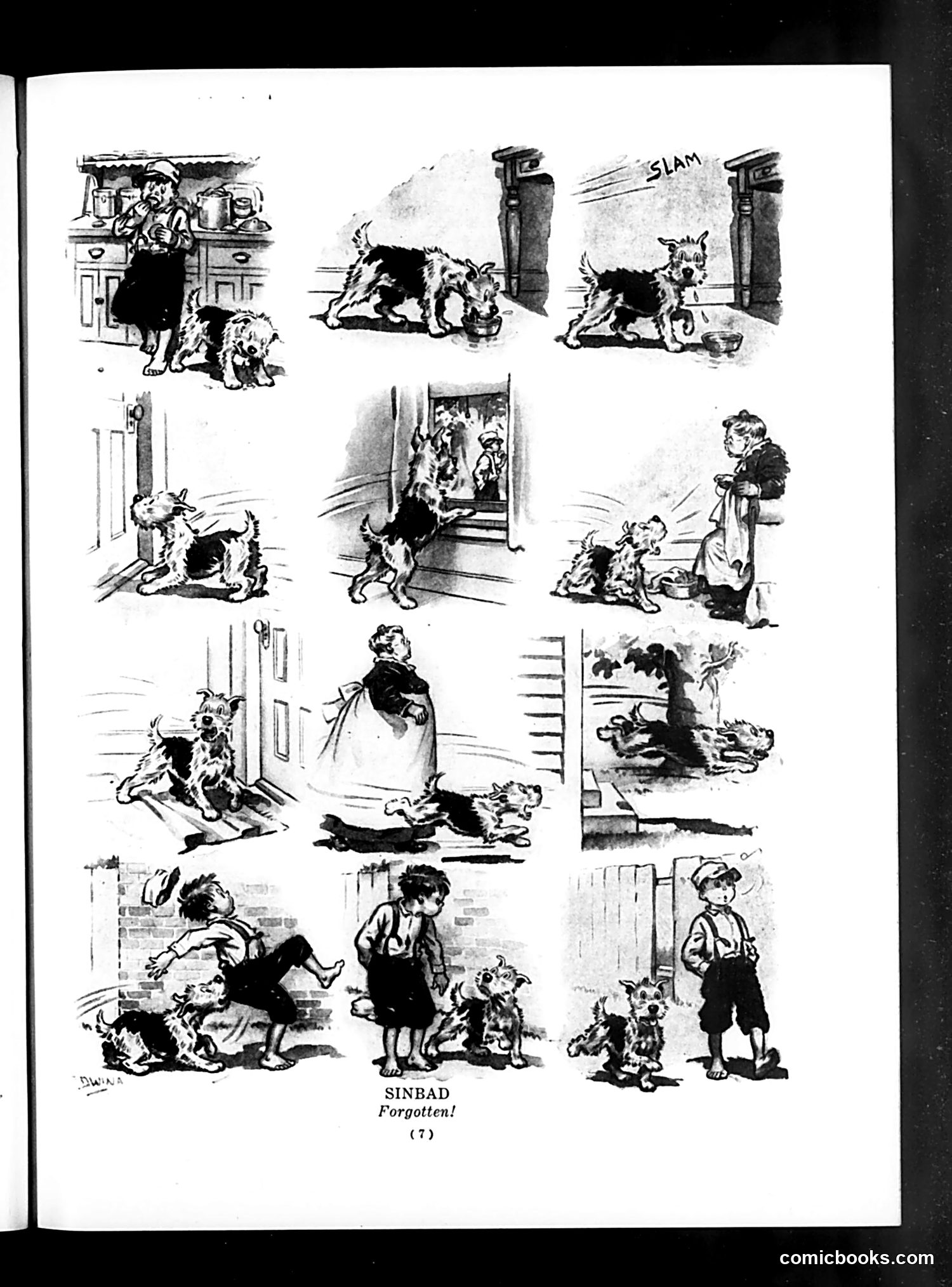
# Analysis of "Sinbad Forgotten!" Comic Strip This appears to be a sequential comic strip showing a child and a dog in various domestic scenes. The title "Sinbad Forgotten!" suggests the narrative concerns the child neglecting or abandoning the dog. The strip depicts: a woman with the child and dog at home; the dog being shooed away or locked out; the child playing with other activities while ignoring the pet; and final scenes showing the lonely dog. The "SLAM" sound effect in an early panel emphasizes the door closing on the dog. The satire likely critiques childhood fickleness or the disposability of pets—a social commentary on how quickly children abandon their animal companions for new interests. The irony of naming the dog "Sinbad" (evoking adventure) only to forget it adds to the pointed humor about broken bonds and neglect.
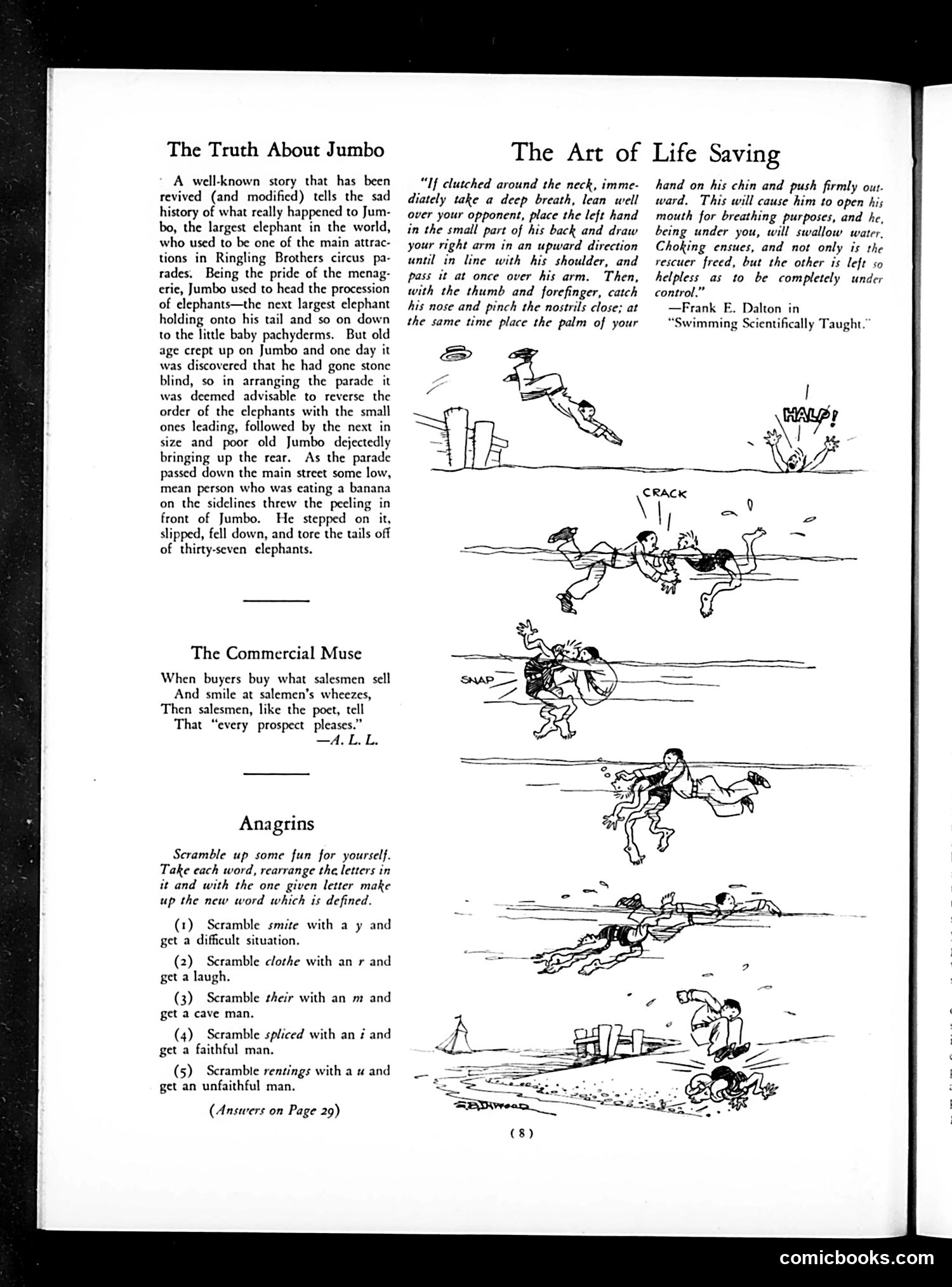
# "The Art of Life Saving" - Cartoon Explanation This instructional cartoon series satirizes rescue techniques by depicting increasingly chaotic and absurd drowning-rescue scenarios. Each panel shows people attempting to save a drowning swimmer, but the "rescuers" themselves end up in the water through mishaps—slipping, falling, or being dragged down. The accompanying quote from Frank E. Dalton's "Swimming Scientifically Taught" provides serious, technical instructions for proper rescue technique, creating deliberate irony: while the text explains the *correct* method for saving someone, the illustrations show what happens when untrained or panicked people attempt rescue. The humor lies in this contrast between theory and chaotic reality—suggesting that without proper training, well-intentioned rescue efforts become disasters themselves.
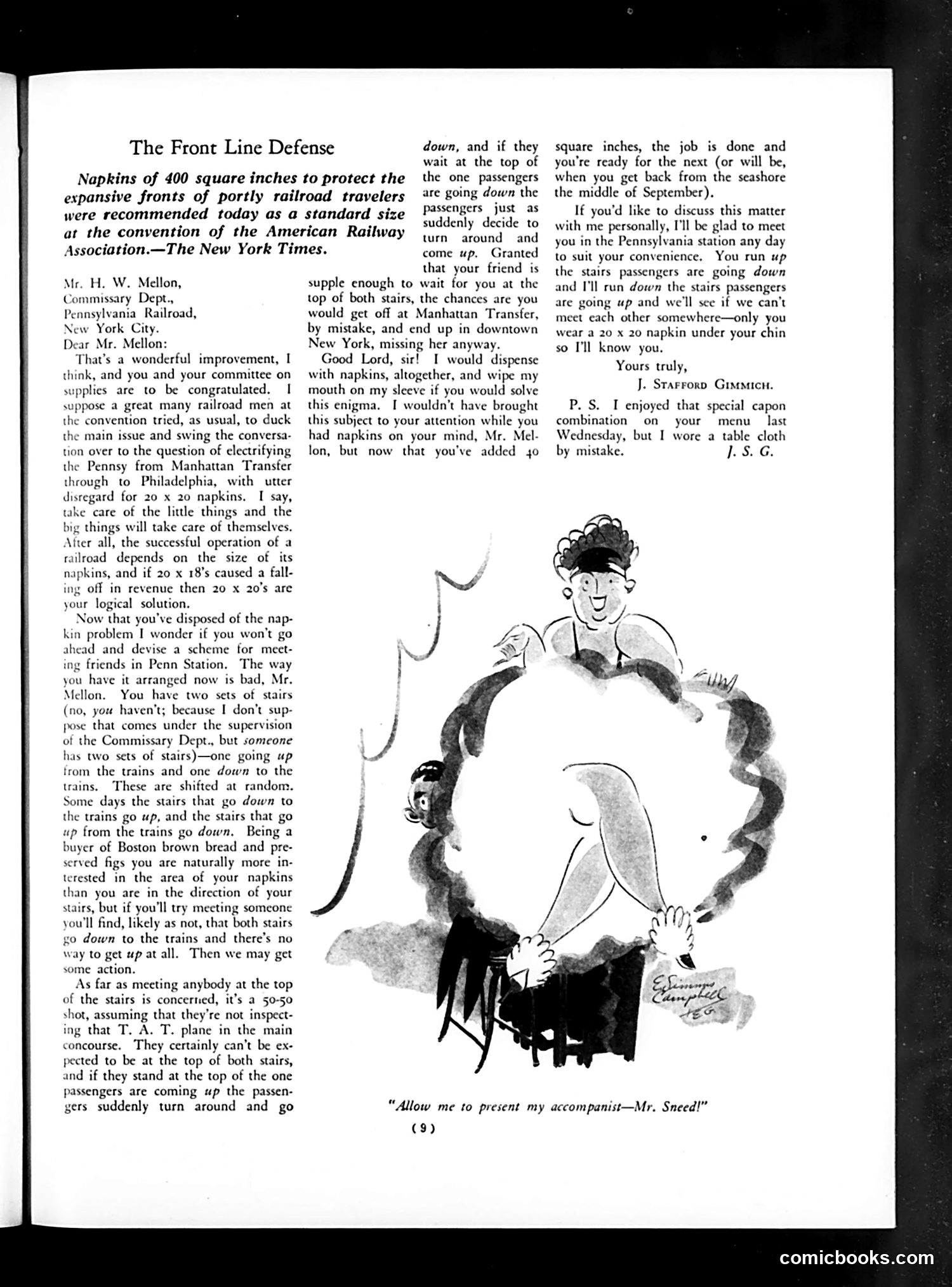
# "The Front Line Defense" - Life Magazine Satire This page satirizes the Pennsylvania Railroad's solution to a practical problem: passengers on crowded trains getting their clothes soiled by expansive bodies. The railroad commissary proposed using 400-square-inch napkins. The letter from J. Stafford Gimmich mocks this absurd approach, suggesting the real issue isn't napkin size but the chaos of Penn Station itself—where stairs go randomly up or down, making it impossible to coordinate meeting friends. His sarcastic postscript jokes about wearing a tablecloth by mistake. The cartoon illustrates the absurdity: a woman being engulfed by an enormous napkin, captioned "Allow me to present my accompanist—Mr. Sneed!" The satire targets bureaucratic solutions that address symptoms rather than root causes of passenger inconvenience.
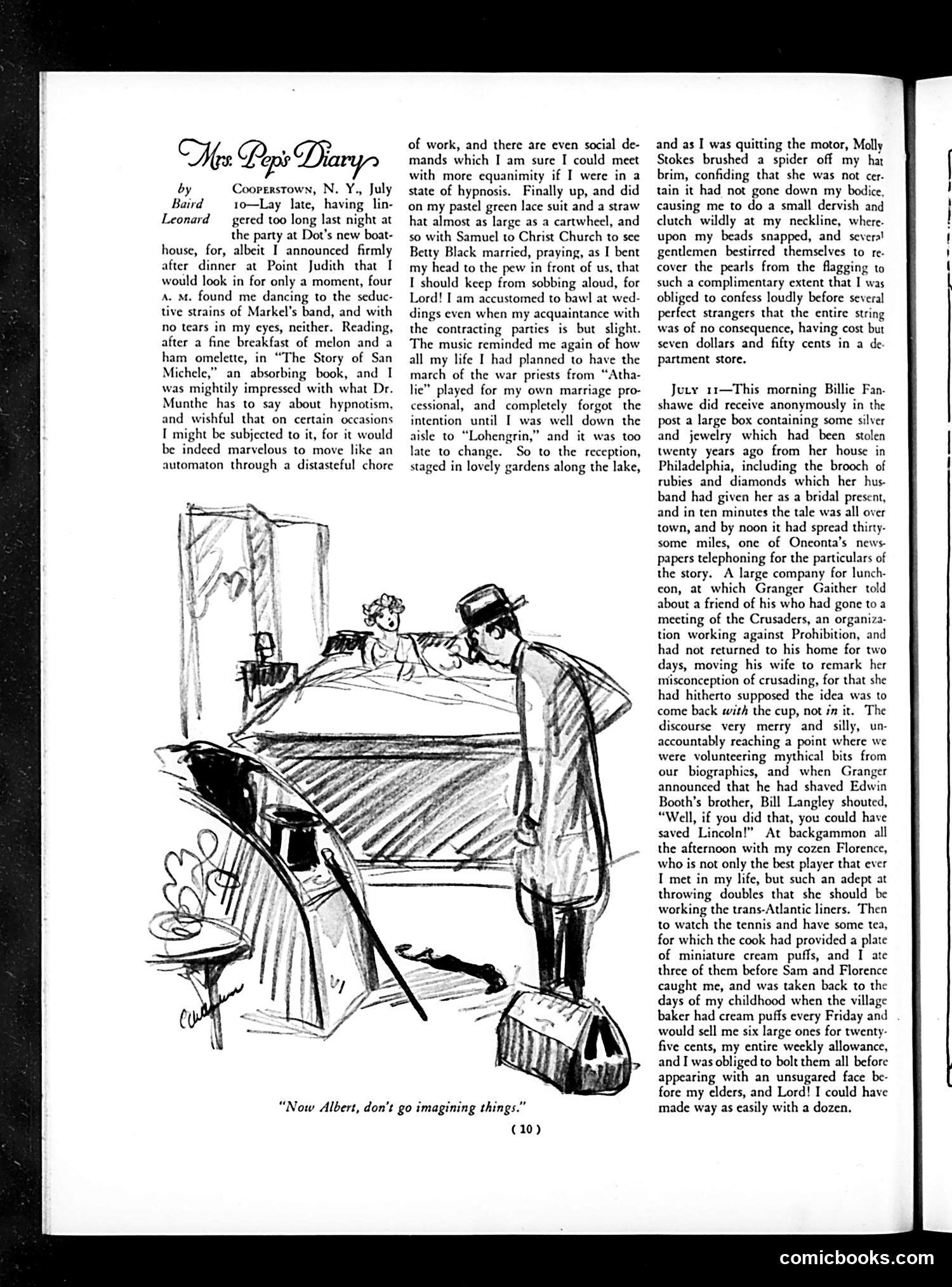
# Analysis of "Mrs. Pen's Diary" Page This page from *Life* magazine presents a humorous domestic diary entry dated July 10-11, set in Cooperstown, N.Y. The cartoon illustrates a scene where a woman in bed addresses a man standing beside it with the caption "New Albert, don't go imagining things." The humor derives from a marital misunderstanding: the diary describes the woman attending social events and receiving anonymous gifts (jewelry and a brooch), which she's carefully explained away. The cartoon captures the moment of potential domestic suspicion—the husband "Albert" apparently suspects infidelity, while she's defensively reassuring him. The satire gently mocks early 20th-century gender dynamics, anxieties about marital fidelity, and the gap between spouses' perceptions of innocent social activities. The exaggerated domestic anxiety is typical of *Life*'s lighthearted social commentary.