A complete issue · 36 pages · 1930
Life — May 9, 1930
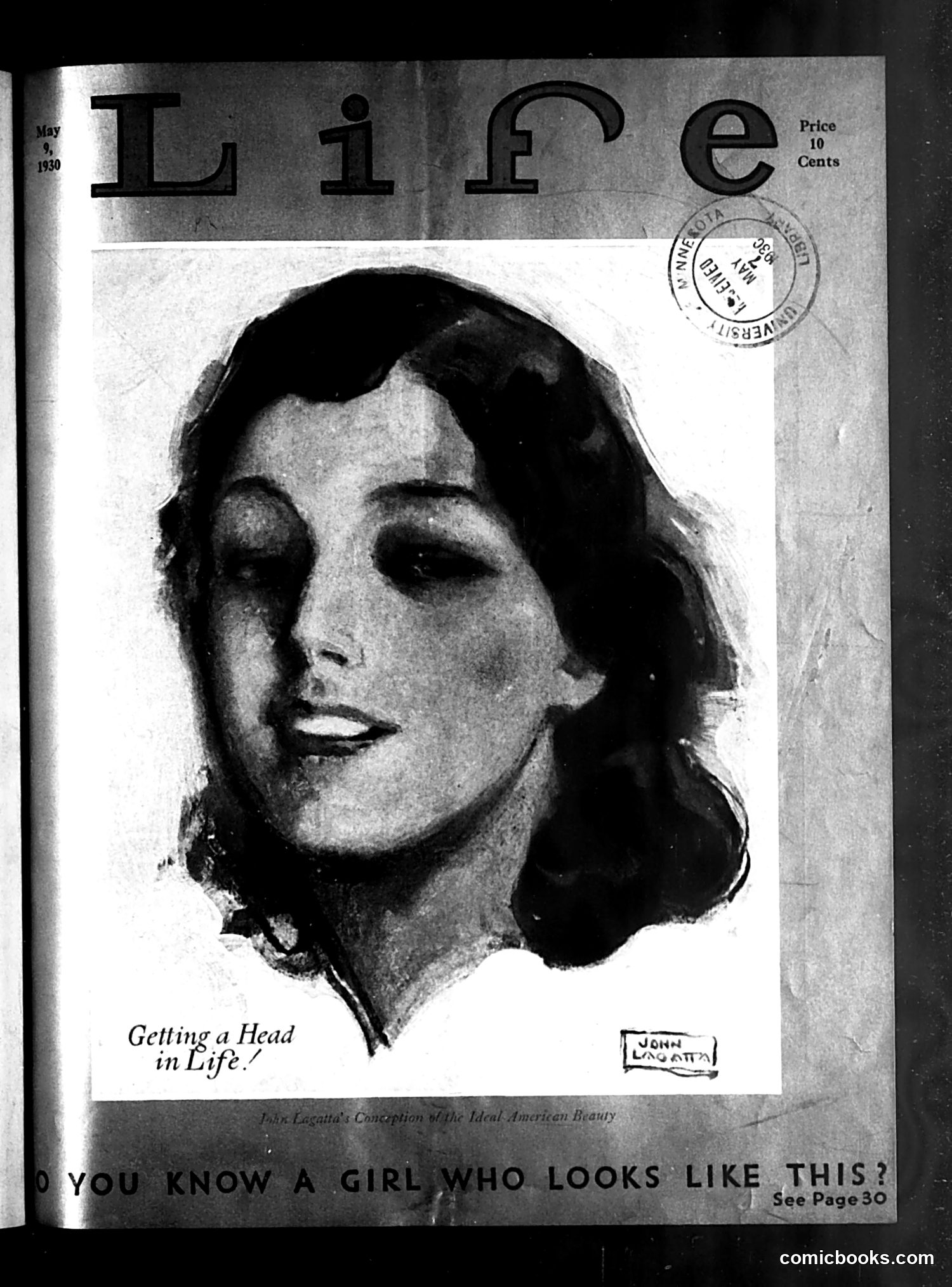
# Life Magazine Cover Analysis (May 9, 1930) This is a Life magazine cover featuring a portrait illustration credited to John Lagatta. The headline reads "Getting a Head in Life" with a caption below asking "DO YOU KNOW A GIRL WHO LOOKS LIKE THIS?" directing readers to page 80. The satire appears to target 1930s beauty standards and the concept of "getting ahead" through appearance. Lagatta's illustration represents the "ideal American Beauty" according to the caption, suggesting Life will discuss what constitutes fashionable femininity and social advancement for women of the era. The cover presents beauty ideals as a commodity and social currency—the joke being that women's "success" or progress depended significantly on conventional looks rather than ability or merit. This reflects the period's commercialization of female appearance.
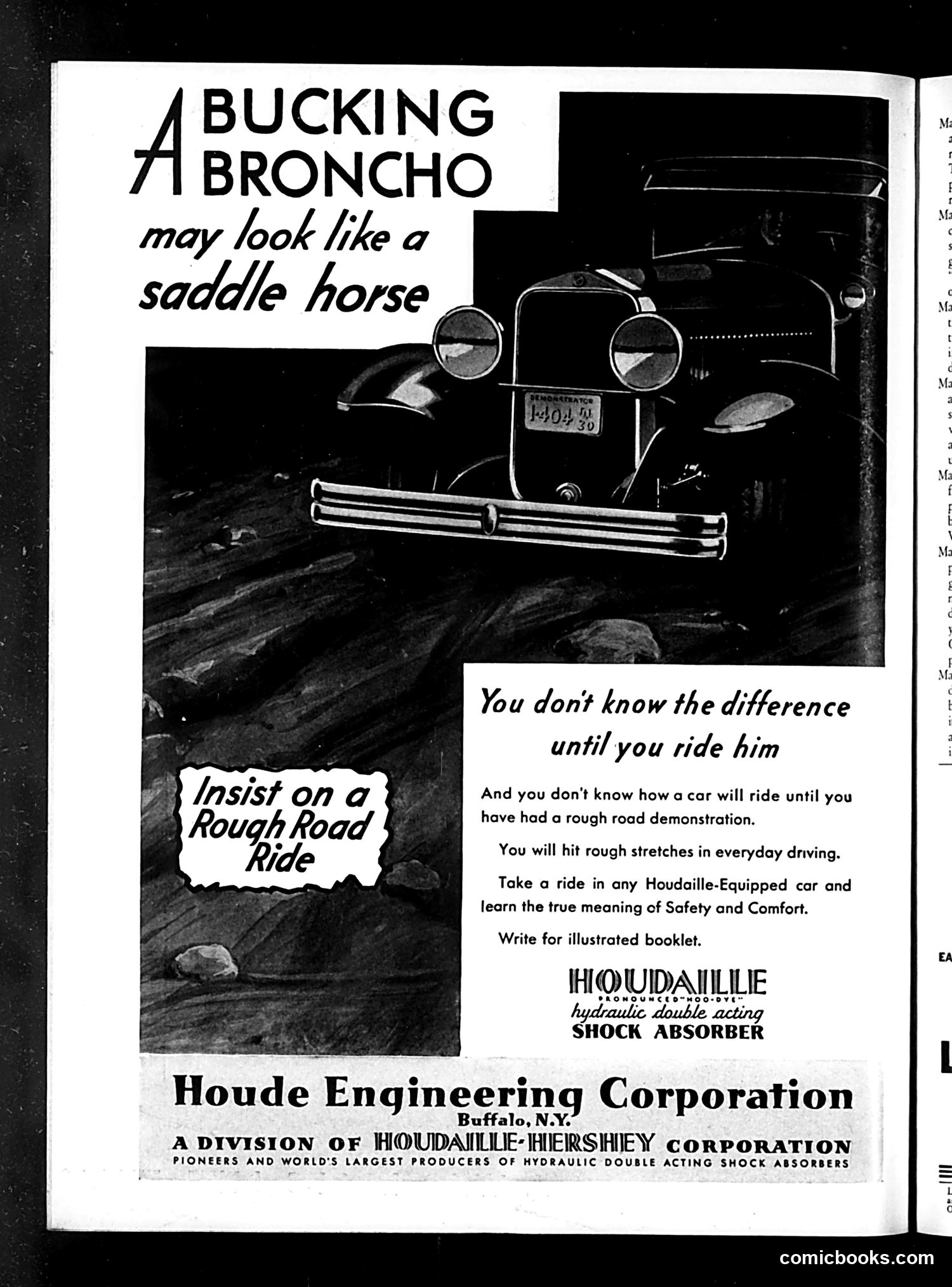
# Advertisement Analysis This is a **Houdaille shock absorber advertisement**, not satire or political commentary. The ad uses a humorous visual metaphor: a bucking bronco horse representing a car with poor suspension on rough roads. The joke is comparative—a vehicle without Houdaille shock absorbers will buck and jolt like a wild horse when hitting rough terrain. The ad encourages potential customers to request a "Rough Road Ride" demonstration to experience the difference between equipped and unequipped vehicles. The advertisement emphasizes safety and comfort as selling points, suggesting that proper shock absorption technology was a notable automotive feature worth demonstrating to skeptical buyers in this era.
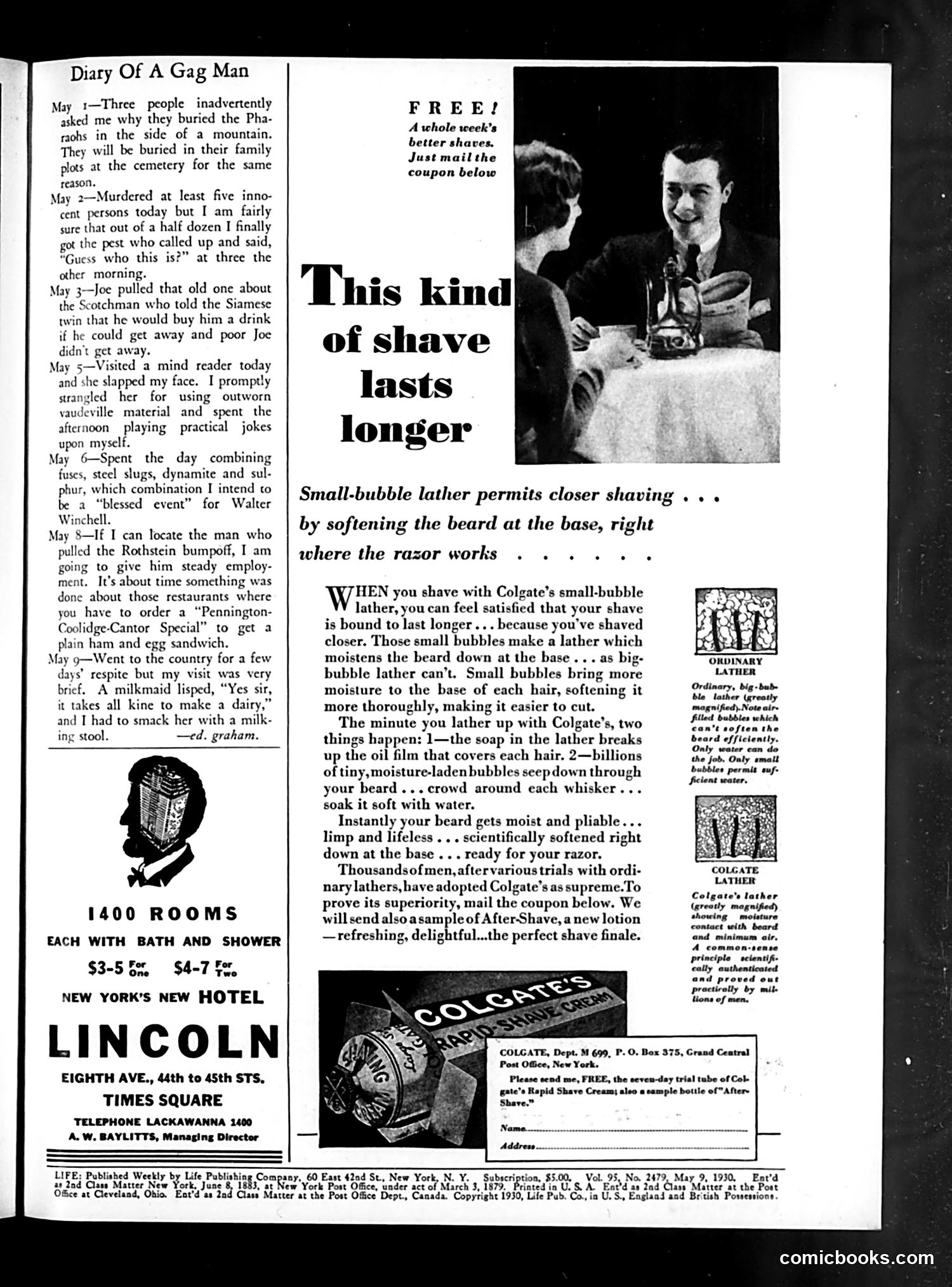
# "Diary of a Gag Man" - Historical Context This page is primarily a **Colgate shaving cream advertisement** disguised as editorial content. The "Diary" entries on the left are humorous fictional observations (murders, mind readers, etc.) — typical of Life magazine's satirical style in the 1920s-30s. The main advertisement promotes Colgate's "small-bubble lather" as superior because it softens beards at the base for closer shaving. The pitch emphasizes scientific superiority: small bubbles allegedly penetrate better than large ones. The "gag man" diary format was a common Life feature — showcasing witty one-liners. The page also advertises the Hotel Lincoln in Times Square, reflecting Life's New York-centric audience. This reflects an era when advertisements posed as entertainment rather than clearly labeled commercial content.
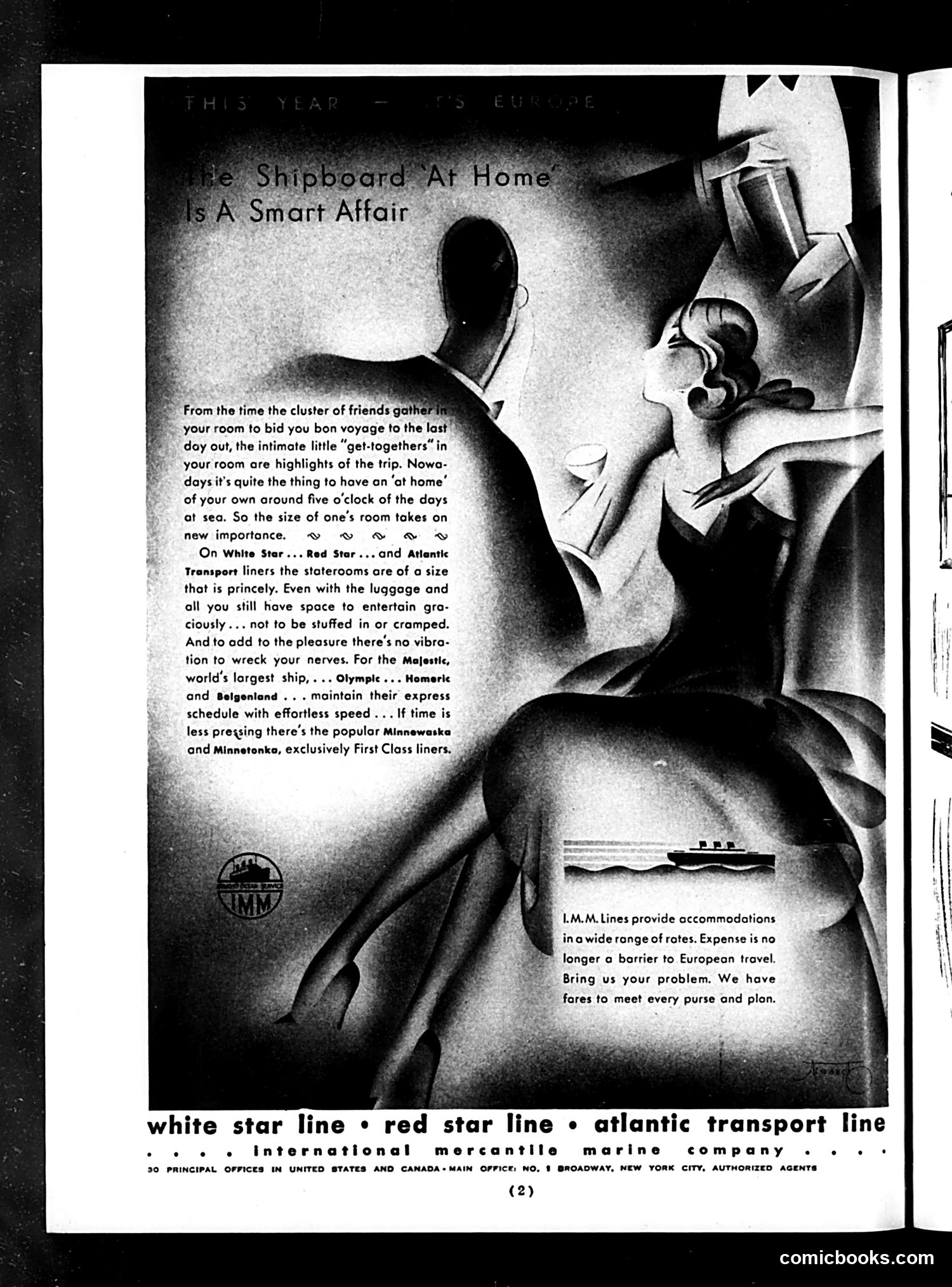
# Analysis This is an advertisement, not political satire. It promotes transatlantic ocean liner travel via White Star Line, Red Star Line, and Atlantic Transport Line (operated by International Mercantile Marine Company). The illustration depicts two stylized figures in 1920s-30s fashion examining what appears to be ship accommodations or travel materials. The ad's central argument is that shipboard staterooms have become spacious enough to host social gatherings—making ocean travel an appealing leisure experience rather than mere transportation. The text emphasizes that modern liners like the *Majestic*, *Olympic*, *Homeric*, *Minnewaska*, and *Minnetonka* offer comfortable, affordable accommodations across multiple price points, removing financial barriers to European travel. This reflects the interwar era's growing middle-class tourism market.
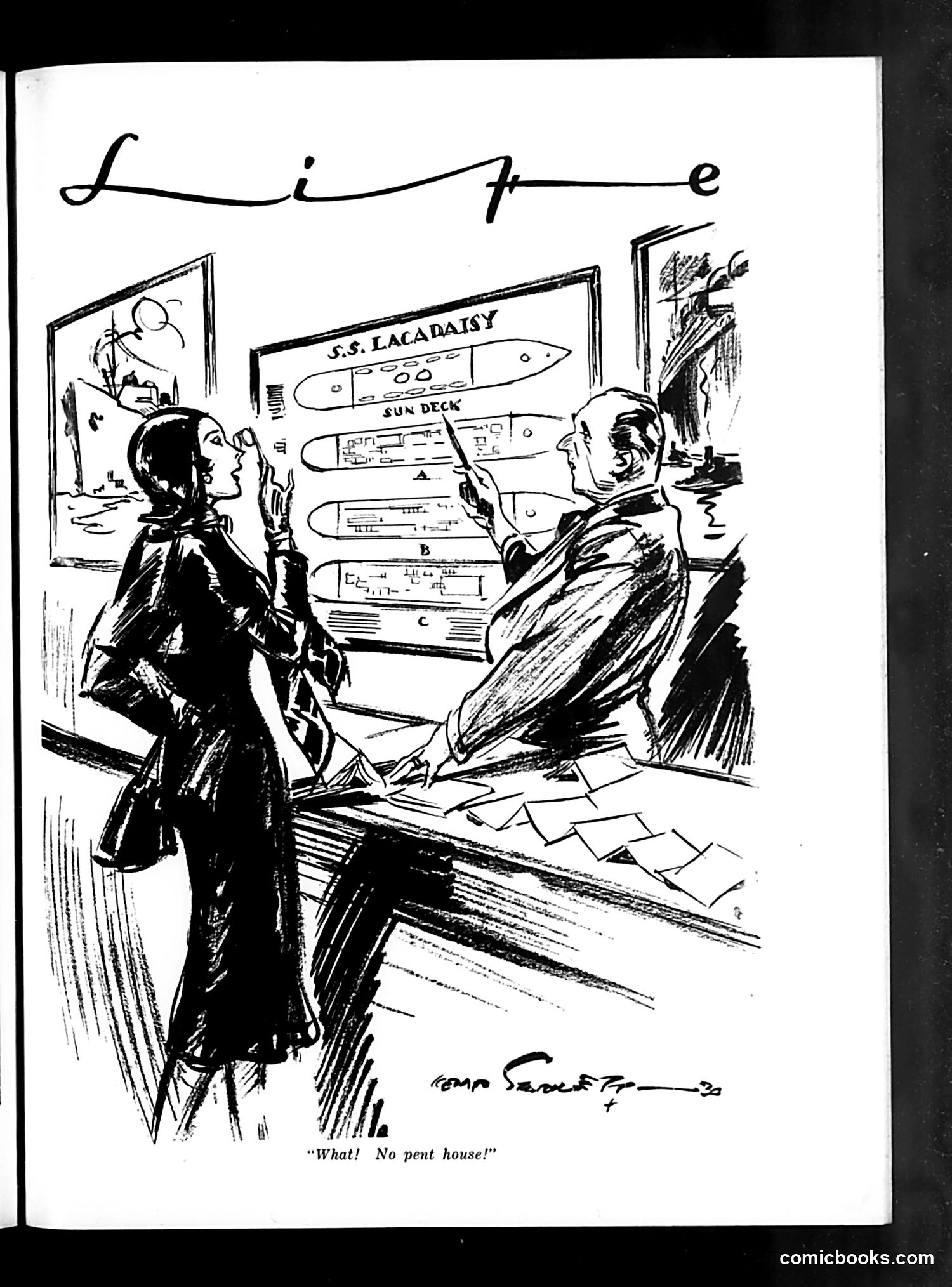
# Explanation for Modern Readers This cartoon titled "What! No pent house!" satirizes luxury apartment marketing in early 20th-century America. A well-dressed woman (likely a wealthy prospective tenant) examines a blueprint of the S.S. Lacadaisy, a ship repurposed as luxury housing. She expresses shock that this vessel lacks a "penthouse"—the fashionable rooftop apartments that were becoming status symbols among the wealthy. The satire mocks two things: the absurdity of marketing a *ship* as residential housing, and the era's obsession with penthouse apartments as status symbols. The joke suggests that even conversion of ocean liners into housing couldn't satisfy the wealthy's appetite for the latest architectural trends. The cartoon critiques both real estate marketing excess and consumer materialism of the period.
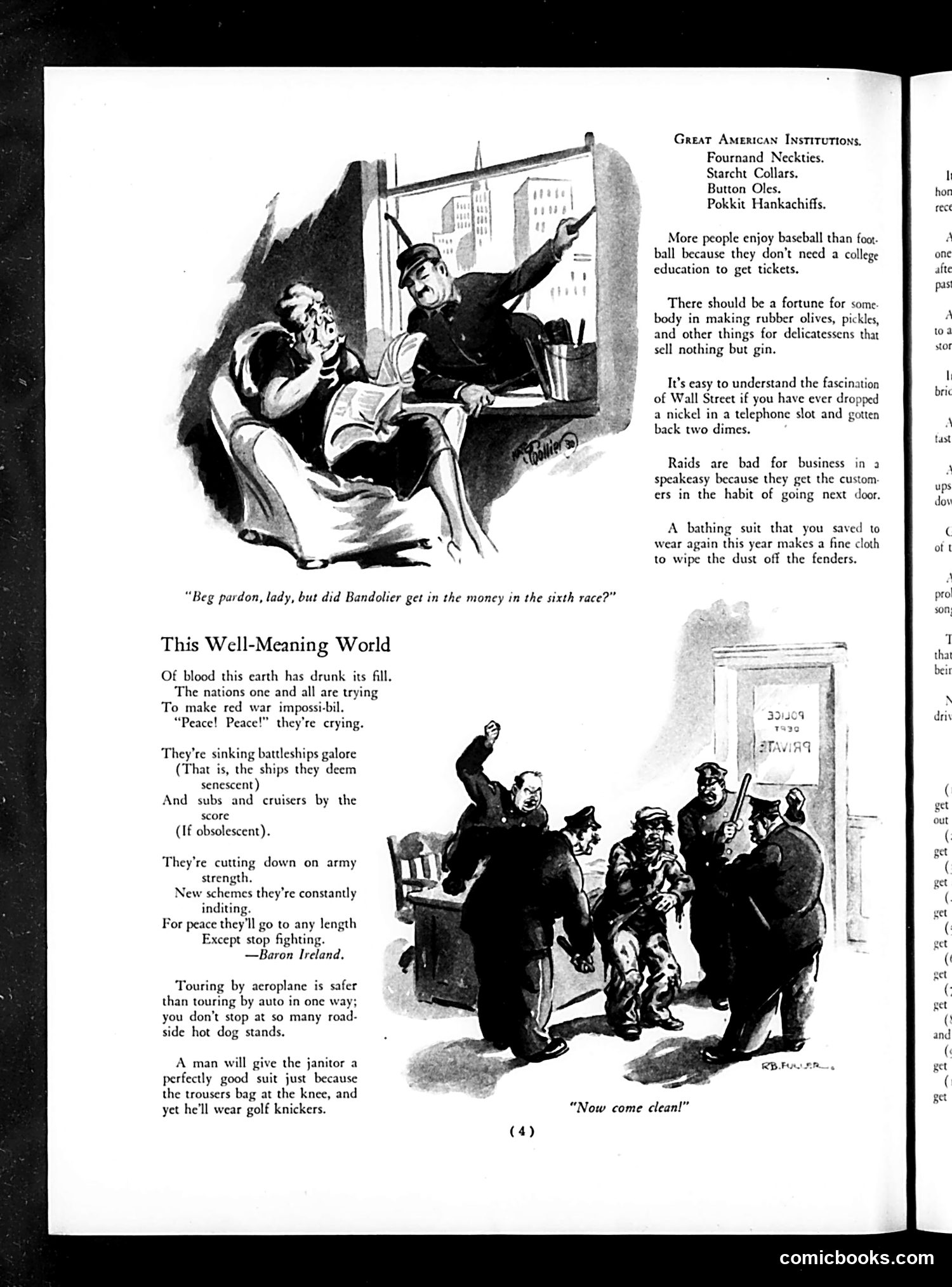
# Analysis of Life Magazine Page This page contains satirical commentary on 1920s American society and politics. The top cartoon depicts someone asking about "Bandolier" in a horse race—likely referencing gambling and Wall Street speculation, which the adjacent text mocks as a "fascination" comparable to inserting nickels into slots. The poem "This Well-Meaning World" by Baron Ireland critiques post-WWI peace efforts, sarcastically describing nations' failed attempts at peace while simultaneously building weapons and planning wars. The phrase "Except stop fighting" undercuts the entire premise of their peace rhetoric. The lower cartoon captioned "Now come clean!" appears to depict political or police figures confronting someone, likely satirizing corruption or investigative proceedings, though specific figures remain unclear without additional context.
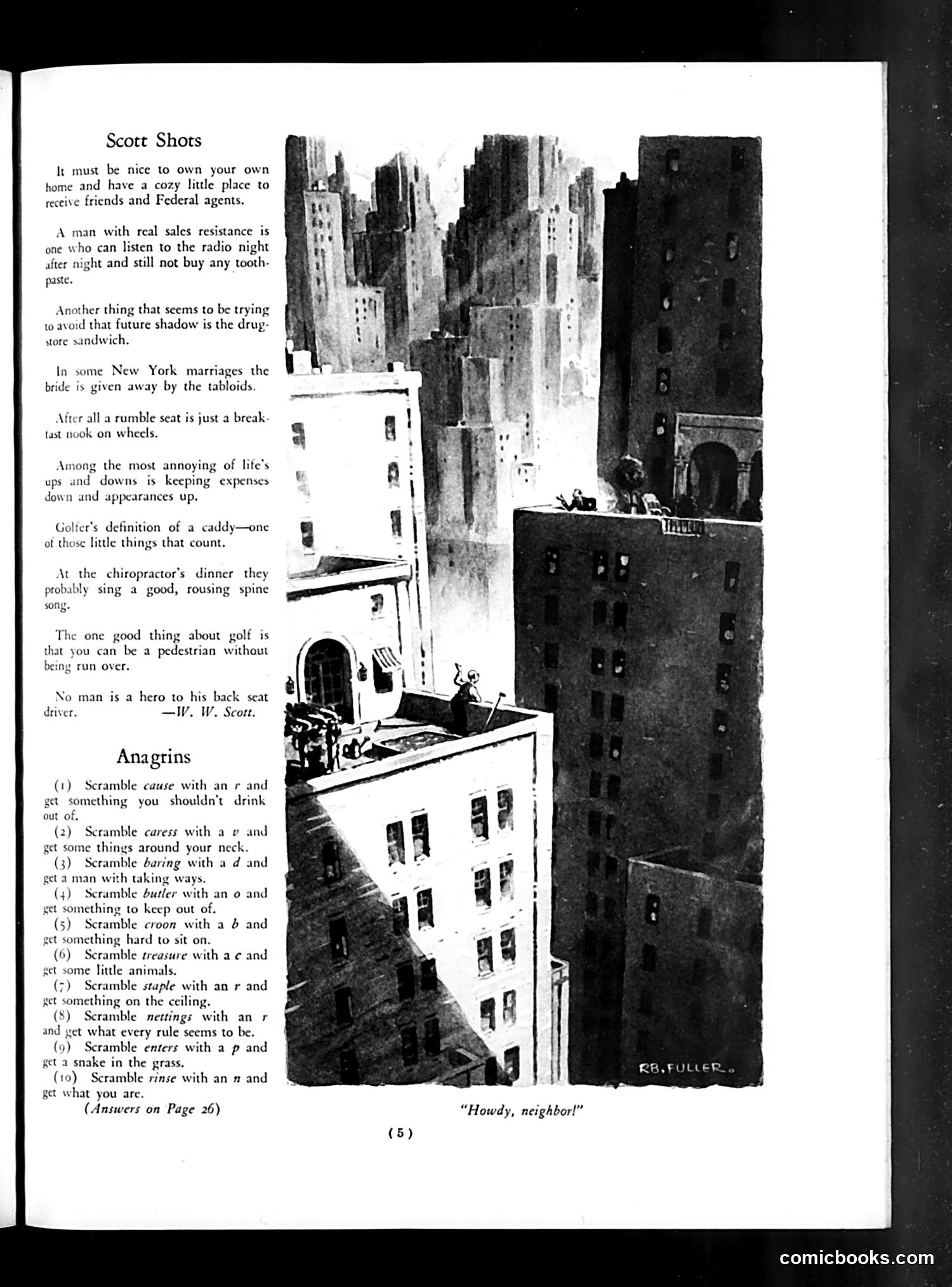
# "Howdy, neighbor!" - Urban Apartment Life Satire This page satirizes modern urban living, particularly apartment-dwelling in New York City. The large illustration shows a crowded residential building with inhabitants visible in windows and on fire escapes, depicting the close quarters and lack of privacy characteristic of city apartment living. The text section "Scott Shors" offers humorous observations about city life—owning a small home, avoiding door-to-door salesmen, drugstore sandwiches, and tabloid-given wedding gifts. The "Anagins" wordplay section plays on letter scrambles, a popular puzzle format of the era. The title "Howdy, neighbor!" is ironic: despite living in dense proximity to many people, urbanites remain isolated and anonymous. The cartoon critiques the impersonal nature of crowded metropolitan existence.
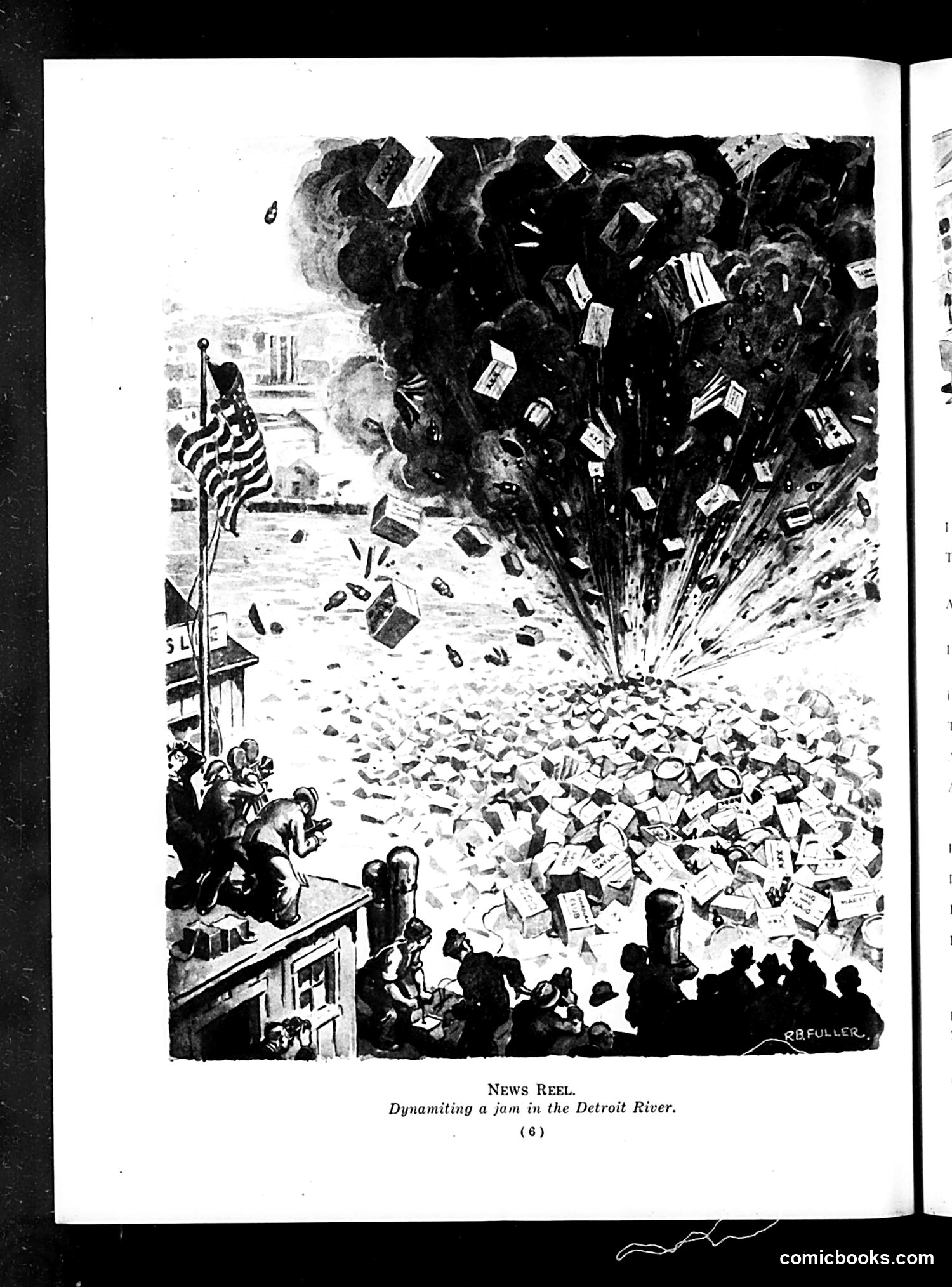
# "News Reel: Dynamiting a Jam in the Detroit River" This cartoon satirizes efforts to clear a log jam in the Detroit River using dynamite. The image shows an explosion detonating a massive pile of logs, with debris and wooden blocks scattered across the water. An American flag flies prominently on the left, and crowds of observers gather to watch the spectacle from shore-based structures. The satire appears to mock the dramatic, forceful approach to solving what may have been a recurring civic problem—treating infrastructure management as a spectacular public event. The artist (R.B. Fuller, signed lower right) uses the contrast between the American flag's patriotic symbolism and the chaotic destruction to suggest either the absurdity or the heavy-handed nature of the solution employed.
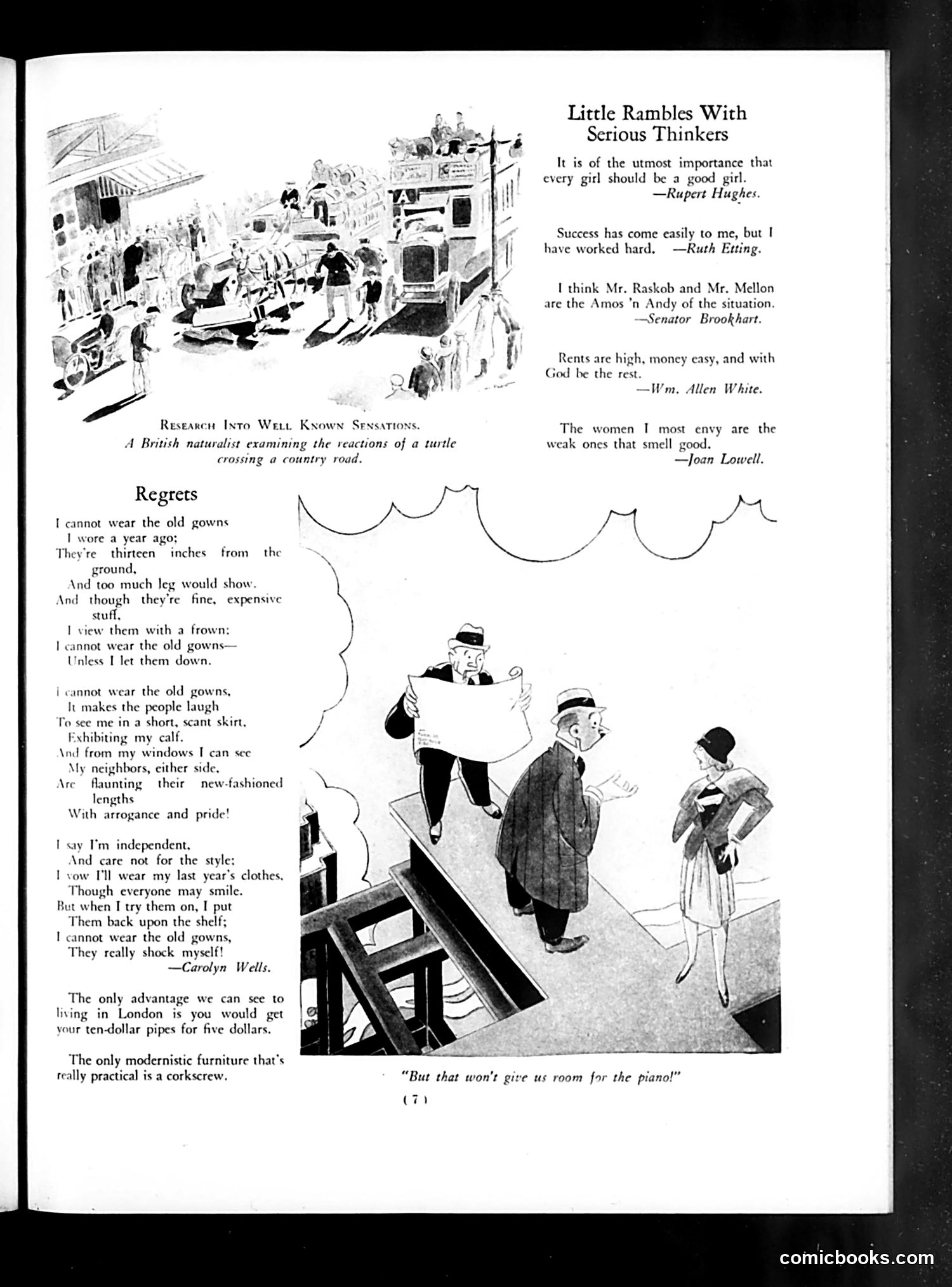
# Analysis This page from *Life* magazine contains two distinct sections: **Upper section ("Little Rambles With Serious Thinkers"):** A series of humorous quotes from public figures (Rupert Hughes, Ruth Etting, Senator Brookhart, William Allen White, and Joan Lowell) commenting on contemporary issues—fashion standards, financial conditions, and social envy. These appear to be satirical observations on 1920s concerns. **Lower section ("Regrets"):** A poem by Carolyn Wells lamenting fashion constraints, particularly women's inability to wear year-old gowns without social embarrassment due to changing hemlines and neighbor judgments. **The cartoon:** Three men discuss furniture placement in a tight apartment. One man holds what appears to be a piano diagram, while another says "But that won't give us room for the piano!"—satirizing the conflict between modern minimalist living spaces and maintaining traditional middle-class status symbols like pianos. The page satirizes 1920s anxieties about fashion, social standing, and changing living standards.
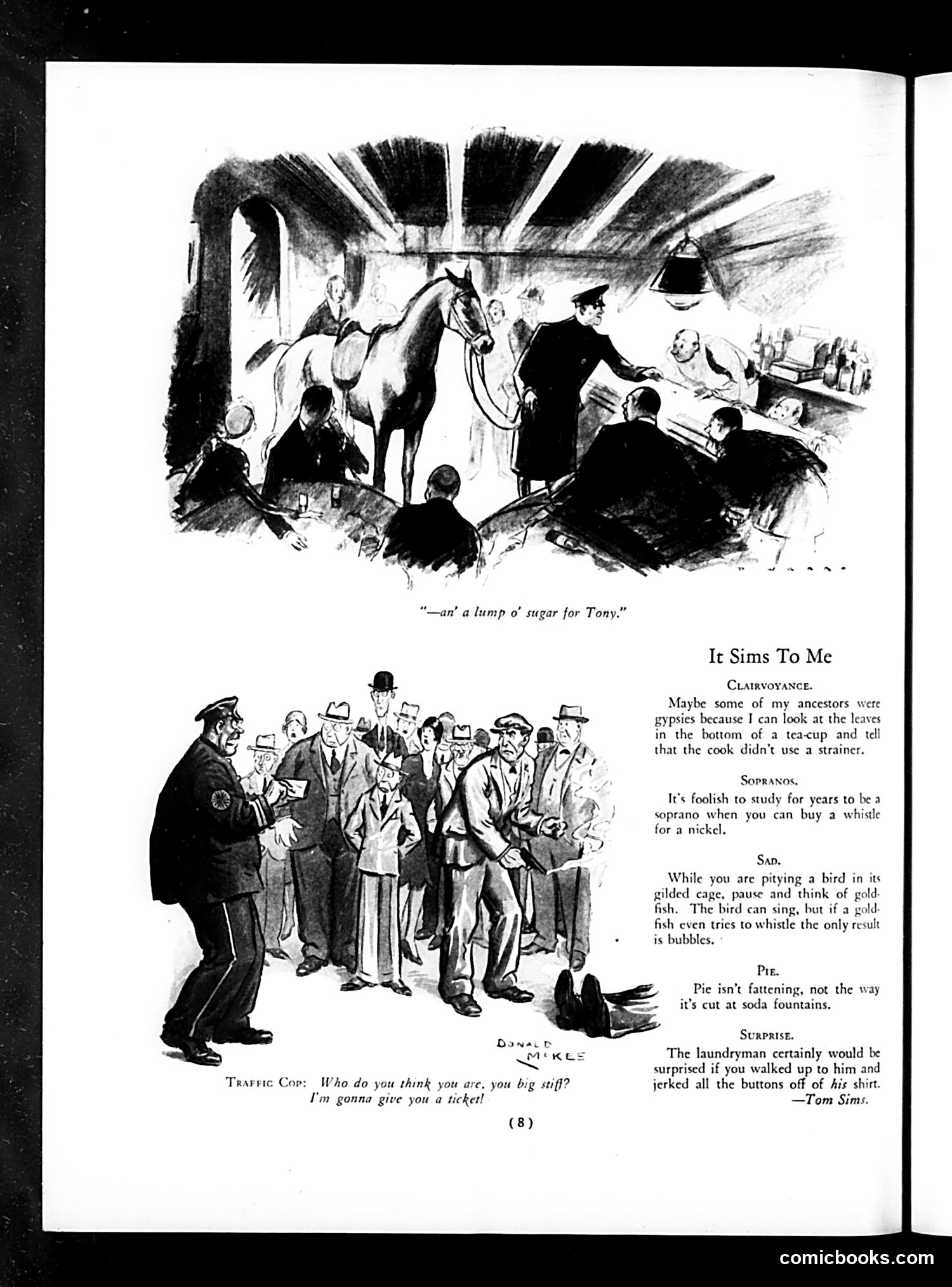
# Explanation for Modern Readers This page contains two satirical cartoons from *Life* magazine mocking superstition and pretension. **Top cartoon**: Shows a stable scene where someone offers "a lump o' sugar for Tony" (a horse). The joke satirizes people who anthropomorphize animals or engage in magical thinking. **Bottom cartoon**: A traffic cop confronts a well-dressed man, saying "Who do you think you are, you big stiff? I'm gonna give you a ticket!" The humor targets arrogant, entitled individuals who believe their status exempts them from rules. The accompanying column, "It Sims To Me," offers brief satirical observations mocking gullibility—studying to be a soprano, fortune-telling via teacups, and other foolish pursuits. The overall page ridicules human vanity, superstition, and disrespect for authority across social classes.
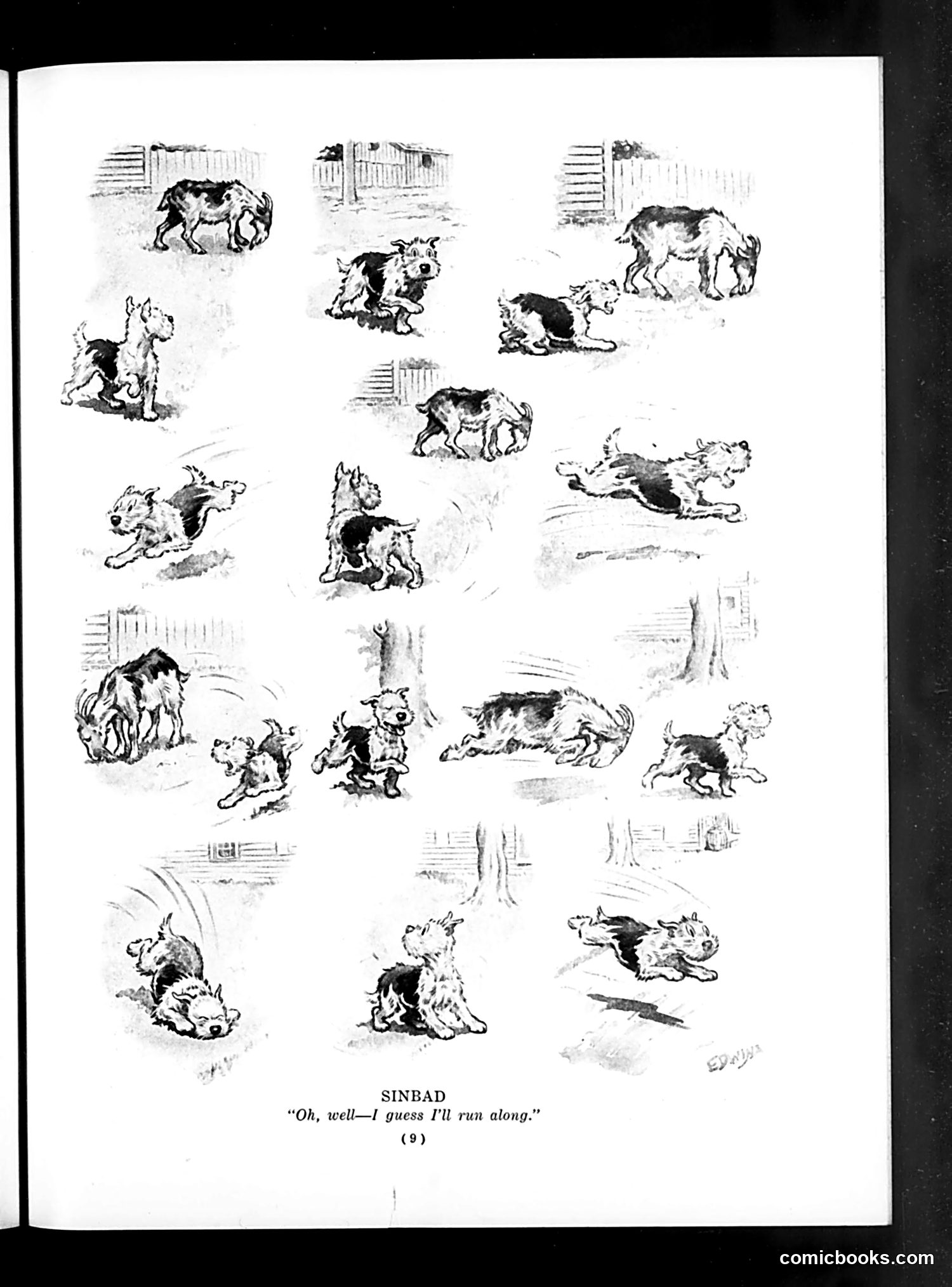
# Analysis This page features a series of sketches titled "Sinbad" with the caption "Oh, well—I guess I'll run along." The drawings appear to be humorous illustrations of dogs in various poses and situations—playing, running, resting, and interacting with their environments (fences, trees, and ground). Rather than political satire, this is a comic strip or illustration sequence depicting animal behavior. The repeated character (presumably "Sinbad," likely a dog) is shown in different activities and moods. The caption suggests the character's casual, wandering nature—fitting for a dog who moves from one activity to the next. This appears to be entertainment content rather than commentary on political or social issues, typical of Life magazine's mix of humor and satire.
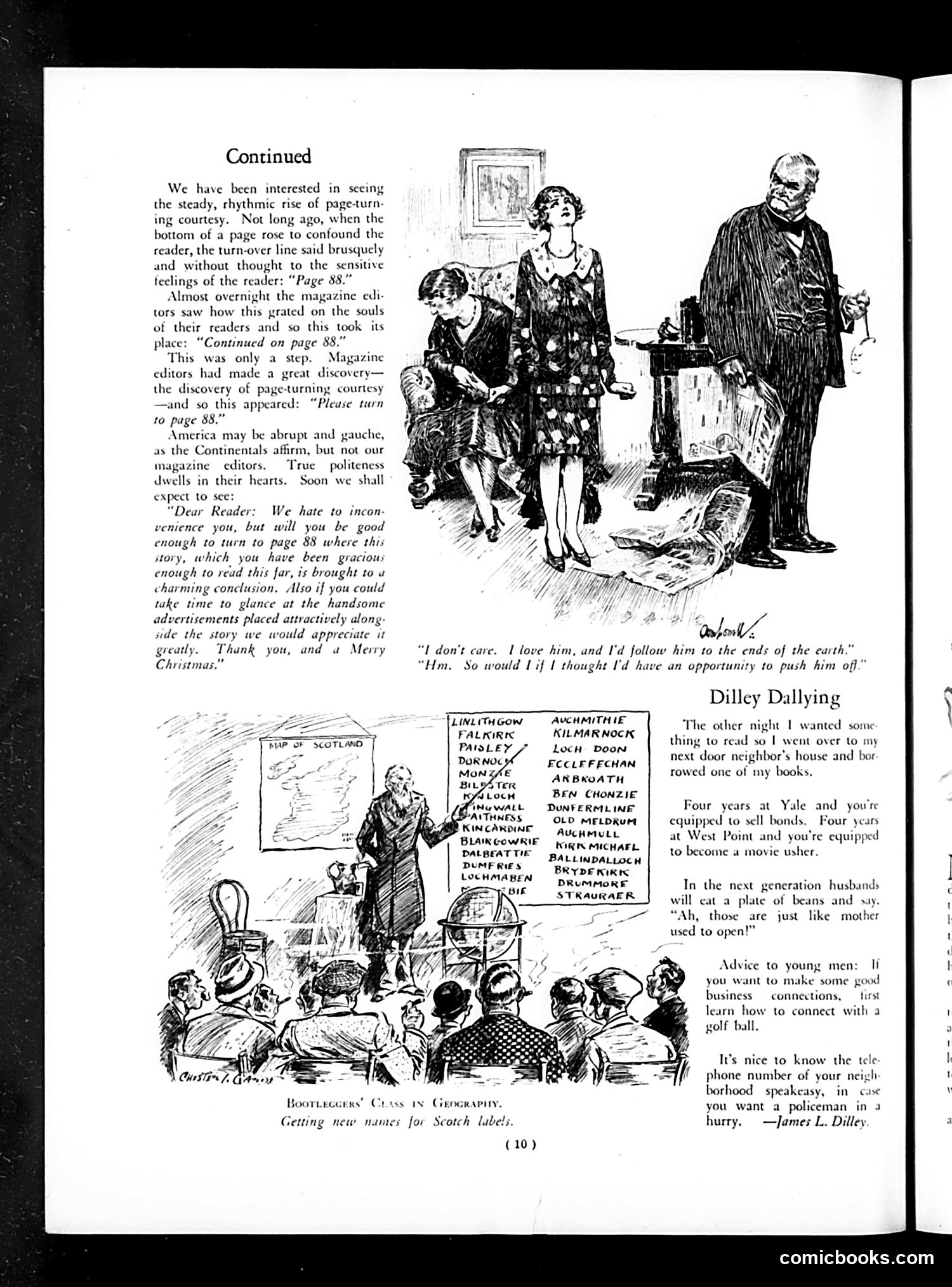
# Analysis of Life Magazine Page This page contains two distinct elements: **Upper cartoon**: Shows three figures in an interior domestic scene, with the caption about a woman's devotion to a man. The satire appears to mock romantic sentimentality and domestic relationships, though the specific reference is unclear without additional context. **Lower cartoon**: Titled "Bootleggers' Class in Geography: Getting new names for Scotch labels," depicts a man lecturing to an audience holding what appears to be a chart of Scottish place names (Linlithgow, Falkirk, Paisley, etc.). This is **Prohibition-era satire**: bootleggers (illegal alcohol producers/distributors) were learning Scottish geographic names to fraudulently label counterfeit or homemade whiskey as imported Scotch. The joke mocks both prohibition's failure and consumer deception during that period (1920-1933).