A complete issue · 36 pages · 1930
Life — March 28, 1930
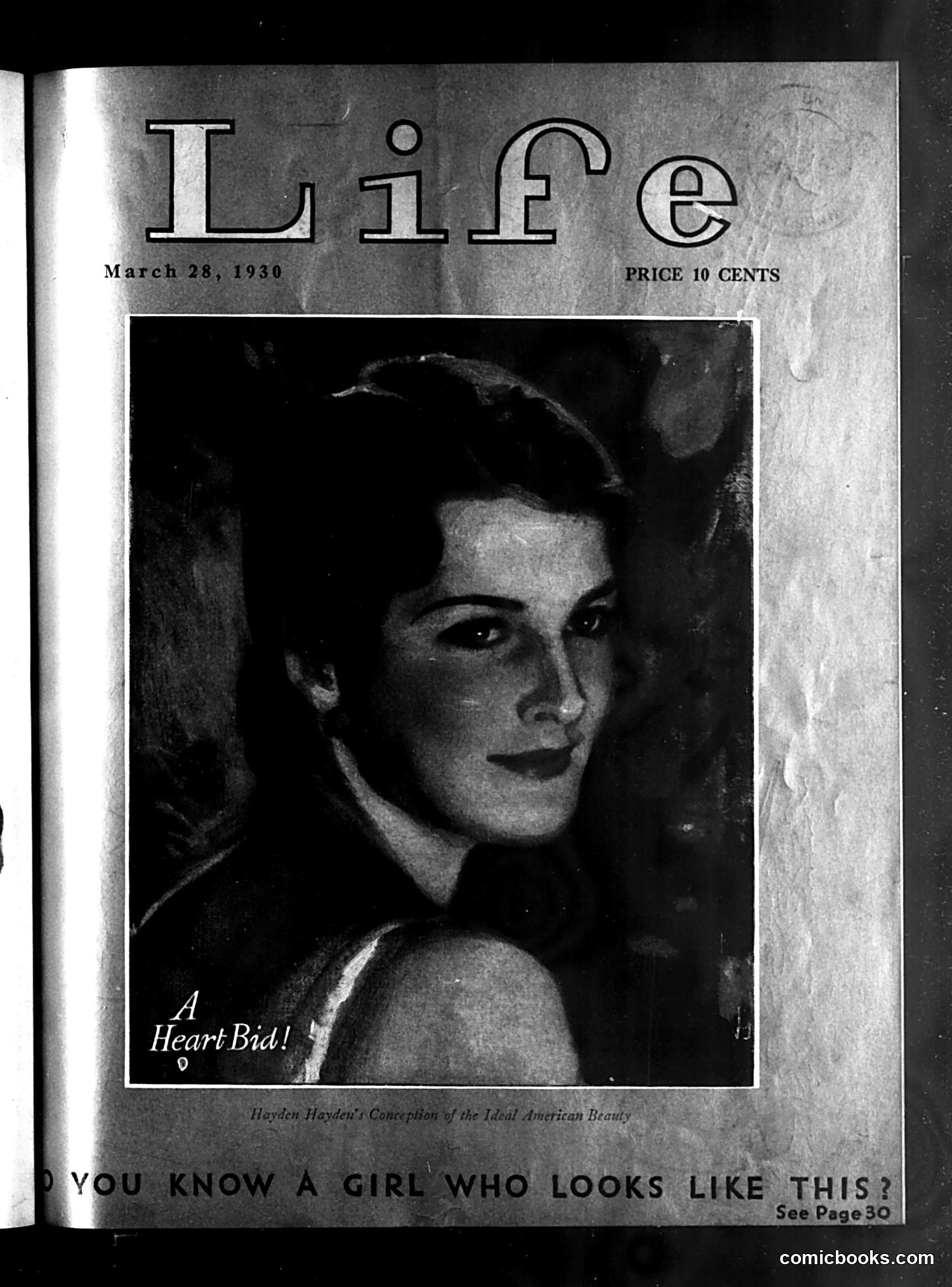
# Life Magazine Cover Analysis - March 28, 1930 This is a **magazine cover**, not a political cartoon. It features a portrait photograph labeled "A Heartbird" with the caption "Hayden Hayden's Conception of the Ideal American Beauty." The cover appears to be advertising content about beauty standards, asking readers "DO YOU KNOW A GIRL WHO LOOKS LIKE THIS?" with a reference to "See Page 30." This reflects 1930s popular culture's obsession with defining and promoting idealized feminine beauty. The term "Heartbird" (likely a playful neologism) and the formal presentation suggest the magazine is promoting specific aesthetic standards to its readers. The price of 10 cents indicates this is a vintage publication aimed at a general American audience interested in lifestyle and entertainment content.
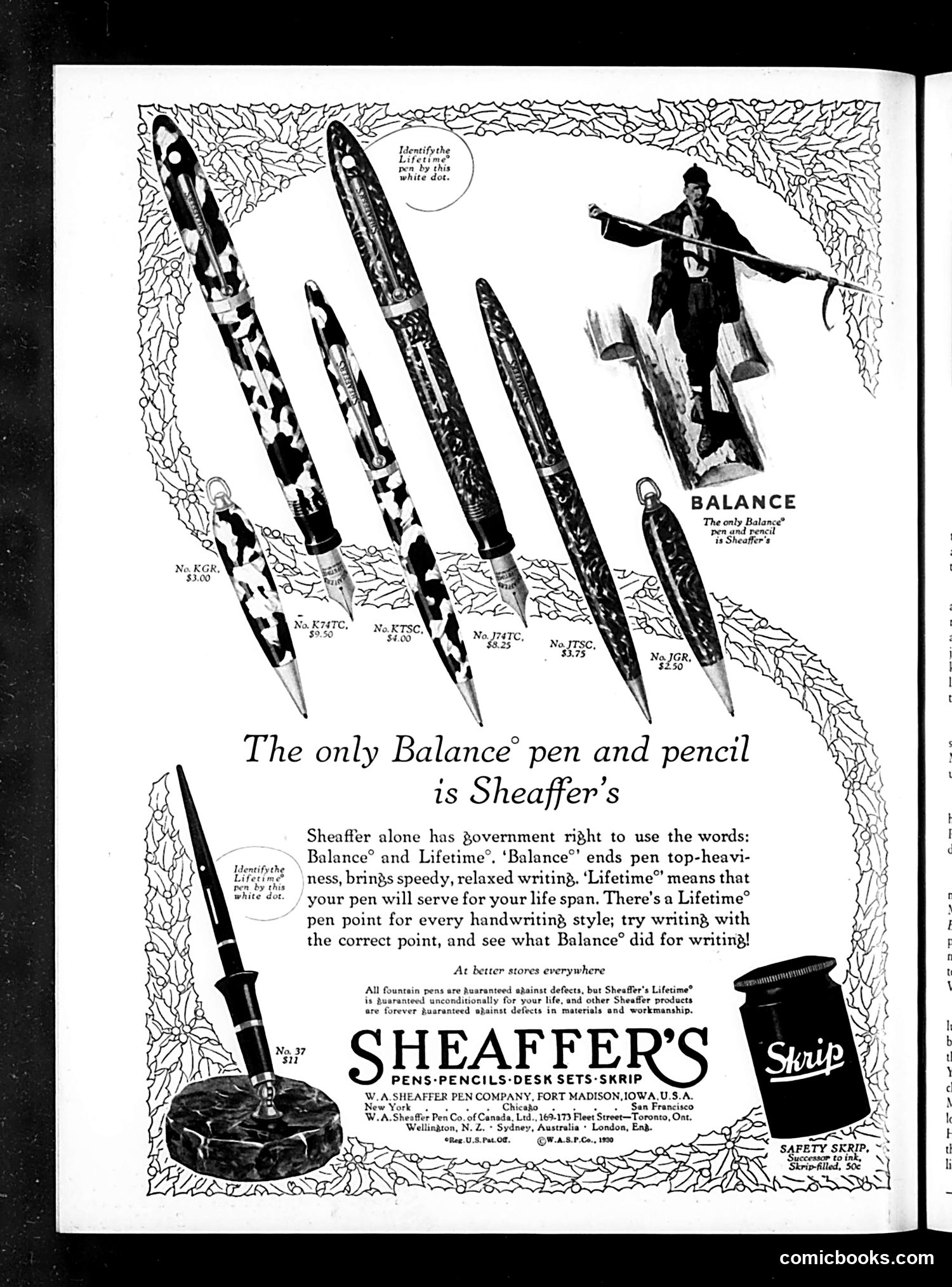
# Advertisement Analysis This is a **Sheaffer pen and pencil advertisement**, not political satire. The page promotes Sheaffer's "Balance" line of writing instruments through product display. The illustration shows a man balancing on skis while holding a rifle, demonstrating the concept of "balance" through physical equilibrium. Six different pen and pencil models are displayed below, each labeled with product numbers and prices (ranging from $2.50 to $4.00). The ad emphasizes Sheaffer's exclusive government rights to the "Balance" and "Lifetime" brand names, claiming superior quality and lifetime durability guarantees. The skiing imagery is purely metaphorical—suggesting that balanced, quality writing instruments help users navigate life smoothly, much as balance helps a skier move effectively. This is commercial advertising, not editorial content.
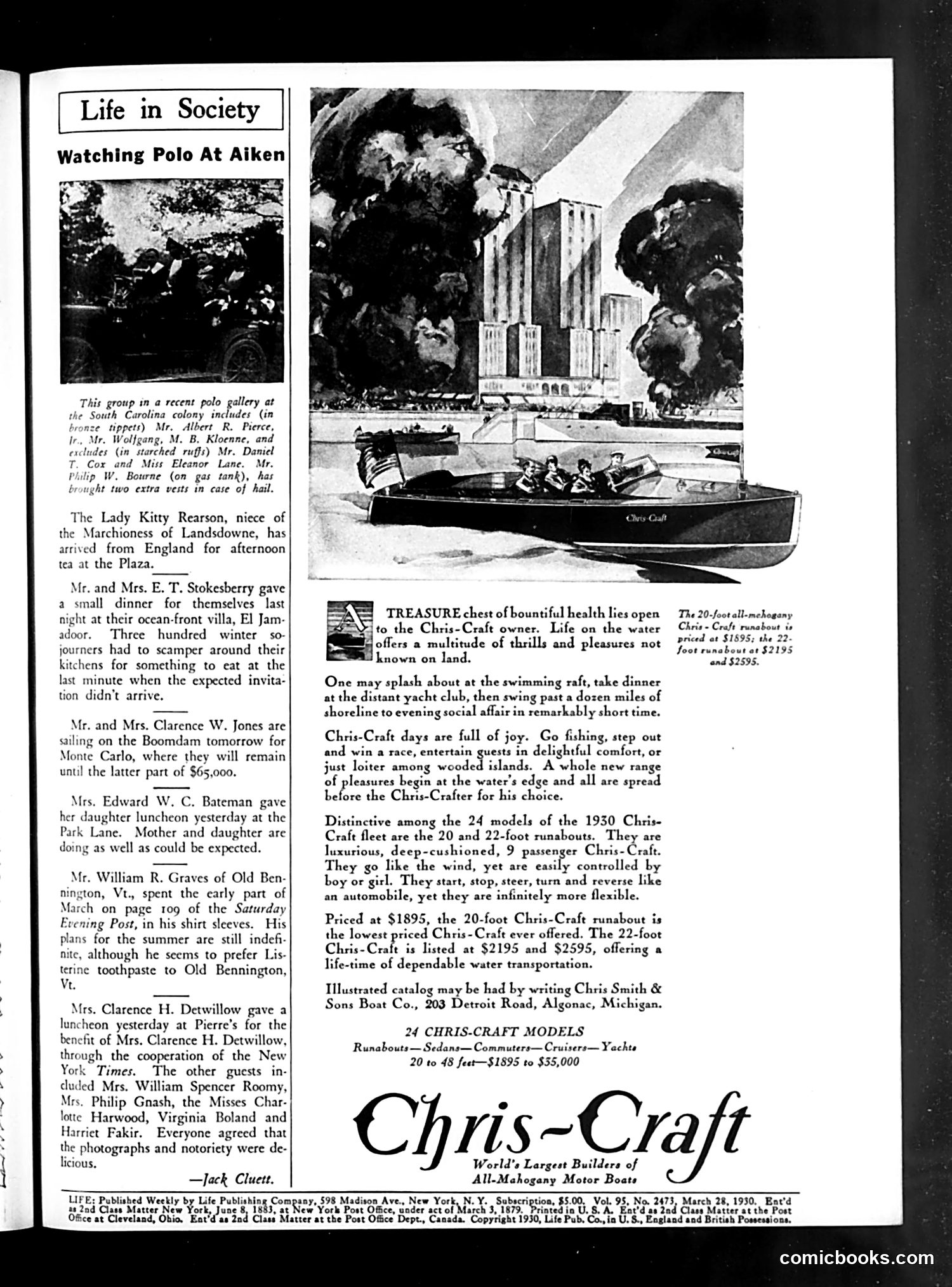
# Life Magazine Page Analysis This page is primarily **advertising and social reporting**, not satire or political commentary. The left column contains "Life in Society" gossip items about wealthy socialites attending polo matches, dinners, and yachting events in locations like Aiken, South Carolina, and Monte Carlo. These brief notices document leisure activities of the upper class. The right side is a **full-page advertisement for Chris-Craft boats**, emphasizing luxury recreation. The ad copy promotes the pleasure and prestige of owning one of their 24 motorboat models, priced from $1,895 to $35,000. The page reflects 1930s **upper-class leisure culture** during the Depression era—it's aspirational material for wealthy readers. There is no political cartoon or satirical commentary; it's straightforward lifestyle journalism and commercial advertising.
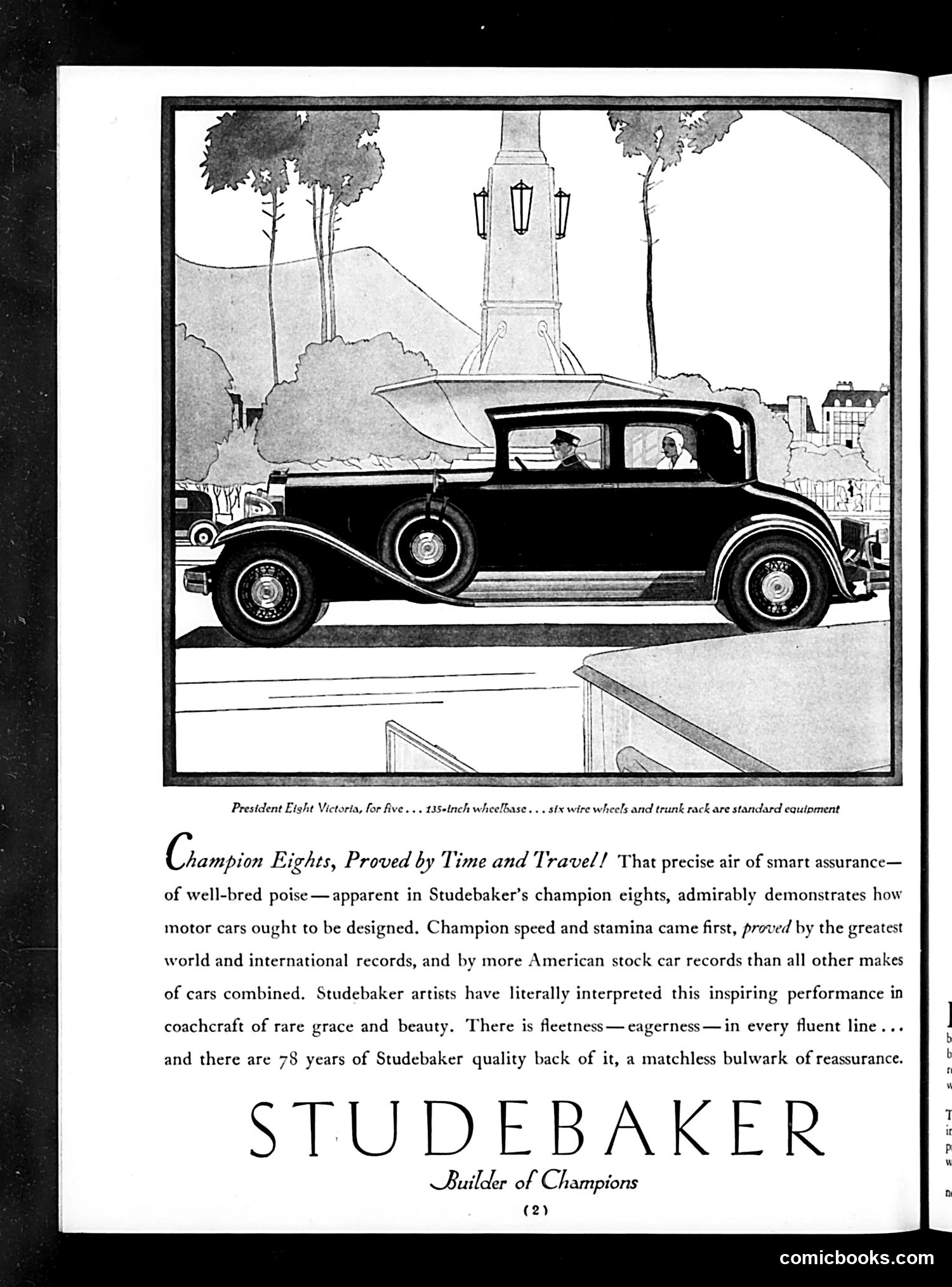
# Analysis This is **not a cartoon or satire**—it's a straightforward **advertisement** for Studebaker automobiles, specifically the "President Eight Victoria" model. The image shows a luxury car from approximately the 1920s-30s era parked in front of a civic monument (appears to be a memorial or civic building). Two well-dressed figures sit in the vehicle. The advertising copy emphasizes Studebaker's racing pedigree and engineering quality, claiming 78 years of manufacturing tradition. The tagline "Builder of Champions" references the company's competitive racing record and accumulated "world and international records." This is product advertising targeting affluent buyers, not political commentary or satire. It appears in *Life* magazine's advertising section, using prestige and performance credentials to sell automobiles to wealthy consumers.
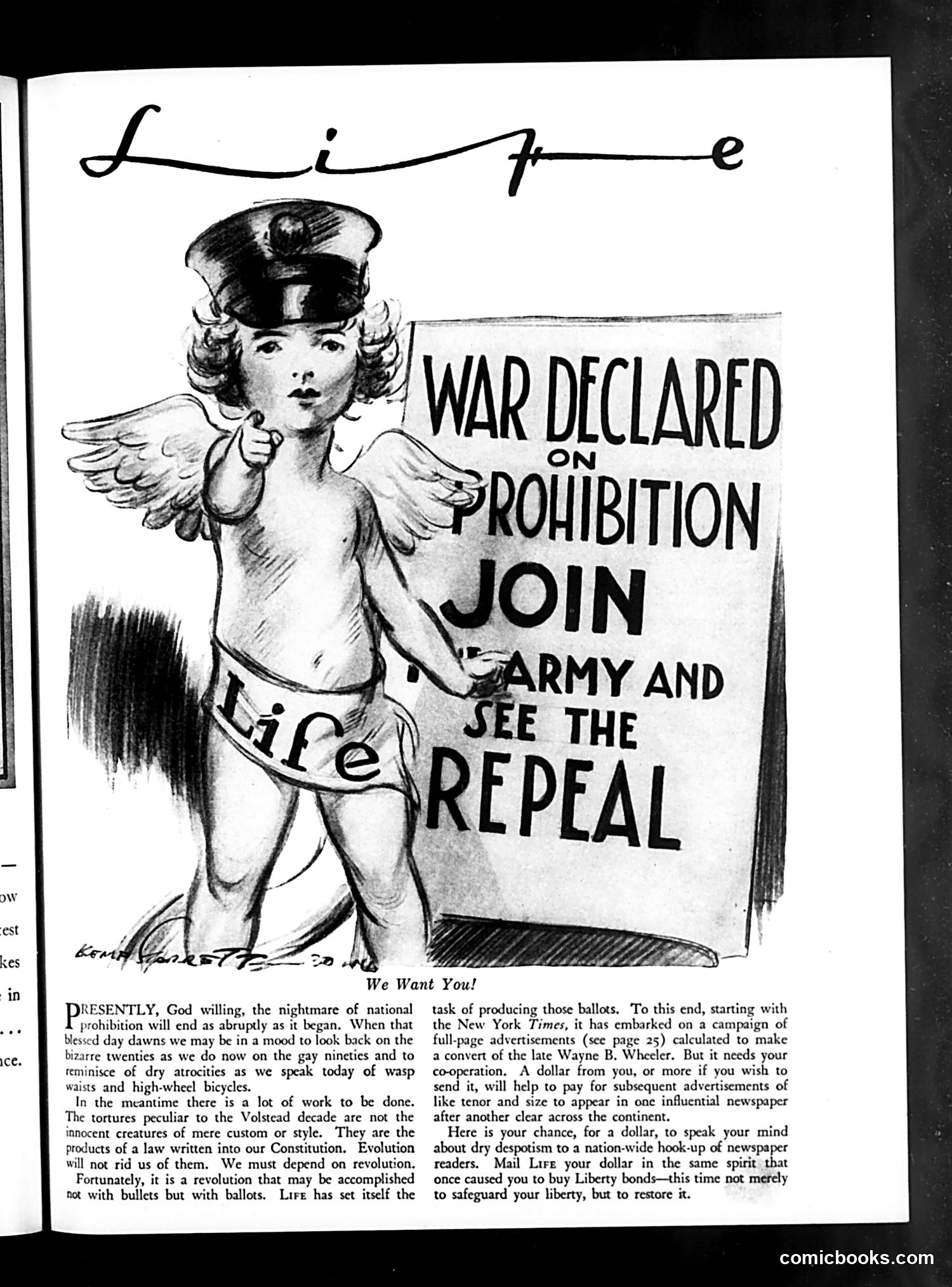
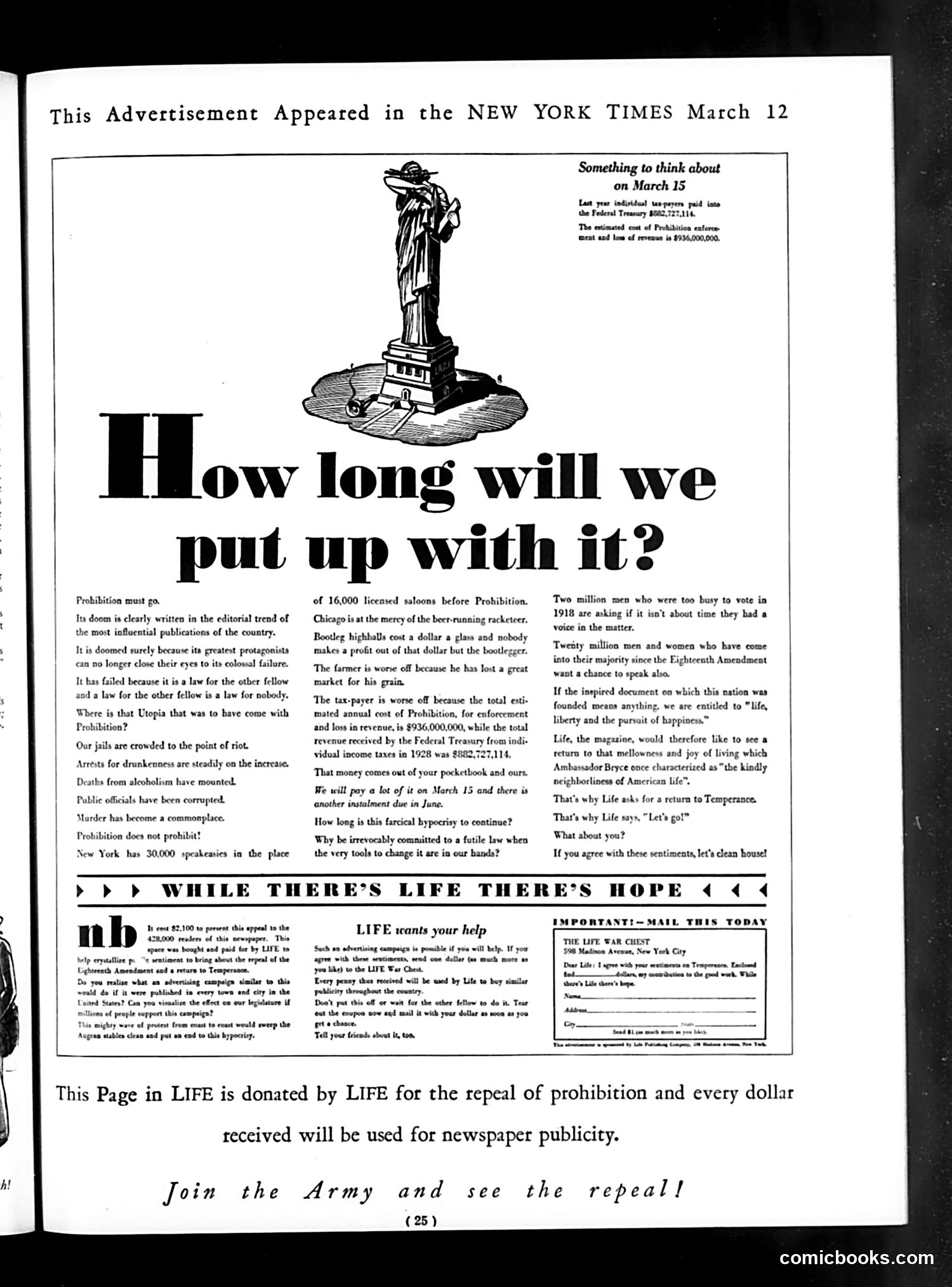
# Political Satire on Prohibition's Repeal This *Life* magazine page uses an allegorical figure—a winged cherub labeled "Life" wearing a military cap—to advocate for ending Prohibition (the constitutional ban on alcohol, 1920-1933). The satire personifies Prohibition as an enemy requiring military action. The text declares "war" on Prohibition itself, calling readers to "join army and see the repeal"—inverting typical military recruitment rhetoric to promote alcohol legalization. The accompanying article criticizes Prohibition's failures, calling it a "nightmare of national prohibition" that produced "dry aristocrats," "wasps," and "high-wheeled bicycles." The piece argues Prohibition has become unenforceable and proposes using newspaper advertising campaigns to mobilize public opinion for repeal—essentially weaponizing media against the law itself.
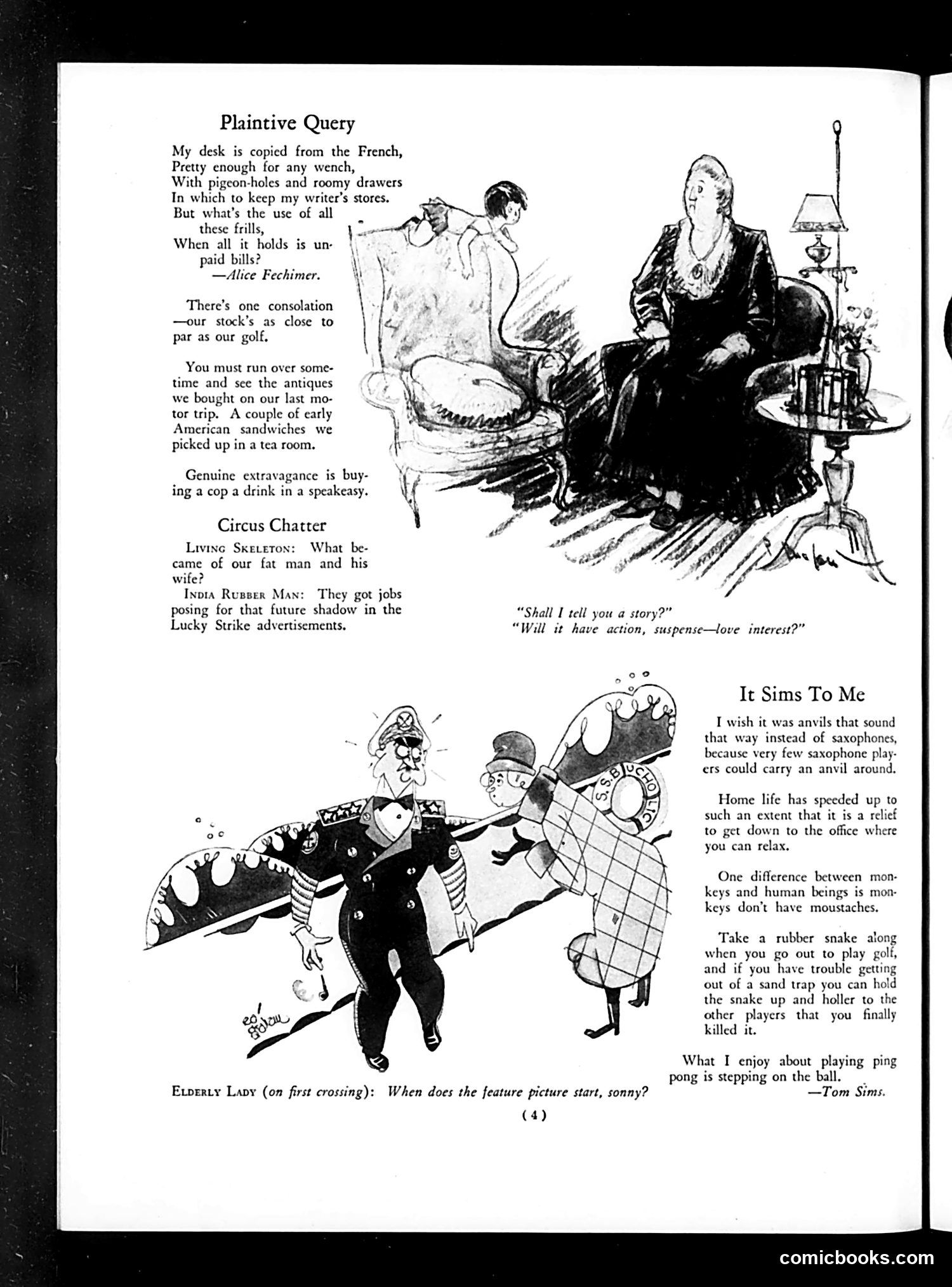
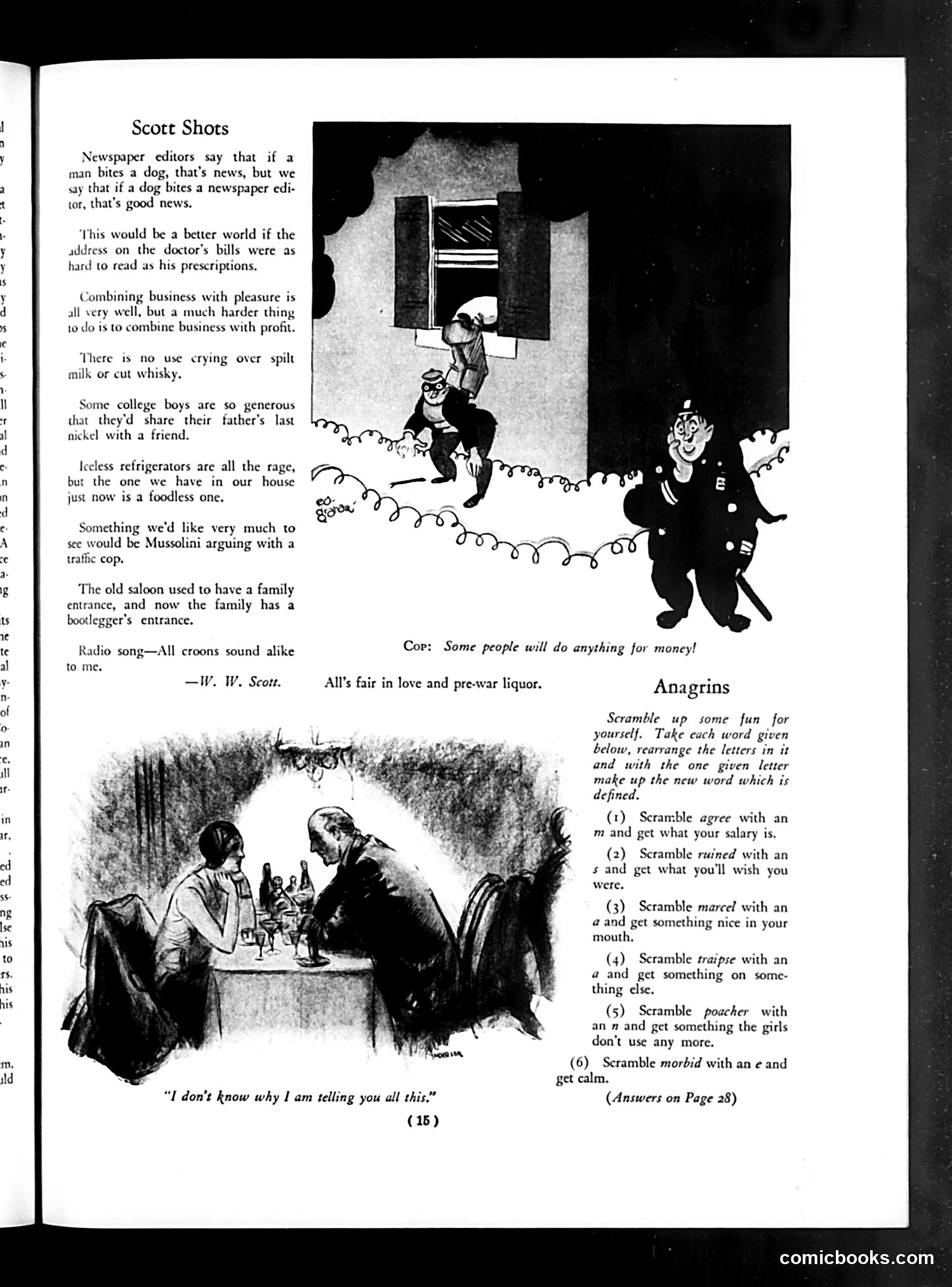
# Analysis of Life Magazine Page This page contains three separate humorous pieces typical of early 20th-century Life magazine: 1. **"Plaintive Query"** (top): A poem by Alice Fchimer about a French-style desk cluttered with unpaid bills—satirizing the impracticality of decorative furniture over function. 2. **"Circus Chatter"** (middle): A brief joke about a fat man and his wife getting jobs posing for "Lucky Strike" cigarette advertisements, mocking advertising's use of ordinary people. 3. **"It Sims To Me"** (right): Tom Sims's humorous column complaining about modern life's pace, saxophones, and the superiority of office relaxation over home chaos—typical domestic humor of the era. The cartoons illustrate these pieces with ink sketches. The overall tone mocks consumer culture, advertising, and modern domestic life in gentle, satirical fashion.
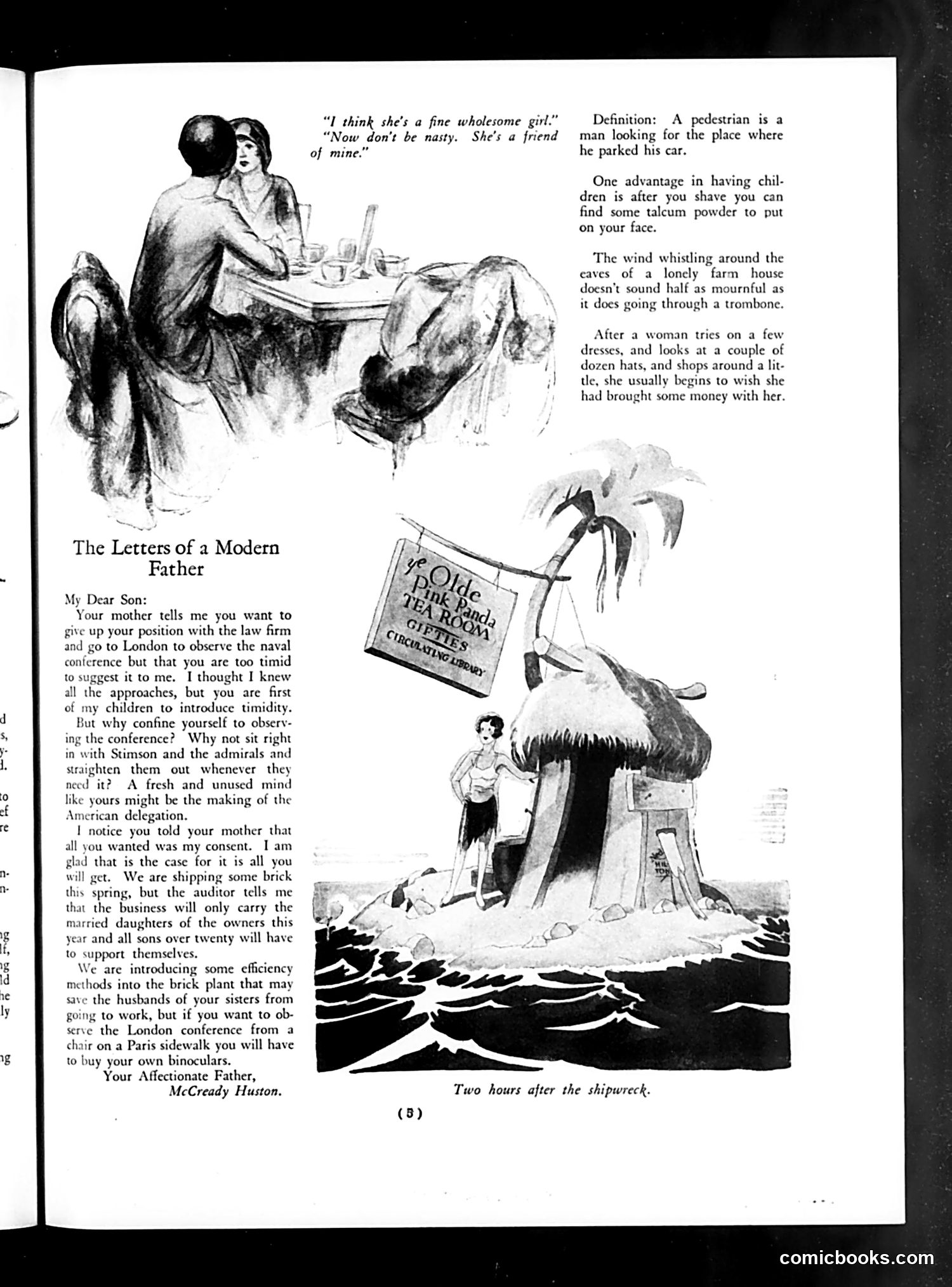
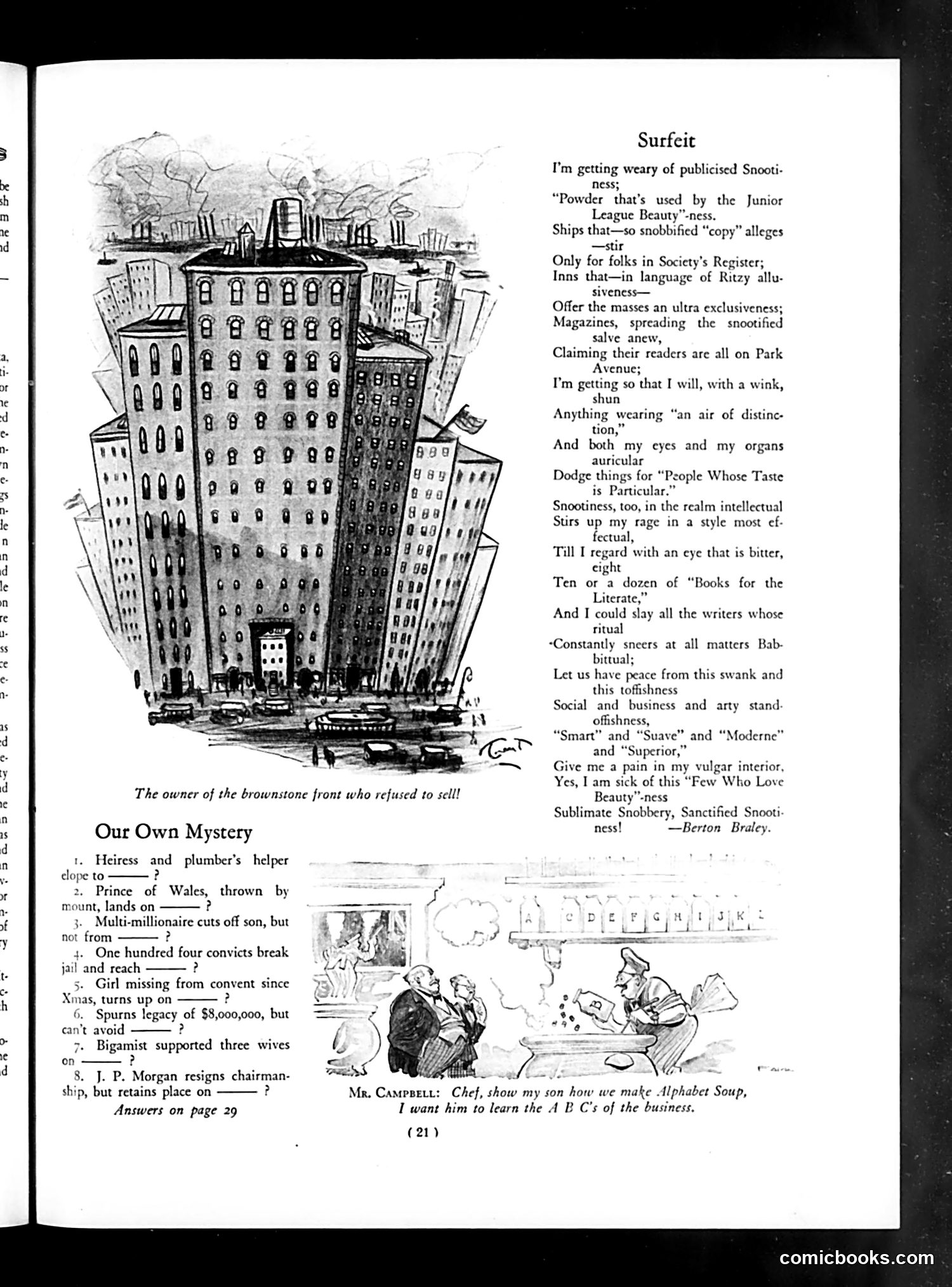
# Explanation for Modern Readers This page combines humorous observations with a satirical letter. The top section offers witty definitions and social commentary—including a joke about a "pedestrian" as someone searching for where they parked their car, reflecting early automotive culture anxieties. "The Letters of a Modern Father" presents a father (McCready Huxton) advising his timid son to attend a naval conference in London rather than staying safe at home. The father encourages boldness and suggests his son observe important proceedings firsthand. The satire mocks both paternal pressure to succeed and the era's emphasis on masculine assertiveness. The illustration "Two hours after the shipwreck" shows a man clinging to a sinking structure labeled with a book or pamphlet title, likely satirizing impractical advice or false confidence in crisis situations—contrasting the father's bold recommendations with actual consequences.
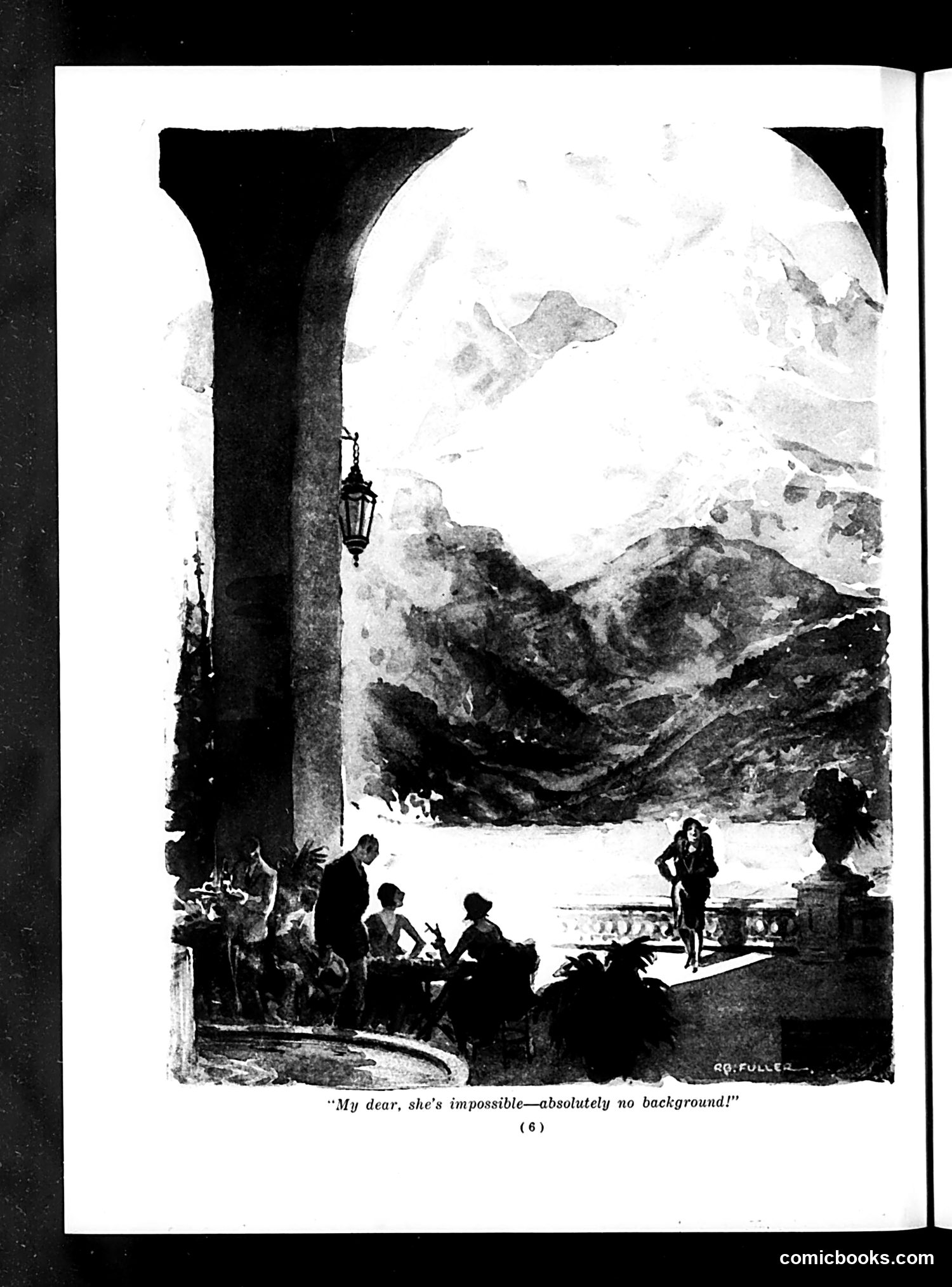
# Analysis of Life Magazine Cartoon This cartoon depicts a social scene set in a mountainous resort or villa. A man gestures dismissively toward a woman, declaring "My dear, she's impossible—absolutely no background!" The satire targets early 20th-century upper-class social snobbery and the rigid class hierarchies of the era. The joke centers on the phrase "no background"—a euphemism wealthy society used to exclude people lacking aristocratic or wealthy family lineage. The woman's apparent lack of "proper" social pedigree makes her unacceptable to the elite circles, regardless of her other qualities. The mountainous backdrop and formal setting emphasize the exclusive social spaces where such gatekeeping occurred, mocking the pretentiousness of those who enforced these artificial class boundaries.
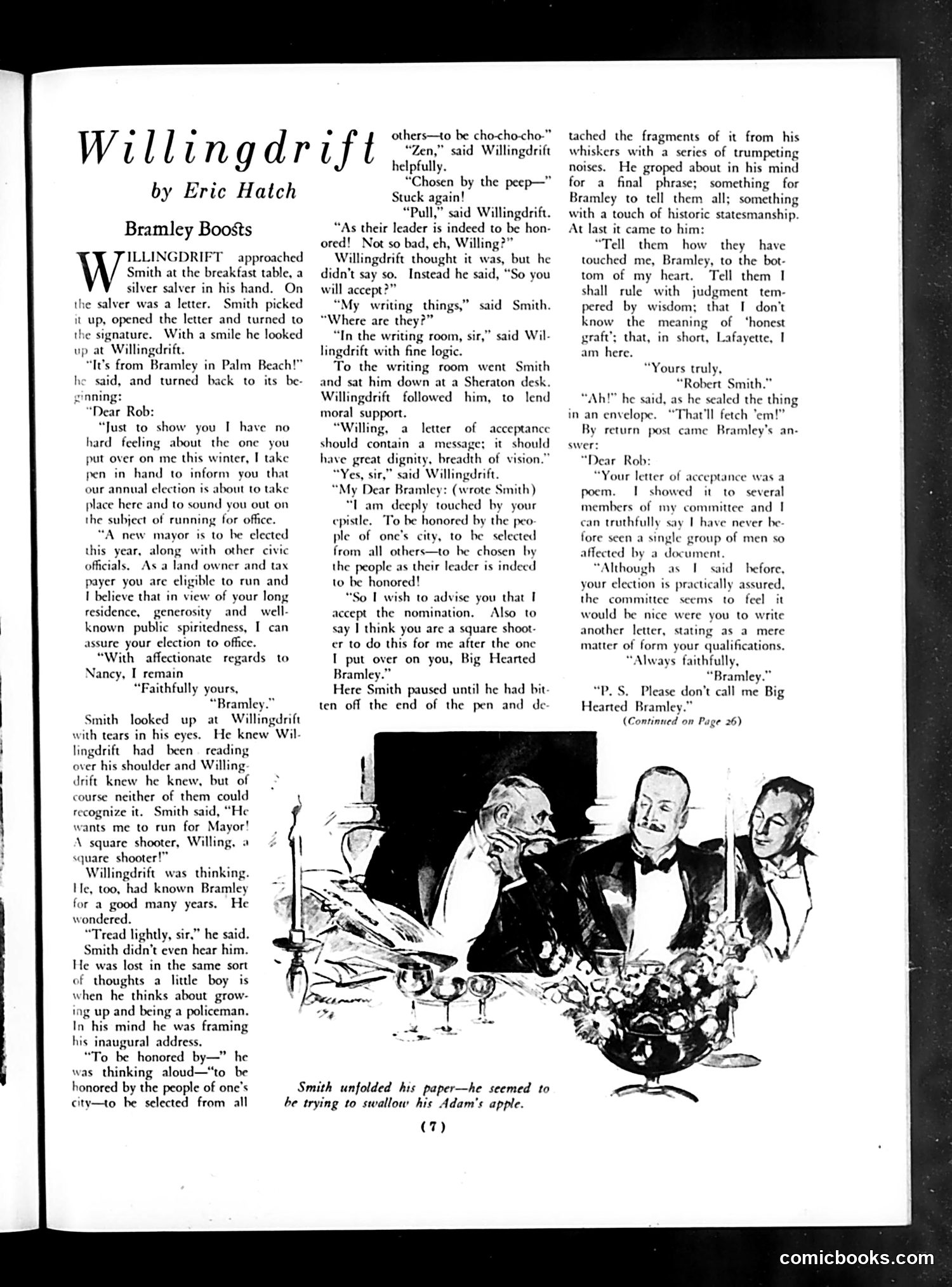
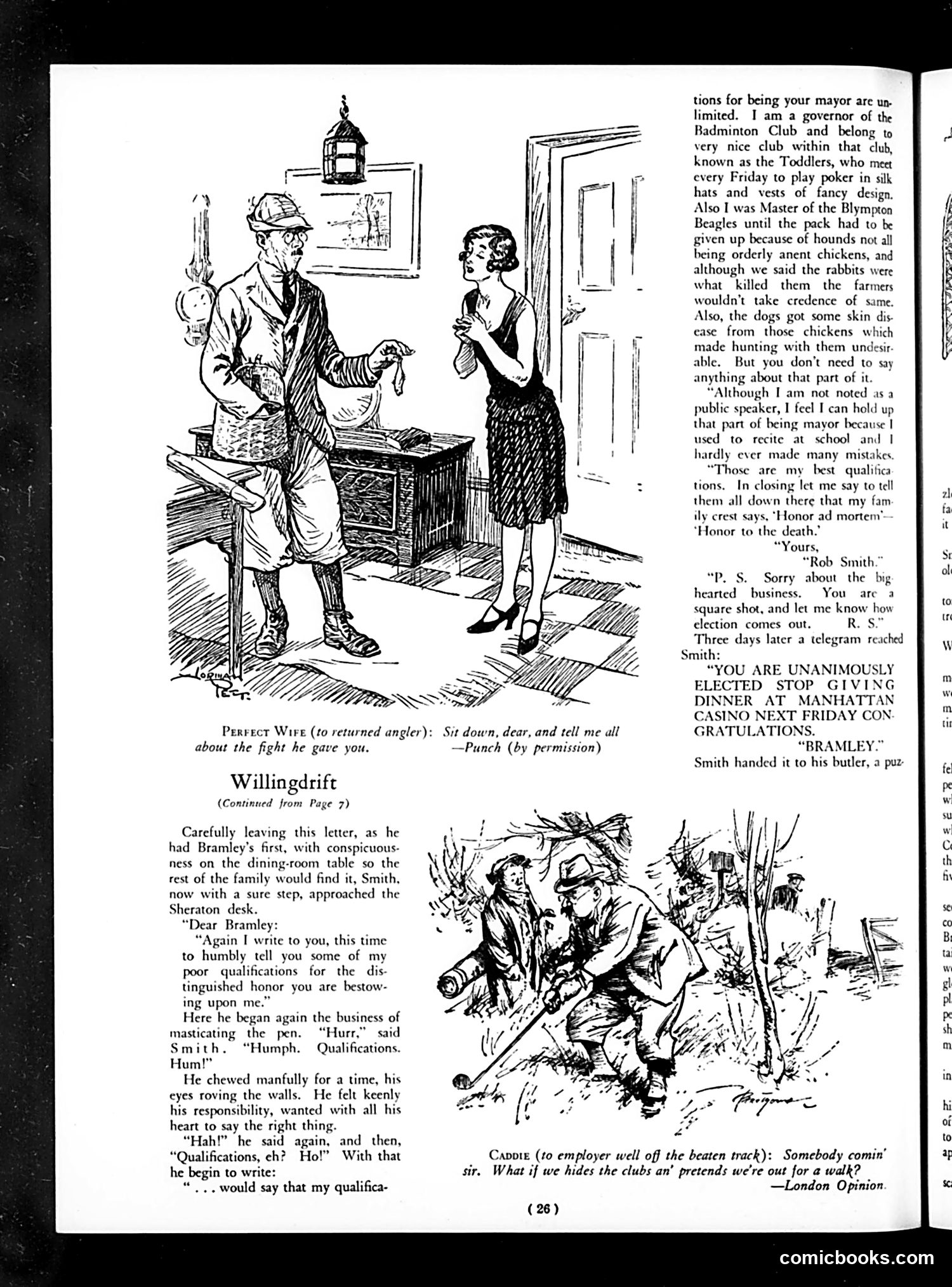
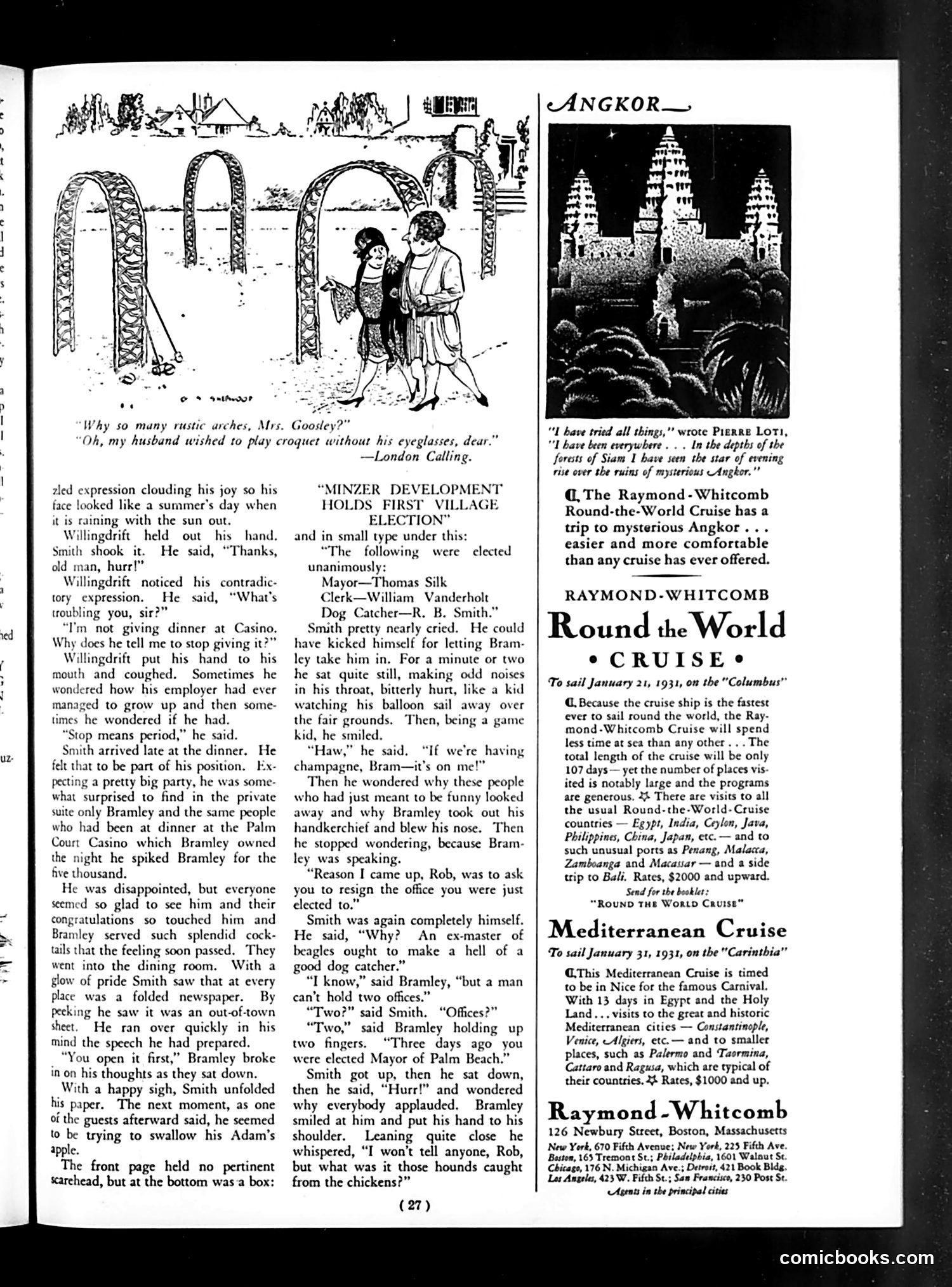
# "Willingdrift" by Eric Hatch This is a short story titled "Bramley Boosts" about a character named Willingdrift who receives a letter offering him nomination for mayor. The illustration depicts a dinner scene where Smith (who wrote the nomination letter) appears to be choking or struggling with food while dining with other gentlemen. The satire likely mocks political ambition and the absurdity of unsolicited political nominations. Willingdrift's internal monologue reveals his vanity—he immediately imagines himself as an honored civic leader despite having done nothing to earn the position. The humorous caption notes Smith seems "trying to swallow his Adam's apple," suggesting the awkwardness or insincerity of the nomination process itself. This is social/political satire about how easily people are flattered by hollow recognition.
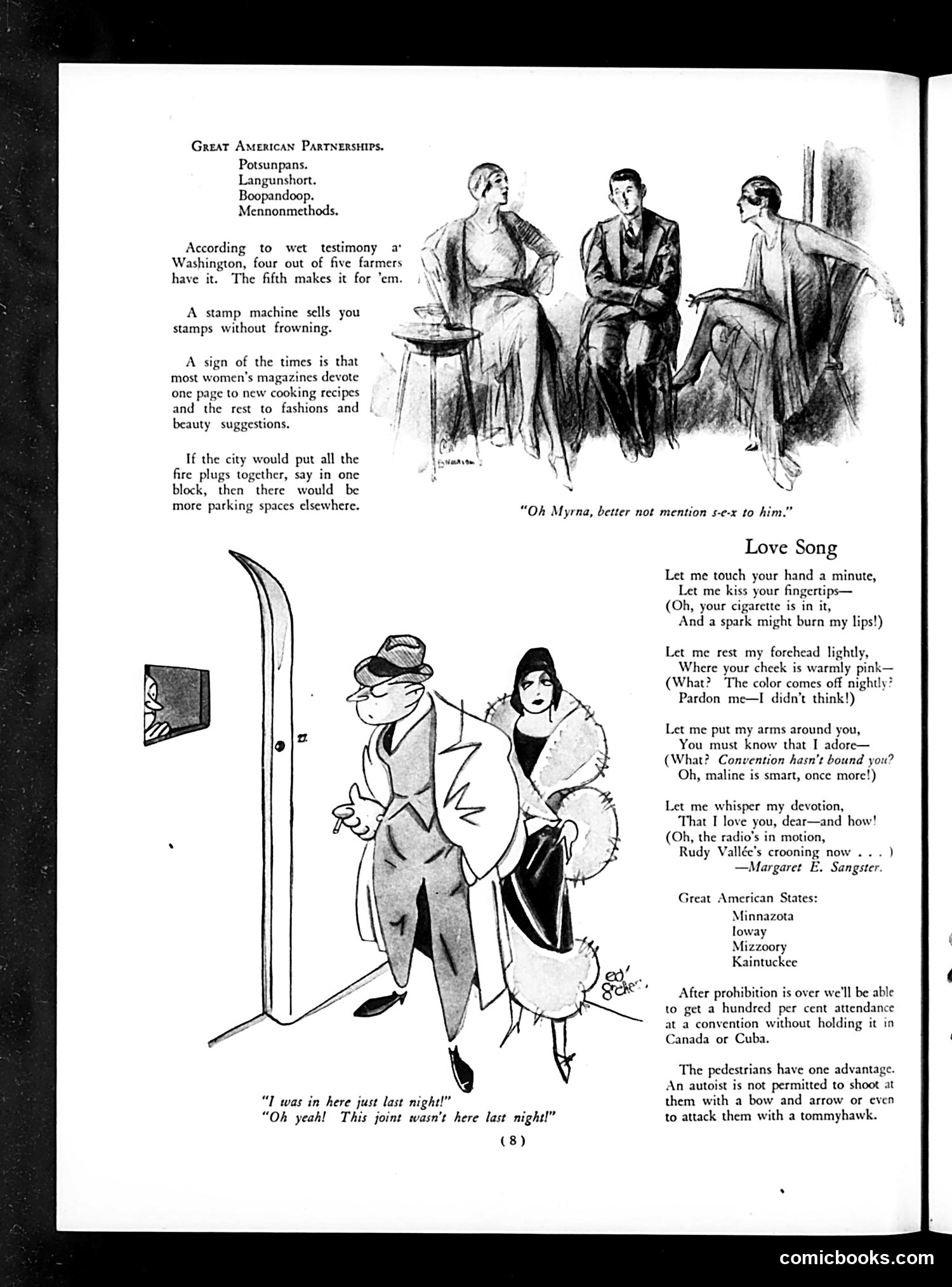
# Analysis of Life Magazine Page This page contains satirical commentary on contemporary American life, circa early 20th century. **Top cartoon** ("Great American Partnerships"): Lists absurd pairings (Potsunpans, Languishort, Boopandoop, Mennonmethods)—nonsense terms mocking how Americans casually coin phrases. The sketch shows three people gossiping, with the caption "Oh Myrna, better not mention i-o-e-s to him," suggesting scandalous rumors being shared. **Bottom cartoon** depicts a couple leaving a nightclub ("It was in here just last night!" / "Oh yeah! This joint wasn't here last night!"), satirizing Prohibition-era speakeasies that constantly relocated to evade authorities. **Right side** contains a poem "Love Song" by Margaret E. Sangster, humorously romantic with parenthetical asides about cigarettes and radio crooning—poking fun at 1920s dating culture and commercialism. Brief quips about parking, conventions, and pedestrians complete the miscellaneous satirical content typical of Life magazine's format.
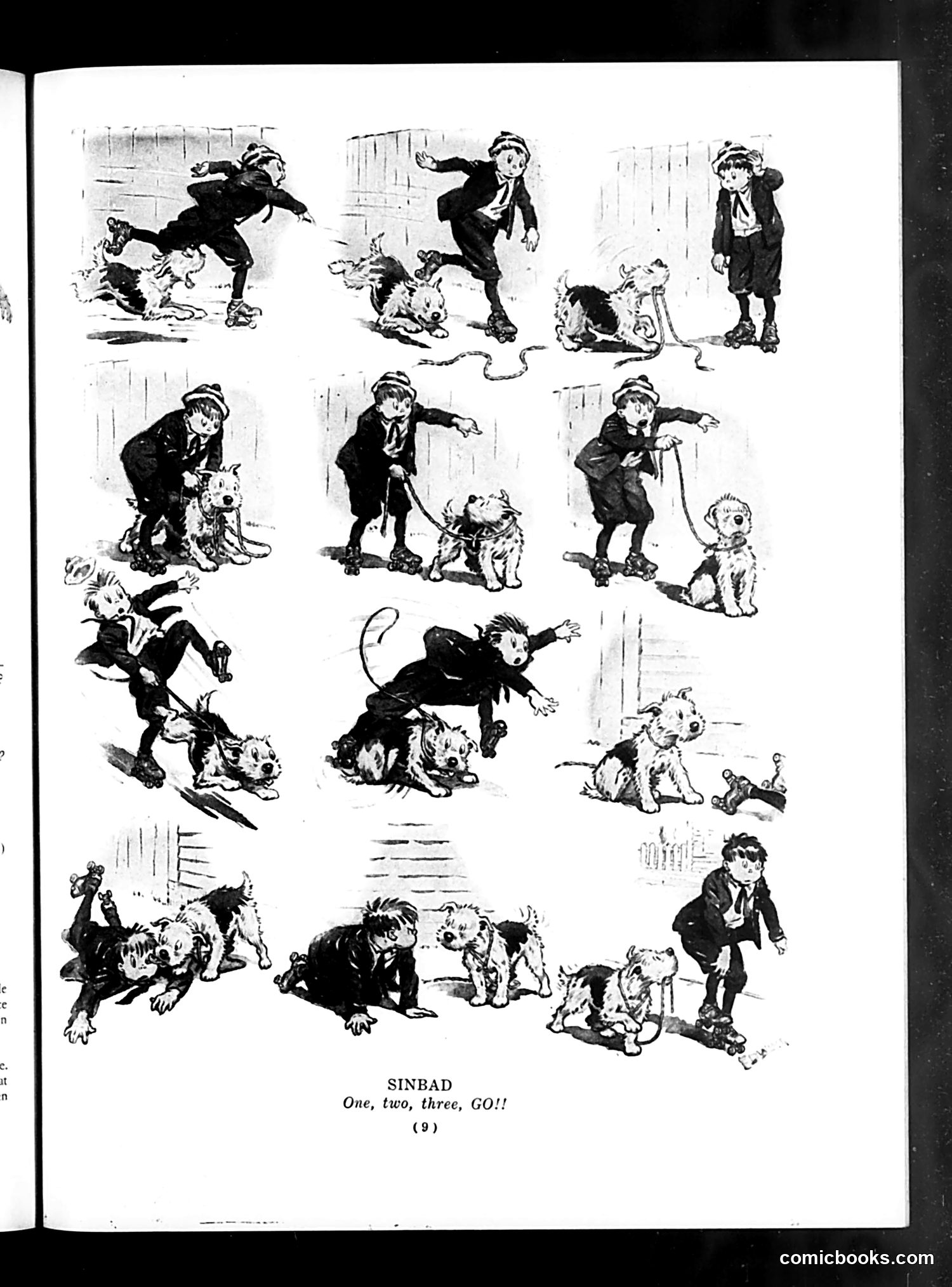
# Analysis of "Sinbad: One, two, three, GO!!" This appears to be a humorous sequential illustration series depicting a child's street game, likely a chasing or tag game with dogs. The caption "One, two, three, GO!!" suggests children playing a traditional playground counting-out game to select who is "it." The comic shows various poses of children in formal clothing (suits, hats) engaged in energetic play with small dogs, creating comedic chaos. The repetitive sequence emphasizes the frenetic action and disorder of street play. The title "Sinbad" likely references the adventurous character, joking that ordinary children's games constitute their own adventures. The humor derives from the contrast between the children's formal dress and their wild, uncontrolled interactions with animals—a gentle satire on childhood exuberance overcoming social propriety.
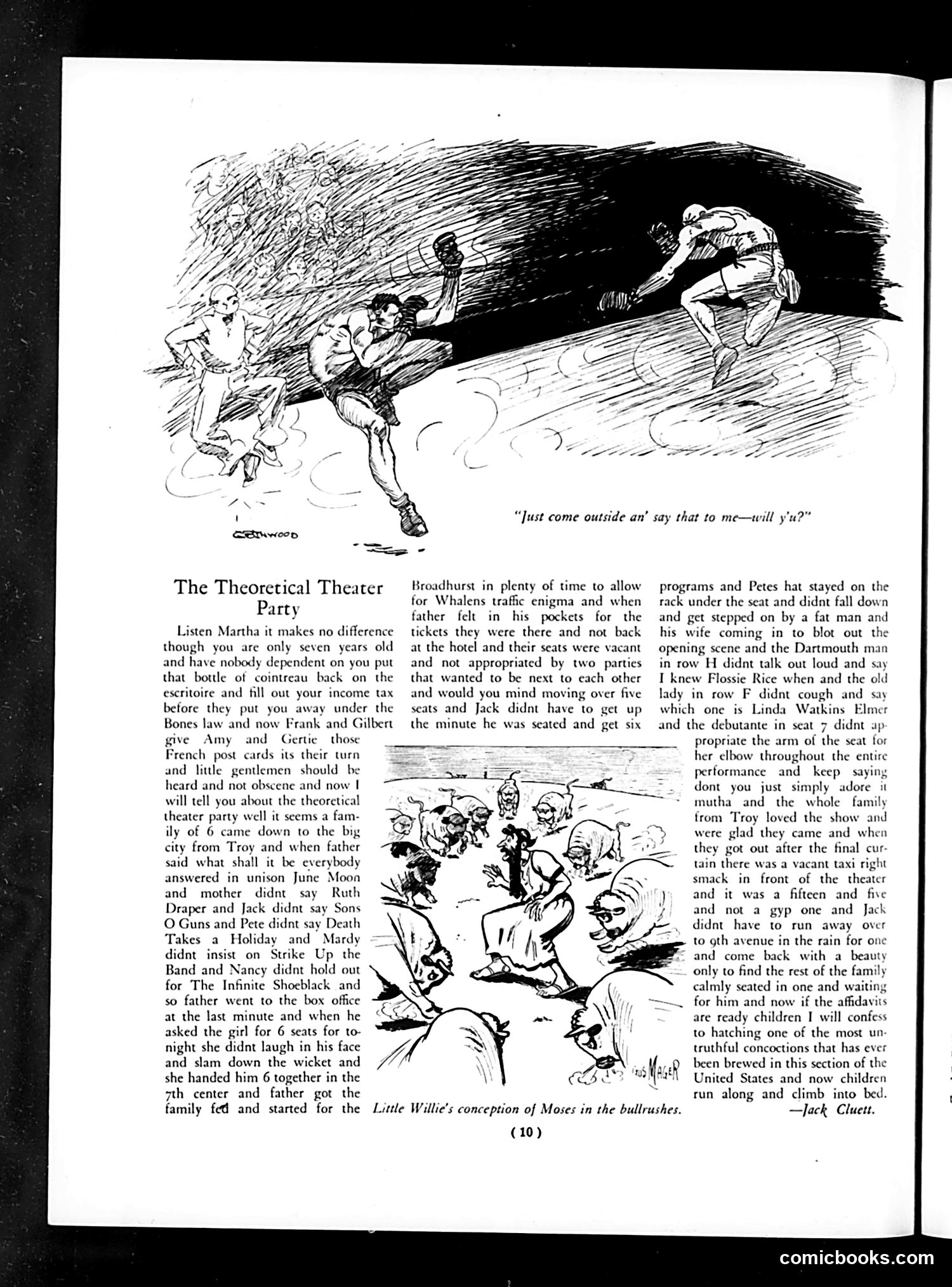
# Analysis of "The Theoretical Theater Party" This is a humorous essay about a family theater outing that goes awry. The piece satirizes middle-class pretensions about "cultured" entertainment—the father insists on attending despite practical obstacles (traffic, seating issues, cost). The accompanying cartoons illustrate the chaos: children misbehaving during the performance, adults struggling with logistics, and the aftermath where the family ends up in an unplanned brawl outside the theater ("Just come outside an' say that to me—will y'u?"). The satire mocks the gap between aspirational middle-class values (attending serious theater) and messy reality (children fighting in the rain afterward). The title's emphasis on "Theoretical" suggests the planned evening exists only in theory while actual experience proves far less dignified.