A complete issue · 40 pages · 1930
Life — March 14, 1930
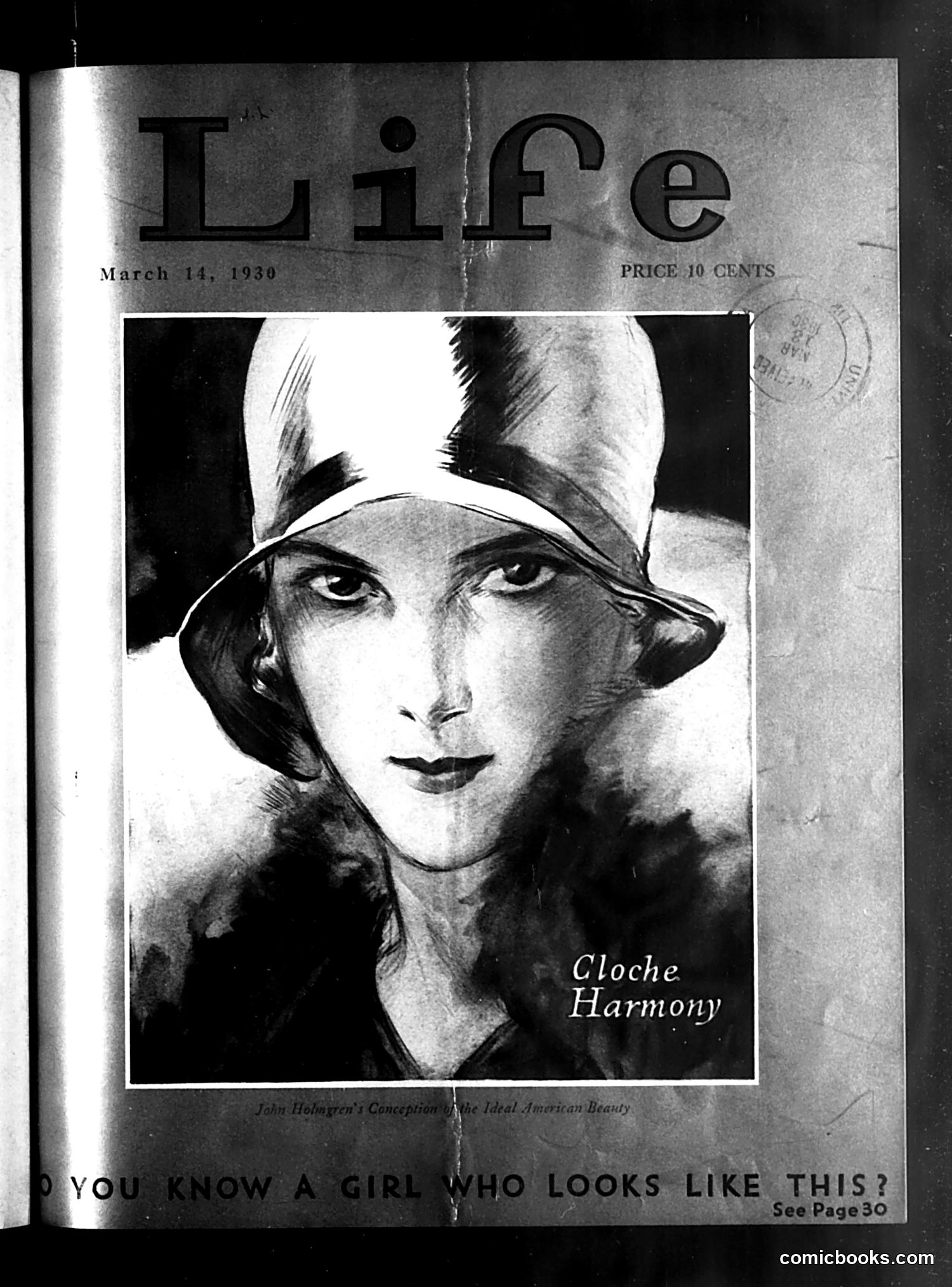
# Life Magazine Cover Analysis - March 14, 1930 This is a **magazine cover, not political satire**. It features a woman wearing a distinctive cloche hat (the tight, close-fitting hat style popular in the 1920s-30s) with a headband. The cover credits "John Holmgren's Conception of the Ideal American Beauty." The caption "DO YOU KNOW A GIRL WHO LOOKS LIKE THIS?" with a reference to Page 30 suggests this is part of a beauty or fashion feature rather than political commentary. The "Cloche Harmony" subtitle likely refers to coordinating fashion elements. This represents typical Life magazine content of the era—fashion, beauty standards, and lifestyle coverage aimed at a general readership. The 10-cent price indicates this is from the Great Depression period.
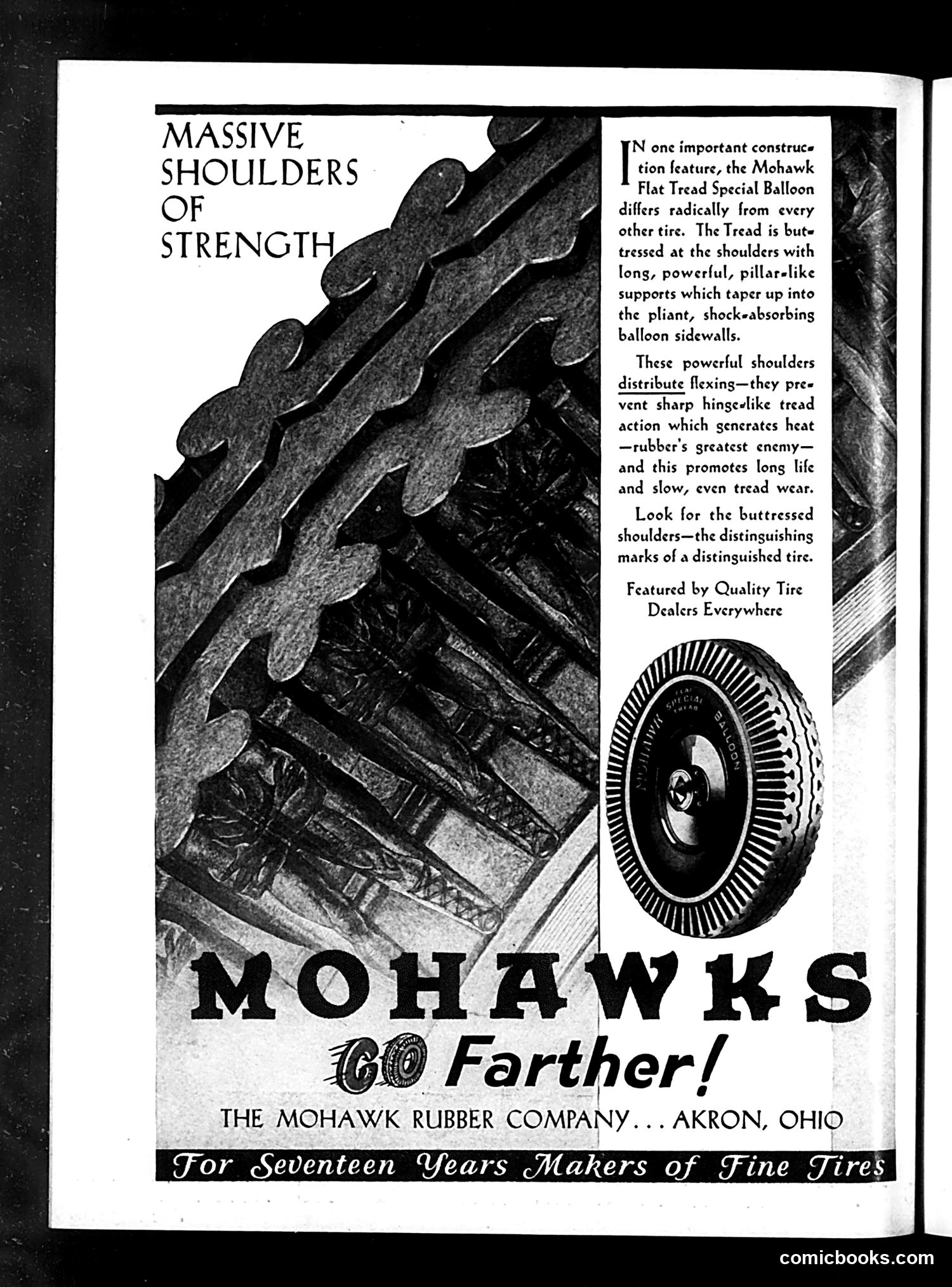
# Analysis This is **advertising, not satire or editorial content**. It's a full-page Mohawk Rubber Company tire advertisement from an early 20th-century Life magazine. The ad promotes Mohawk "Flat Tread Special Balloon" tires by highlighting their "buttressed shoulders"—reinforced sidewalls designed to prevent heat buildup and extend tire life. The close-up photograph shows the tire's tread pattern and construction details. The tagline "Go Farther!" emphasizes durability and longevity. The company claims seventeen years of tire-manufacturing experience. There are **no political references, caricatures, or satirical elements**. This is straightforward product marketing using technical specifications and visual evidence to convince readers of quality—a common advertising approach of the era before modern consumer skepticism.
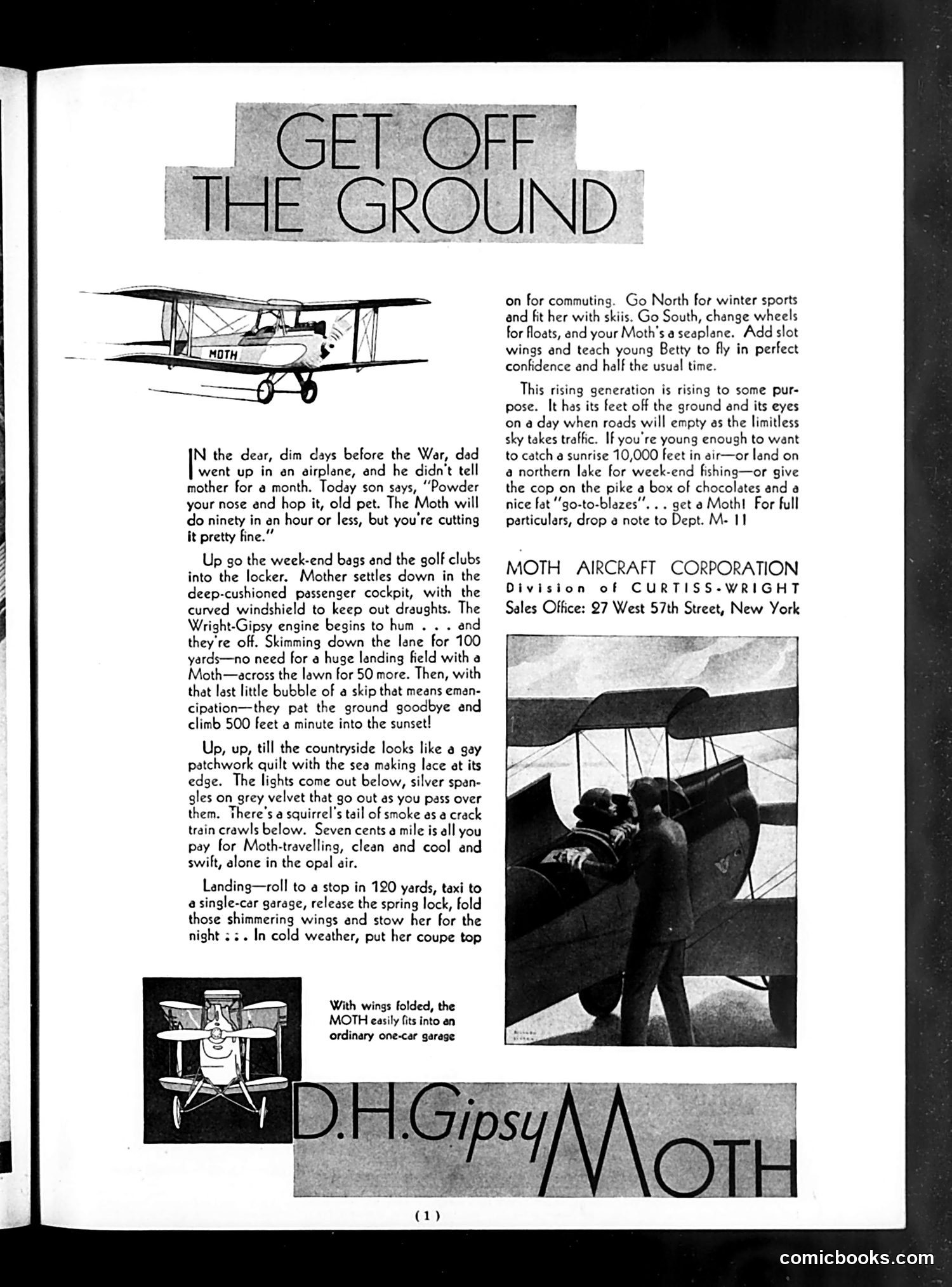
# Analysis of "Get Off the Ground" - Moth Aircraft Advertisement This page is primarily a **commercial advertisement**, not political satire. It promotes the D.H. Gipsy Moth aircraft, manufactured by Moth Aircraft Corporation (a division of Curtiss-Wright), with sales offices in New York. The ad uses nostalgic, whimsical copy addressing post-WWI aviation enthusiasm. It describes recreational flying—weekend trips, winter sports access, casual travel—positioned as accessible luxury for the affluent. The "Gipsy Moth" name and illustrations emphasize the aircraft's compact, foldable design that fits in a standard garage. The tone suggests this targets wealthy leisure travelers of the 1920s-early 1930s era, when private aviation was novel and aspirational. The copywriting emphasizes speed (500 feet/minute climb), practicality, and adventure rather than any political message.
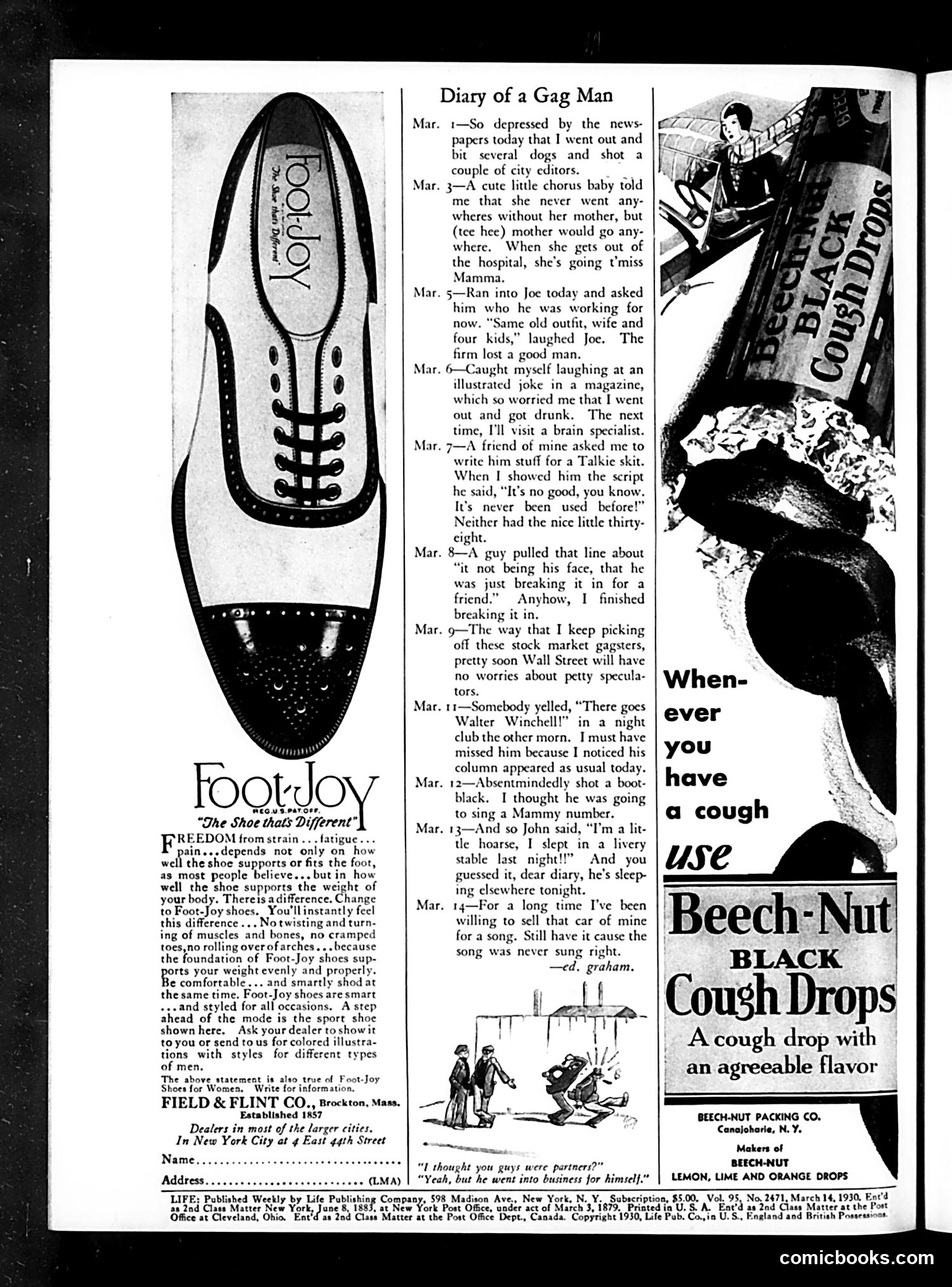
# Page Analysis: Life Magazine (circa 1930) This page combines satirical content with period advertising. The left side features "Diary of a Gag Man"—entries from March documenting a comedy writer's daily mishaps and observations, including depression-era references (shooting newspaper editors' dogs, stock market anxiety). The humor relies on absurdist incongruity typical of 1920s-30s magazine comedy. The right side shows a Footjoy shoe advertisement emphasizing orthopedic design, alongside a Beech-Nut cough drops ad. The small cartoon caption ("I thought you guys were partners?") appears to reference business conflict, likely reflecting Depression-era economic uncertainty. Overall, the page mixes disposable gag humor with product advertisements, reflecting Life's format as a humor magazine carrying commercial endorsements.
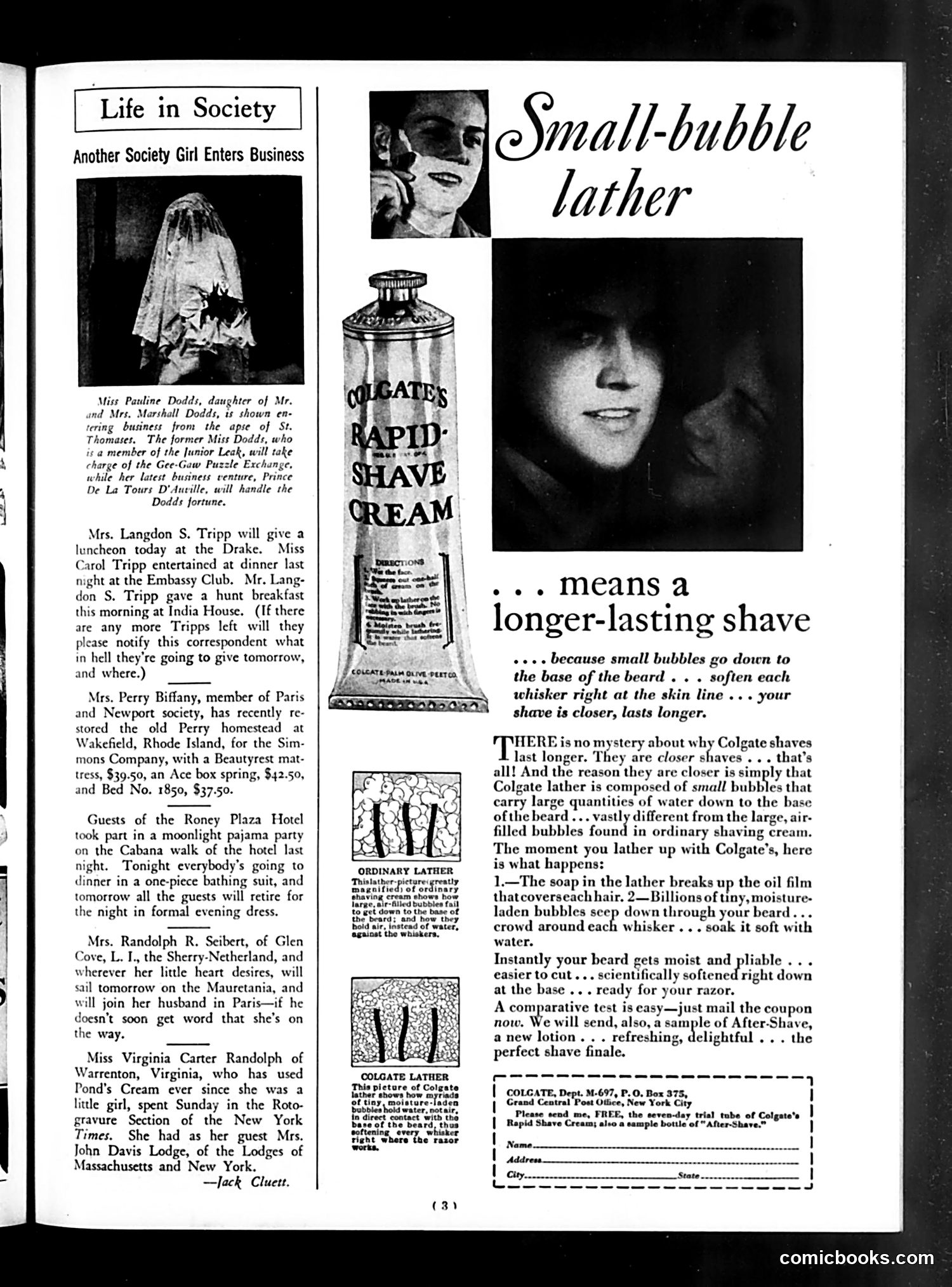
# Analysis This page is primarily a **Colgate's Rapid Shave Cream advertisement**, not satire. The right side features a large product ad explaining that small bubbles in the lather penetrate deeper than ordinary shaving cream, producing a "longer-lasting shave." The left column contains **"Life in Society"** — a regular gossip/society section listing social events and activities of wealthy individuals (luncheons, hotel visits, boat trips). This was typical magazine content documenting the leisure activities of the upper class. There is **no political cartoon** on this page. The images are purely commercial: a product photograph of the shaving cream tube and diagrams comparing ordinary versus Colgate lather bubbles. The page represents **advertising integrated into editorial content**, common in mid-20th-century magazines.
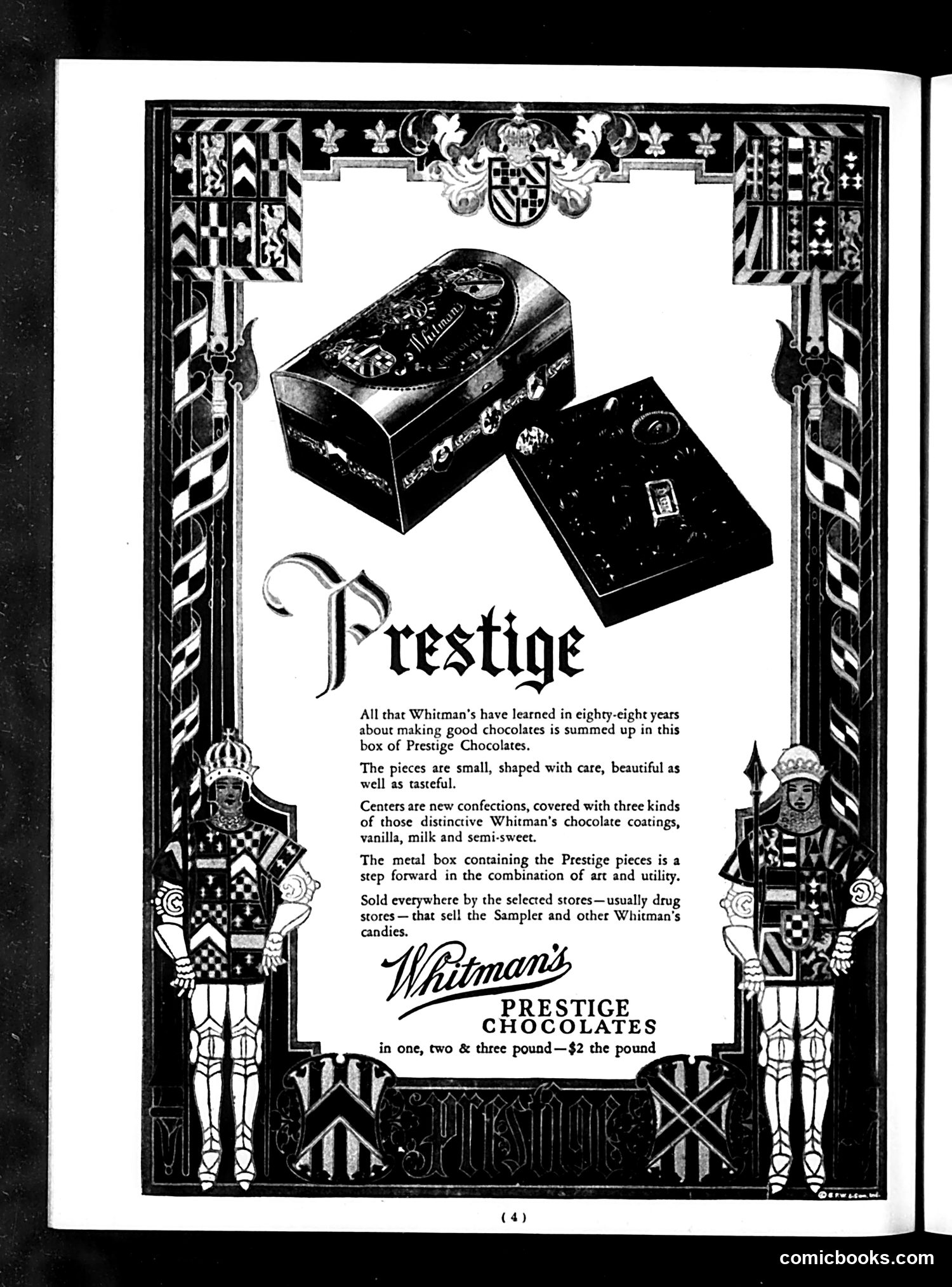
# Analysis This page is **primarily an advertisement**, not satire or political commentary. It promotes Whitman's Prestige Chocolates, a real American candy brand. The ad emphasizes luxury and heritage: "All that Whitman's have learned in eighty-eight years about making good chocolates is summed up in this box." The ornate border—featuring heraldic crests, crowned figures, and medieval-style decorative elements—creates an impression of Old World sophistication and prestige (hence the product name). The two decorated boxes shown are presented as premium gift items. The ad targets affluent consumers, with pricing at "$2 the pound"—substantial for the era. This is marketing, not editorial content—there is no political meaning or satirical intent here.
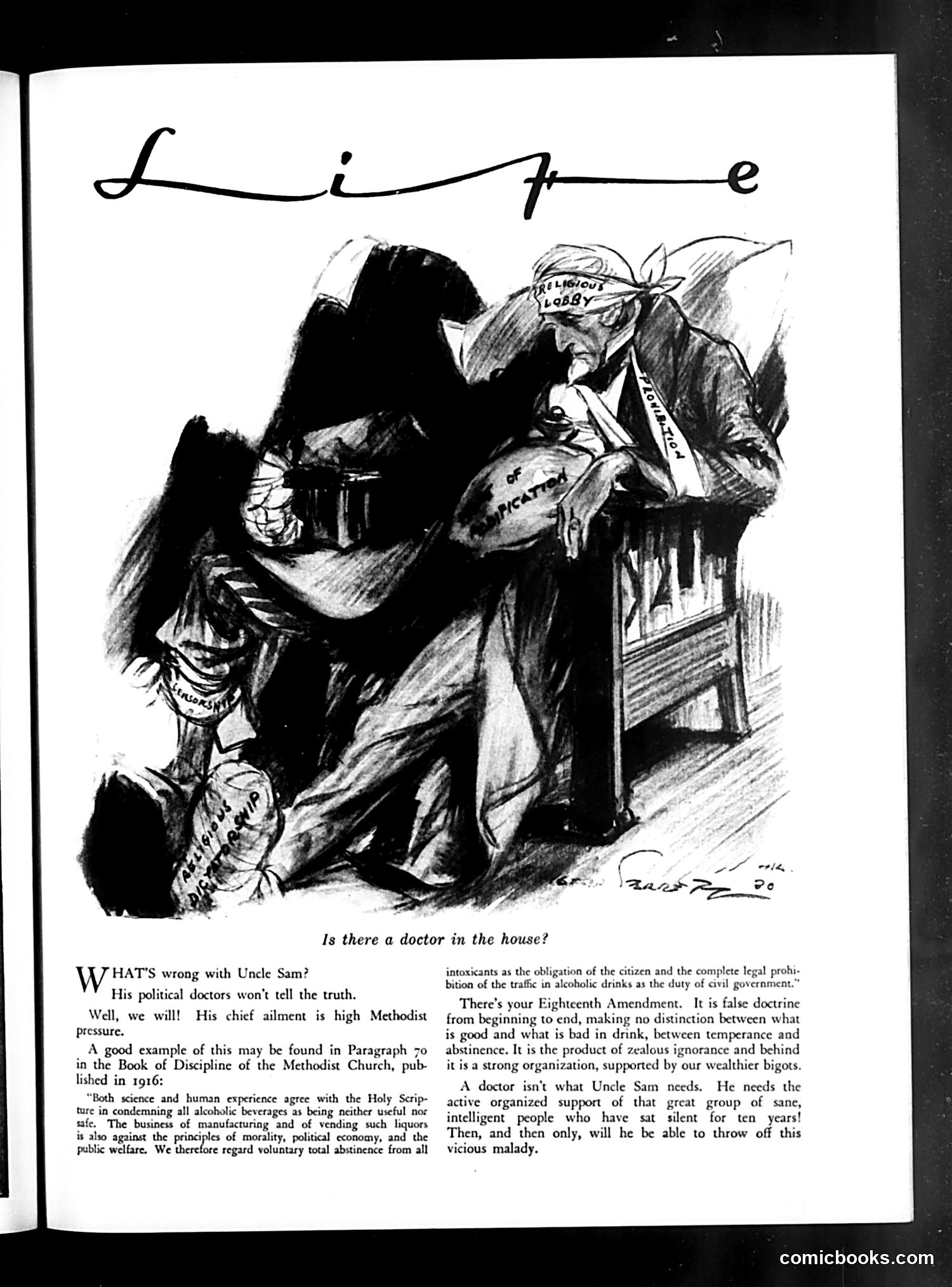
# Explanation of "Is There a Doctor in the House?" This political cartoon satirizes Uncle Sam's inability to address America's "high Methodist pressure"—a reference to the Methodist Church's prohibition stance and temperance advocacy. The image shows Uncle Sam as a sick patient being examined by a doctor figure labeled with Methodist doctrine. The article criticizes Methodist "political doctors" for diagnosing the nation's problems while promoting total abstinence from alcohol, citing Paragraph 70 of the Methodist Book of Discipline. The satire's point: the Methodist Church, though well-intentioned and supported by "wealthy bigots," oversimplifies complex social and economic issues by reducing them to the alcohol question. The author argues Uncle Sam needs practical solutions, not ideological medicine, and that only organized support from "sane, intelligent people" can cure America's "vicious malady."
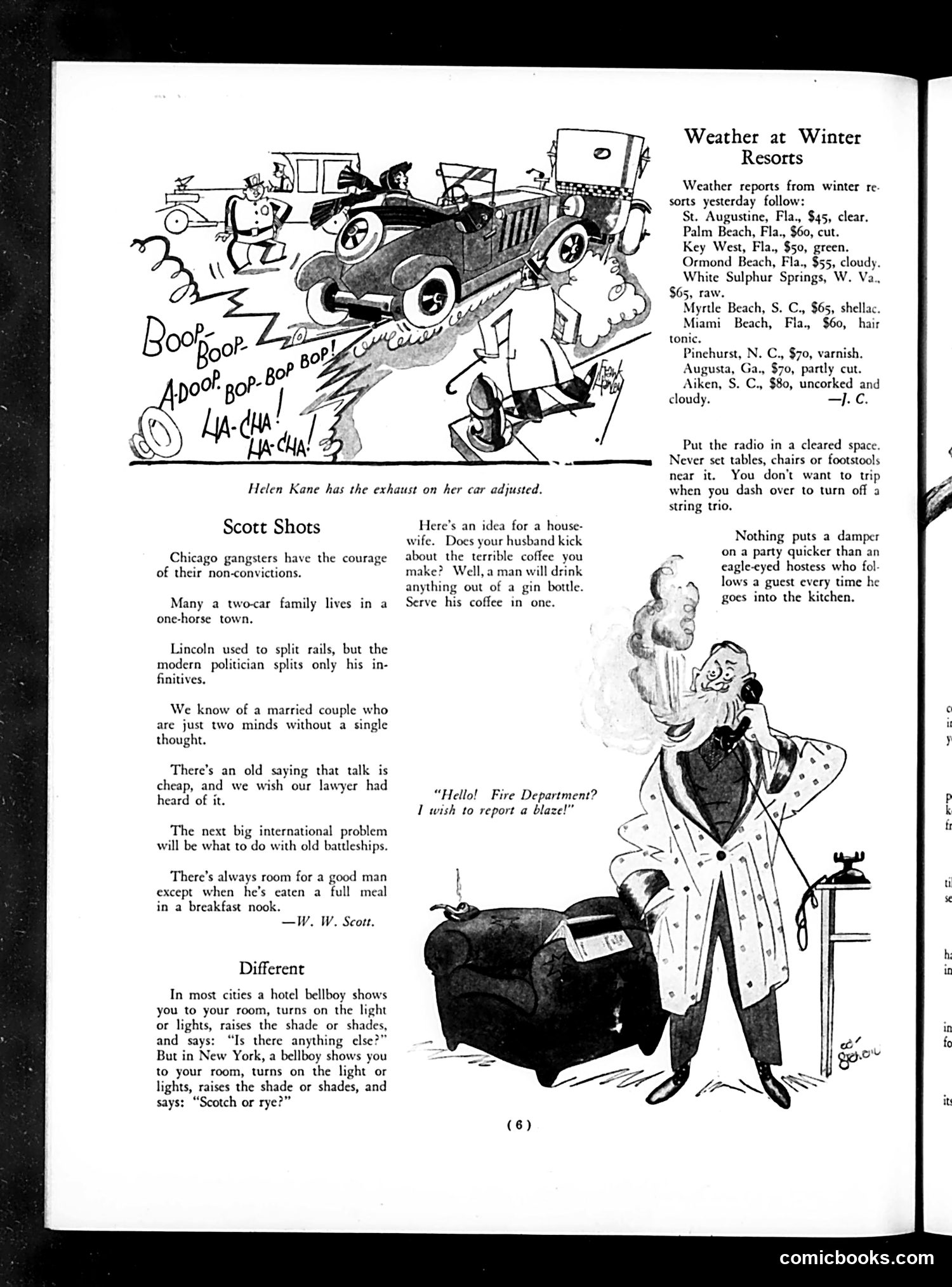
# Analysis of Life Magazine Page (undated) This page contains three separate humor pieces typical of Life magazine's satirical style: 1. **"Weather at Winter Resorts"**: A cartoon showing cars honking loudly on a road, with the caption "Helen Kane has the exhaust on her car adjusted." This references Helen Kane, the 1920s-30s performer famous for her "boop-boop-a-doop" catchphrase. The joke satirizes her distinctive vocal style by comparing it to car horn noise. 2. **"Scott Shots"**: A column of humorous one-liners about social observations—marriage, politicians, lawyers—typical of magazine filler humor. 3. **"Different"**: A cartoon contrasting hotel bellhop behavior between cities. The punchline plays on ethnic/regional stereotypes: a New York bellhop asks "Scotch or rye?" (implying drinking) versus other cities. The cartoon reflects dated assumptions about regional characteristics. All content reflects early-20th-century American humor conventions and stereotypes.
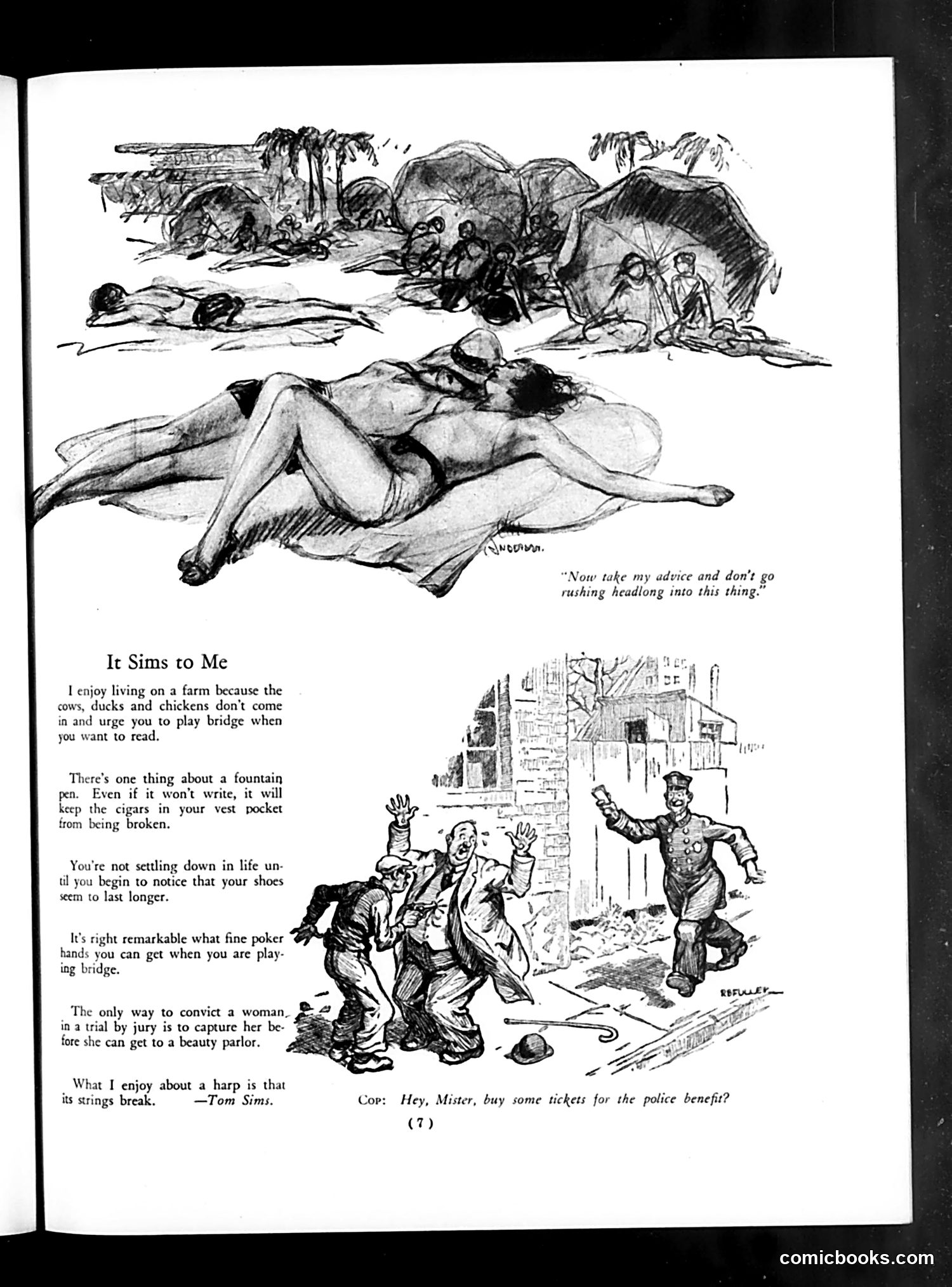
# Analysis of Life Magazine Page This page contains two distinct pieces: **Top Illustration**: A suggestive beach scene with the caption "Now take my advice and don't go rushing headlong into this thing." The drawing depicts intimate physical contact, using double entendre humor typical of early 20th-century satirical magazines. **"It Sims to Me" Column**: Attributed to Tom Sims, this is a humorous essay about life observations—farming, fountain pens, poker hands, convicting women, and harps. It's gentle observational comedy rather than pointed satire. **Bottom Cartoon**: Shows a street scene where a cop solicits a man to buy police benefit tickets. The humor plays on corrupt police practices—officers pressuring citizens for "donations" under the guise of charity fundraising, a recognized social problem of the era. Both pieces reflect Life's satirical approach to American social conditions and human behavior.
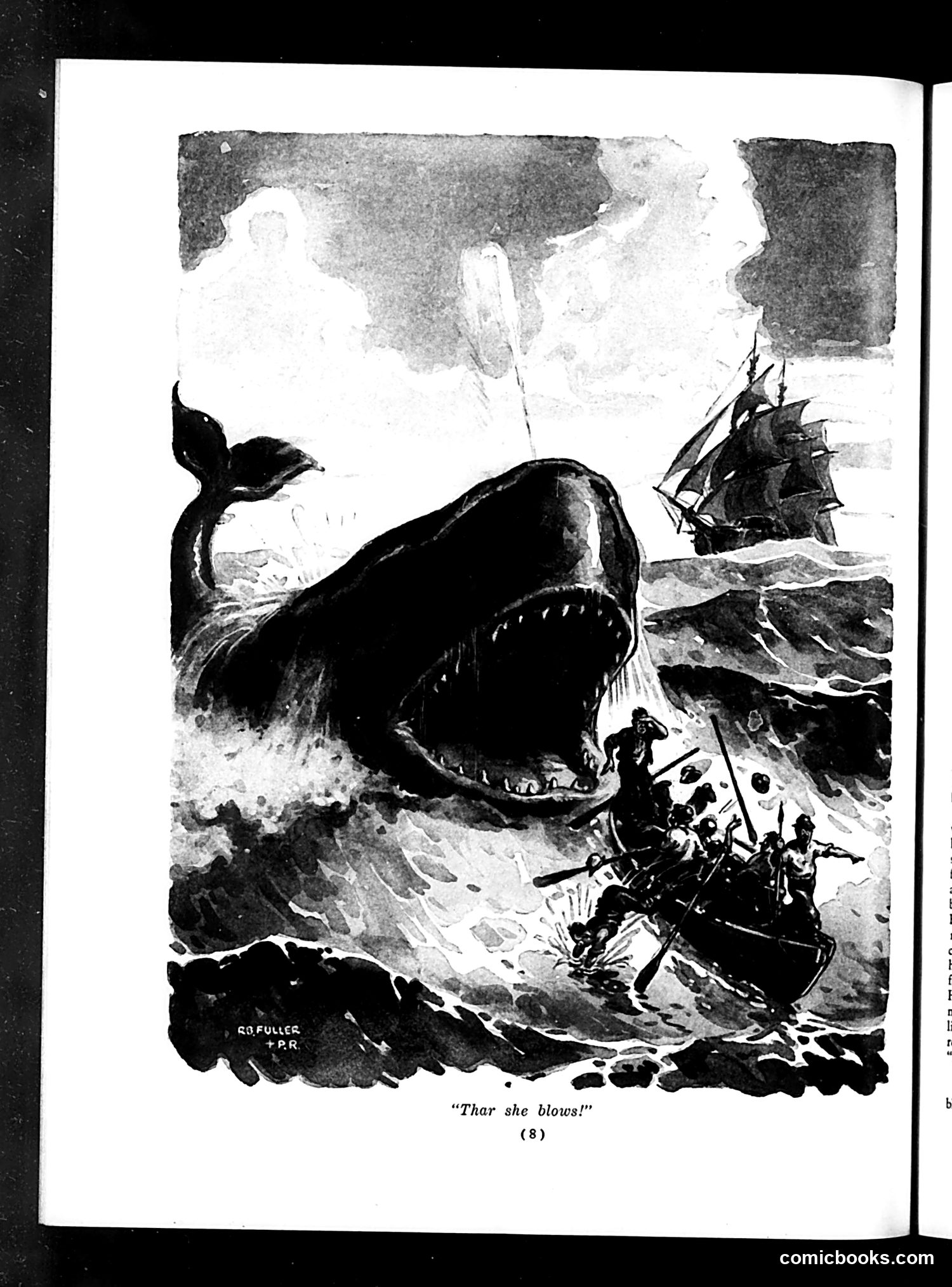
# Analysis This illustration, signed by S.D. Fuller, depicts a dramatic whaling scene with the caption "Thar she blows!" (a whaler's call upon spotting a whale). The image shows sailors in a small boat confronting an enormous whale with its mouth wide open, while a sailing ship appears in the background. The artwork appears to be a straightforward adventure illustration rather than political satire. It captures a moment of maritime danger and excitement that would have appealed to *Life* magazine's readers. The dramatic composition and dynamic action—the whale's threatening posture, the sailors' precarious position, the churning sea—emphasize the peril and excitement of 19th-century whaling. Without additional context from surrounding text, this seems primarily an entertainment illustration celebrating maritime adventure rather than satirizing specific political or social figures.
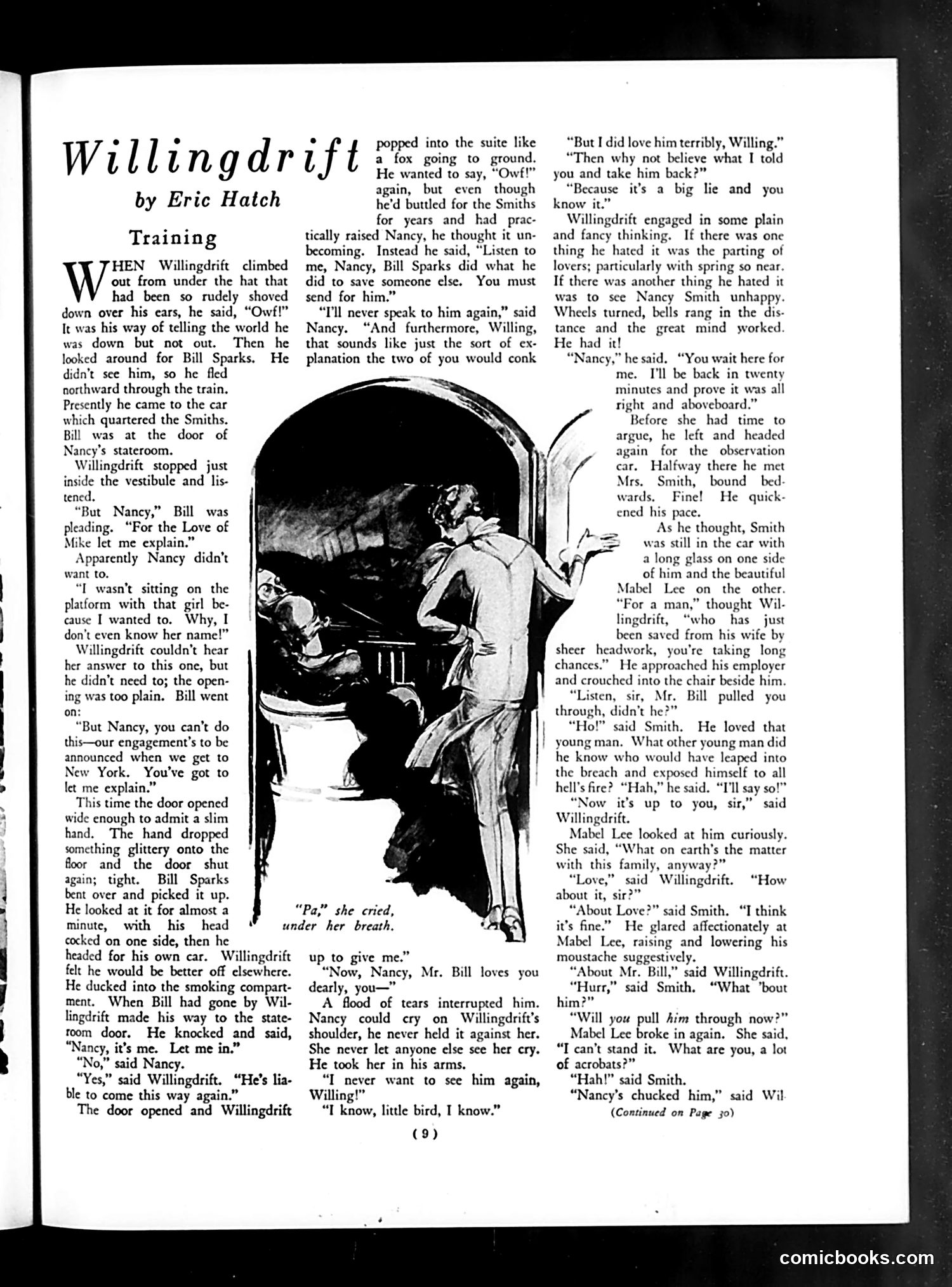
# "Willingdrift" by Eric Hatch This page contains the beginning of a short story titled "Training," not a political cartoon. The narrative follows a character named Willingdrift, who climbs out from under a hat in a train car and encounters Bill Sparks and Nancy Smith. The accompanying illustration shows a dramatic scene in a train compartment where a woman (Nancy) cries out "Pa!" while a man attends to her. The story involves romantic tension and reconciliation—Willingdrift attempts to reunite the couple after they've separated. This appears to be mainstream fiction entertainment rather than political satire, typical of Life magazine's content mix during the early-to-mid twentieth century.
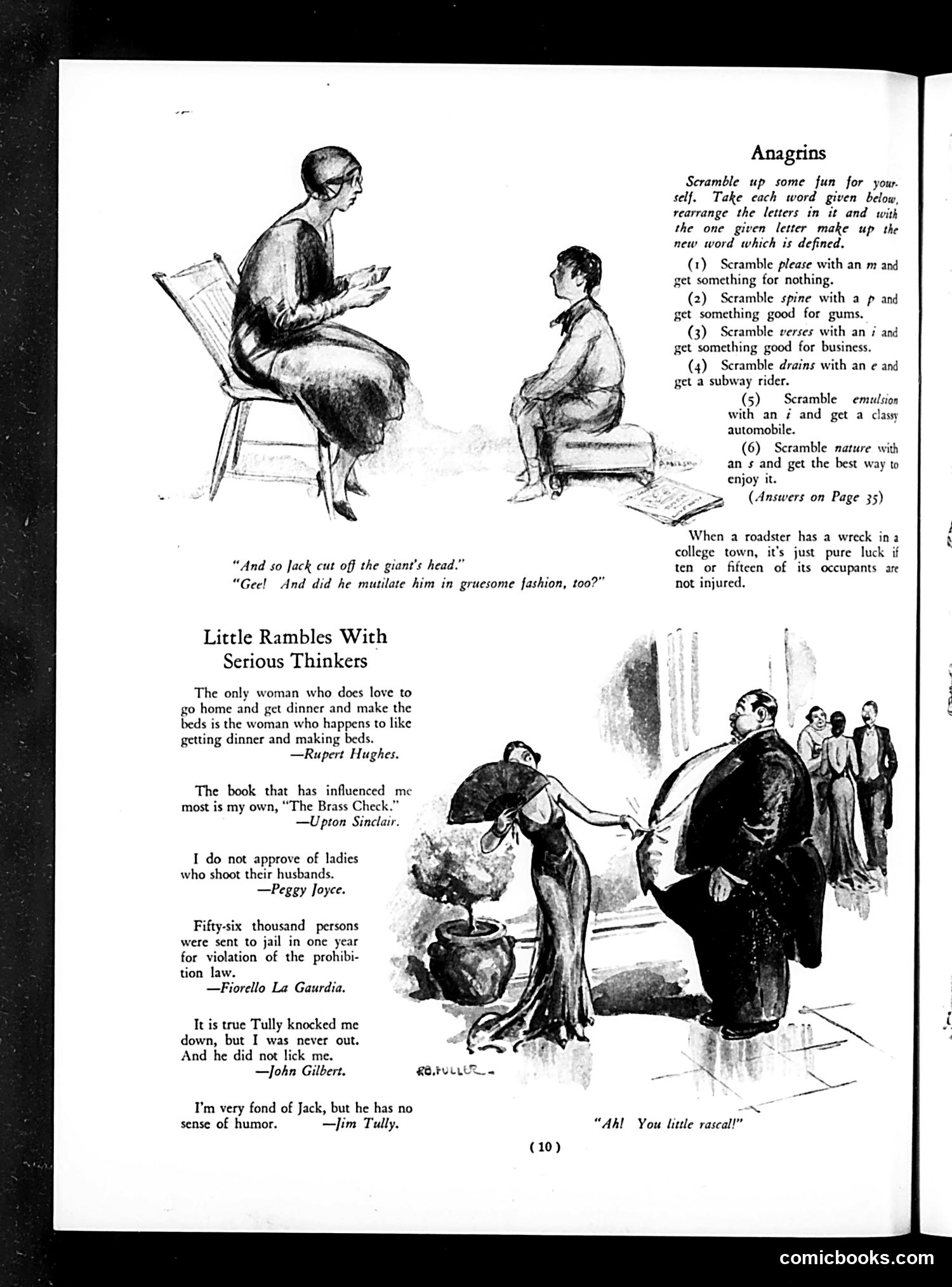
# Page Analysis This page contains two distinct sections: **Top section ("Anagrins"):** A word-scramble puzzle where readers rearrange letters to form new words with humorous definitions (e.g., "please" with an M becomes something "for nothing"). **Bottom section ("Little Rambles With Serious Thinkers"):** A collection of brief, sardonic quotes attributed to named individuals (Rupert Hughes, Upton Sinclair, Peggy Joyce, etc.), each offering wry observations on domestic life, literature, law, and relationships. The accompanying cartoon illustrates one quote about someone named Jack and Tully, depicting what appears to be a domestic dispute or confrontation. The page's humor relies on cynicism about marriage, authority, and human nature—typical of *Life* magazine's satirical approach during the early 20th century.