A complete issue · 36 pages · 1930
Life — January 24, 1930
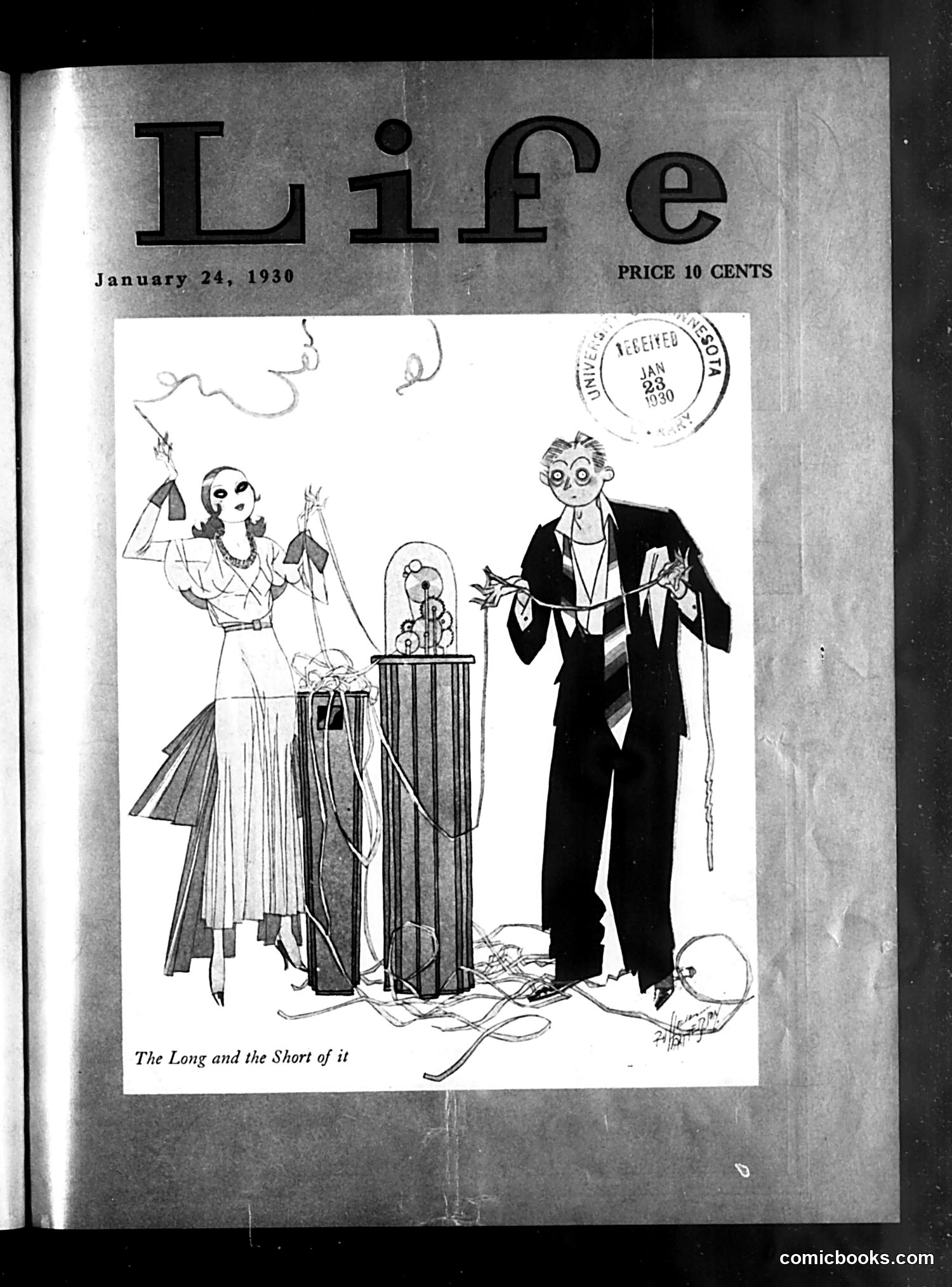
# "The Long and the Short of It" - Life Magazine, January 24, 1930 This cartoon satirizes height differences in romantic or social pairings, a common topic for 1930s humor. The illustration shows a tall, thin man in formal wear and a shorter woman in a fashionable dress, surrounded by tangled string or yarn—likely representing the complications and awkwardness of their height disparity. The title "The Long and the Short of It" is a pun: it refers both to their physical heights and to the phrase meaning "the essential point" or "the bottom line." The cartoon mocks how such mismatched couples navigate everyday interactions, with the visual chaos of the tangled strings emphasizing the comedic confusion their size difference creates. This reflects 1930s social commentary on courtship and physical compatibility.
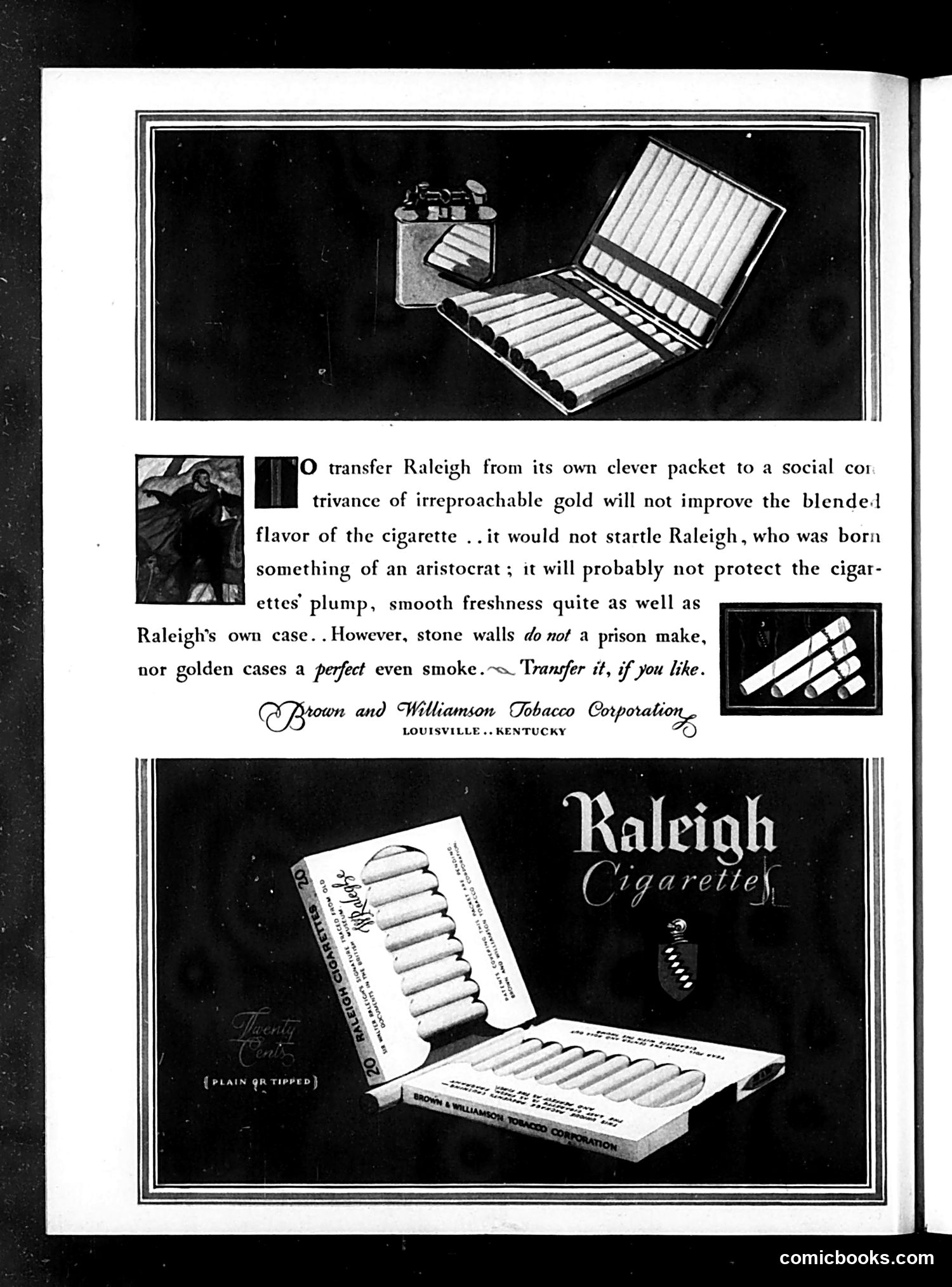
# Analysis This page is primarily **advertising for Raleigh cigarettes** by Brown and Williamson Tobacco Corporation (Louisville, Kentucky), not political satire. The ad's joke plays on the brand's luxurious packaging. The text suggests transferring Raleigh cigarettes from their elegant gold case to a plain case wouldn't improve the smoke—implying the brand's quality speaks for itself, not its fancy packaging. The phrase "stone walls do not a prison make, nor golden cases a *perfect* even smoke" mocks the idea that expensive cases guarantee superior smoking experience. The ad emphasizes that Raleigh offers a quality smoke regardless of packaging, positioning it as an aristocratic choice for discerning smokers. This is straightforward product marketing using gentle humor about conspicuous consumption rather than political commentary.
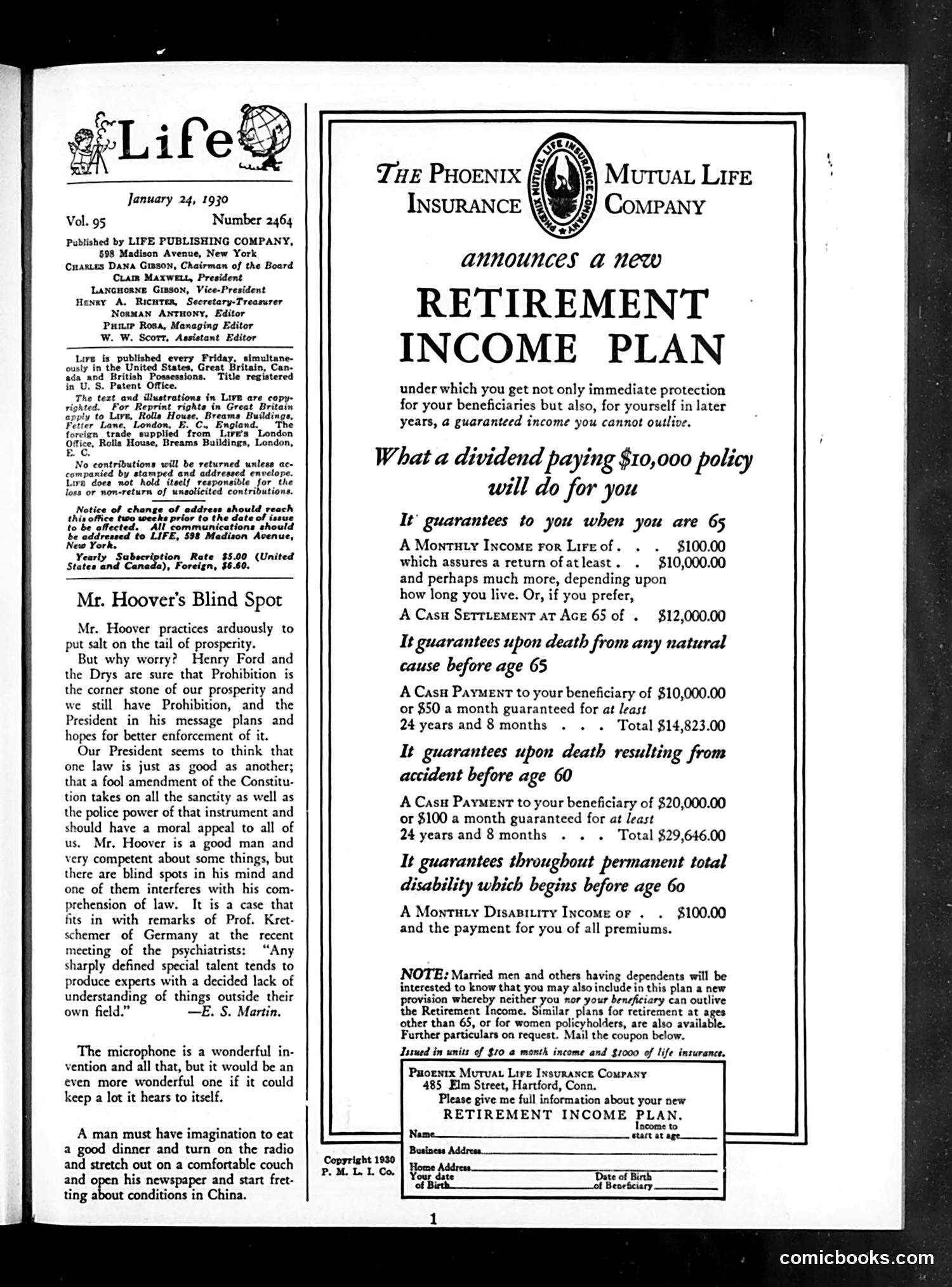
# Page Analysis This page is primarily a **Life magazine advertisement** for Phoenix Mutual Life Insurance's new "Retirement Income Plan" (1939). The ad occupies most of the right side. The left side contains an **editorial piece titled "Mr. Hoover's Blind Spot,"** which appears to criticize Herbert Hoover's political philosophy. The author argues Hoover has "blind spots" regarding law and governance, sarcastically suggesting he believes one law is as good as another and that fools' constitutional amendments are acceptable. The piece seems to critique Hoover's stance on Prohibition and his general approach to enforcing laws. The brief final paragraph makes an unrelated observation about radio and newspapers. This is primarily **content and advertising**, not a political cartoon.
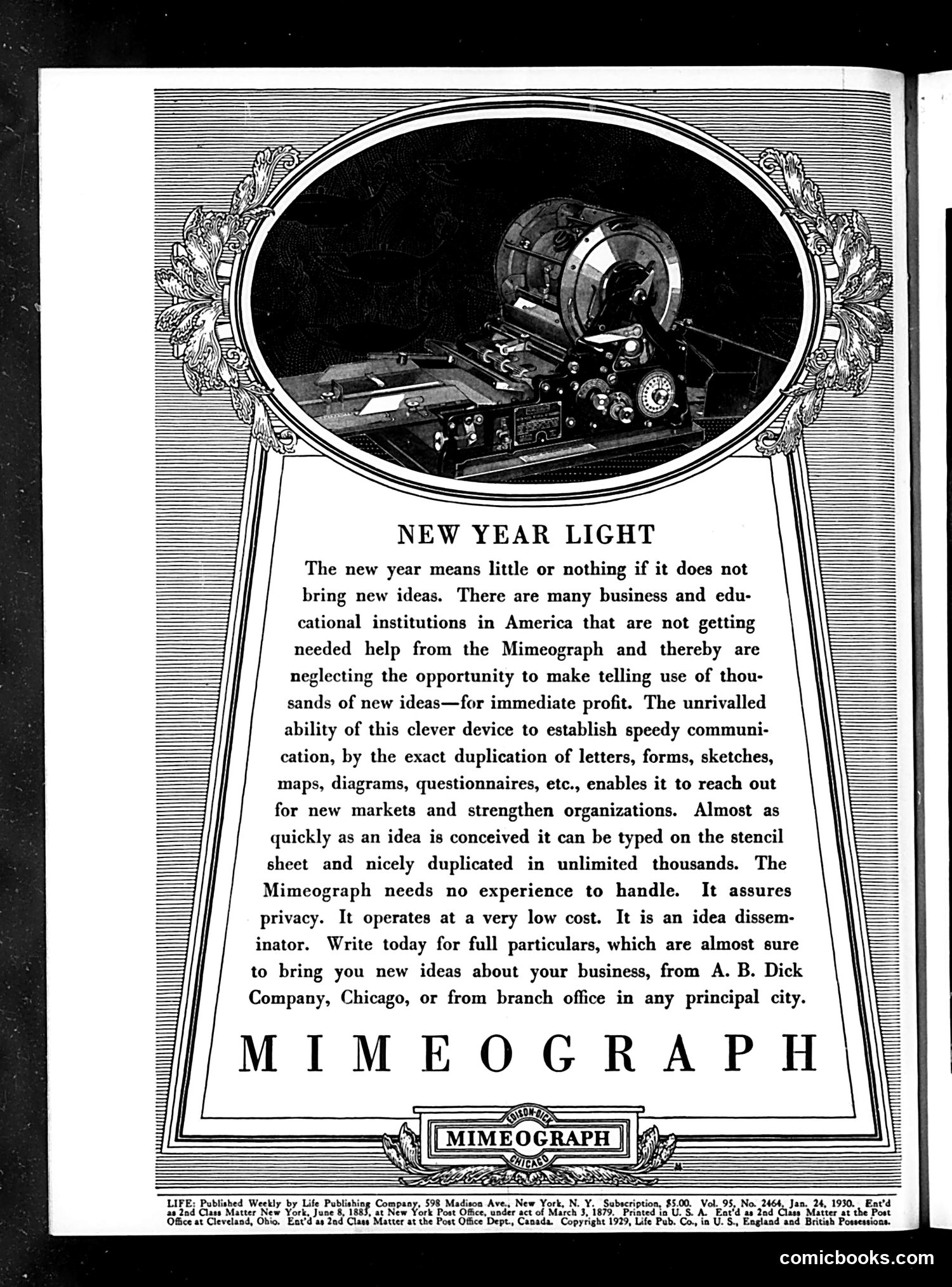
# Content Analysis This page is **primarily an advertisement**, not a political cartoon. It promotes the Mimeograph machine, a document-copying device manufactured by the A.B. Dick Company of Chicago. The ad's headline "NEW YEAR LIGHT" frames the mimeograph as a modern business solution for the new year. The pitch argues that American businesses and educational institutions are missing opportunities by not using mimeographs to duplicate and distribute documents—letters, forms, maps, diagrams—quickly and affordably. The image shows the mimeograph device itself. The advertisement emphasizes speed, low cost, and ease of operation as selling points for expanding business reach and organizational strength. This reflects early-20th-century enthusiasm for new office technology as a path to business efficiency and profit.
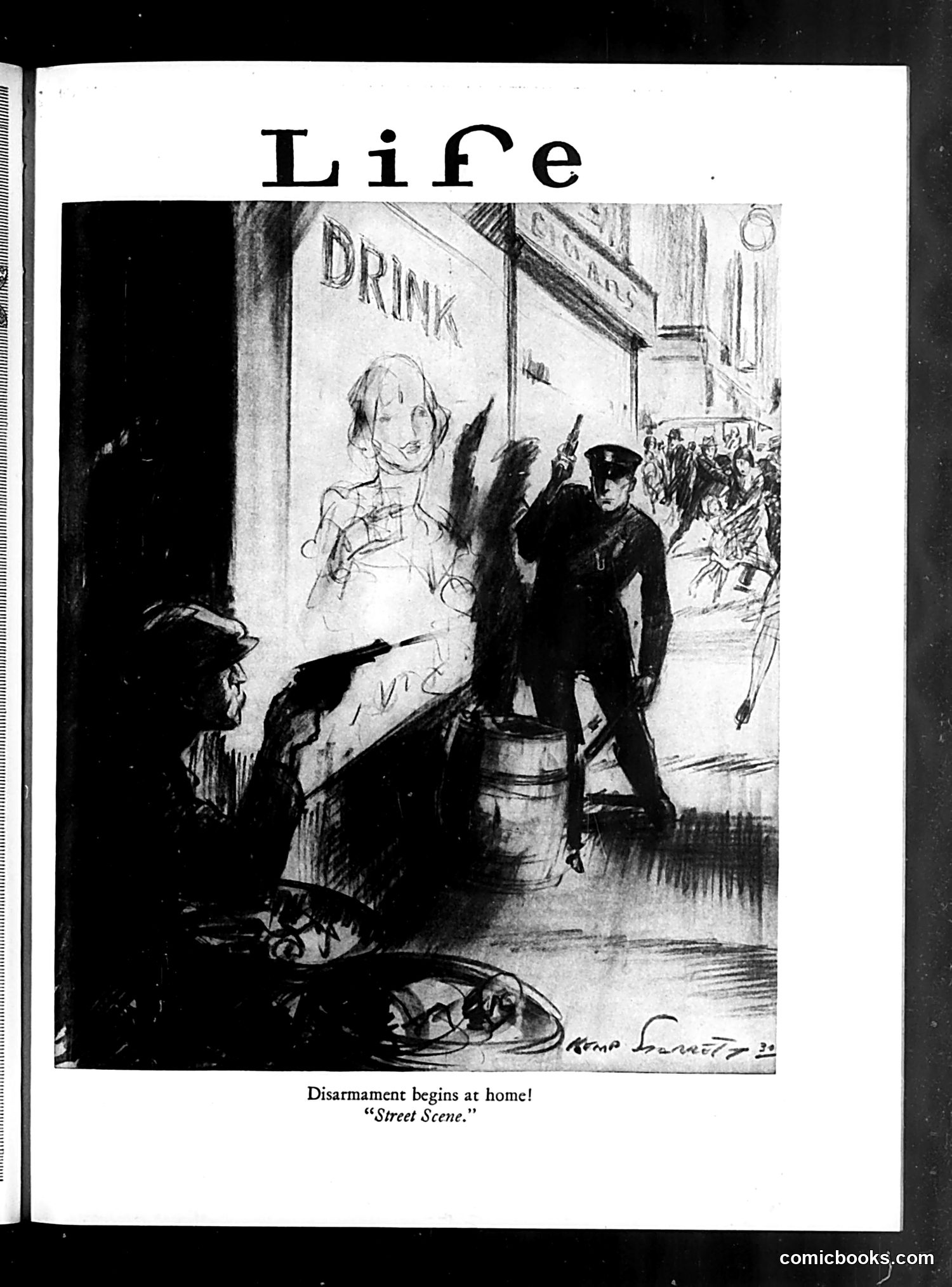
# Analysis This Life magazine page satirizes early 20th-century disarmament debates. The cartoon depicts a uniformed military officer confronting a street artist who has drawn anti-military propaganda on a wall—specifically, a caricatured figure labeled "DRINK" above text reading "DRINK." The caption "Disarmament begins at home! 'Street Scene'" suggests ironic commentary: true disarmament efforts must start with eliminating domestic social problems (represented by the drinking figure and street poverty) rather than focusing on international military reduction. The officer's confrontational stance toward the artist implies authorities suppress grassroots criticism of militarism while ignoring underlying social issues. The satire critiques how governments tout disarmament policies as solutions while neglecting the poverty and social decay visible on their own streets.
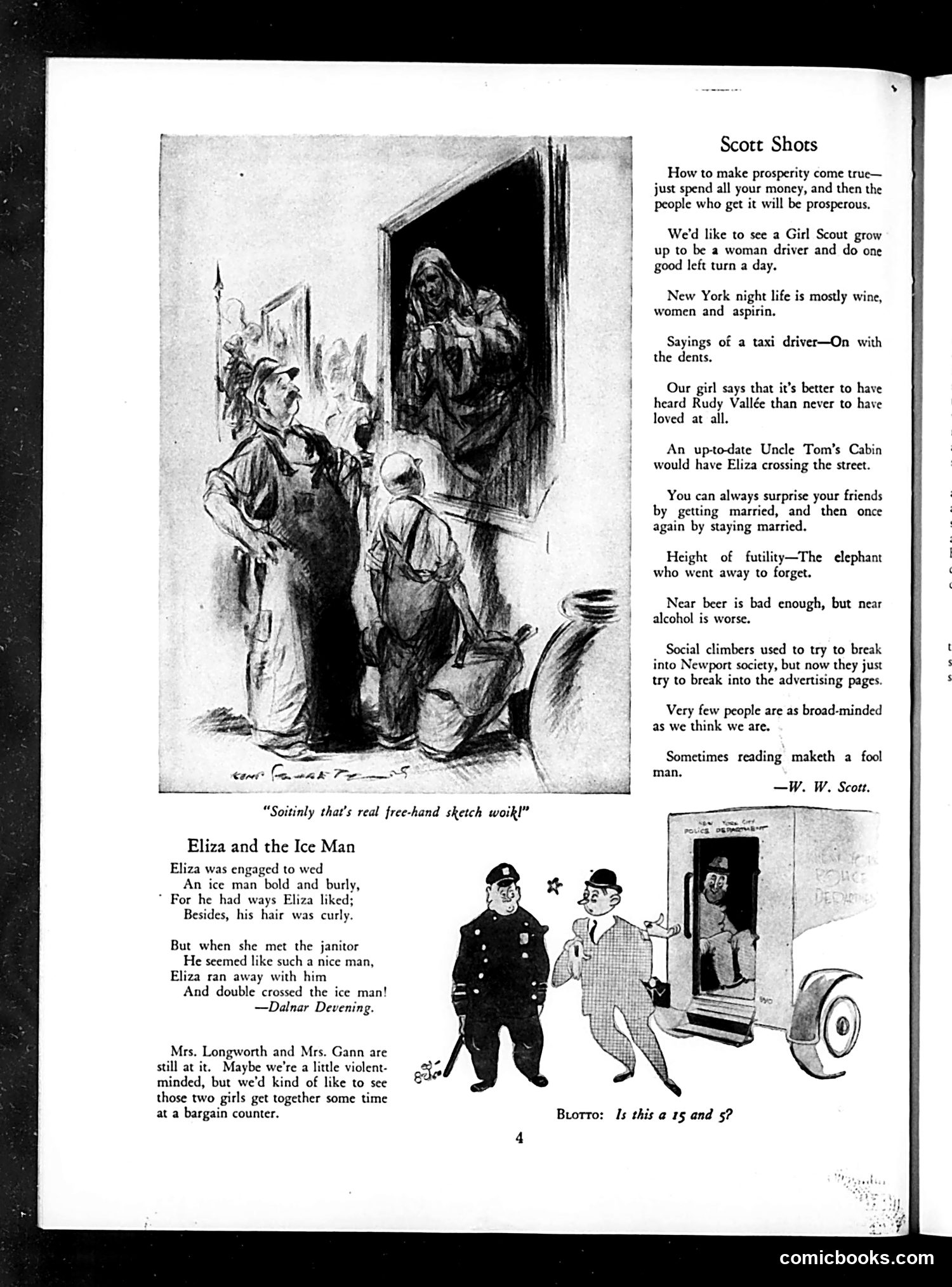
# Scott Shorts & "Eliza and the Ice Man" This page contains humor columns and verses by W.W. Scott, plus a poem by Dalnar Deecning. **"Eliza and the Ice Man"** is a humorous poem about a woman engaged to marry an ice vendor, but who runs away with the janitor instead. The verse plays on class assumptions and romantic irony—she abandons her respectable fiancé for someone of lower social standing. **The top cartoon** shows what appears to be people viewing artwork or a sketch, with someone commenting on its quality as "real free-hand sketch work"—likely satirizing art criticism or pretension. **Scott's "Shorts"** are brief satirical observations on contemporary American life: Girl Scouts, New York nightlife, taxi drivers, marriage, wealth, and social climbing. The final item notes that "reading maketh a fool man," mocking intellectual pretension.
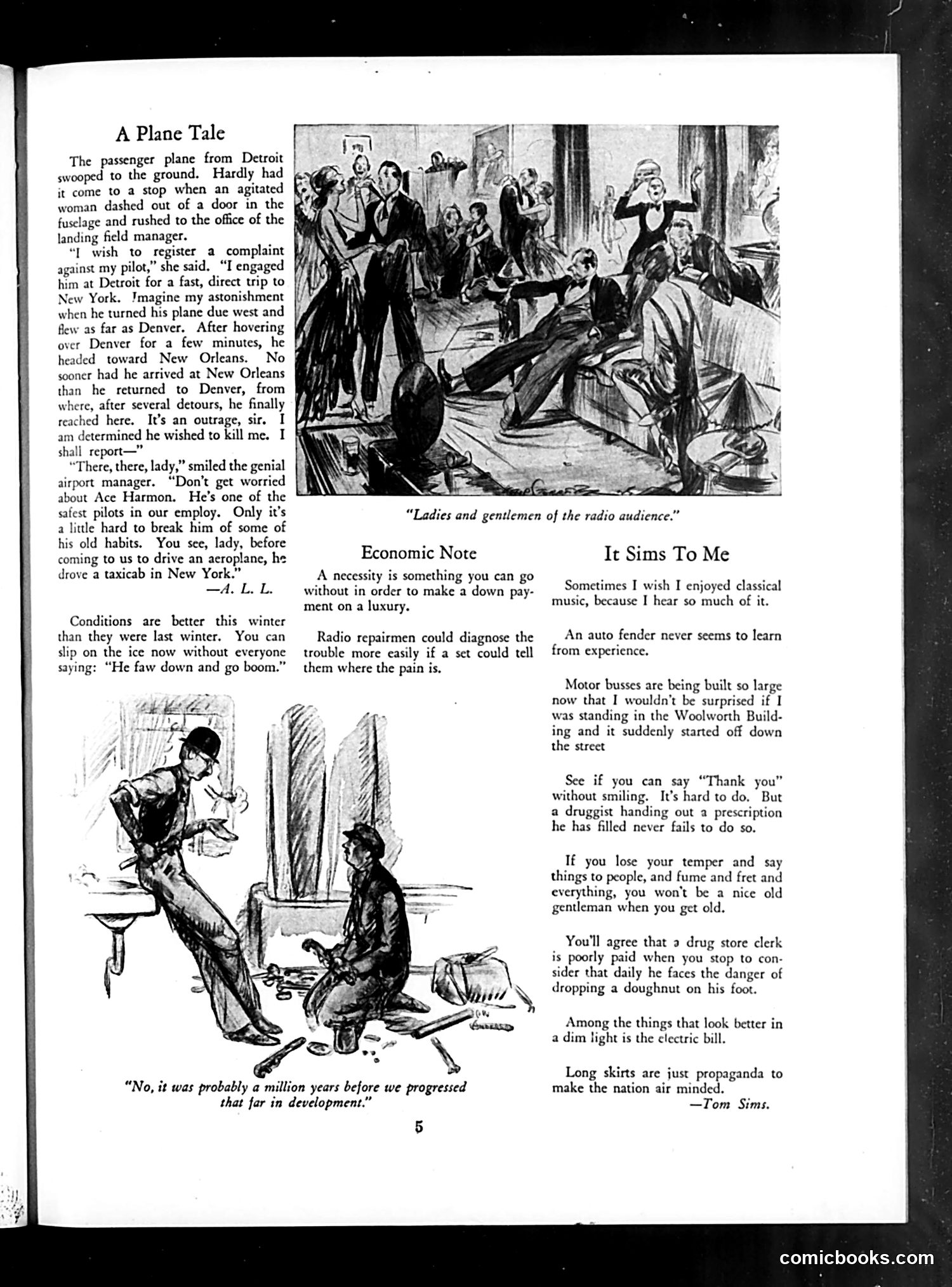
# Explanation for Modern Readers This page contains three distinct pieces: 1. **"A Plane Tale"** (top): A humorous anecdote about an erratic pilot named Ace Harmon who, hired for a direct Detroit-to-New York flight, inexplicably detoured to Denver and New Orleans before returning. The joke satirizes unpredictable, dangerous early aviation practices when pilot accountability was minimal. 2. **Lower cartoon**: Shows two figures (appears to be a plumber and worker) with the caption "No, it was probably a million years before we progressed that far in development"—likely mocking slow technological advancement or incompetent workmanship. 3. **"It Sims To Me"** (right): A humor column by Tom Sims offering social observations about modern life (buses, drugstores, politeness)—light satirical commentary on everyday behavior and commercialism.
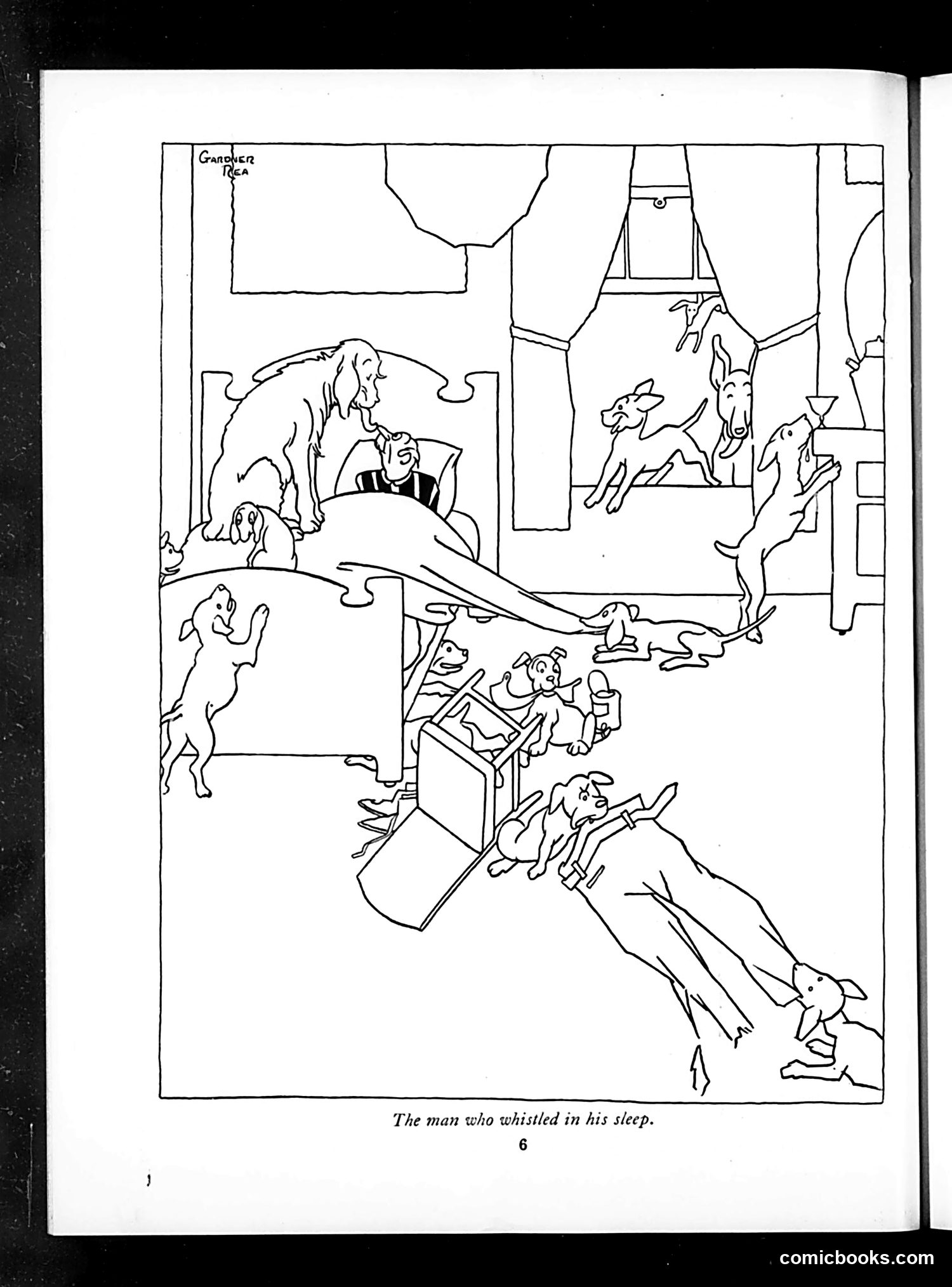
# Analysis This is an illustration titled "The man who whistled in his sleep" (page 6). The cartoon depicts a chaotic household scene where a sleeping man in bed is whistling, causing numerous dogs throughout the home to become wildly agitated and misbehave. Dogs are jumping on furniture, running through rooms, and generally creating mayhem in response to the whistling sound. The satire appears to be about unintended consequences—how a seemingly innocent action (whistling while asleep) can trigger disproportionate chaos. It's a humorous commentary on how one person's behavior can inadvertently disrupt an entire household, likely poking fun at domestic life and the unpredictable nature of family (or in this case, pet) dynamics. The joke relies on the visual humor of widespread disorder stemming from one simple act.
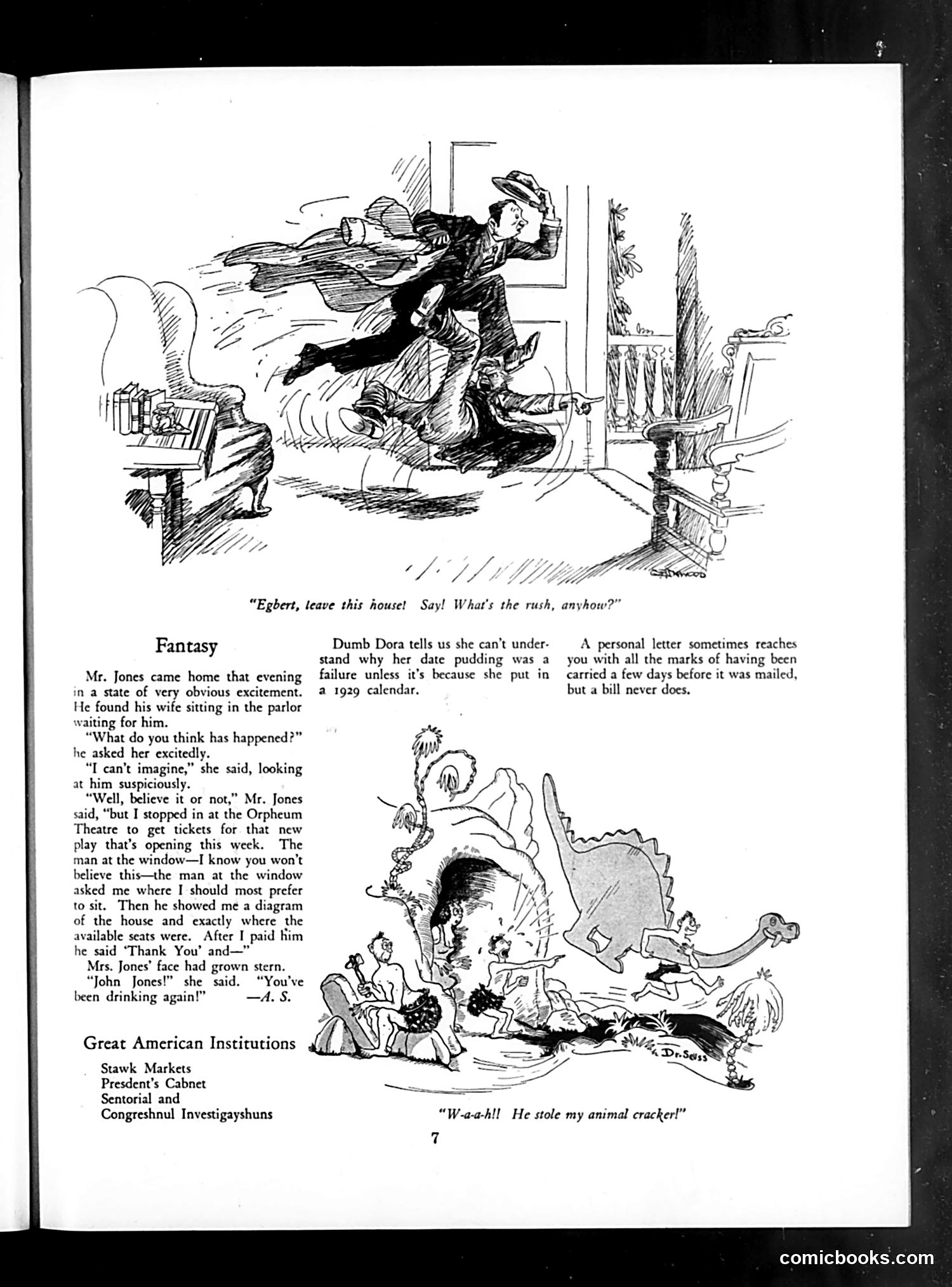
# Analysis This page contains two satirical pieces from *Life* magazine: **"Fantasty" (top story):** A humorous domestic anecdote where Mr. Jones claims to have obtained theater tickets from a man at the Orpheum who provided a diagram of available seats. His wife suspects he's fabricated this story, calling him out for drinking. The humor lies in the absurdity of receiving such detailed assistance from a stranger—a mild satire on either gullibility or marital deception. **"Great American Institutions":** A list mockingly labeling "Stark Markets," "President's Cabinet," "Senatorial and Congressional Investigayshuns" as supposedly great American institutions—satirizing their actual ineffectiveness or corruption. The two cartoons illustrate these pieces with exaggerated, slapstick imagery typical of early 20th-century comic illustration.
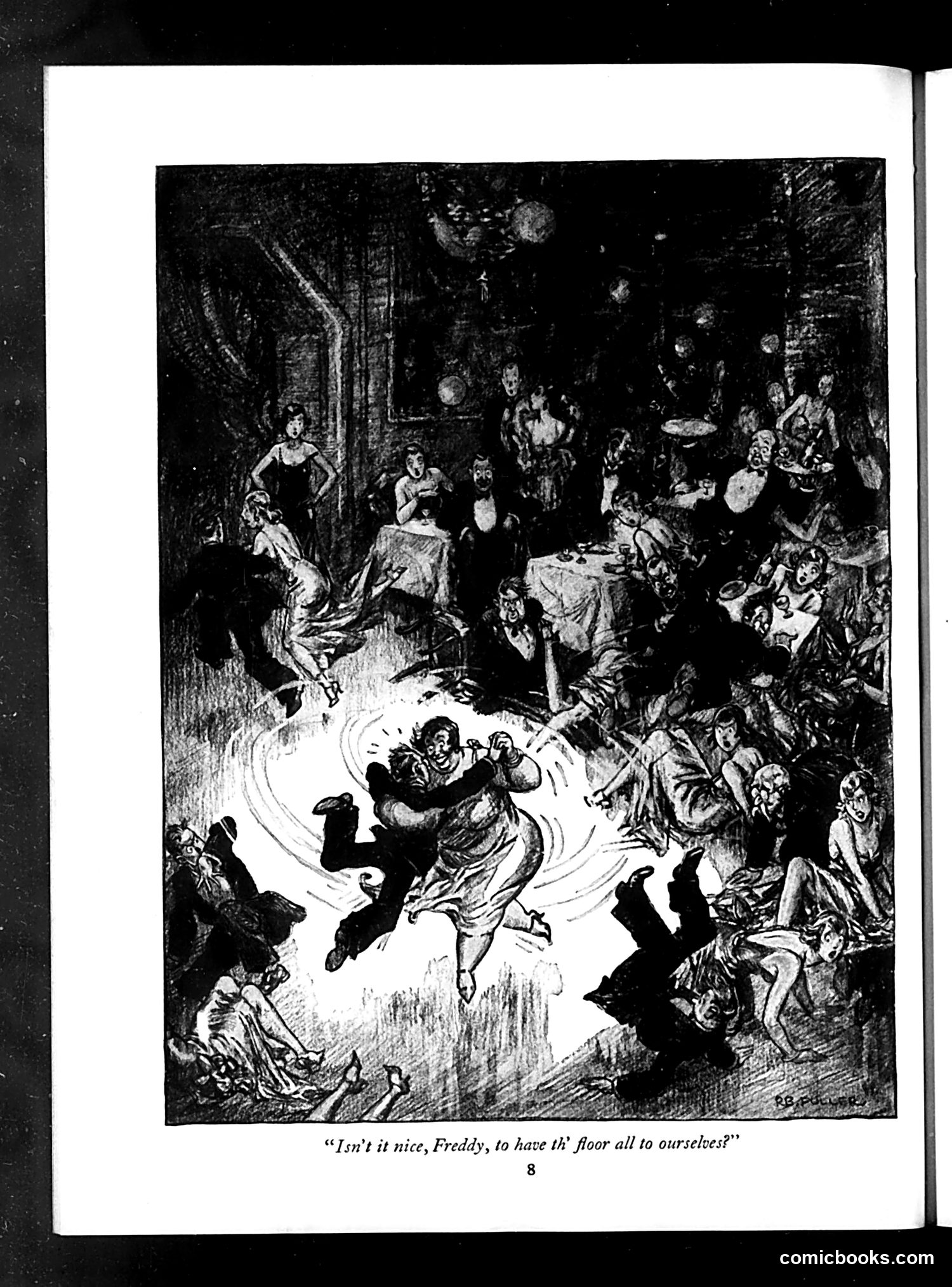
# Analysis This is a single-panel cartoon depicting a crowded ballroom or dance scene. The caption reads: "Isn't it nice, Freddy, to have th' floor all to ourselves?" The satire is visual irony: two figures dance in the center on what appears to be an empty, glowing floor, while they're actually surrounded by a large crowd of onlookers pressing in from all sides. The joke comments on a couple's self-absorption or delusion—they believe they have privacy and exclusivity ("all to ourselves") despite being in a packed, public venue with numerous spectators watching them. This reflects early 20th-century social commentary about vanity, obliviousness, or the illusion of privacy in crowded modern social spaces. The crowded, chaotic rendering emphasizes the contrast between the dancers' perception and reality.
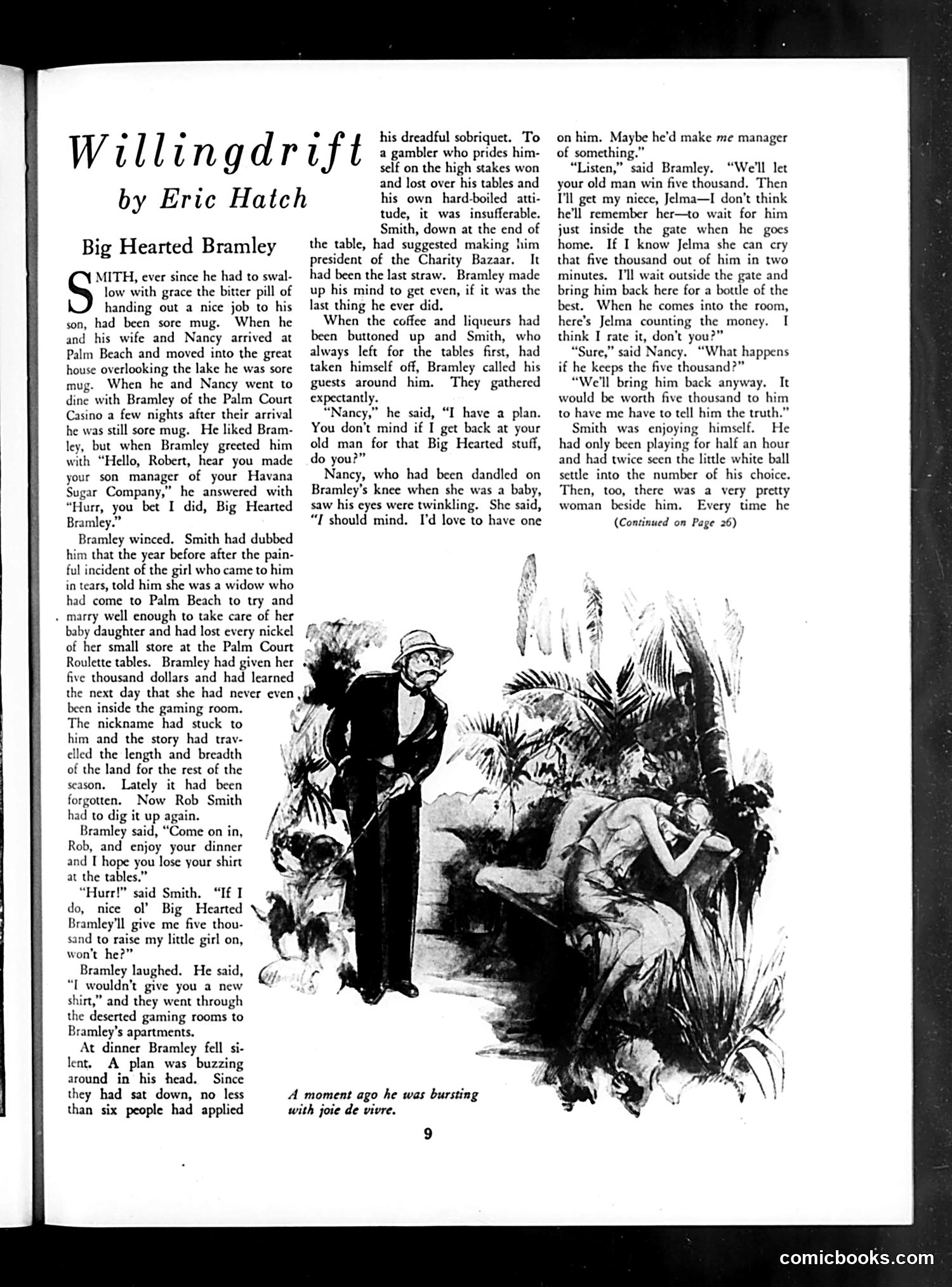
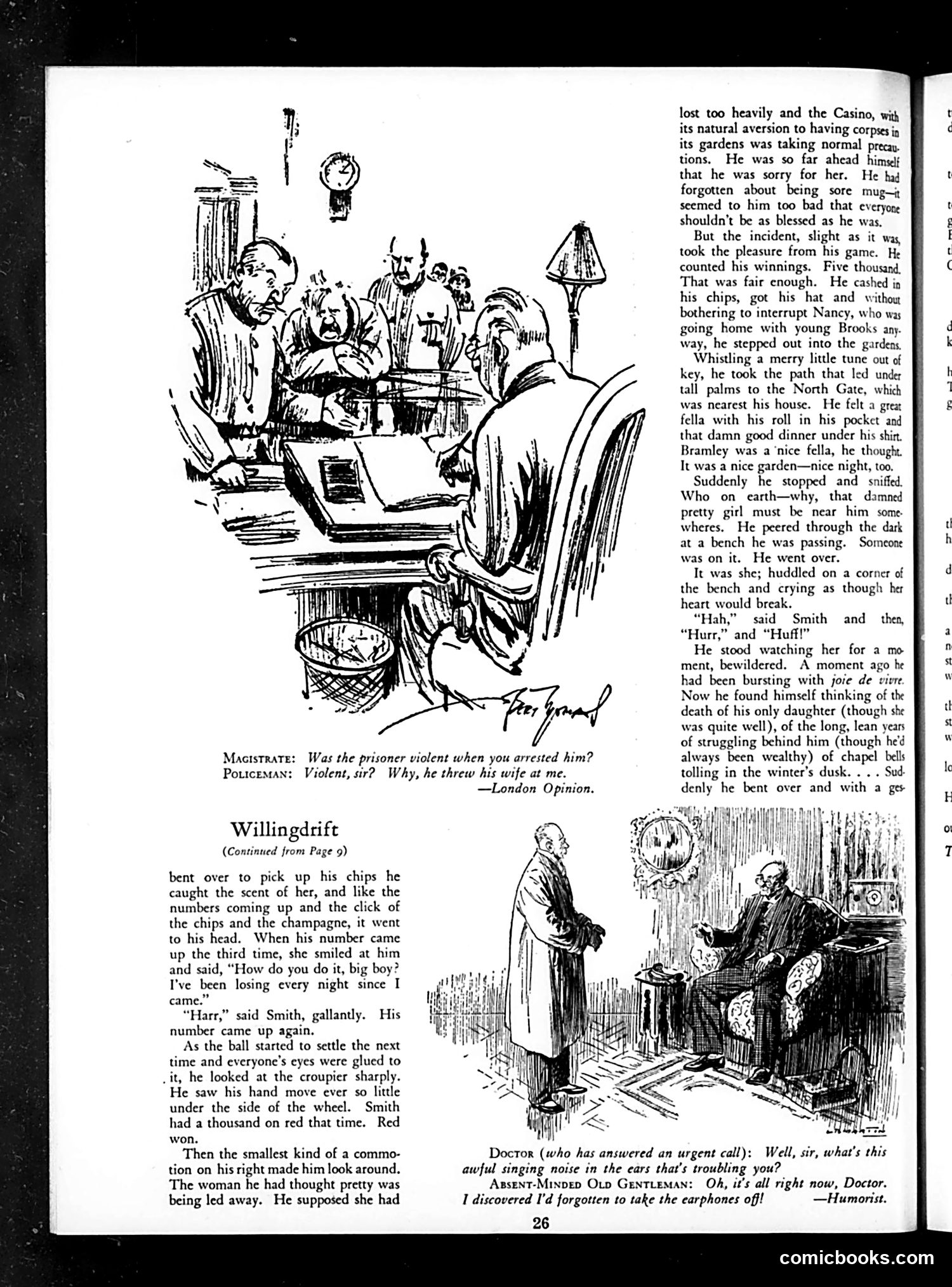
# "Willingdrift" by Eric Hatch - Page Analysis This is a short story page, not a political cartoon. The narrative concerns "Big Hearted Bramley," a wealthy Palm Beach resident who gambles at an exclusive club. Rob Smith, a club employee, attempts to manipulate Bramley by fabricating a sob story about a fictional widow and orphaned daughter needing five thousand dollars, hoping to extract money from the generous gambler. The accompanying illustration shows a man in a hat meeting a woman in tropical surroundings, depicting the moment Bramley is "bursting with joie de vivre"—presumably when Smith's scheme is about to be executed. This is straightforward fiction rather than social satire or political commentary. The story examines greed, deception, and generosity among the wealthy leisure class.
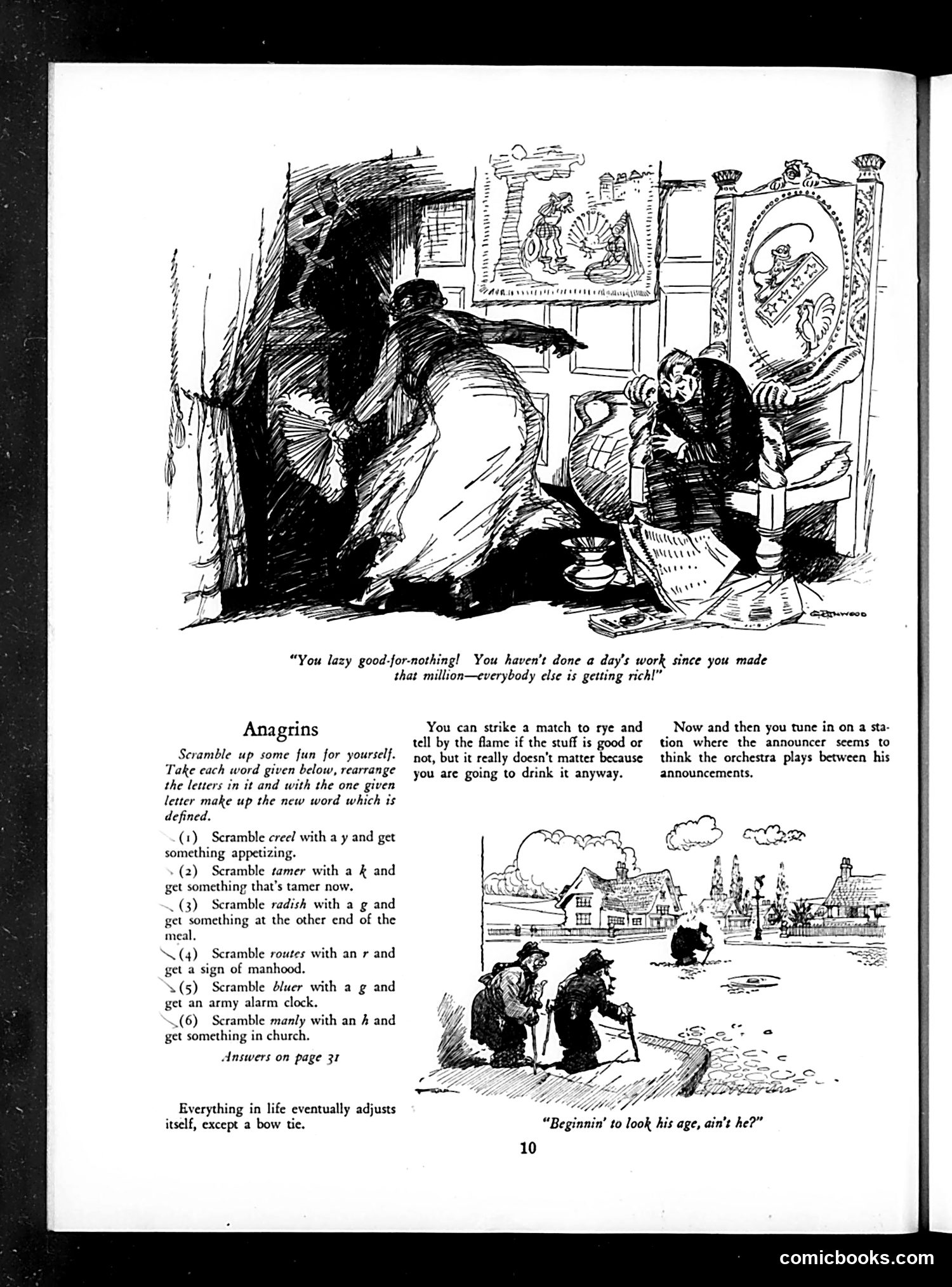
# Cartoon Analysis The top cartoon depicts a wealthy, rotund man lounging in luxury while being scolded by what appears to be his wife or family member. The caption criticizes his idleness: "You lazy good-for-nothing! You haven't done a day's work since you made that million—everybody else is getting rich!" The satire targets nouveau riche indolence during what appears to be an economic boom period. The man's massive wealth has freed him from productive labor, yet he's still criticized for not participating in the general prosperity around him. The joke exposes the contradiction: he's already rich, yet society expects continuous wealth-building regardless. The page also includes "Anagins" (anagrams), a word puzzle game, and another cartoon below showing working-class figures, demonstrating Life magazine's mix of humor, satire, and entertainment content typical of early 20th-century American humor magazines.