A complete issue · 36 pages · 1930
Life — January 3, 1930
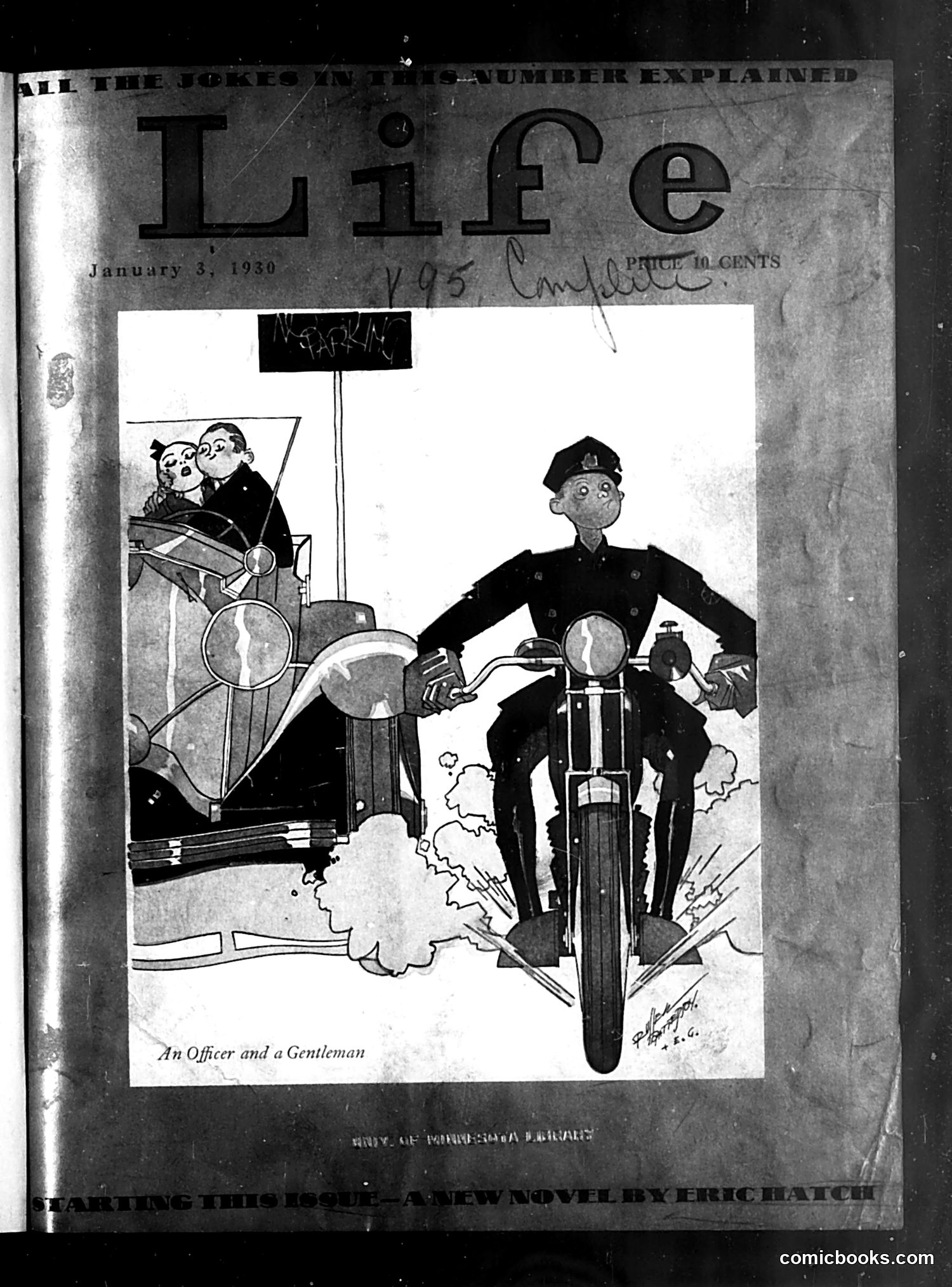
# Analysis of Life Magazine Cover, January 3, 1930 This cover illustrates "An Officer and a Gentleman"—likely referring to the contrast between law enforcement and civilian conduct. The policeman on a motorcycle represents authority, while the elegantly-dressed gentleman in the car represents wealth and status. The satire appears to critique class-based justice: despite the officer's presence, the wealthy motorist seems confident or untroubled, suggesting that affluent individuals face different treatment than ordinary citizens when it comes to traffic laws or other violations. This reflects 1930s concerns about whether wealthy Americans could evade consequences that poorer citizens couldn't. The handwritten annotation and magazine's subtitle ("All the Jokes of the Number Explained") indicate this was a humorous puzzle-style publication.
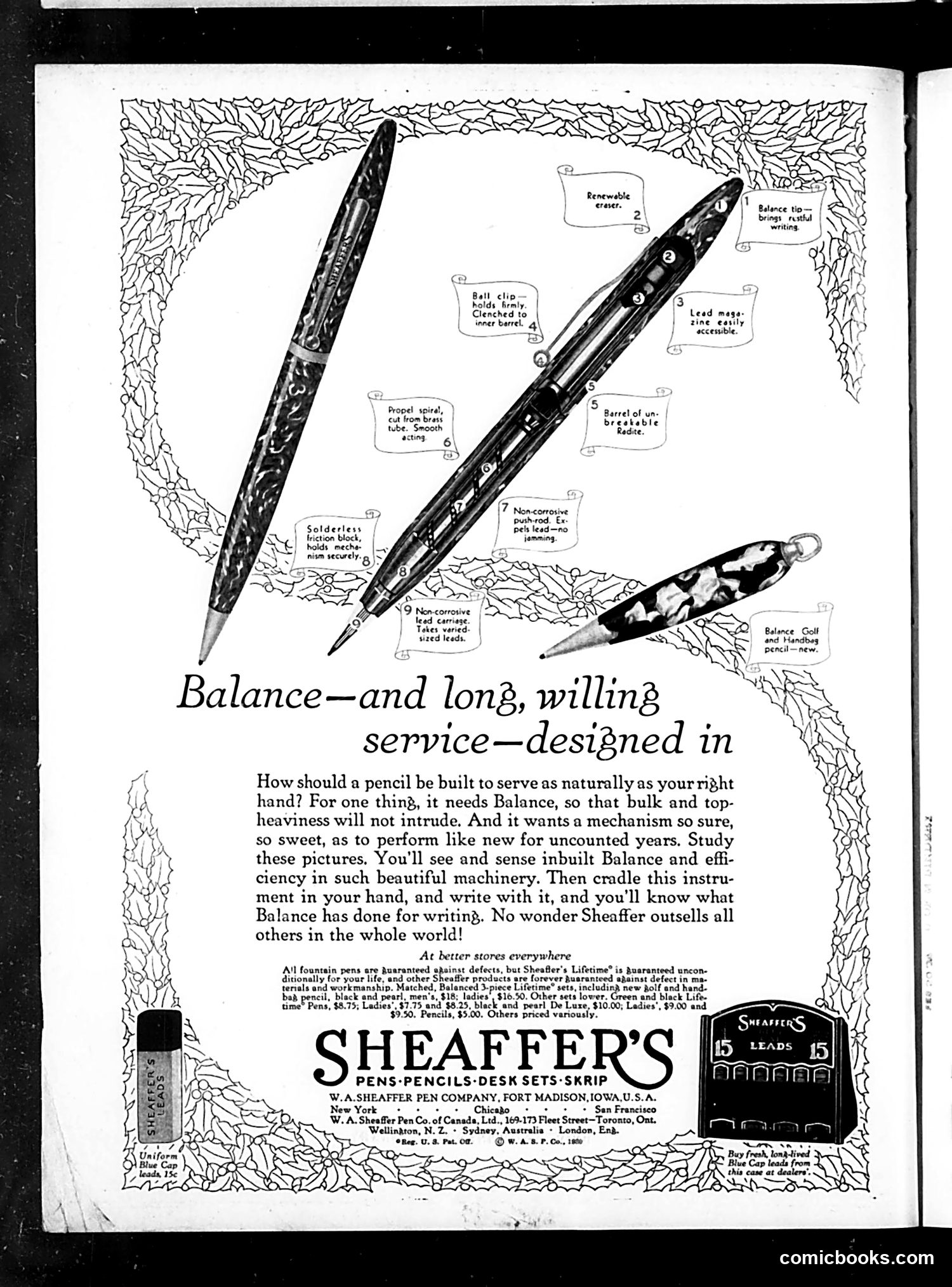
# Analysis This is **not a cartoon or satirical content**—it's a **straightforward advertisement** for Sheaffer's fountain pens and pencils. The page shows three writing instruments with detailed mechanical annotations highlighting their features: balance, durable construction, and smooth writing performance. The ad emphasizes engineering quality through labeled callouts identifying components like "ball slip," "lead cage," and "non-corrosive materials." The accompanying text celebrates the "Balance" design principle, arguing that a well-engineered pen should feel natural in hand and perform reliably for years. The ad promises Sheaffer pens outperform competitors. This represents typical **early-to-mid 20th century product advertising**, targeting consumers who valued durability and mechanical precision in everyday writing instruments—before ballpoint pens became standard.
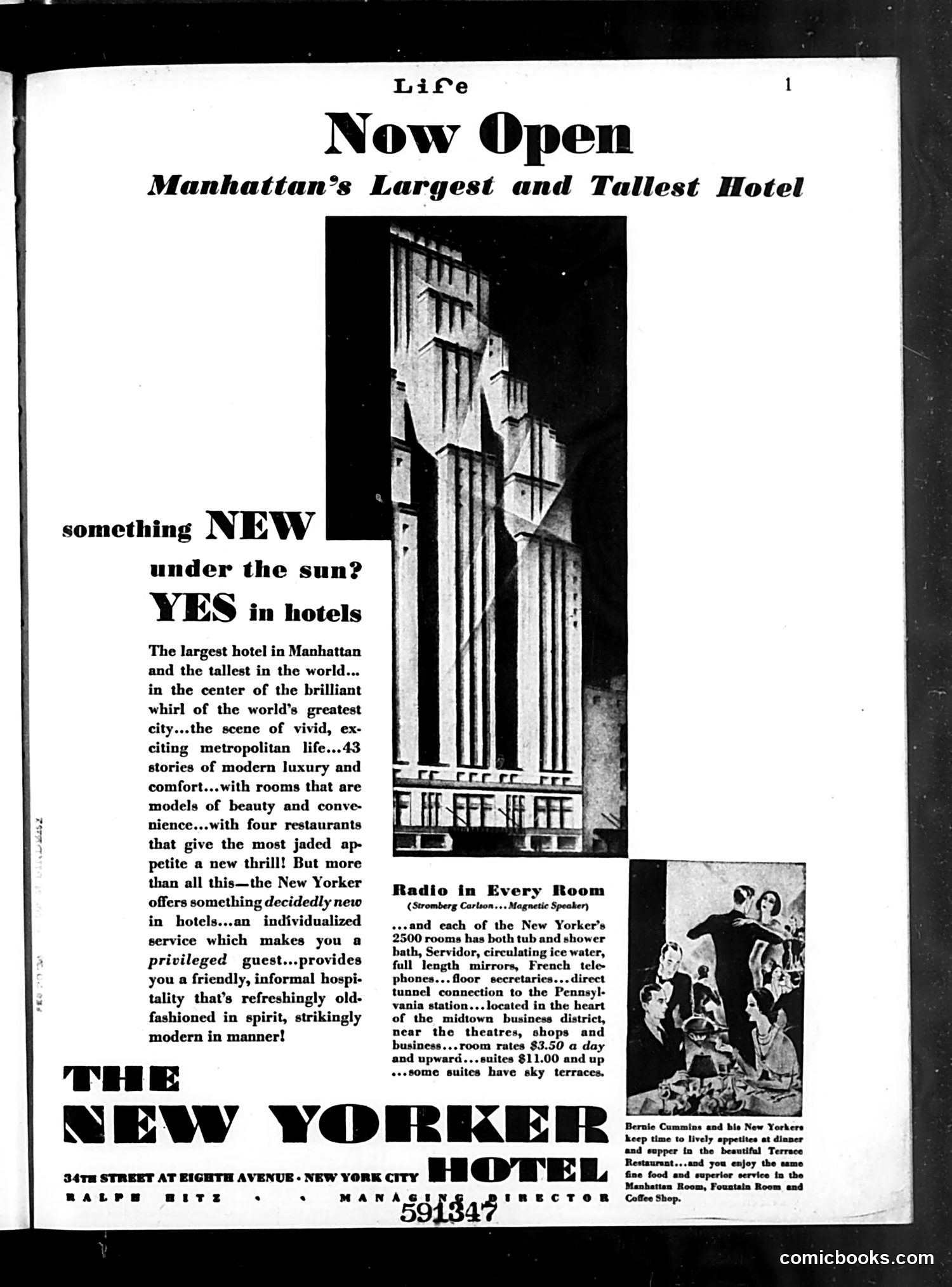
# Analysis This page is **primarily an advertisement**, not political satire. It announces the opening of the New Yorker Hotel in Manhattan, described as "the largest hotel in Manhattan and the tallest in the world." The ad emphasizes novelty and luxury features: 43 stories, 2,500 rooms with modern amenities (radios, private baths, circulating ice water), four restaurants, and sky-terrace suites. Room rates start at $3.50 daily. The right image shows people socializing, likely depicting the hotel's entertainment venues—the caption mentions enjoying "Herold Comedies" at the Terrace Restaurant. The appeal is to comfort-seeking travelers and the aspirational middle class, positioning the hotel as offering "something decidedly new" in hospitality. This reflects 1930s marketing emphasizing technological progress and urban sophistication.
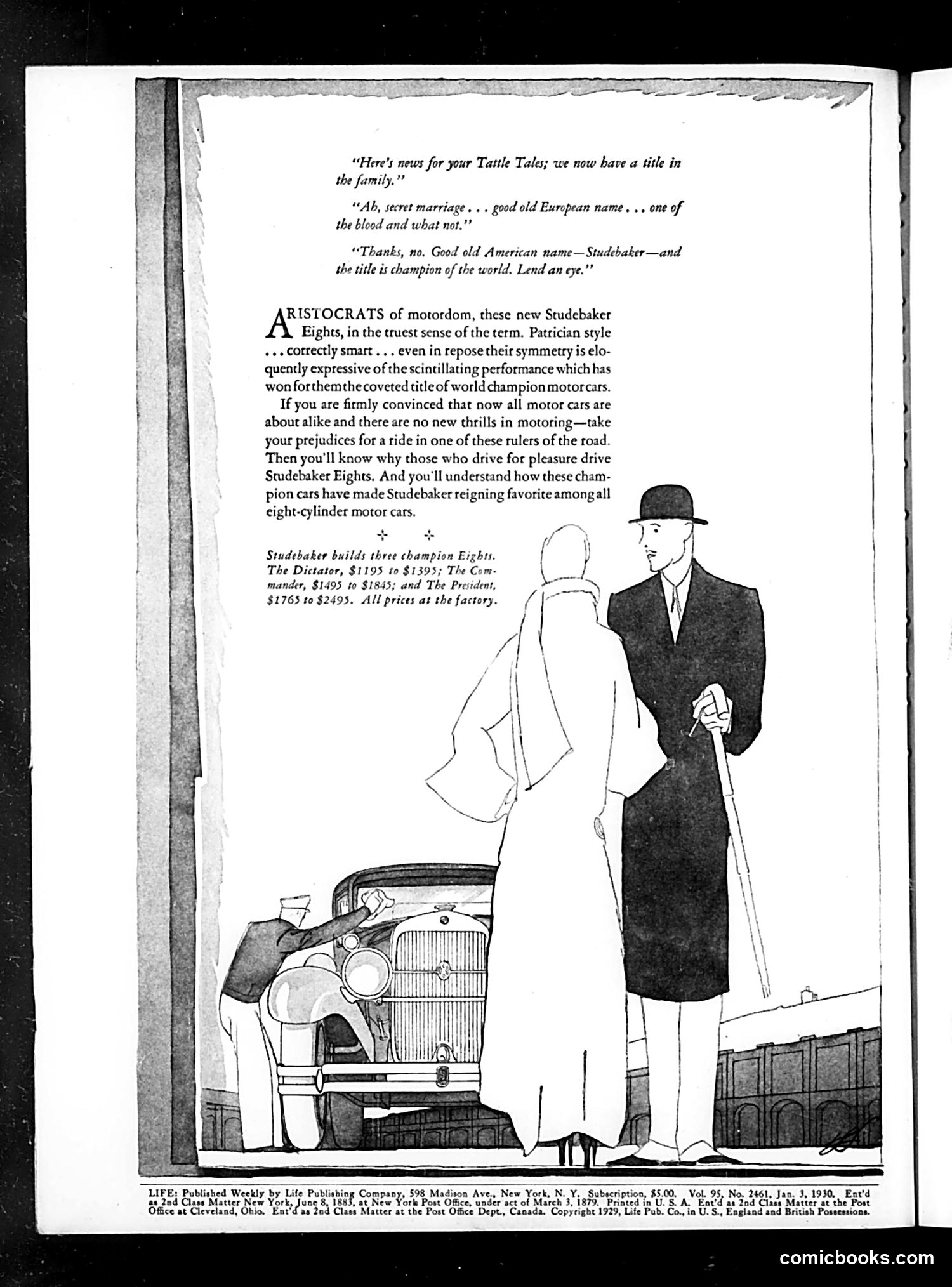
# Studebaker Advertisement, Life Magazine (1930) This is a **car advertisement**, not political satire. It depicts a wealthy couple admiring a Studebaker Eight automobile. The dialogue jokes that acquiring the car gives them a "title in the family"—playing on the woman's apparent aristocratic bearing and the man's formal attire (bowler hat, cane). The ad's humor relies on class aspiration: owning this luxury vehicle supposedly elevates one's social status to "aristocrat" level. The copy emphasizes the car's performance credentials and championship racing titles, positioning it as superior to other eight-cylinder competitors. The piece targets affluent, status-conscious buyers of the late 1920s-early 1930s, when automobile ownership signaled wealth and refinement. Prices ranged from $1,195 to $2,495.
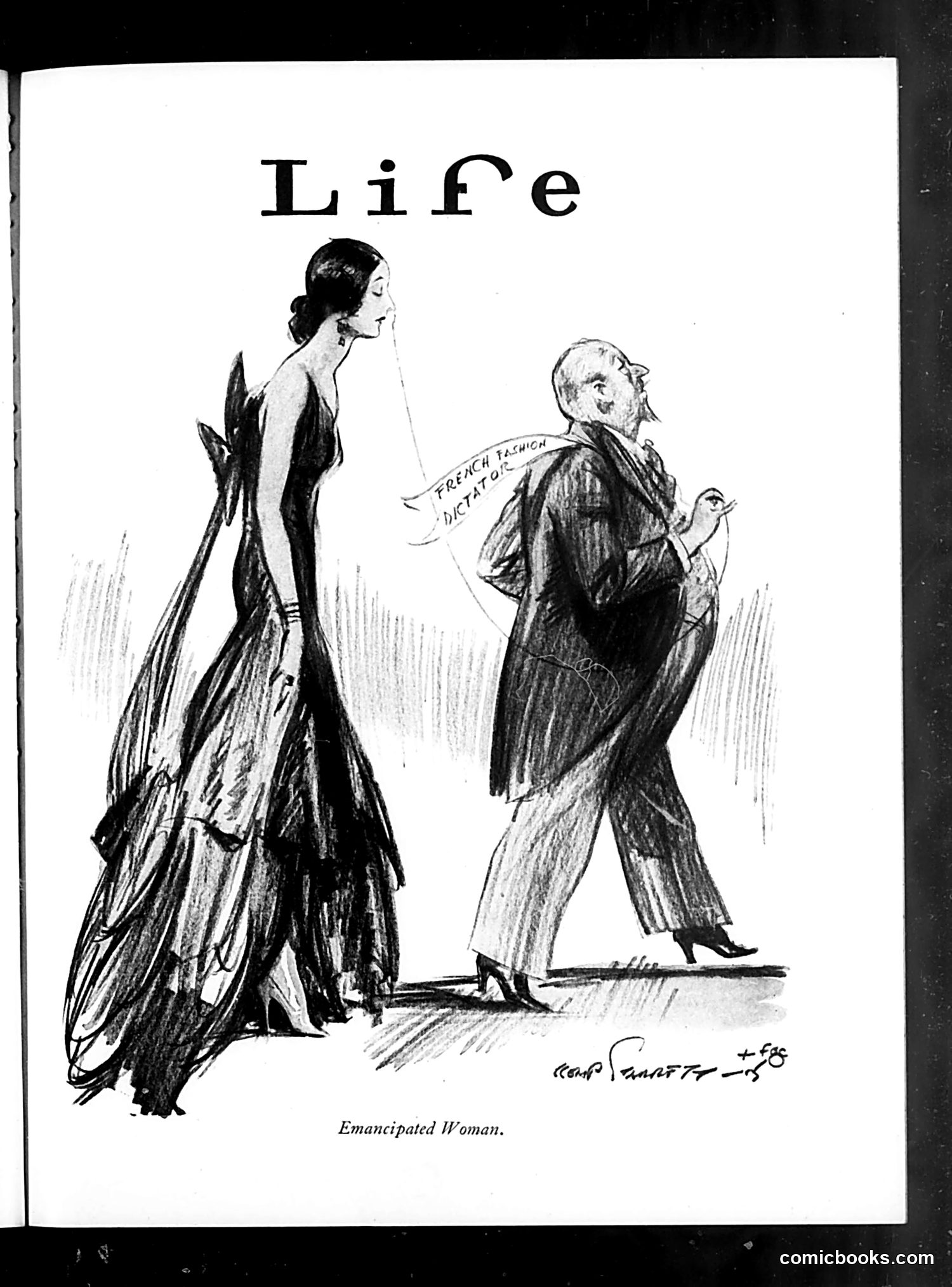
# Analysis of "Life" Magazine Cartoon: "Emancipated Woman" This satirical cartoon critiques the early women's liberation movement. The elegantly dressed woman on the left represents the "New Woman" or feminist advocate, depicted with exaggerated fashionable clothing and a trailing scarf labeled "French Fashion Dictator." The man on the right, appearing bewildered and holding what looks like a leash or string, represents the traditional male figure seemingly controlled or confused by women's emancipation. The satire suggests that women's liberation movements of the era were frivolous, driven by fashion trends rather than substantive ideology. The "French Fashion Dictator" label mocks the association of women's independence with European fashionability, implying the movement was superficial rather than a genuine social movement. The cartoon reflects contemporary male anxieties about changing gender roles.
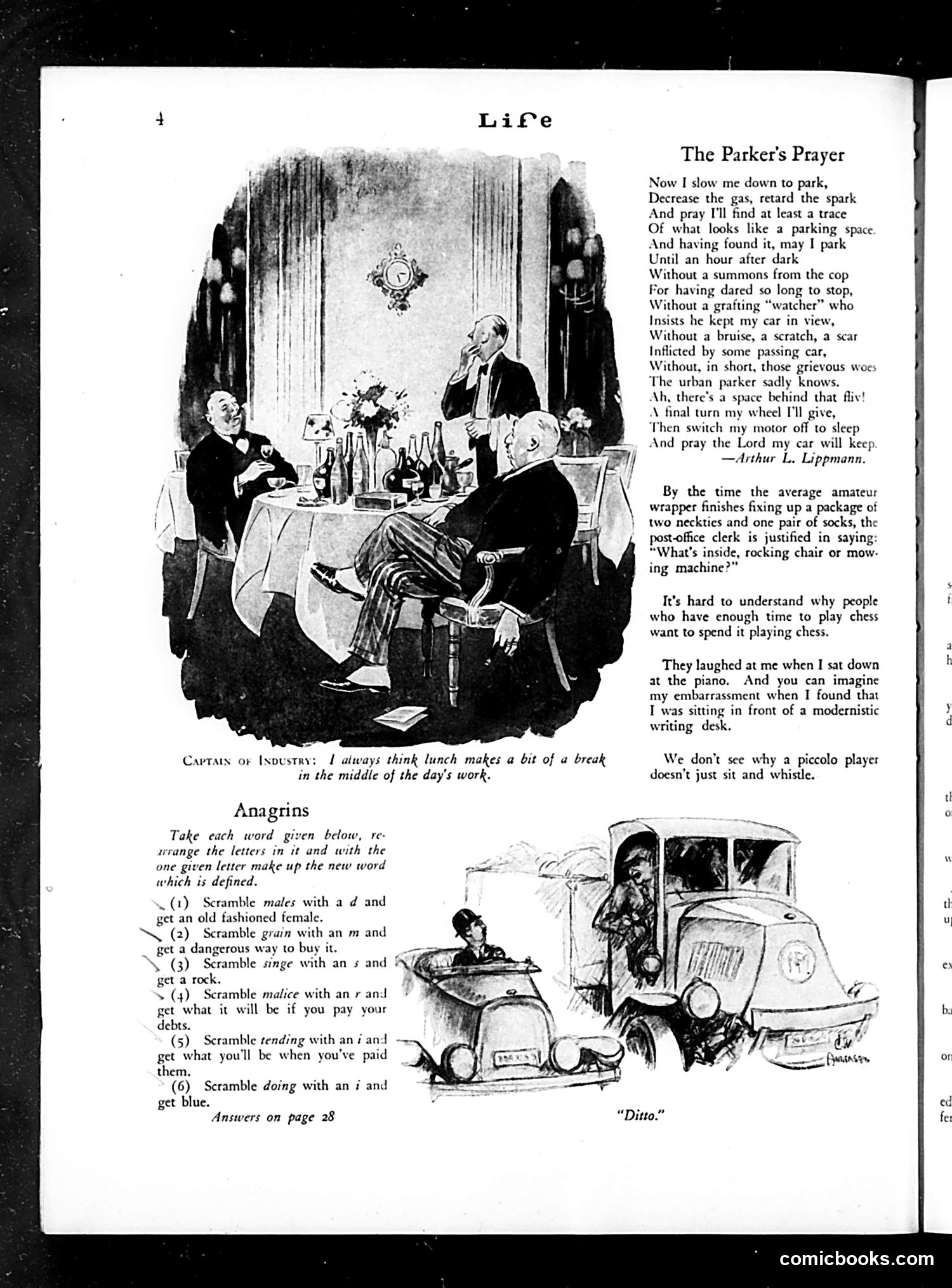
# Analysis of Life Magazine Page 4 **"The Parker's Prayer"** is a humorous poem by Arthur L. Lippmann satirizing the frustrations of urban parking in the early-to-mid 20th century. The poem treats parking spot-hunting as a religious supplication, asking for divine intervention to find available space without traffic violations or vehicle damage. This reflects growing anxieties about automobile congestion in American cities. **"Captain of Industry"** cartoon depicts well-dressed businessmen at lunch, with one remarking that lunch provides "a bit of a break in the middle of the day's work"—satire on how even brief respites structure industrial-era labor. **"Dino"** cartoon shows a small car being swallowed by a larger automobile, likely satirizing traffic dangers or vehicle size disparities. The page mixes humor with social commentary on modern urban life.
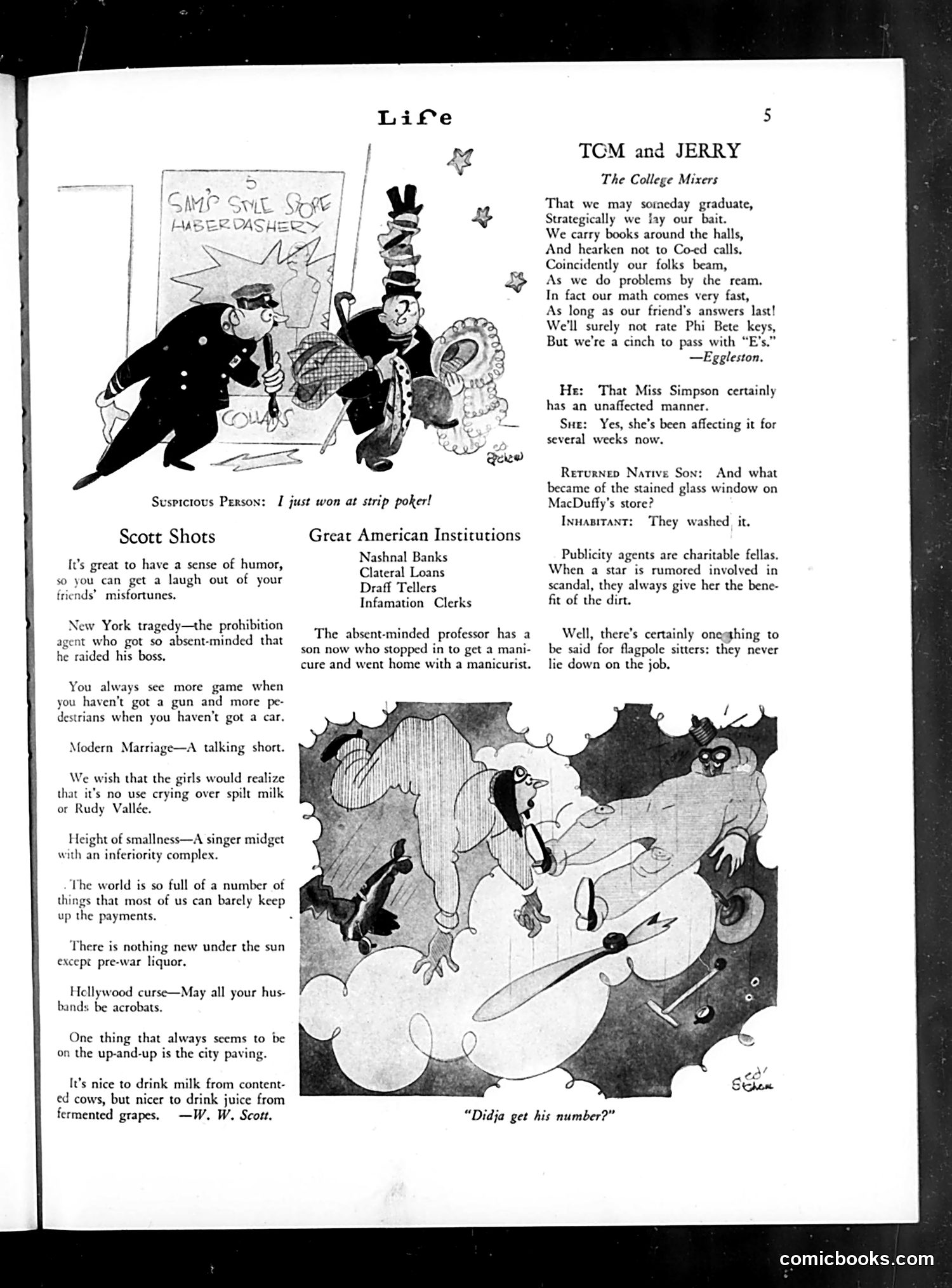
# Analysis of Life Magazine Page 5 **Top Cartoon ("Suspicious Person"):** Two caricatured figures—one appearing to be a police officer or authority figure, the other in formal dress—confront someone over a sign reading "SAMP SYLE STORE / HABBERDASHERY" (likely a haberdashery shop). The joke appears to reference strip poker, suggesting illicit gambling activity discovered during a raid. **Scott Shots Section:** Brief satirical quips about American life—prohibition enforcement, absent-minded professors, modern marriage, and social absurdities. These are observational humor typical of 1920s magazine humor. **Bottom Cartoon ("Didja get his number?"):** Depicts what appears to be a traffic accident or confrontation between a car and pedestrian, with the caption suggesting someone asking for the vehicle's license plate—likely mocking the growing concern over automobile accidents in this era.
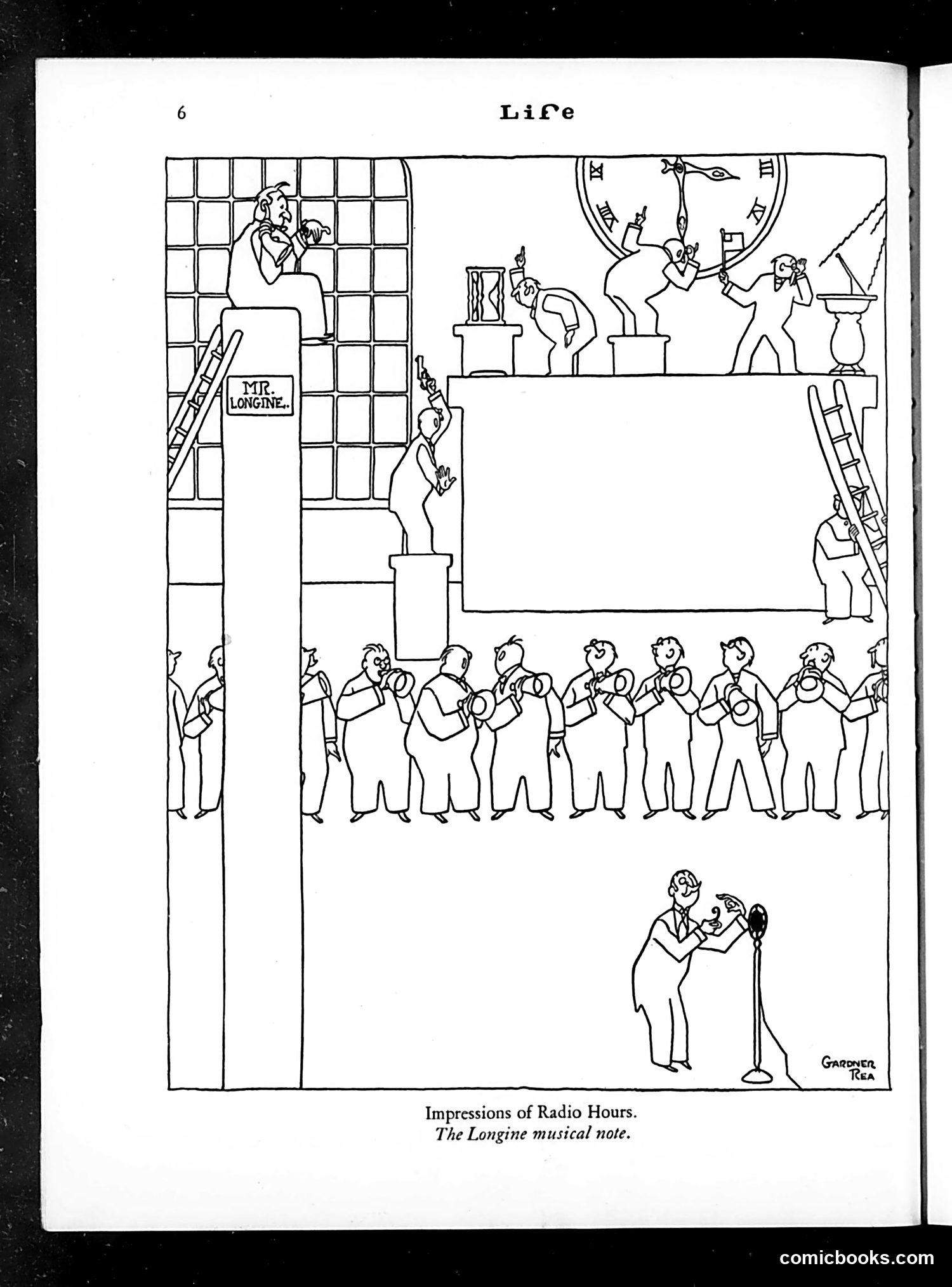
# Analysis of "The Longine Musical Note" This single-panel cartoon satirizes early radio broadcasting. The illustration shows a tall building labeled "M'r LONGINE" with multiple levels of activity: - At ground level: an audience of men holding megaphones - Multiple stories above: performers and musicians at various heights - At the top: a large clock face - Ladders connecting the levels - Bottom right: a conductor or announcer at a microphone The title "Impressions of Radio Hours" suggests this depicts the chaotic, multi-layered nature of radio production in the early broadcasting era. "Longine" likely references Longines watches, suggesting the satirical connection between timekeeping and radio broadcasting schedules. The absurd vertical stacking of activities mocks the complexity and somewhat disorganized nature of early radio operations.
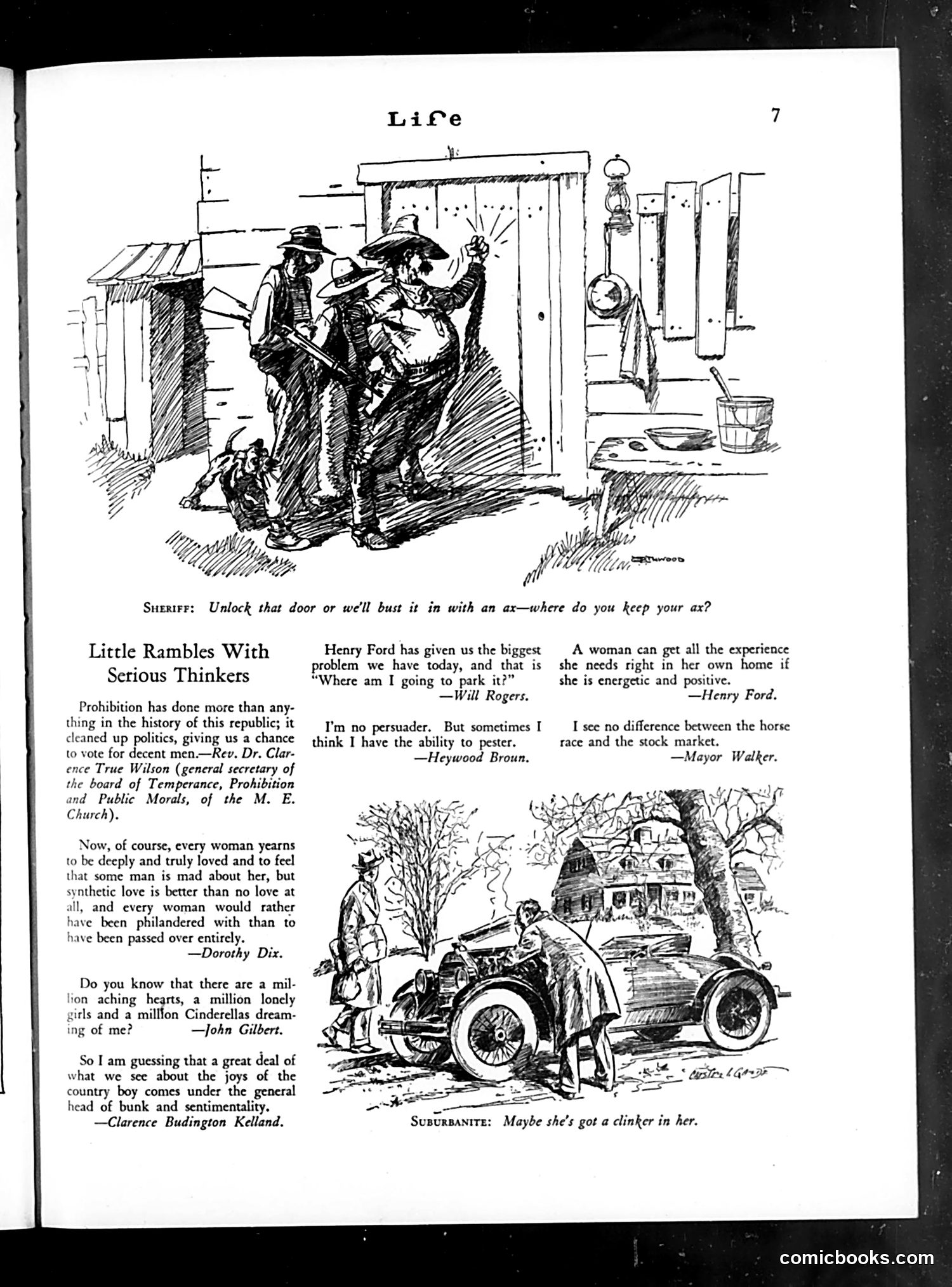
# Analysis of Life Magazine Page 7 This page contains two cartoons and quotations addressing **Prohibition and women's social roles**. The top cartoon depicts a sheriff confronting men in what appears to be an illegal drinking establishment ("bust it in with an ax"), satirizing Prohibition enforcement challenges. The lower cartoon shows a woman with a broken-down car and a man, captioned "Maybe she's got a clinker in her"—a sexist joke implying women are mechanically incompetent or unreliable (a "clinker" meaning something defective). The surrounding quotations from public figures like Henry Ford, Will Rogers, and others debate Prohibition's effects and women's capabilities. The page generally mocks Prohibition's difficulty in enforcement while reinforcing stereotypes about women's limitations, reflecting 1920s-era cultural tensions around both alcohol regulation and changing women's roles.
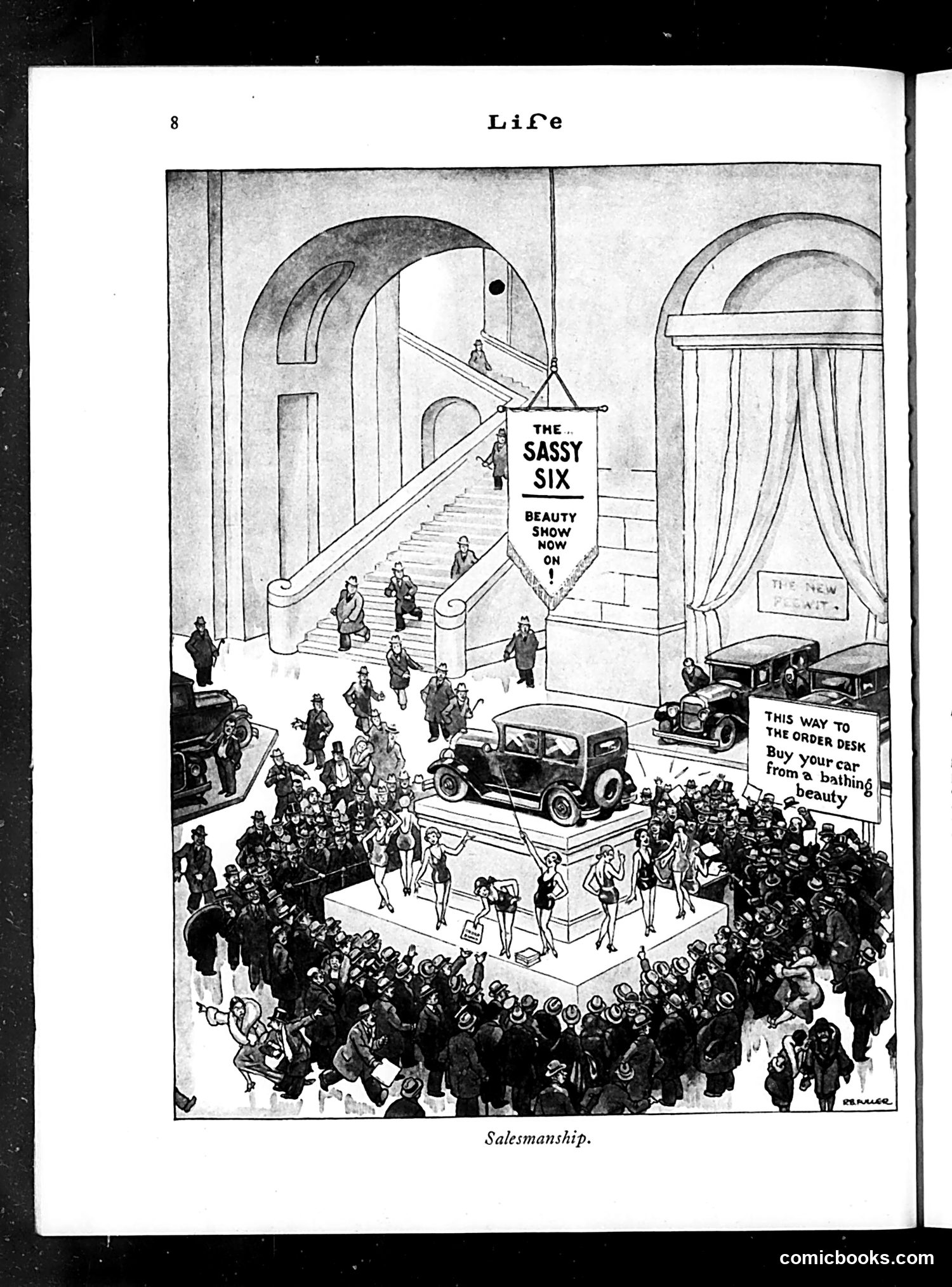
# Analysis This is a satirical cartoon titled "Salesmanship" depicting a grand, Art Deco-style lobby or showroom. The central spectacle features "The Sassy Six"—a beauty show being promoted—with scantily-clad women displayed on a platform as the main attraction. Massive crowds surround them, while automobiles are prominently positioned in the scene. The satire targets aggressive 1920s marketing tactics: retailers used any eye-catching gimmick—here, a beauty pageant—to draw crowds and sell unrelated products (cars). The sign reads "Buy your car from a bathing beauty," mocking how companies exploited novelty and sex appeal to move merchandise, regardless of actual product relevance. The cartoon critiques both the brazenness of such advertising and public eagerness to swarm around spectacle for consumption.
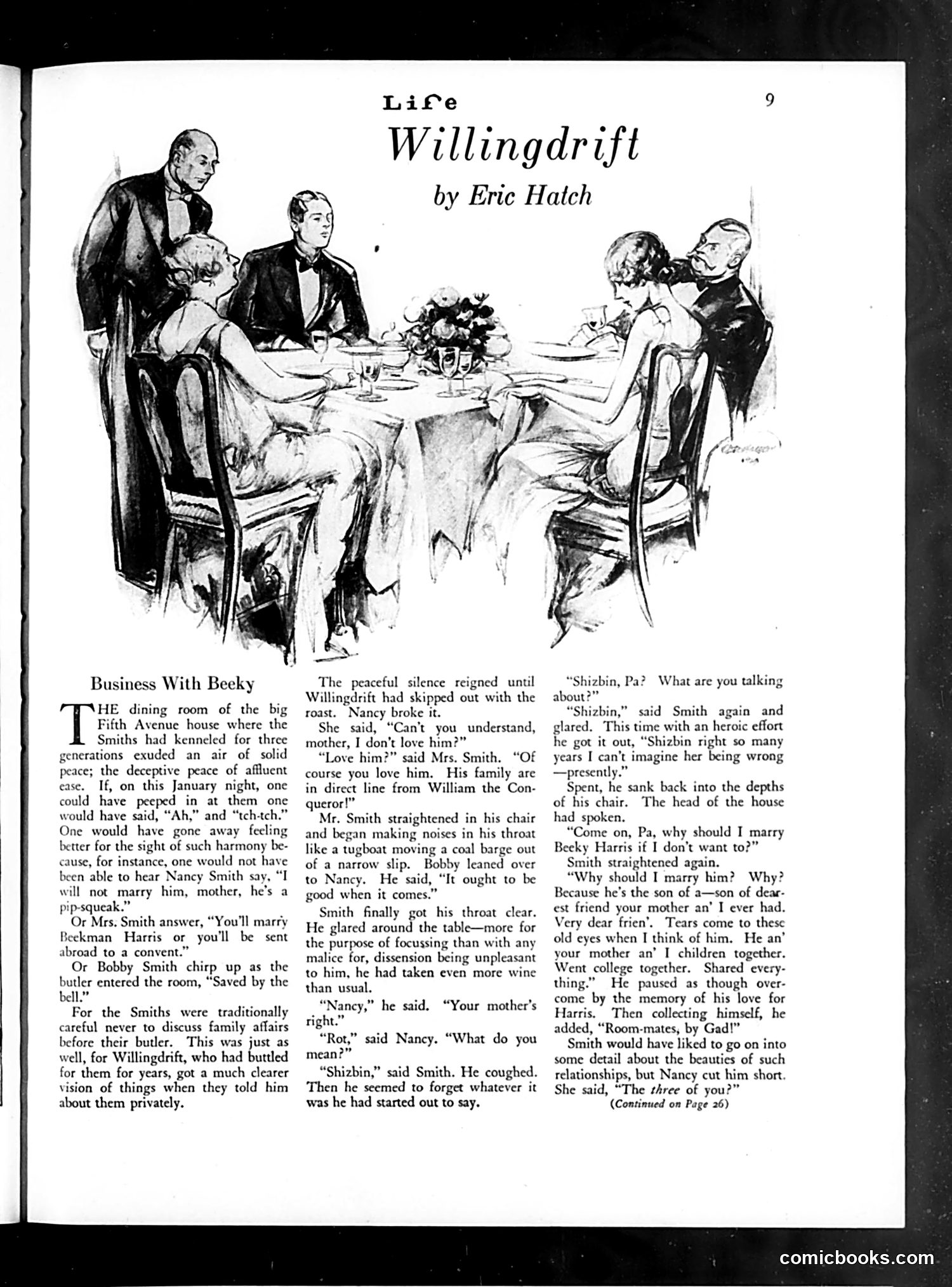
# "Willingdrift" by Eric Hatch - Page Analysis This is a short story illustration, not political satire. The piece depicts an upper-class dinner scene centered on family conflict over marriage. The narrative concerns Mr. and Mrs. Smith's disapproval of their son Bobby's intended marriage to Nancy Harris. The conflict hinges on class differences—Nancy's family background apparently troubles the Smiths, who come from old money ("traditionally credited users to discuss family affairs before their butler"). The humor is social satire about rigid class consciousness among the wealthy. Bobby defends Nancy against his parents' snobbery, while his father makes dismissive remarks. The story explores tension between romantic love and parental social expectations—a common 1920s-30s literary theme about generational values regarding marriage and class. The illustration captures the strained dinner conversation that reveals these tensions.
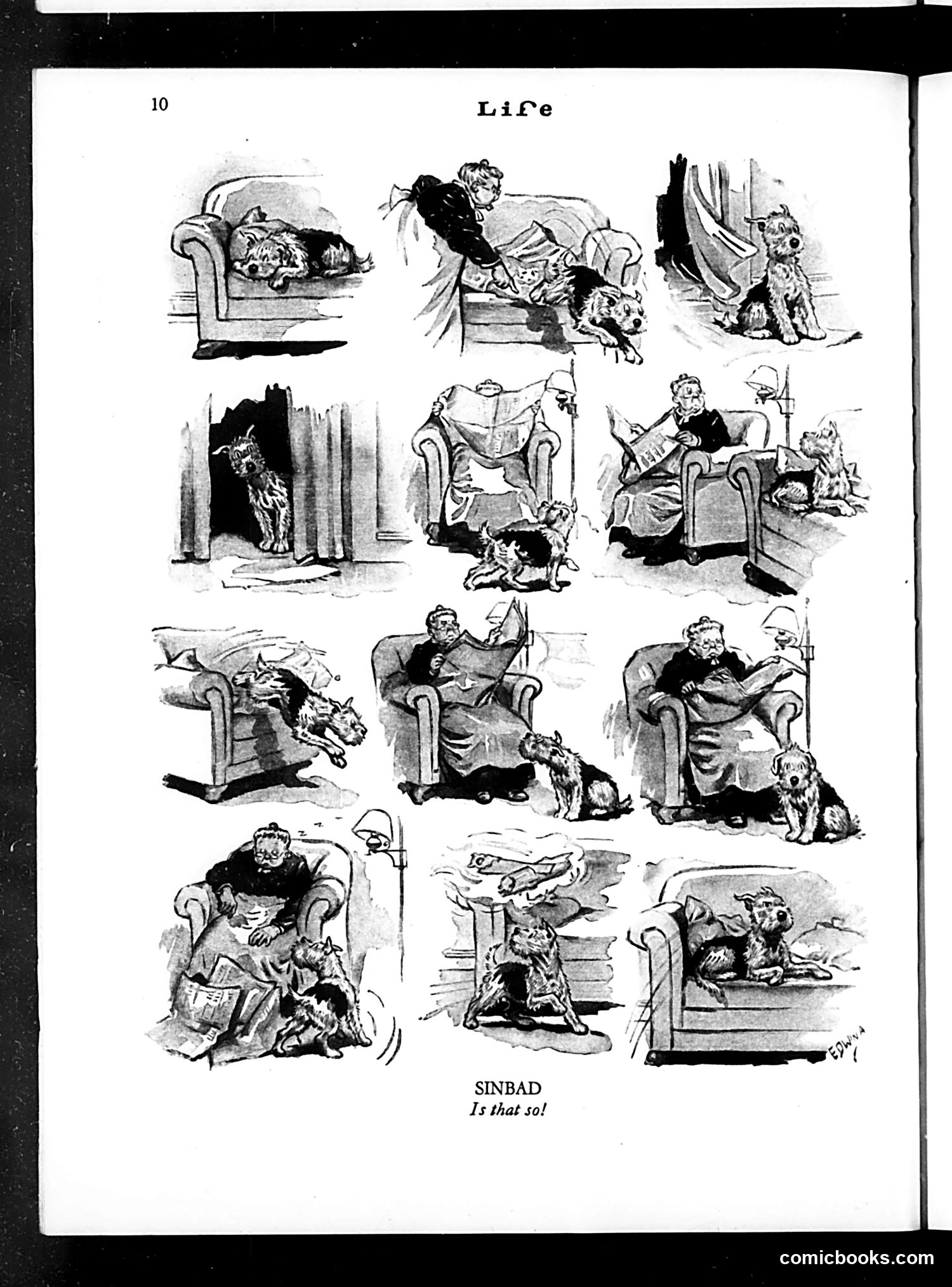
# Analysis This page from *Life* magazine presents a comic strip titled "SINBAD: Is that so!" depicting a series of scenes where a man (Sinbad) interacts with various dogs in domestic settings—primarily armchairs and furniture. The humor appears to center on the dogs' mischievous behavior: they're shown jumping on furniture, stealing items, creating chaos, and generally disrupting the household. The caption "Is that so!" suggests Sinbad is responding incredulously to claims about the dogs' conduct. This is domestic satire about pet ownership frustrations rather than political commentary. The strip mocks the gap between how people imagine their dogs will behave versus actual canine chaos in the home—a relatable theme for contemporary readers with pets.