A complete issue · 37 pages · 1929
Life — December 27, 1929

# Life Magazine Cover Analysis (December 27, 1929) This satirical cover addresses Prohibition-era smuggling at the U.S.-Mexico border. The illustration depicts a stylishly dressed woman at a U.S. Border Customs stop, apparently caught smuggling alcohol across the border. The numerous bottles visible in the lower left—along with the caption "She didn't know it was loaded"—suggests she was unknowingly transporting contraband liquor, likely hidden in her vehicle or luggage. The satire targets the absurdity and widespread violation of Prohibition laws (1920-1933). The fashionable woman represents upper-class Americans who casually participated in illegal alcohol smuggling, viewing it as socially acceptable despite federal law. The "didn't know" excuse mocks the implausible denials common among caught smugglers. This reflects public skepticism about Prohibition's enforceability.
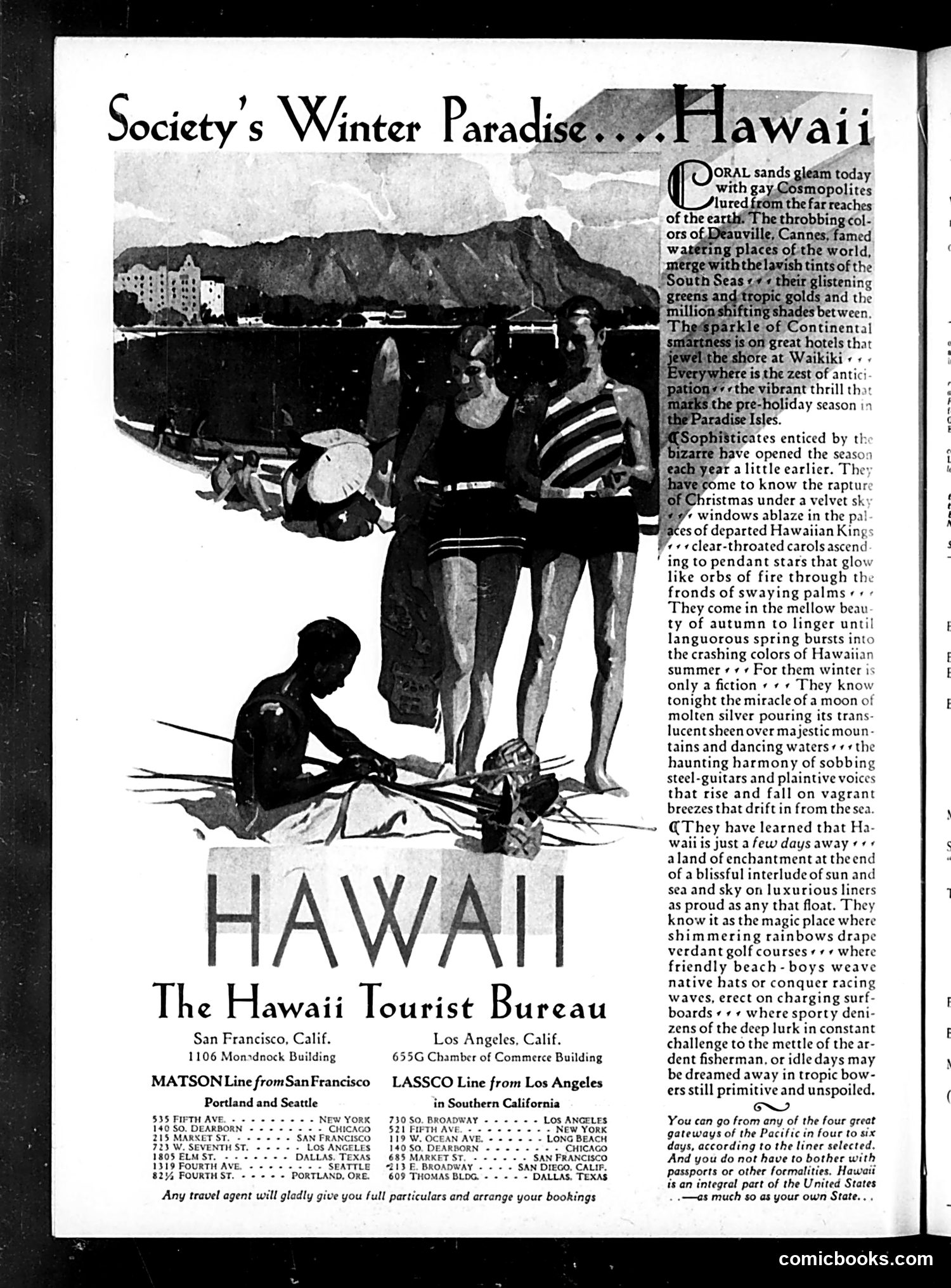
# Analysis This is primarily a **tourism advertisement**, not satirical content. The Hawaii Tourist Bureau placed this full-page ad in Life magazine promoting Hawaii as a winter destination for wealthy Americans. The imagery shows tourists in swimwear enjoying beach activities—surfing, swimming, and socializing—with Diamond Head visible in the background. The text uses romantic language ("winter paradise," "enchantment") to market Hawaii as an escape from cold northern winters. The advertisement emphasizes Hawaii's accessibility via Matson and Lassco shipping lines from California ports, positioning it as an exclusive luxury destination. The prose romanticizes Hawaiian culture ("swaying palms," "Hawaiian Kings") while framing it primarily as an exotic playground for Continental sophisticates seeking pre-holiday leisure. This reflects early 20th-century American tourism marketing that treated Hawaii as an American resort destination.
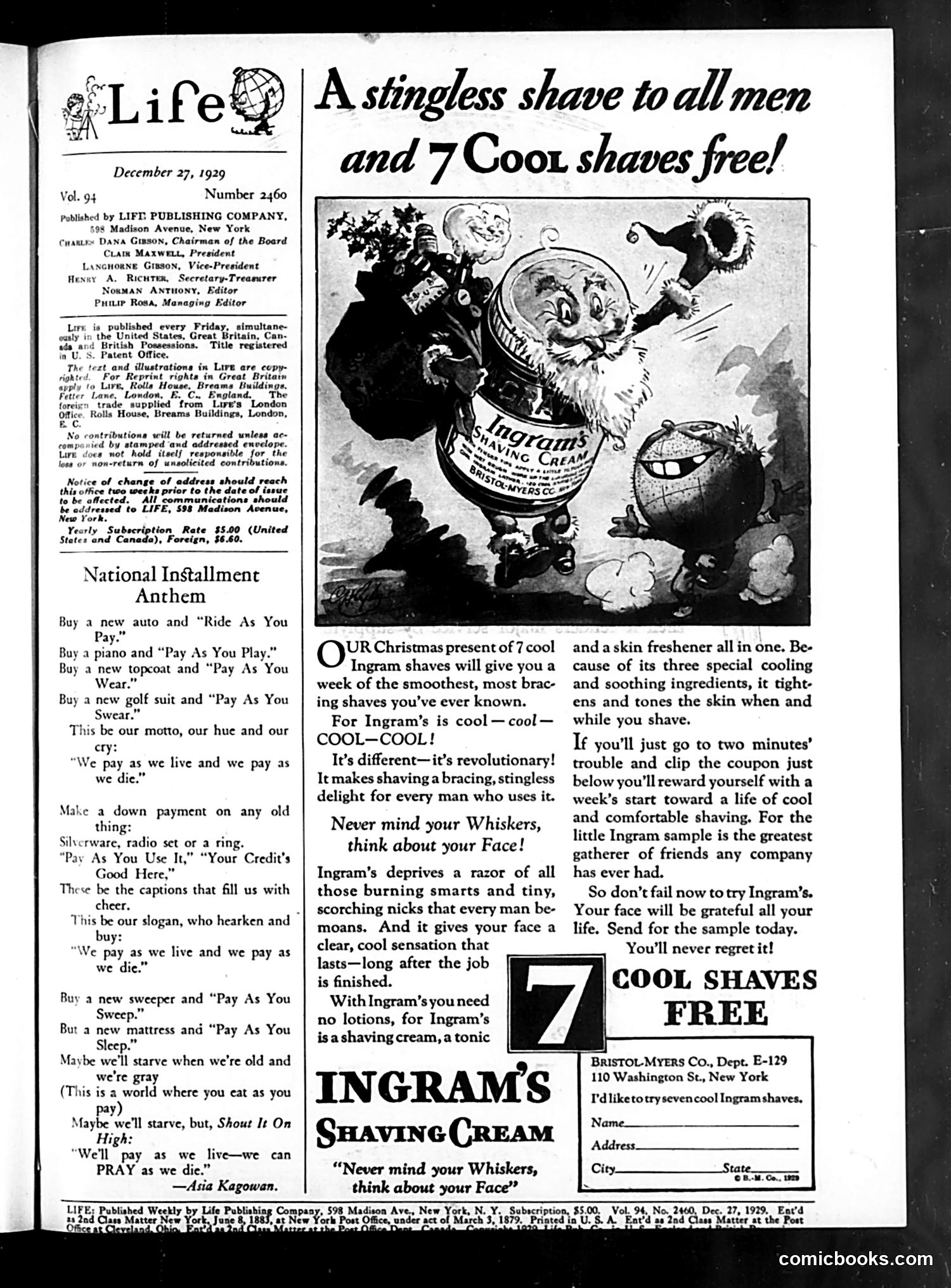
# Analysis This page is primarily a **commercial advertisement**, not satire or political commentary. The central image promotes **Ingram's Shaving Cream**, featuring a cartoonish Santa Claus-like figure emerging from a shaving cream jar, surrounded by decorative clouds and flourishes. The ad's appeal is comedic rather than satirical: it promises "7 Cool shaves free" as a Christmas promotion, emphasizing the product's cooling and soothing properties. The slogan "Never mind your Whiskers, think about your Face" attempts humor by suggesting the cream's skin benefits matter more than beard thickness. The surrounding page content includes a satirical poem about installment buying ("Pay As You Live") and general Life magazine editorial material—typical 1929 magazine filler accompanying advertisements.
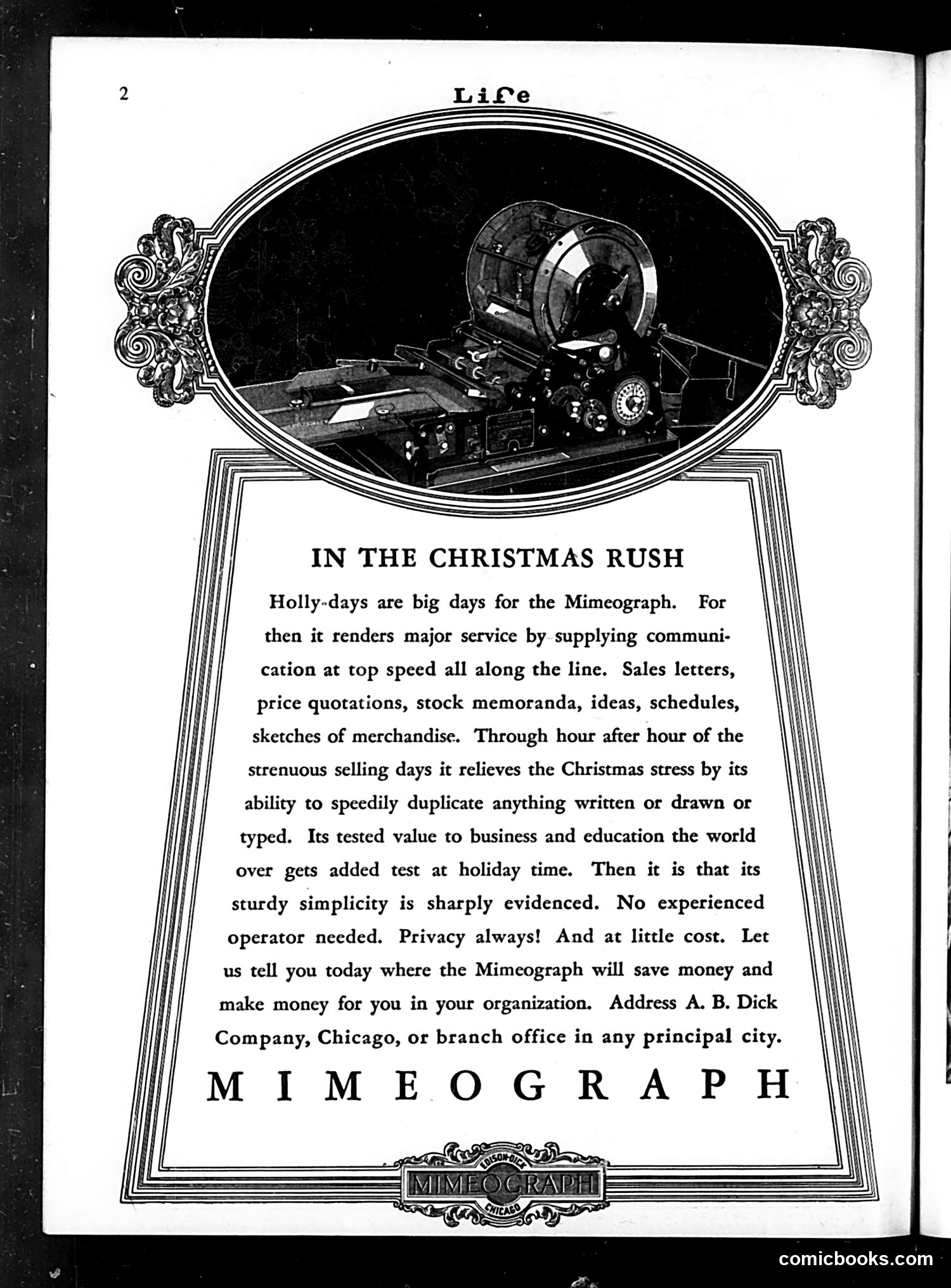
# Analysis This is primarily a **product advertisement**, not satirical content. It promotes the Mimeograph machine during the Christmas shopping season. The ad emphasizes the machine's practical value for businesses during holiday rush periods—duplicating sales letters, price quotes, memos, and sketches quickly and cheaply. The appeal targets commercial organizations needing efficient communication without hiring experienced operators or expensive services. The ornate frame and the image of the mimeograph device itself are typical of early 20th-century advertising design. The text stresses "sturdy simplicity," cost-effectiveness, and privacy—standard sales claims for office equipment. There is **no political satire or caricature** present. This is straightforward commercial promotion for A.B. Dick Company's mimeograph technology, positioned as a holiday-season business solution.
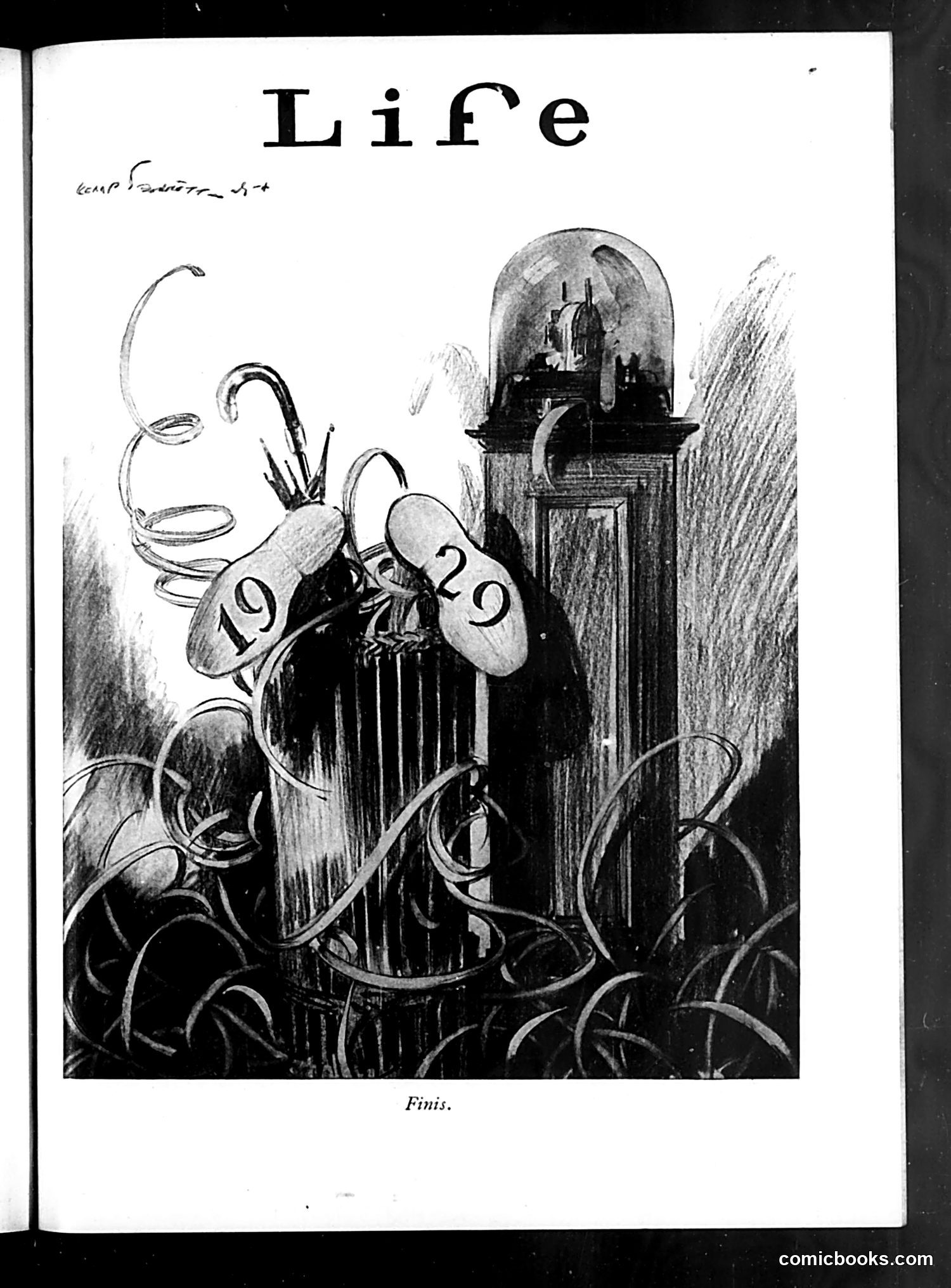
# Analysis of "Life" Magazine Cartoon Page This appears to be the final page of a 1929 *Life* magazine satire titled "Life," marked "Finis" (Latin for "The End"). The central image depicts a grim reaper-like skeletal figure clutching two large pocket watches labeled "19" and "29"—representing 1919 and 1929. The figure stands amid withered plants or vines, with an ominous tower or building looming behind. The cartoon likely satirizes the decade spanning 1919-1929, suggesting mortality, decay, or finality. Given the 1929 date coincides with the stock market crash, this probably comments on the end of the prosperous "Roaring Twenties" and warns of the economic catastrophe beginning. The imagery conveys that this ten-year period—marked by excess and speculation—has reached its inevitable, dark conclusion.
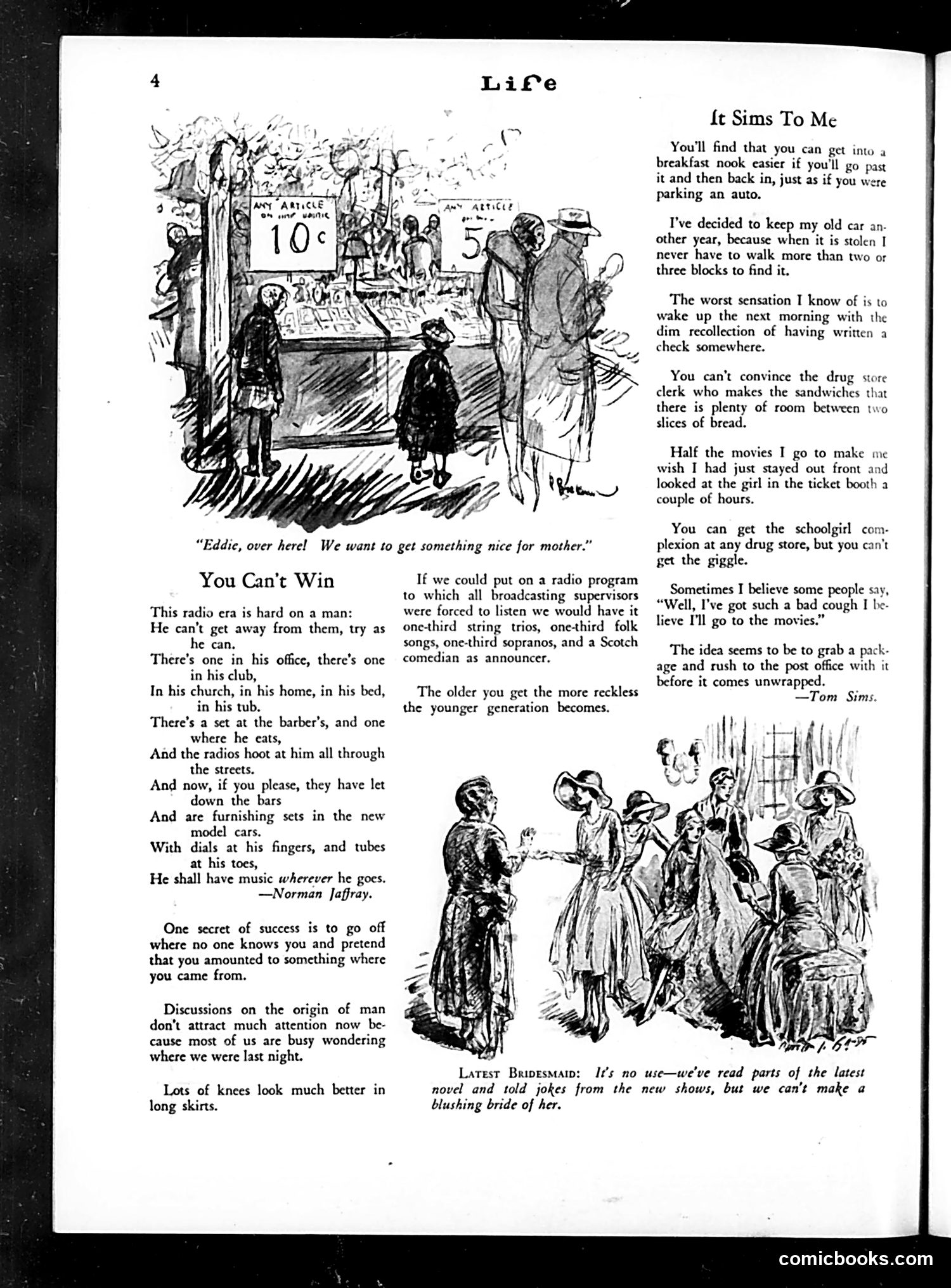
# Analysis of Life Magazine Page 4 This page contains two separate satirical pieces from early 20th-century Life magazine. **"You Can't Win"** (poem by Norman Jaffray) satirizes how radios have inescapably invaded modern life—in offices, homes, churches, barbershops, and streets. The joke is that a man cannot escape radio broadcasts anywhere, with "dials at his fingers" giving him "music wherever he goes." It's social commentary on the ubiquity of new technology. **"It Sims To Me"** (by Tom Sims) offers humorous observations about everyday annoyances: difficulty finding parked cars, check-writing anxiety, overstuffed sandwiches, and inattentive movie-ticket sellers. The cartoon illustration shows people at what appears to be a newsstand or shop. Both pieces humorously complain about modern inconveniences and changing social customs of the era.
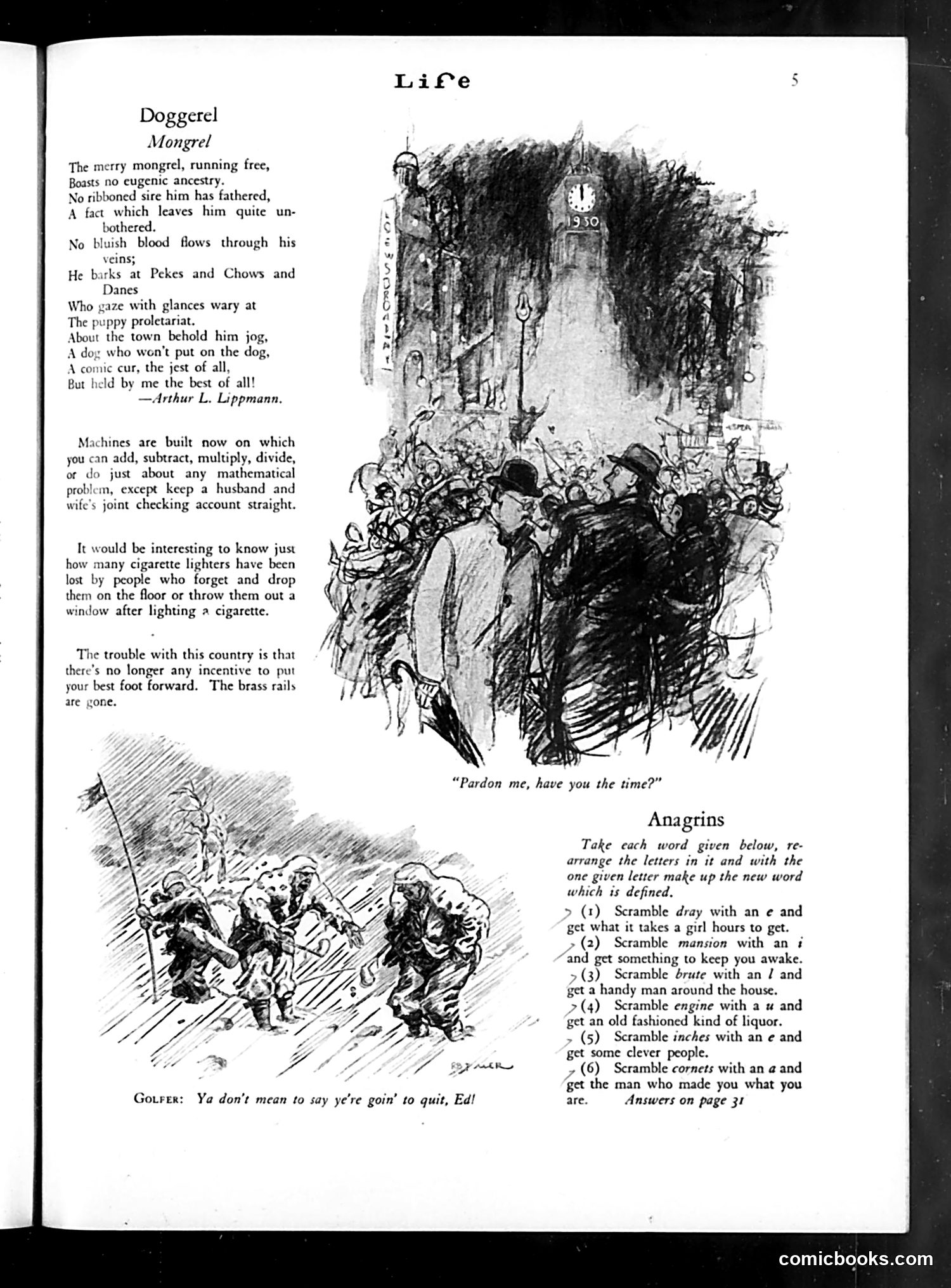
# Analysis of Life Magazine Page 5 This page contains two satirical cartoons and humorous commentary typical of Life magazine's style. The top cartoon depicts a crowded urban street scene with the caption "Pardon me, have you the time?" - satirizing how pedestrians are too busy or distracted to notice each other in modern city life. The bottom cartoon shows golfers in bad weather with dialogue "Ya don't mean to say ye're goin' to quit, Ed!" - mocking golfers' dedication to the sport despite terrible conditions. The page also includes a poem titled "Doggerel/Mongrel" by Arthur L. Lippmann about a mongrel dog's freedom from pedigree constraints, and commentary on modern conveniences and lost incentives in contemporary society. The anagrams puzzle provides wordplay entertainment typical of the magazine's recreational content.
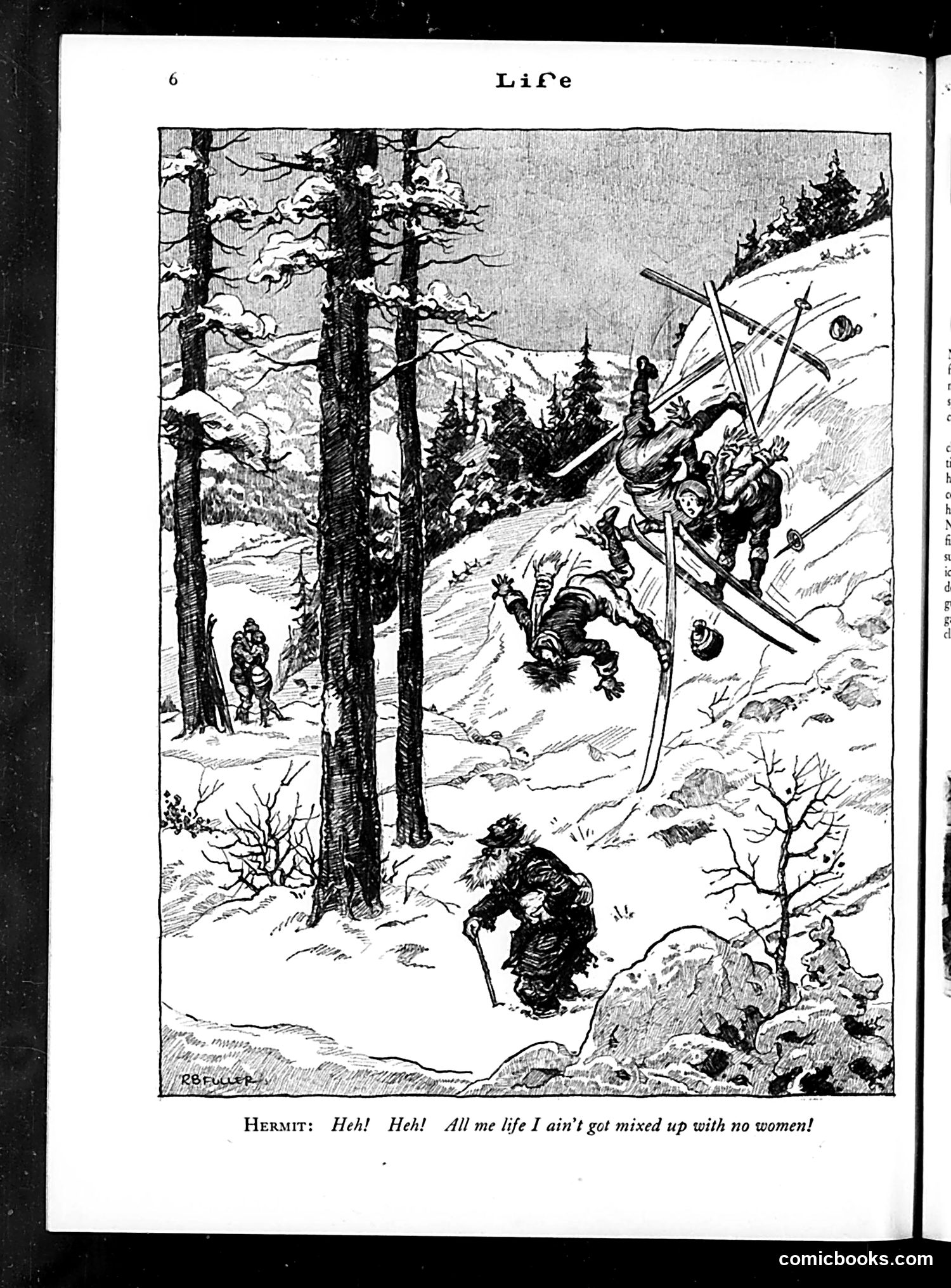
# Explanation of the Cartoon This is a winter mountain scene depicting a hermit character who has apparently encountered a group of skiers. The hermit's caption—"Heh! Heh! All me life I ain't got mixed up with no women!"—is a humorous complaint about unwanted female company invading his isolated solitude. The joke plays on the stereotype of the misogynistic hermit whose entire purpose for living remotely is to avoid women. The irony is that modern recreational activities like skiing have brought women into previously remote mountain areas, making his isolation impossible. The cartoon satirizes both the isolated man's outdated attitudes and the changing landscape of early-to-mid 20th century leisure activities, where skiing was becoming a popular mixed-gender sport accessible to urban populations.
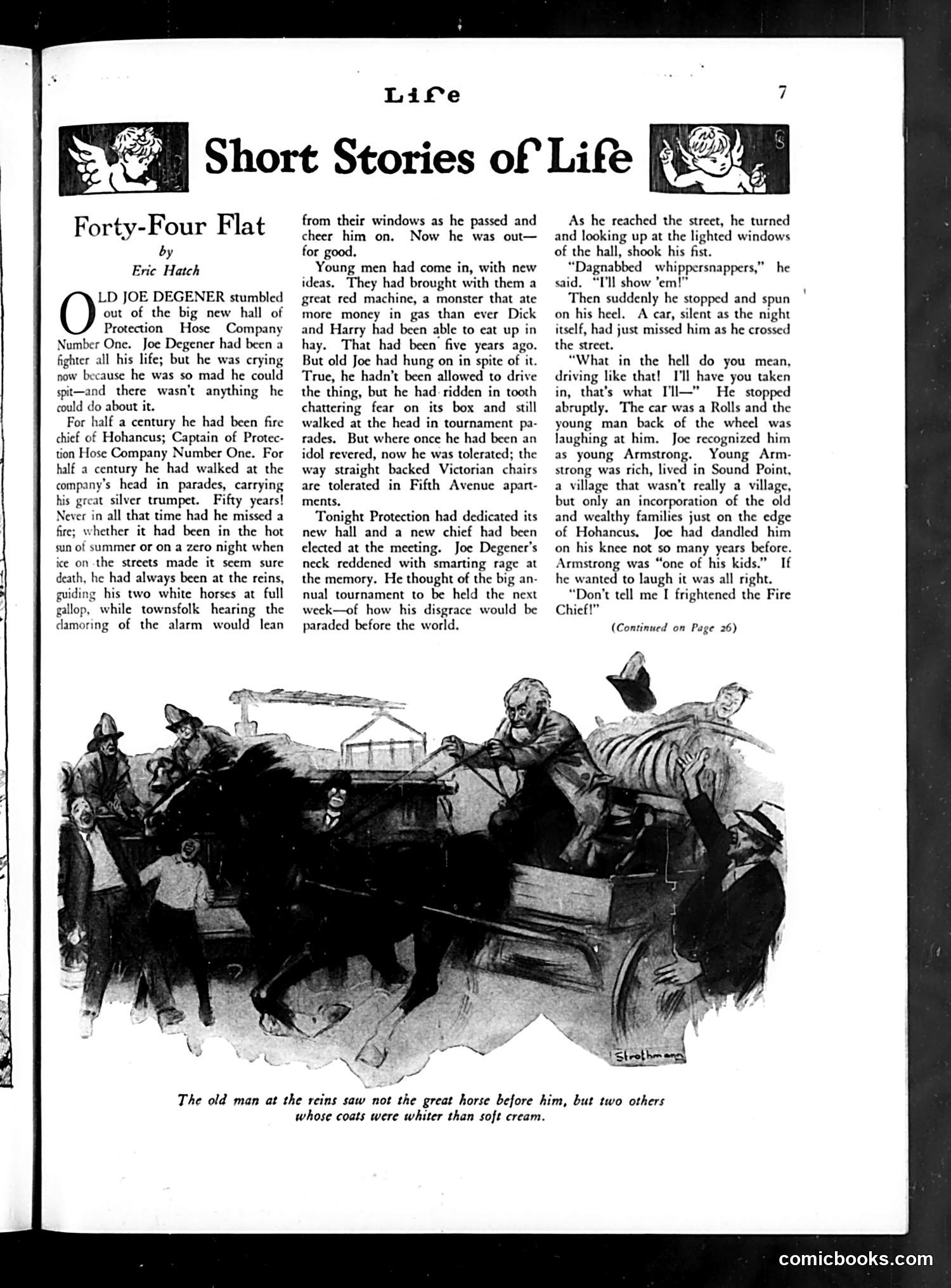
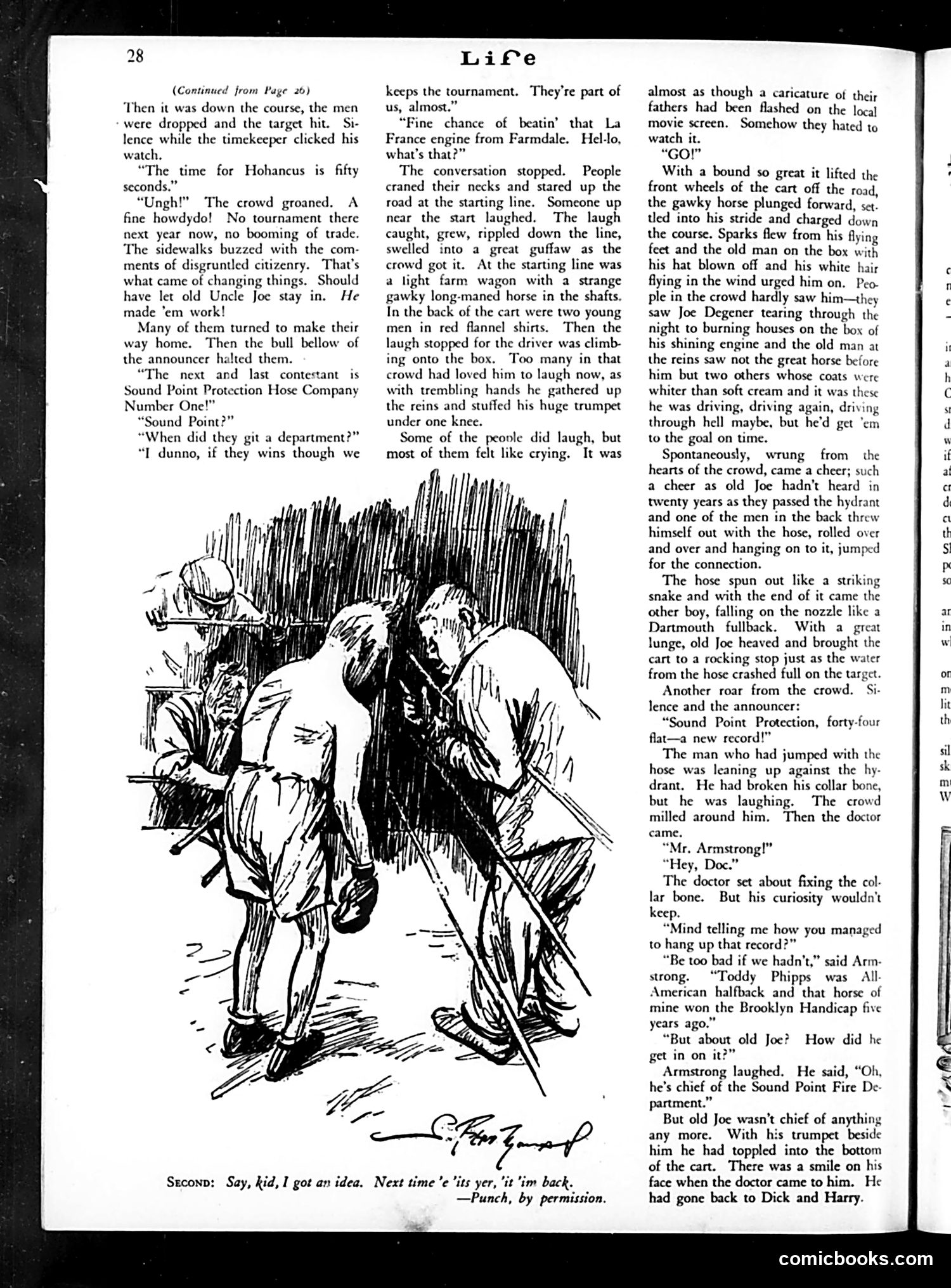
# "Forty-Four Flat" by Eric Hatch This short story opening depicts **Joe Degener**, a veteran firefighter who has served with the Protection Hose Company Number One for half a century. The narrative establishes him as an old-timer resentful of modernization: the company has replaced its proud fire station with a new hall, new equipment (a gas-powered machine replacing horses), and new leadership—changes that humiliate him. The illustration shows horses and firefighting equipment, capturing the story's tension between **traditional horse-drawn firefighting and modern mechanization**. The satire gently mocks Joe's resistance to progress while sympathizing with his displacement—a common early-20th-century American anxiety about industrialization replacing established workers and traditions.
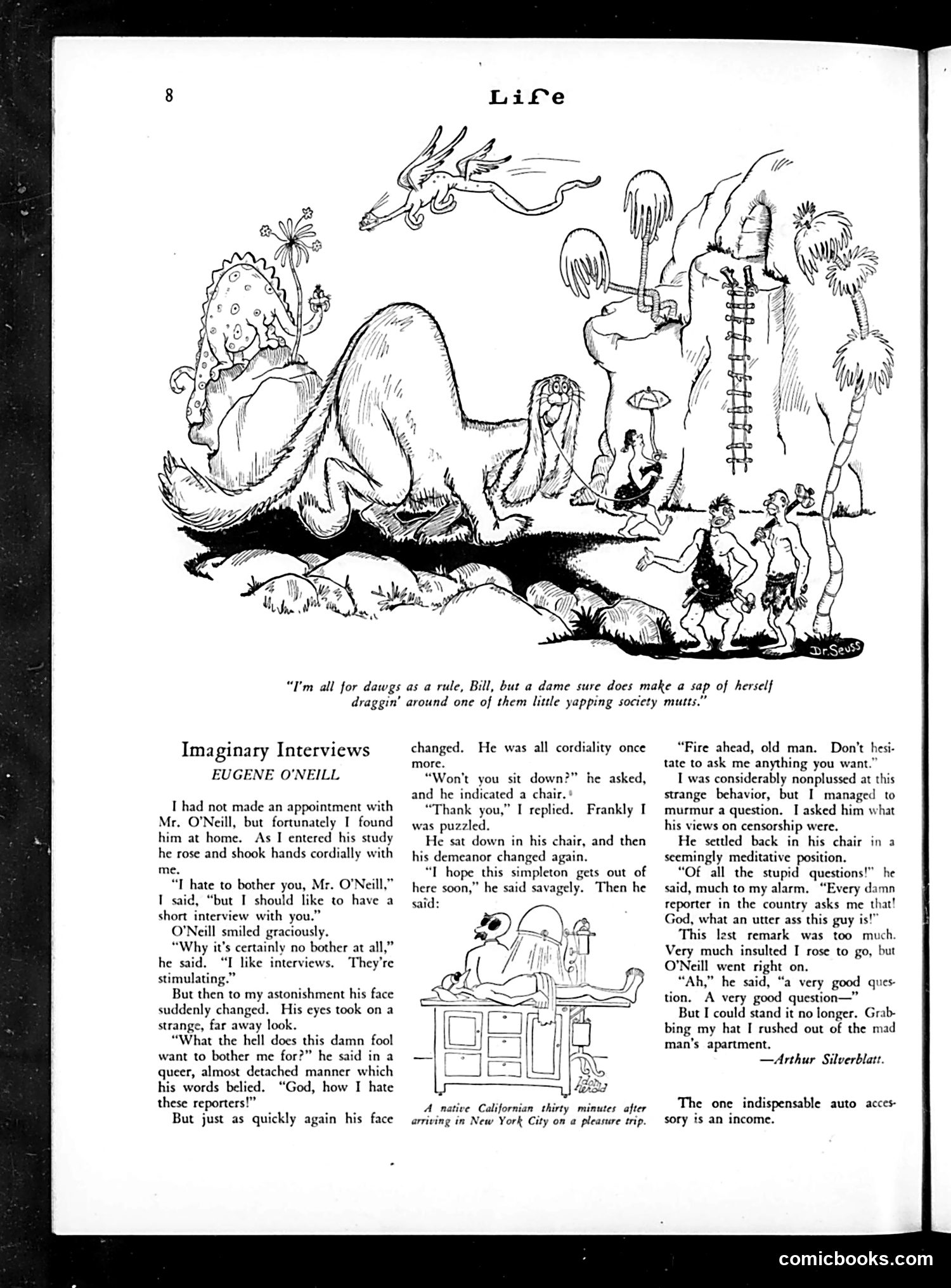
# Analysis of Life Magazine Page 8 **Top Cartoon (Dr. Seuss):** This whimsical illustration depicts fantastical creatures and humans coexisting in an alien landscape. The caption jokes about a dame making "a sap of herself draggin' around" dachshunds in society. This appears to be satirizing upper-class women's obsession with fashionable small dog breeds as status symbols. **"Imaginary Interviews" Section:** The featured interview with Eugene O'Neill (the famous American playwright) presents him as irritable and hostile toward reporters. O'Neill complains about journalists bothering him, expressing contempt for the press. The satire mocks both O'Neill's curmudgeonly nature and the invasive celebrity interview culture of the era. The small illustration accompanying shows a Californian arriving in New York City.
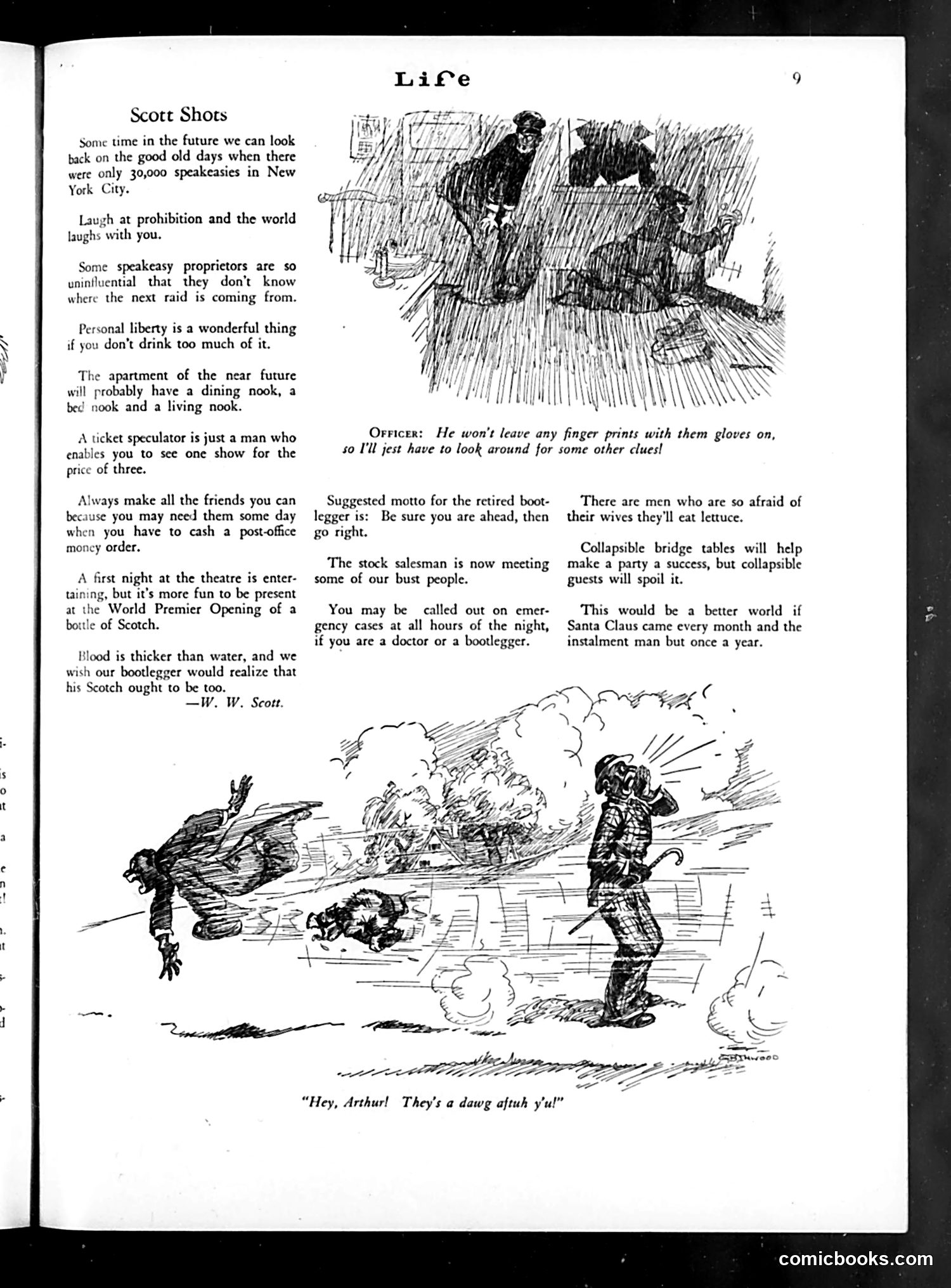
# Analysis of Life Magazine Page 9: "Scott Shots" This page contains humorous short observations by W. W. Scott about urban life and future predictions, paired with two cartoons. The top cartoon depicts a police officer confronting what appears to be a woman in a speakeasy (an illegal bar during Prohibition). The caption reads: "He won't leave any finger prints with them gloves on, so I'll just have to look around for some other clues!" This satirizes how speakeasies operated openly despite Prohibition, with law enforcement either complicit or unable to enforce the law. The bottom cartoon shows someone being blown by an explosion, with the caption "Hey, Arthur! They's a dawg afish y'd!" The humor appears to derive from dialectal speech and slapstick misfortune. The "Scott Shots" text offers witty commentary on contemporary life: speakeasies, apartment design, theater culture, and bootleggers—reflecting 1920s urban concerns.
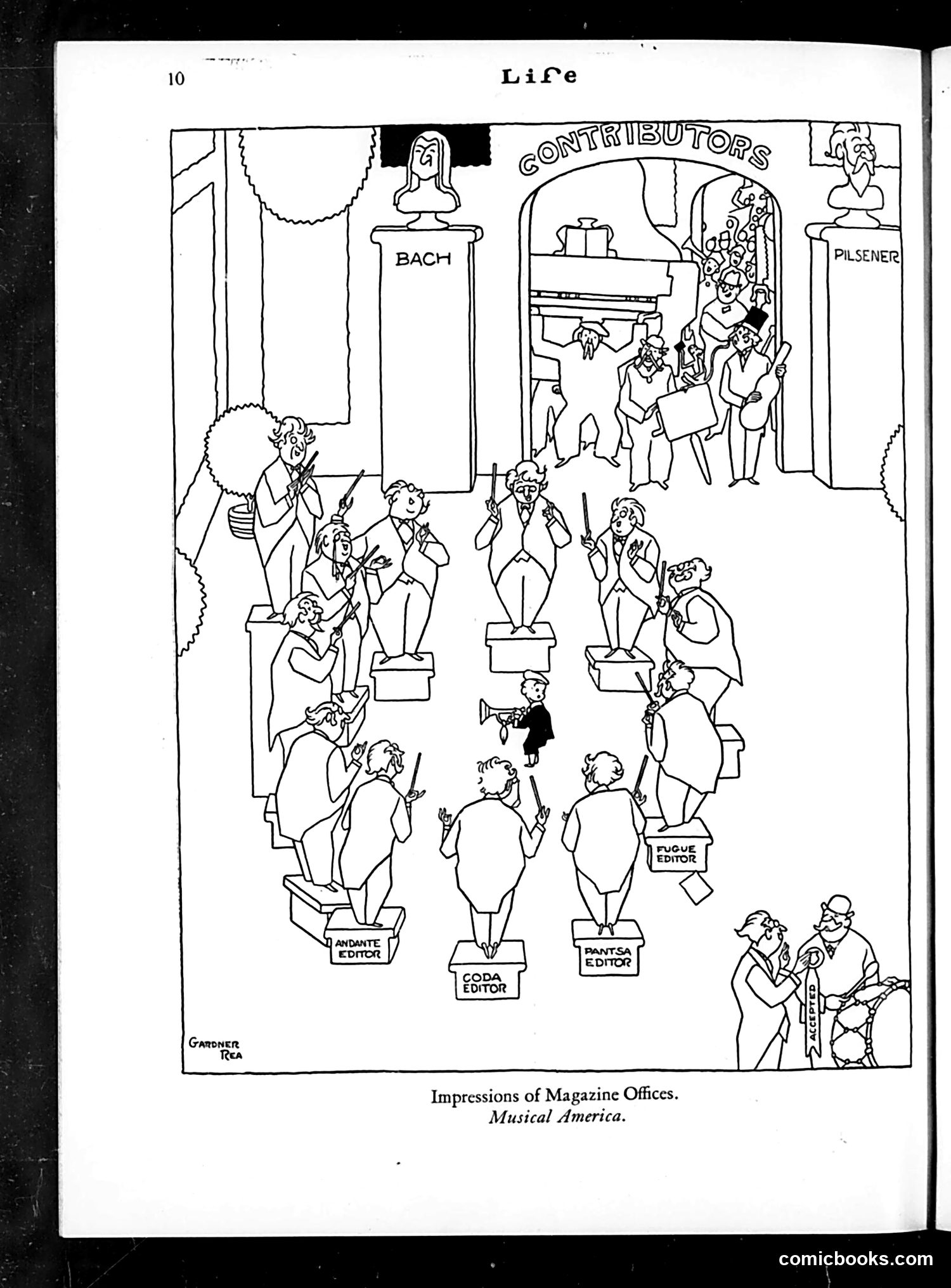
# "Impressions of Magazine Offices: Musical America" This satirical cartoon depicts the hierarchy of a musical magazine's editorial offices. The illustration shows various staff members positioned on pedestals of different heights, labeled with their roles: "Andante Editor," "Rondo Editor," "Fugue Editor," and "Mantissa Editor" among others. At the top are busts of classical composers Bach and Pilsener, suggesting these figures represent the magazine's cultural authority. The "Contributors" section shows a crowded room of musicians performing at a piano, implying the influx of submissions. The joke satirizes magazine editorial hierarchy and the pretentious classical music world—using musical terminology (andante, rondo, fugue) for editorial positions, mocking how such publications adopt grandiose language to organize their mundane administrative structures.