A complete issue · 36 pages · 1929
Life — December 13, 1929
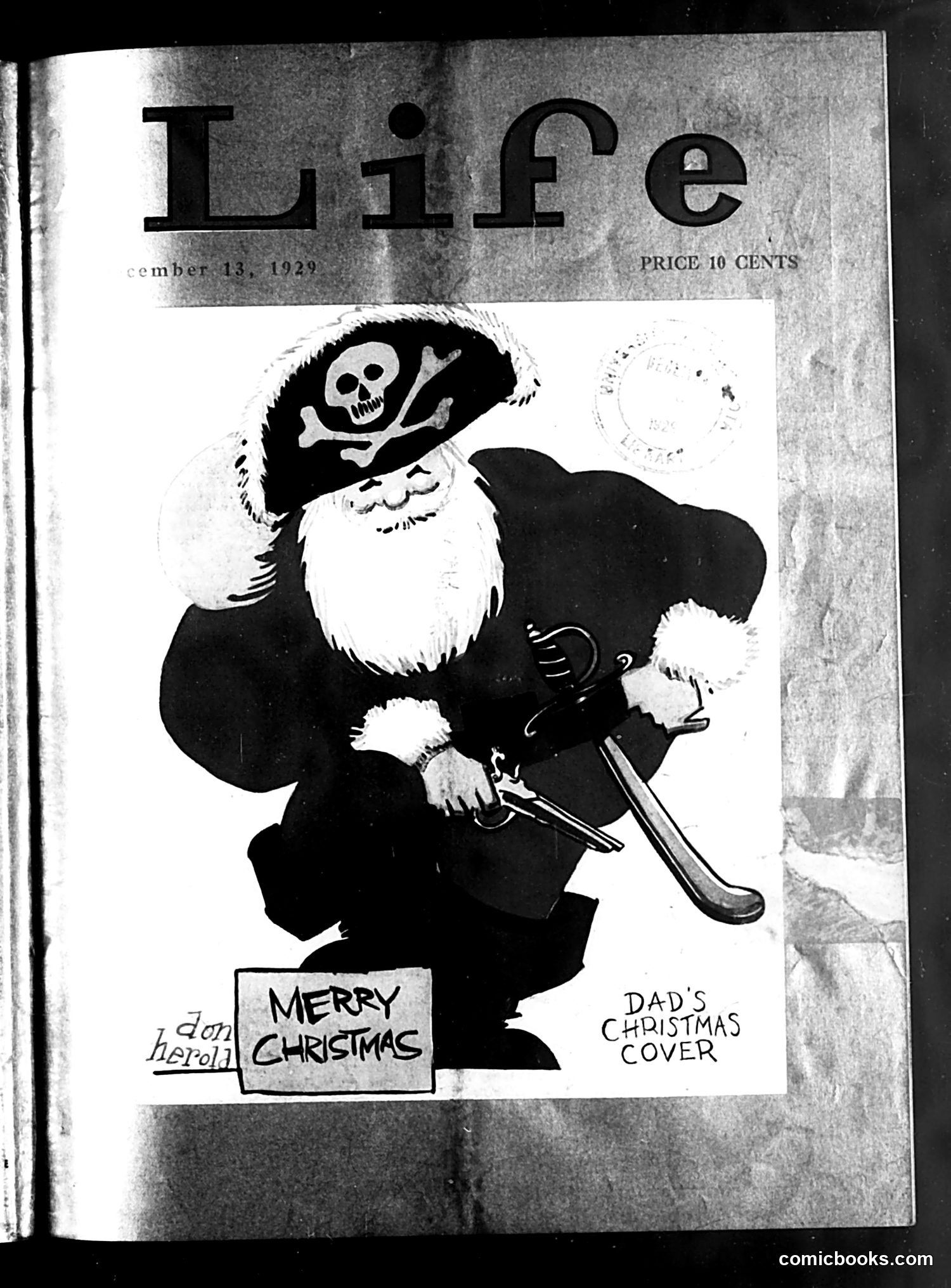
# Life Magazine Cover Analysis (December 13, 1929) This is a Christmas cover featuring a pirate character with a skull-and-crossbones hat, holding a gun and knife. The figure has a large white beard and wears dark clothing trimmed with white fur—evoking both a pirate and a corrupted Santa Claus. The caption reads "Dad's Christmas Cover" and "Merry Christmas," suggesting satirical commentary on American fathers or male authority figures. Given the publication date (December 1929), this appears to reference the recent stock market crash and economic devastation of the Great Depression's onset. The pirate imagery likely satirizes wealthy businessmen or "robber barons" who plundered the economy, presenting them as villainous rather than jolly holiday figures.
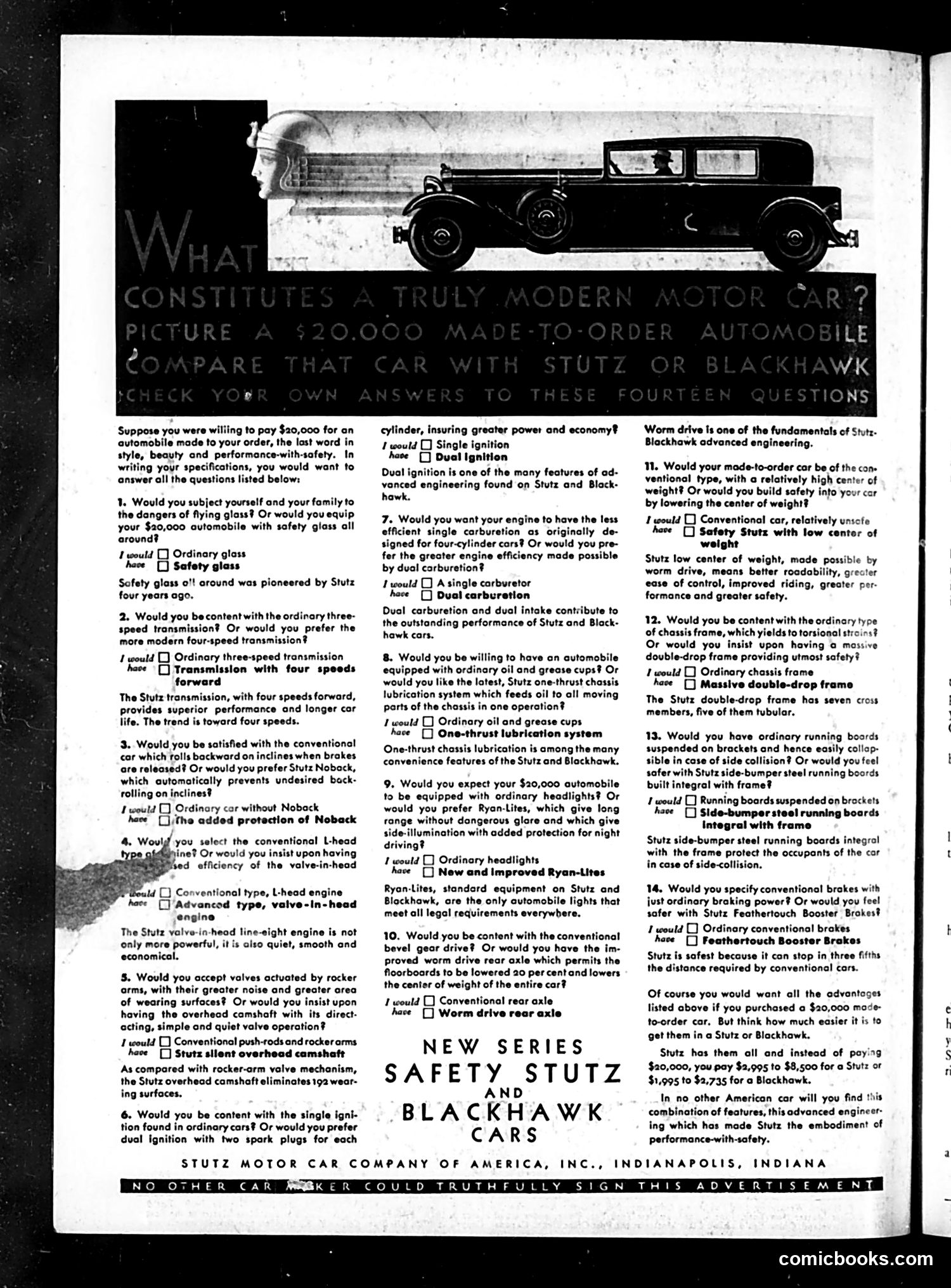
# Analysis This page is primarily **advertising, not satire or political commentary**. It's a Stutz Motor Car Company advertisement for their "Safety Stutz" and "Blackhawk" automobile lines. The ad uses a rhetorical device—14 leading questions—to persuade readers that these cars embody modern engineering superiority. Questions address safety features (safety glass, bumpers, braking systems) and performance innovations (worm drive, valve-in-head engines, lubrication systems). The illustration shows a sleek 1920s automobile in profile alongside a profile of a man's head, visually linking the car's modern design to contemporary ideals of efficiency and progress. The tagline emphasizes exclusivity: "No other car maker could truthfully sign this advertisement," suggesting competitors cannot match these safety and performance claims.
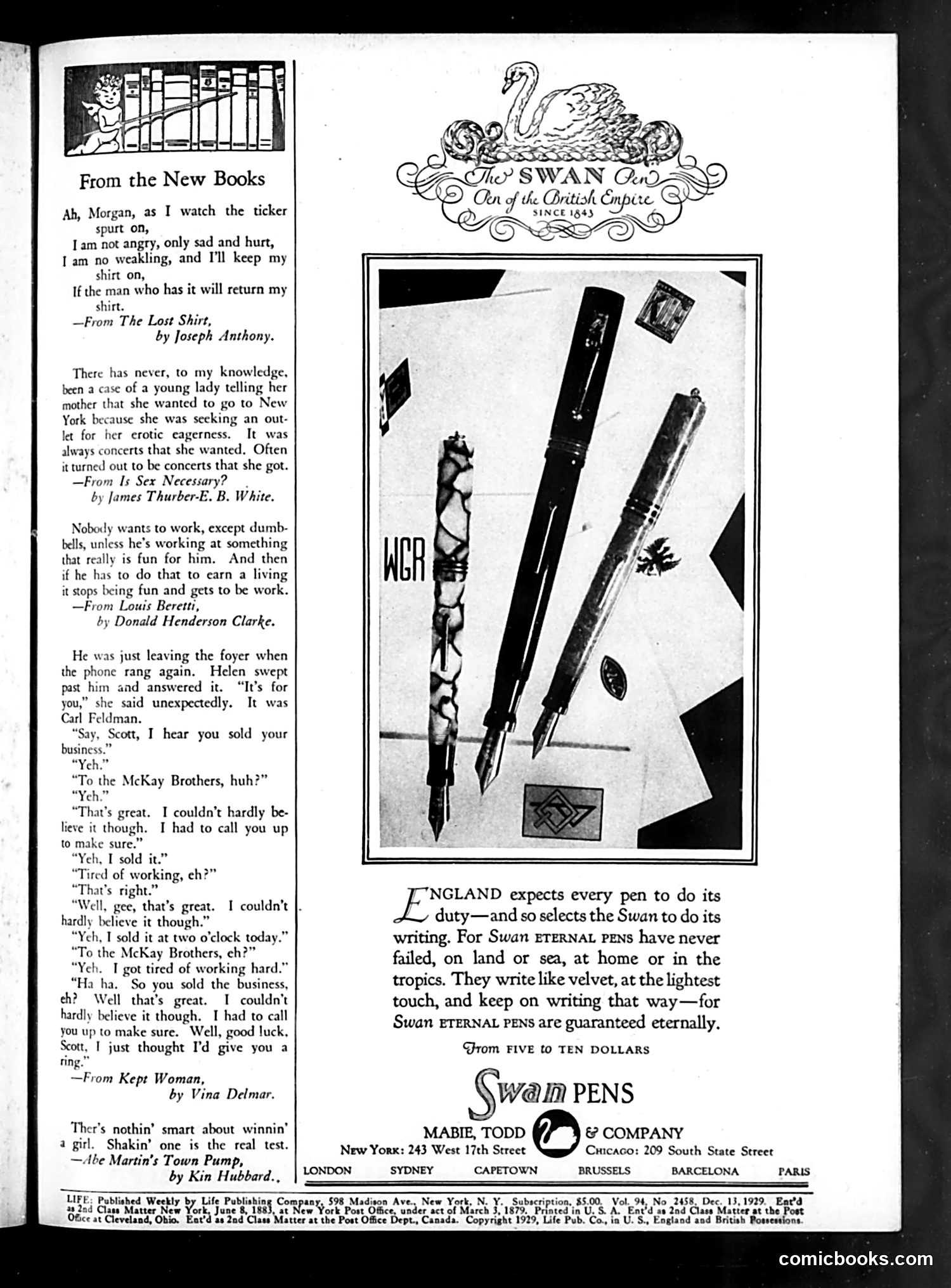
# Analysis This page is **primarily advertising**, not political satire. The left column contains literary excerpts under "From the New Books"—quotes from contemporary novels by Joseph Anthony, James Thurber, Donald Henderson Clarke, and others. These are brief, anecdotal passages meant to entice readers to purchase the books. The right side features a **Swan Pens advertisement**. The image shows writing instruments and an inked drawing, with text emphasizing Swan pens' reliability "on land or sea, at home or in the tropics." The ad targets British imperial pride ("England expects every pen to do its duty"). There is no political cartoon here. This is a typical Life magazine page blending literary promotion with commercial advertising, common in early-20th-century American magazines.
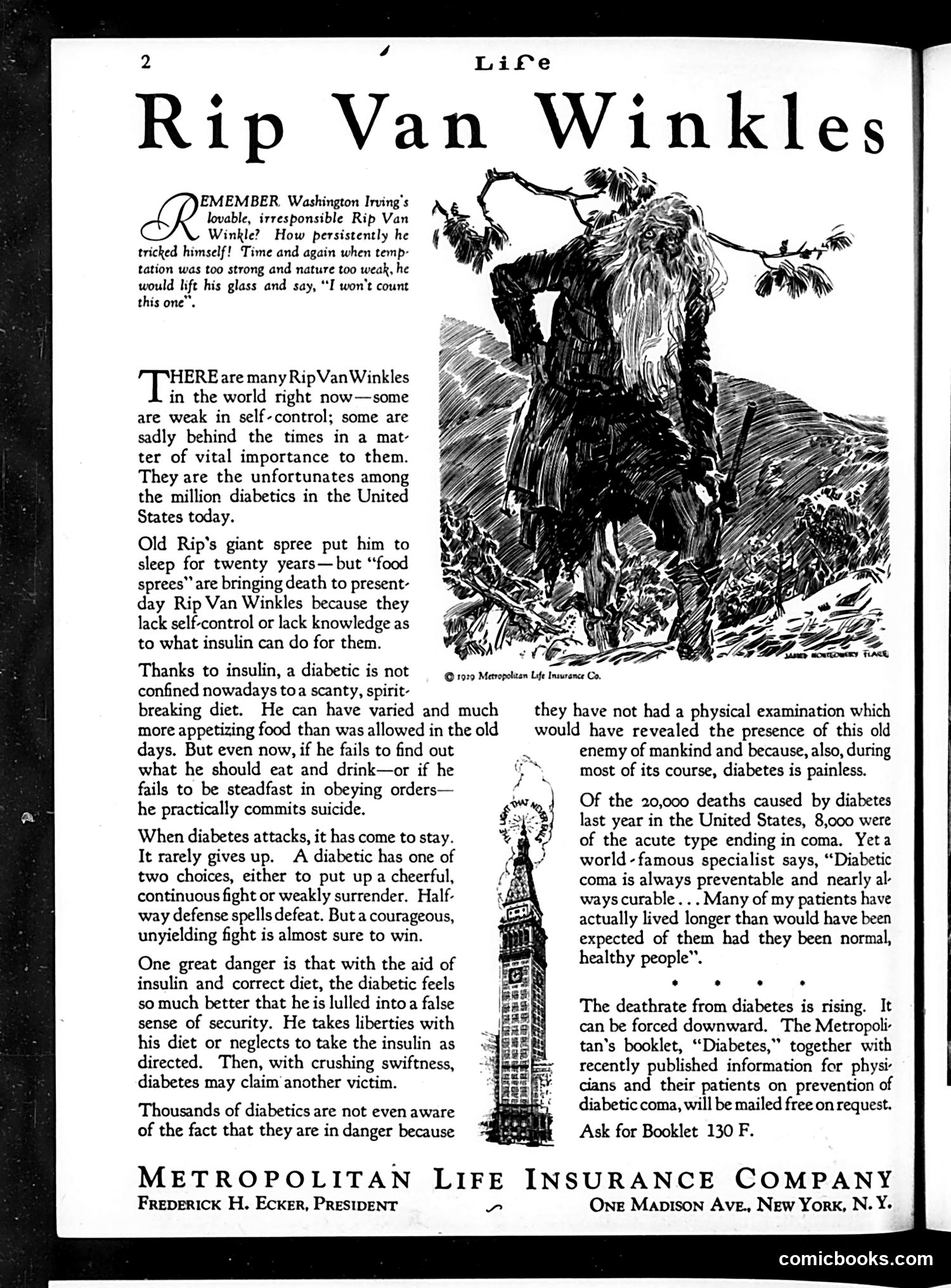
# "Rip Van Winkles" - Diabetes Awareness This is primarily an **advertisement** for Metropolitan Life Insurance Company's diabetes information booklet, disguised as editorial content. The page references Washington Irving's "Rip Van Winkle"—a man who slept for 20 years and awoke unchanged. The metaphor compares diabetics who ignore their condition to Rip Van Winkle: they dangerously delay treatment, pretending the disease doesn't exist. The text warns that **insulin had recently become available** (context suggests early 1920s), offering new hope. However, many diabetics remain unaware they have the disease or neglect insulin treatment, effectively committing "suicide" through non-compliance. The illustration depicts an aged, weathered figure—representing the passage of time and deterioration caused by untreated diabetes. This was public health messaging: highlighting insulin's life-saving potential while shaming patient negligence and ignorance about the disease.
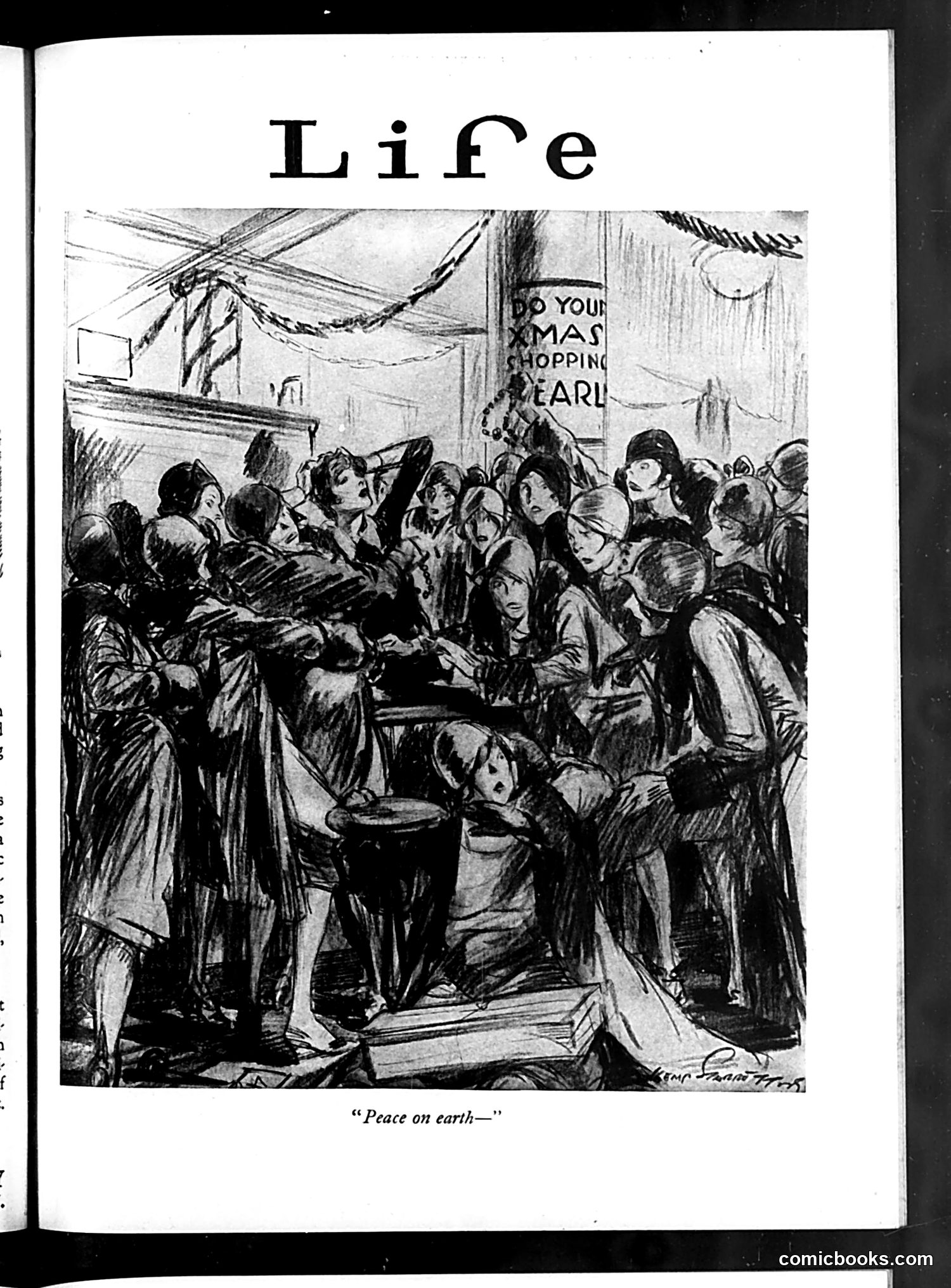
# Analysis of "Peace on earth—" This Life magazine page shows a Christmas-themed political cartoon depicting poor, hungry people gathered around what appears to be a soup pot or meager food source during winter hardship. The phrase "Peace on earth—" sarcastically references the Christian Christmas greeting while the image documents urban poverty and deprivation. The cartoon appears critical of economic inequality, likely created during the Depression era or a period of significant social hardship. A partial sign visible reads "XMAS SHOPPING" and "PEARL," suggesting a commercial district contrasting sharply with the destitute figures shown. The satire juxtaposes the holiday's spiritual message of peace with the grim reality of citizens struggling to survive, critiquing the gap between Christmas ideals and actual living conditions for America's poorest residents.
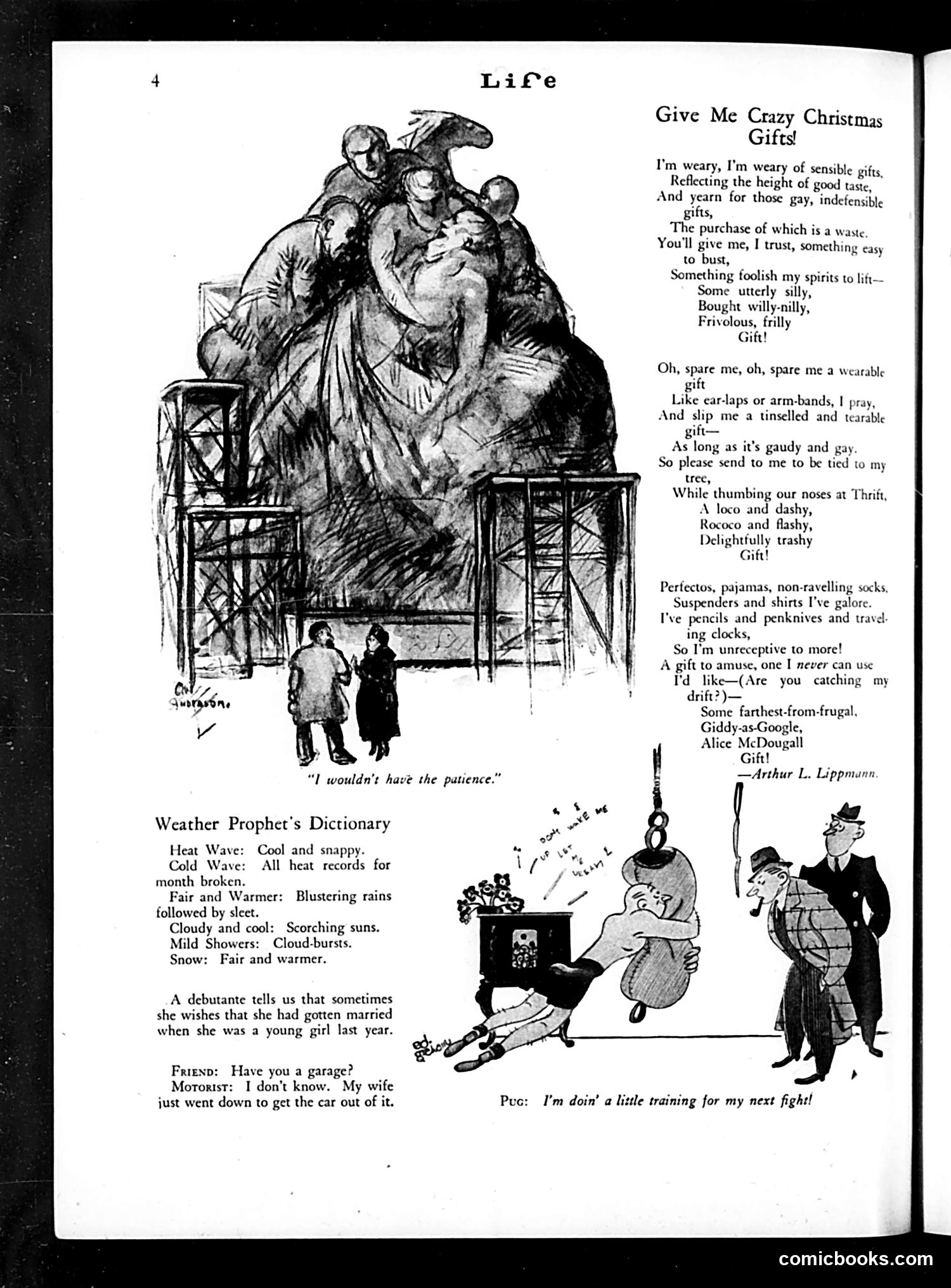
# Analysis of Life Magazine Page This page contains three distinct pieces of early 20th-century satire: **"Give Me Crazy Christmas Gifts"** (poem by Arthur L. Lippmann): A humorous complaint rejecting practical gifts (suspenders, socks, pajamas) in favor of absurd, frivolous ones—poking fun at both excessive consumerism and gift-giving conventions. **"Weather Prophet's Dictionary"**: A satirical glossary inverting actual weather predictions (e.g., "Heat Wave" means "cool and snappy"), mocking the unreliability of weather forecasters—a timeless target. **Bottom illustrations**: Two brief jokes—one about a motorist whose wife retrieved their car from a garage, another showing a boxer in training. These are generic humor rather than political commentary. The page reflects Life's role as a satirical humor magazine targeting middle-class American society and everyday frustrations.
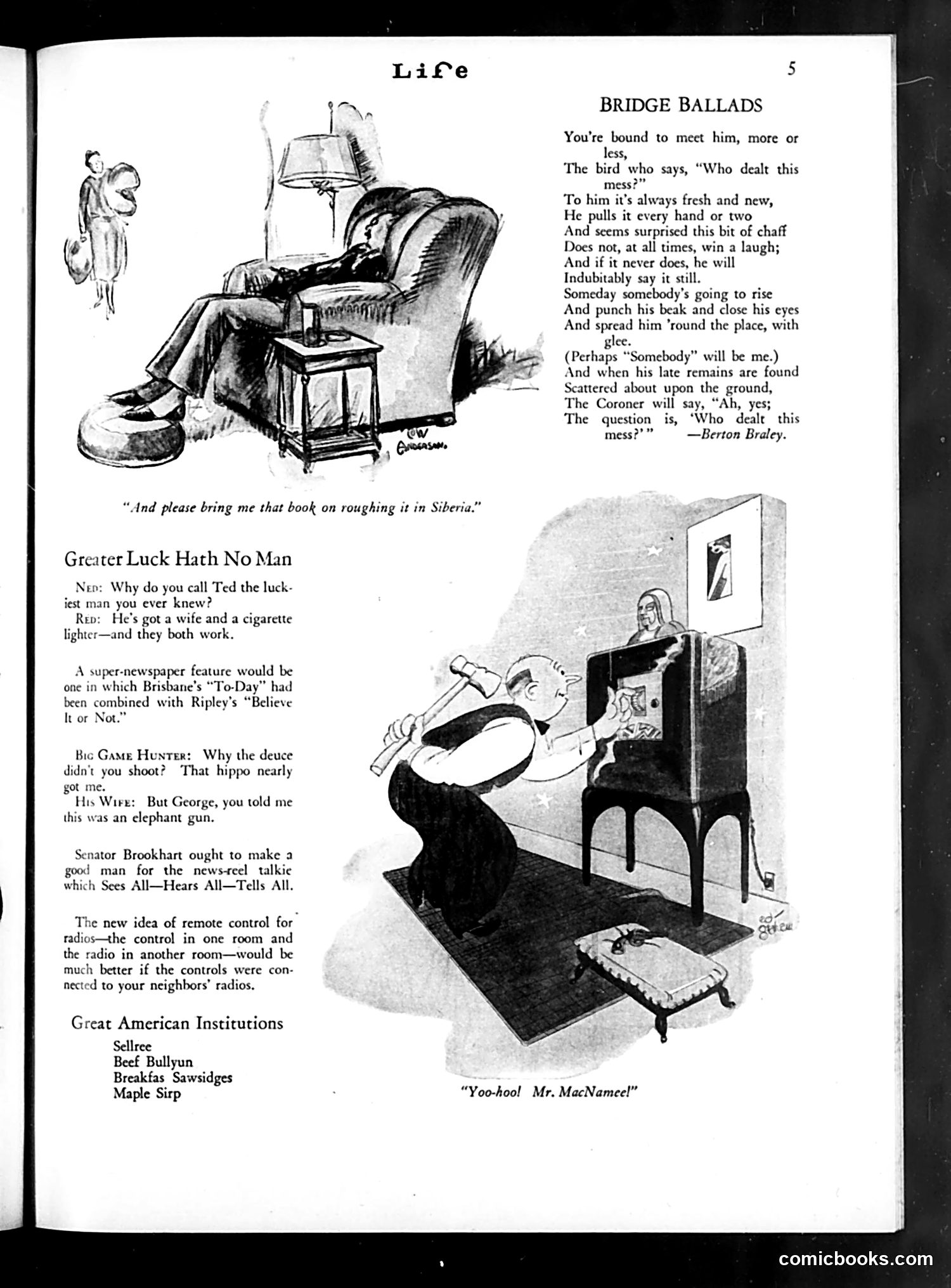
# Life Magazine Page 5 Analysis This page contains three satirical items from Life magazine: **"Bridge Ballads"** (top right) is a poem by Berton Bradley mocking a recurring complaint—someone repeatedly complaining "Who dealt this mess?" about a bad bridge hand. The joke suggests this person will eventually commit violence over cards. **"Greater Luck Hath No Man"** features brief comic dialogues poking fun at everyday situations: a man nicknamed "the luckiest man" because his wife and cigarette lighter both work, and a hunter claiming an elephant gun caused a hippo incident his wife disputes. **The lower cartoon** shows a man shooting at a television set with the caption "Yoo-hoo! Mr. MacNamee!"—likely referencing a popular radio/TV personality, suggesting frustration with broadcast content, a timely joke as television was becoming prevalent. The page also lists "Great American Institutions" (Sellree, Beef Bullyun, etc.)—apparently humorous mock-serious endorsements.
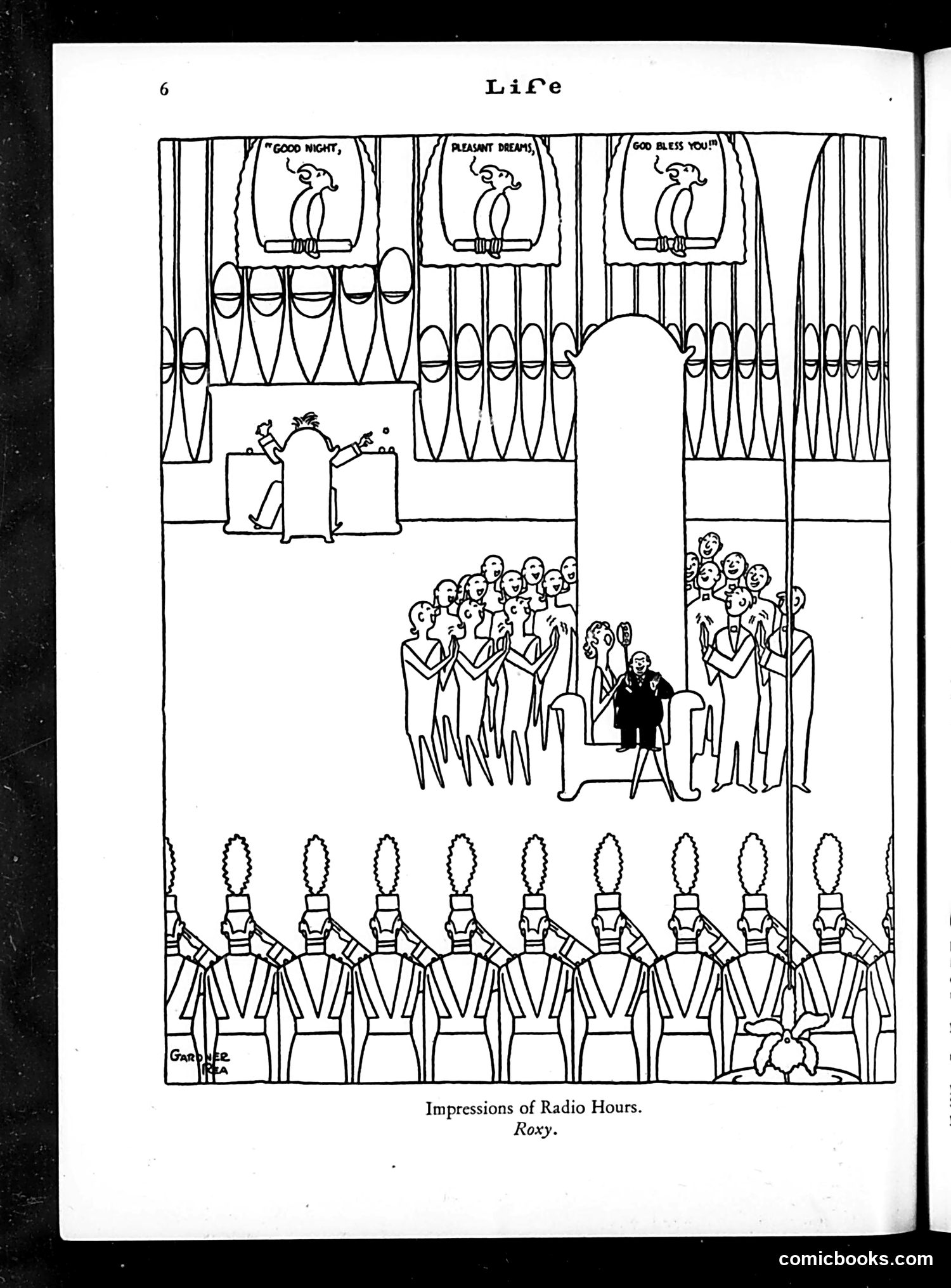
# "Impressions of Radio Hours" by Roxy This cartoon satirizes early radio broadcasting, likely from the 1920s-30s when radio was a new entertainment medium. The title references "Roxy," probably Samuel "Roxy" Rothapfel, a famous theater impresario. The satire depicts the contrast between radio's broadcast image and reality: performers in the upper balconies say pleasant things like "Good night" and "Pleasant dreams," while below, a conductor leads what appears to be a large chorus or orchestra. The bottom section shows elaborately dressed figures (possibly Radio City Music Hall-style dancers), highlighting the disconnect between the refined entertainment supposedly being broadcast versus the theatrical machinery required behind the scenes. The joke mocks the artificiality and spectacle of early commercial radio programming.
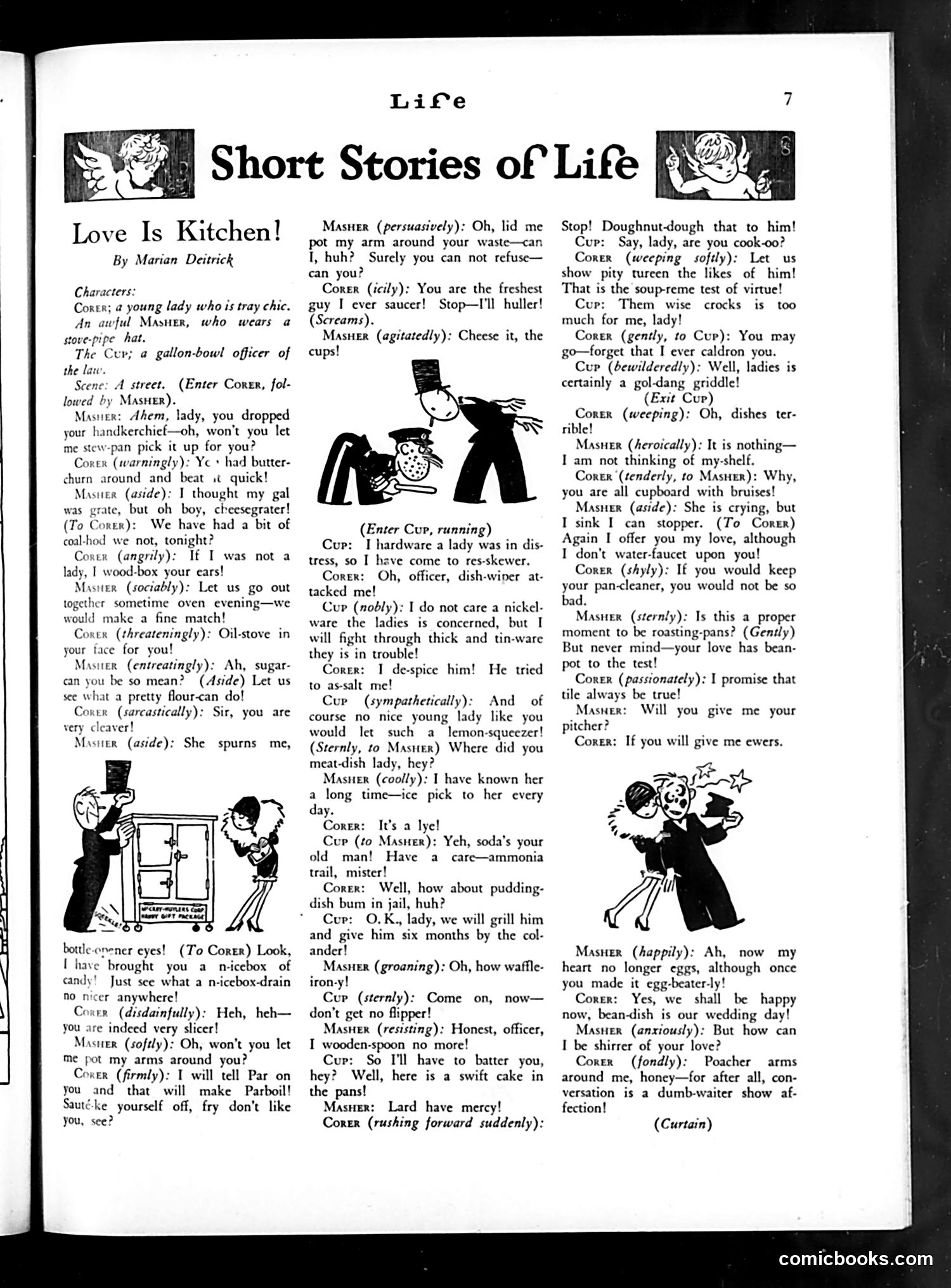
# "Love Is Kitchen!" — A Domestic Comedy This is a one-act play script satirizing early 20th-century marriage dynamics. The humor centers on a young couple's domestic disputes over household management, particularly cooking and kitchen duties. The plot involves **Corer** (a young woman) and **Master** (her husband) quarreling over a dropped handkerchief and ruined dinner preparations. A **Cup** character and visiting **Officer** complicate matters. The satire mocks the era's strict gender roles—the wife's domestic incompetence and the husband's exasperation—while gently poking fun at class pretensions ("meat-dish lady," references to servants). The final punchline about "bean-dish" as a wedding day suggests satirizing both marital discord and snobbish attitudes about social status through food. The cartoon illustrations show the physical comedy of the kitchen chaos.
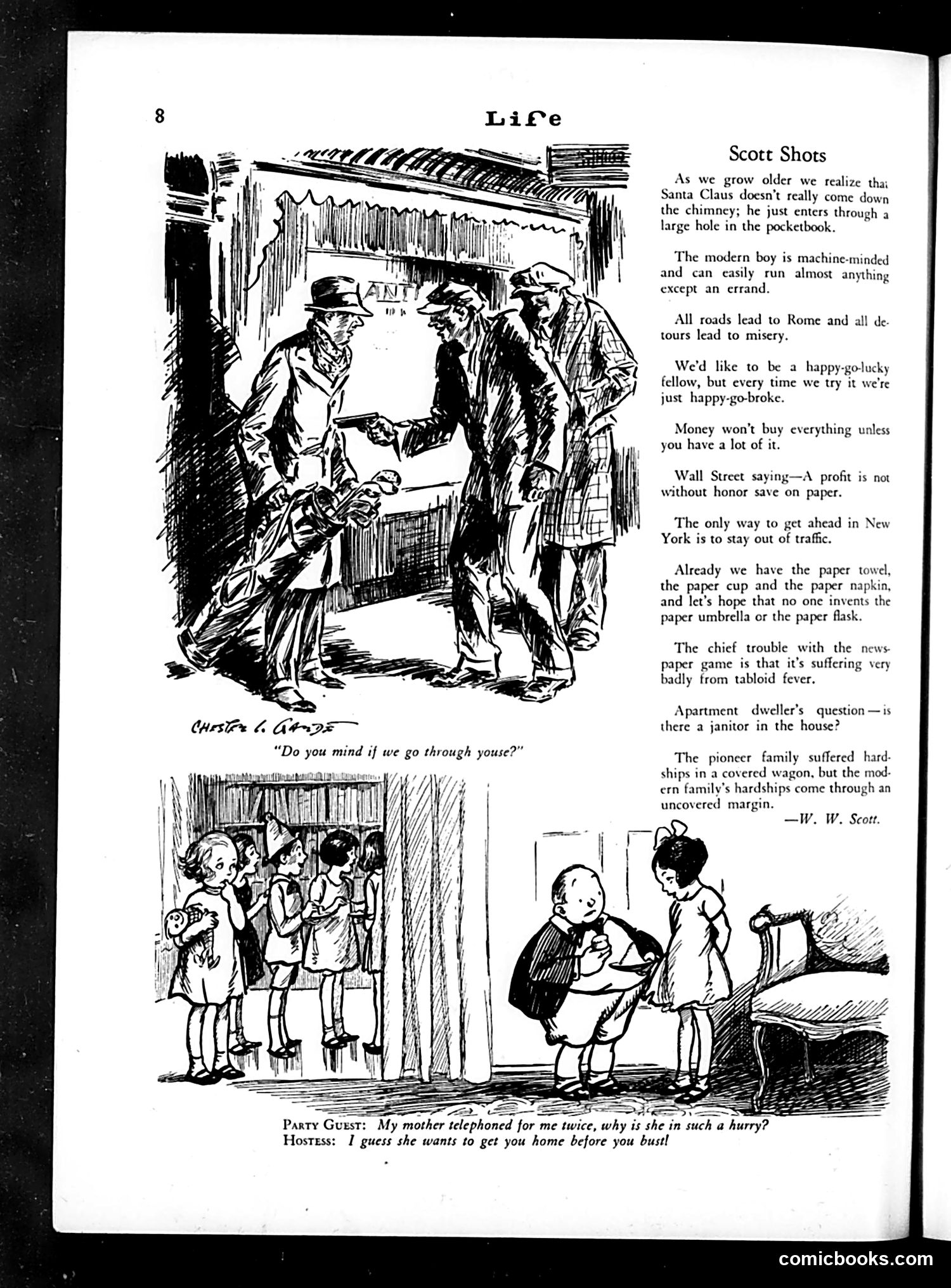
# Scott Shots: Satirical Observations This page from *Life* magazine presents two cartoons by Chester A. Gould illustrating humorous social commentary: **Top cartoon**: Three men in hats appear to be conducting some kind of transaction or negotiation. The caption "Do you mind if we go through you?" suggests they're either pickpockets or salesmen attempting to access someone's pocketbook—a visual pun on the phrase's double meaning. **Bottom cartoon**: Children at a party while a hostess speaks to a young guest. The caption indicates the guest's mother called twice asking him to come home before he "busts"—likely referring to overeating at the party. The accompanying "Scott Shots" text offers cynical one-liners about modern life: observations on Santa Claus, boys being "machine-minded," money, Wall Street, New York traffic, and other contemporary social frustrations typical of satirical humor from this era.
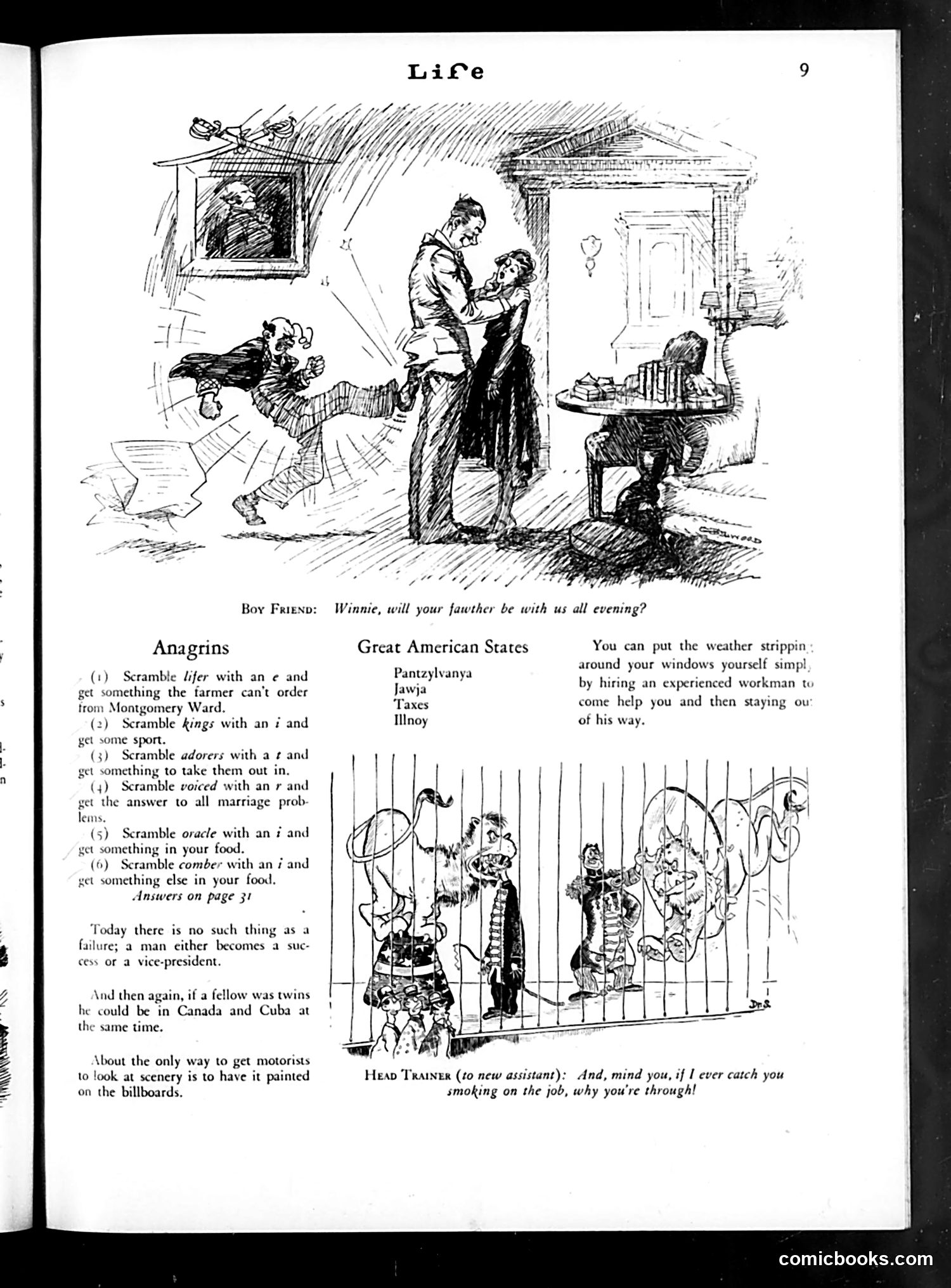
# Analysis of Life Magazine Page 9 The top cartoon depicts a domestic scene where a boy asks his friend "Winnie, will your father be with us all evening?" — a joke about parental supervision during a visit. The bottom cartoon shows a "Head Trainer" scolding a new assistant about smoking on the job at what appears to be a horse stable or training facility. The humor lies in the stern warning and threat of dismissal for workplace misconduct. The page also includes word puzzles labeled "Anagrins" and "Great American States" — standard puzzle features common to Life magazine's format. The weather-stripping advertisement provides practical domestic advice about hiring workers for home improvement. These elements represent typical early 20th-century middle-class American humor and domestic life concerns.
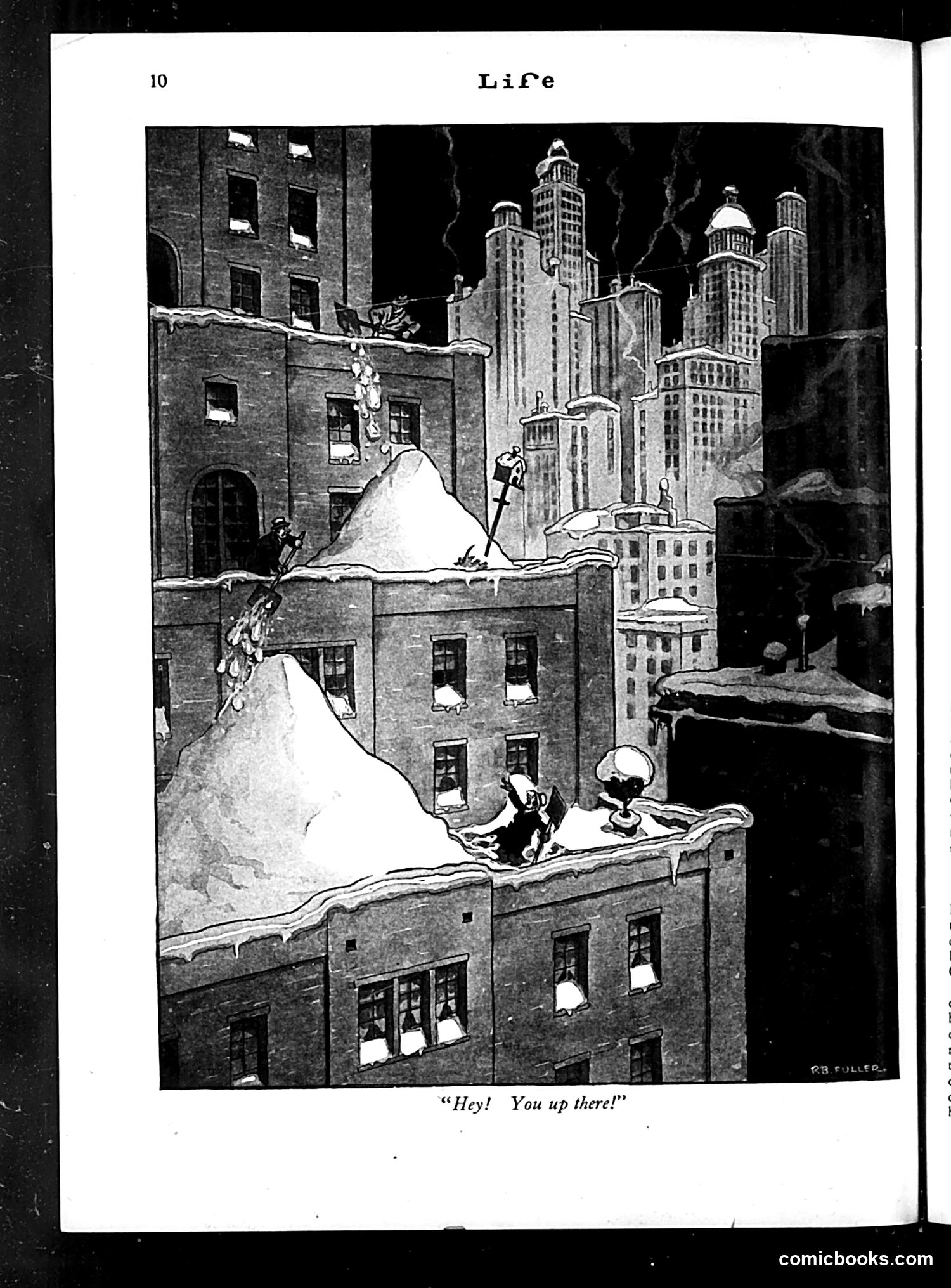
# "Hey! You up there!" This cartoon depicts children playing in urban rooftops during winter, building what appears to be a large snow structure or fort on tenement building rooftops. The illustration contrasts cramped, modest apartment buildings in the foreground with grand skyscrapers visible in the background—a visual commentary on economic inequality in the city. The caption "Hey! You up there!" suggests the children are calling to someone, likely playing a game. The satire appears to critique how poor urban children must make do with rooftops as playgrounds while wealth and grand architecture tower nearby. This reflects early 20th-century concerns about living conditions for working-class families in crowded tenement districts versus the luxury available to the wealthy.