A complete issue · 37 pages · 1929
Life — October 4, 1929
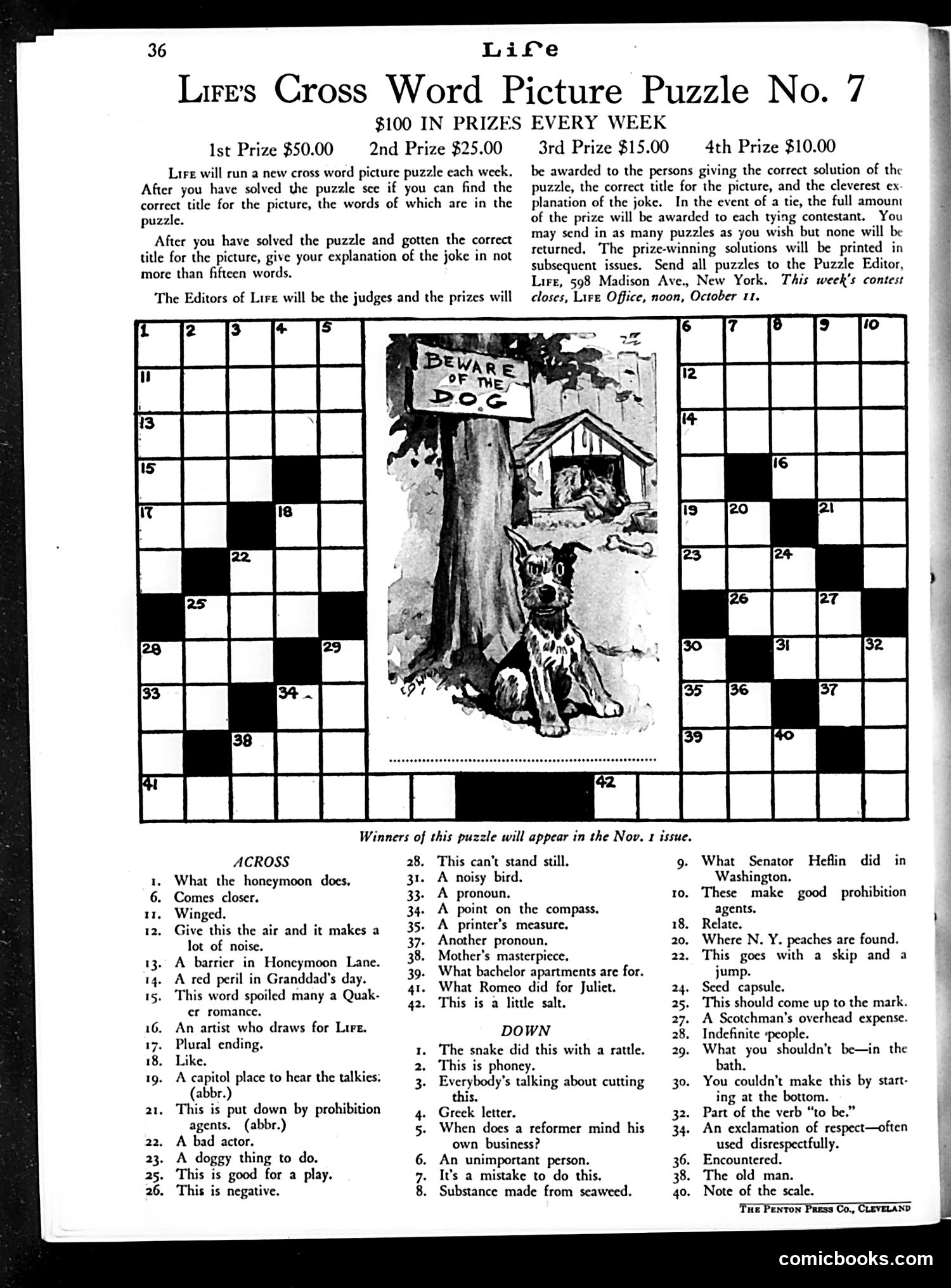
# Analysis of Life Magazine Crossword Puzzle Page No. 7 This page is primarily a **crossword puzzle contest**, not political satire. It features a humorous illustration of a dog beneath a "Beware of the Dog" sign—a visual joke setting up the puzzle's theme. The crossword clues reference **early 20th-century American culture**: Senator Heflin (Washington politics), N.Y. peaches, Romeo and Juliet, and Prohibition-era references ("prohibition agents," "good prohibition agents"). The puzzle offers **$100 in weekly prizes** ($50 first place), typical of Life magazine's entertainment contests during this era. The humor is gentle wordplay rather than political commentary—clues like "What Romeo did for Juliet" and "A doggy thing to do" are lighthearted puns, not satire. This represents Life's evolution from pure satire to a general-interest magazine incorporating puzzles and competitions.
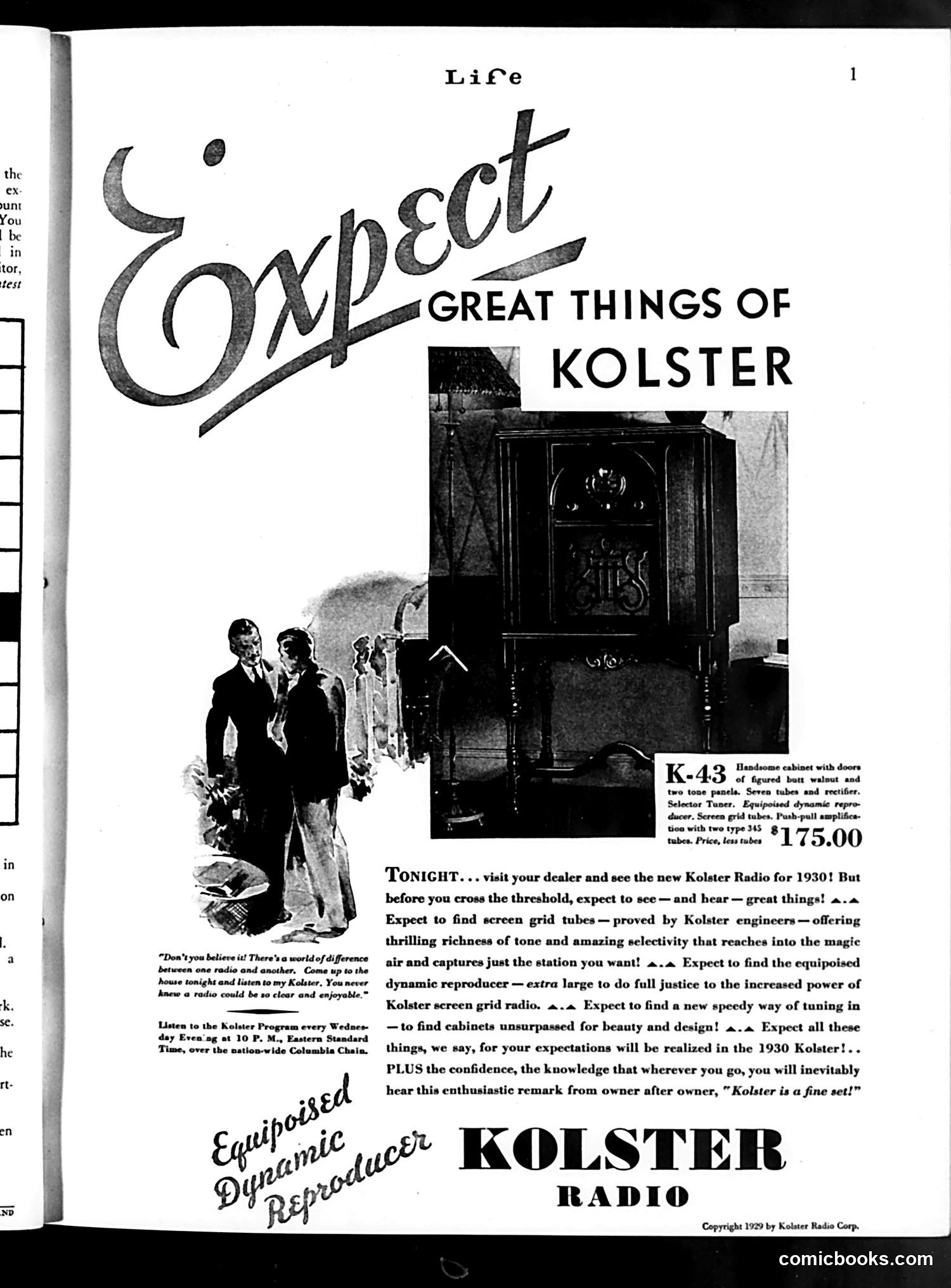
# Analysis This is primarily a **Kolster Radio advertisement**, not a political cartoon. The page shows a 1930 radio cabinet (model K-43, priced at $175.00) being promoted as incorporating advanced features like "seven tubes and rectifier" and "screen grid tubes." The small illustration depicts well-dressed people approaching the radio, suggesting it's a social attraction—a common marketing approach of the era. The text emphasizes Kolster's technological superiority and invites readers to visit dealers to experience the "new Kolster Radio for 1930." There is **no political satire or social commentary** here. This is straightforward commercial advertising leveraging the excitement around radio technology's rapid advancement in the early 1930s. The "great things" referenced are technological features, not historical or political events.
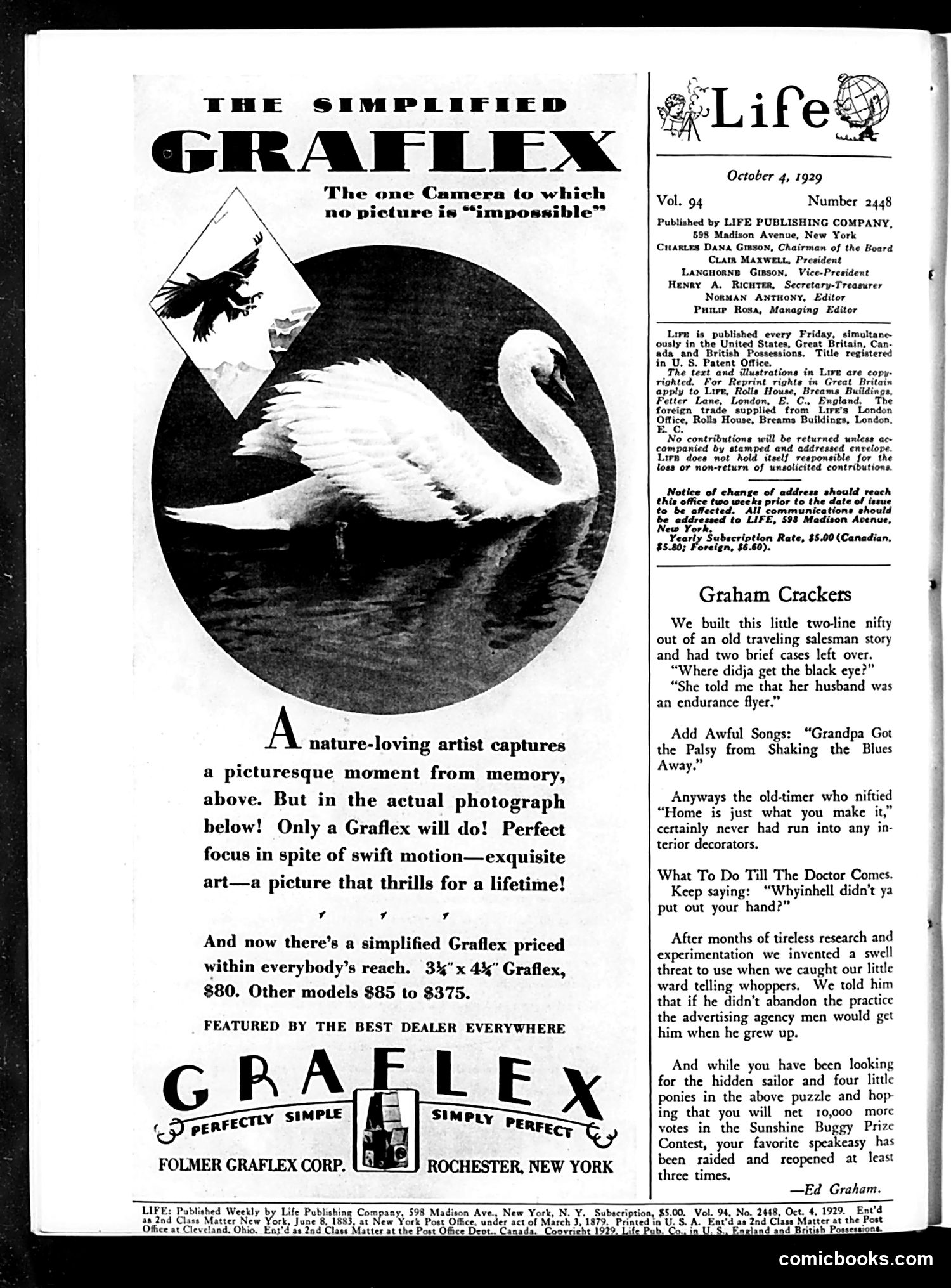
# Analysis This page is **primarily a Graflex camera advertisement** rather than political satire. The main image shows a swan, likely captured in motion photography—the ad emphasizes that only a Graflex camera can achieve "perfect focus in spite of swift motion." The smaller inset illustration (upper left) appears to be an artistic rendering of the same swan scene, illustrating the ad's point: that while artists can paint from memory, photographers need superior equipment for precise, dynamic action shots. The right column contains "Graham Crackers," a humor section with brief, unrelated anecdotes and jokes—typical filler content for Life magazine during this era. There is no political commentary or caricature on this page.
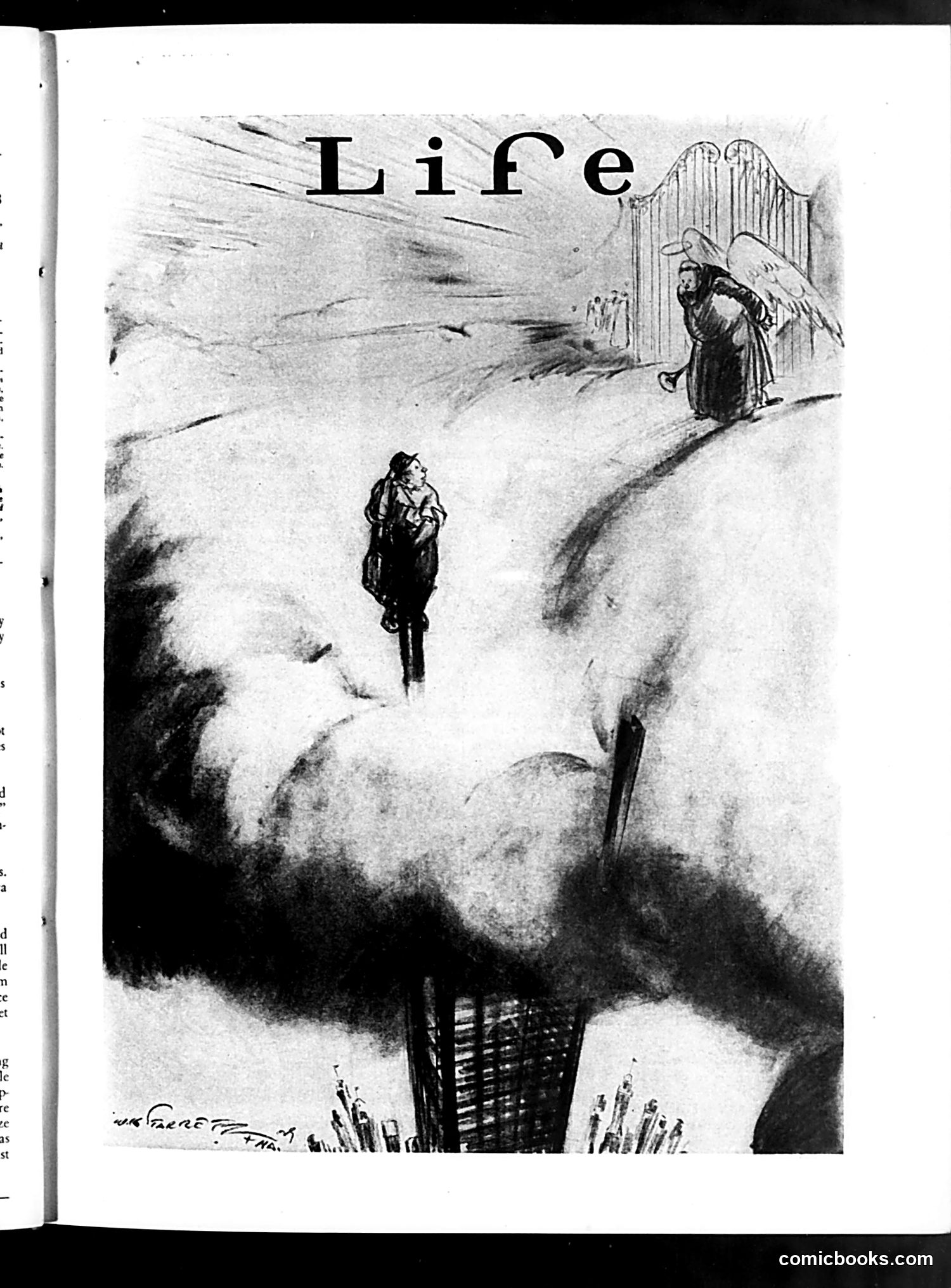
# Analysis of Life Magazine Cover This appears to be a cover illustration for *Life* magazine featuring allegorical imagery. A solitary human figure walks through a barren, snow-covered landscape toward a distant angelic figure standing at what appears to be a gate or threshold. The composition suggests a spiritual or existential journey—possibly depicting the passage from earthly life toward the afterlife or divine judgment. The stark, expressionistic style and somber mood convey themes of mortality and transcendence rather than political satire. Without accompanying text identifying specific figures or referencing particular events, the imagery functions as philosophical commentary on human existence rather than commentary on contemporary political figures or situations. The artistic style and allegorical approach were common in *Life* magazine's cover designs during the early-to-mid twentieth century.
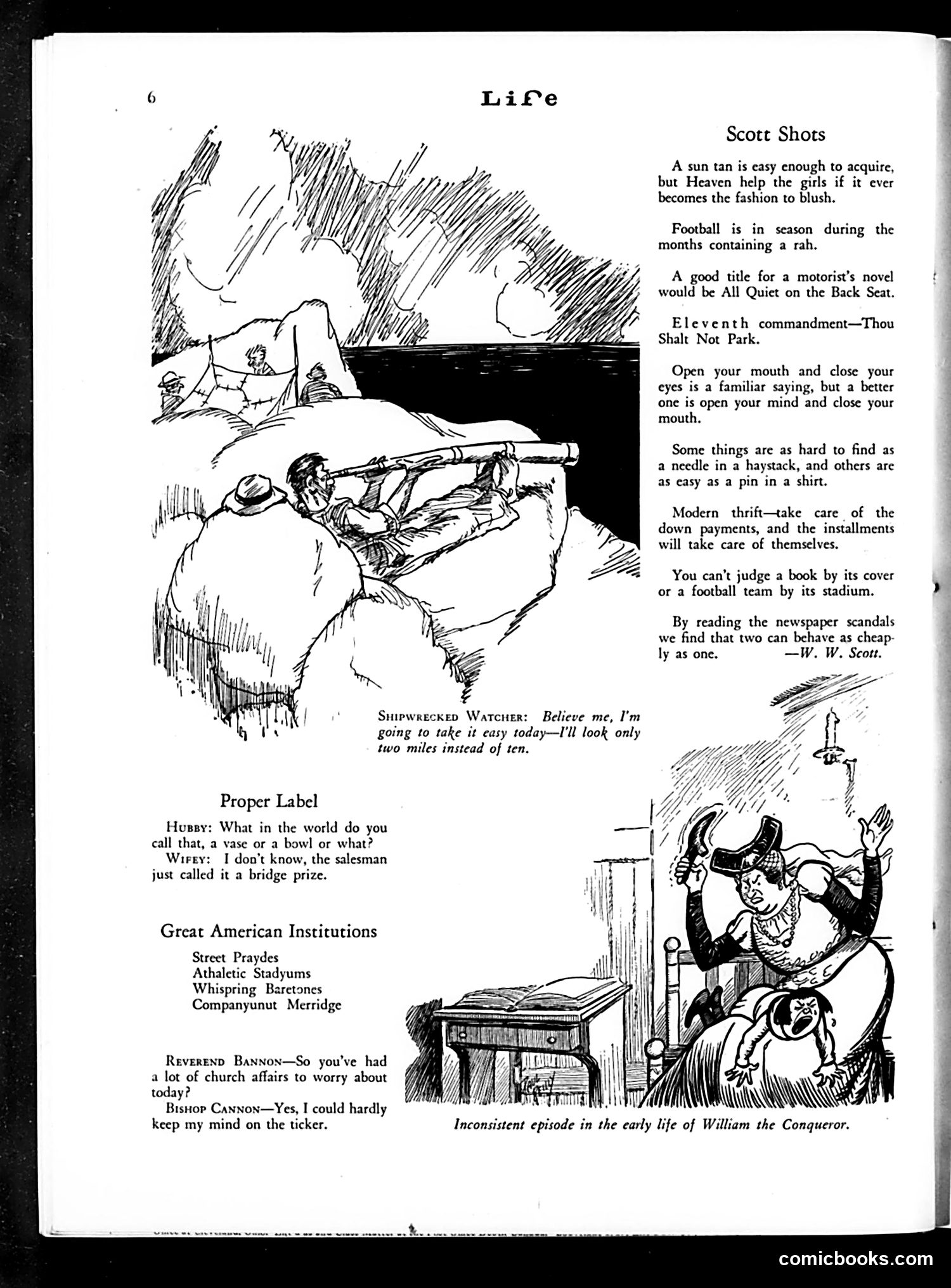
# Analysis of Life Magazine Page 6 This page contains miscellaneous satirical shorts and humor pieces rather than a cohesive political cartoon. The "Scott Shorts" section offers social commentary on contemporary behavior: sun tans becoming fashionable, football season, and parking violations. The "Eleventh Commandment—Thou Shalt Not Park" reflects early automobile-era frustrations. Two illustrated vignettes appear: one depicts a shipwrecked sailor attempting to take "it easy," and another shows "William the Conqueror" as a mischievous child creating chaos indoors. The "Proper Label" dialogue jokes about unclear terminology for decorative objects, while "Great American Institutions" sarcastically lists social phenomena like "Street Praydes" and "Whispering Baritones." The humor is observational rather than explicitly political, targeting everyday American life and social conventions of the era.
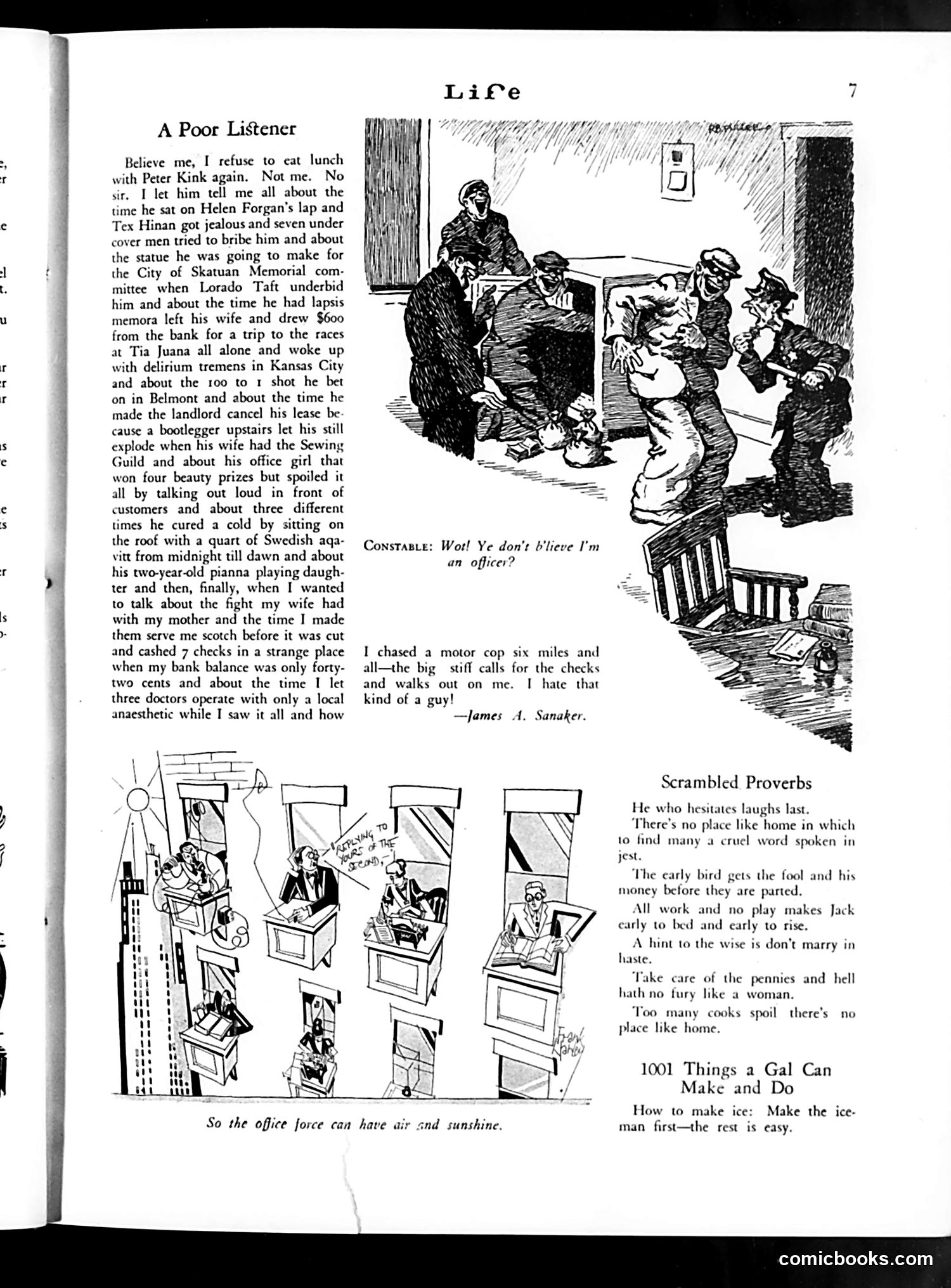
# "A Poor Listener" and Related Content The main cartoon shows a constable (police officer) confronting a group of people on the street, saying "Wot! Ye don't b'lieve I'm an officer?" The accompanying text by James A. Sanaker describes chasing a motor cop six miles who ignored his calls—suggesting police who ignore citizens' requests or fail to help when needed. The left cartoon depicts an office building with workers in stacked windows, captioned "So the office force can have air and sunshine"—satirizing cramped, poorly-ventilated office conditions where management forces workers into tight spaces. Below are "Scrambled Proverbs" (humorous twisted sayings) and "1001 Things a Gal Can Make and Do," typical Life magazine humor content from the early 20th century, likely targeting gender roles and social expectations.
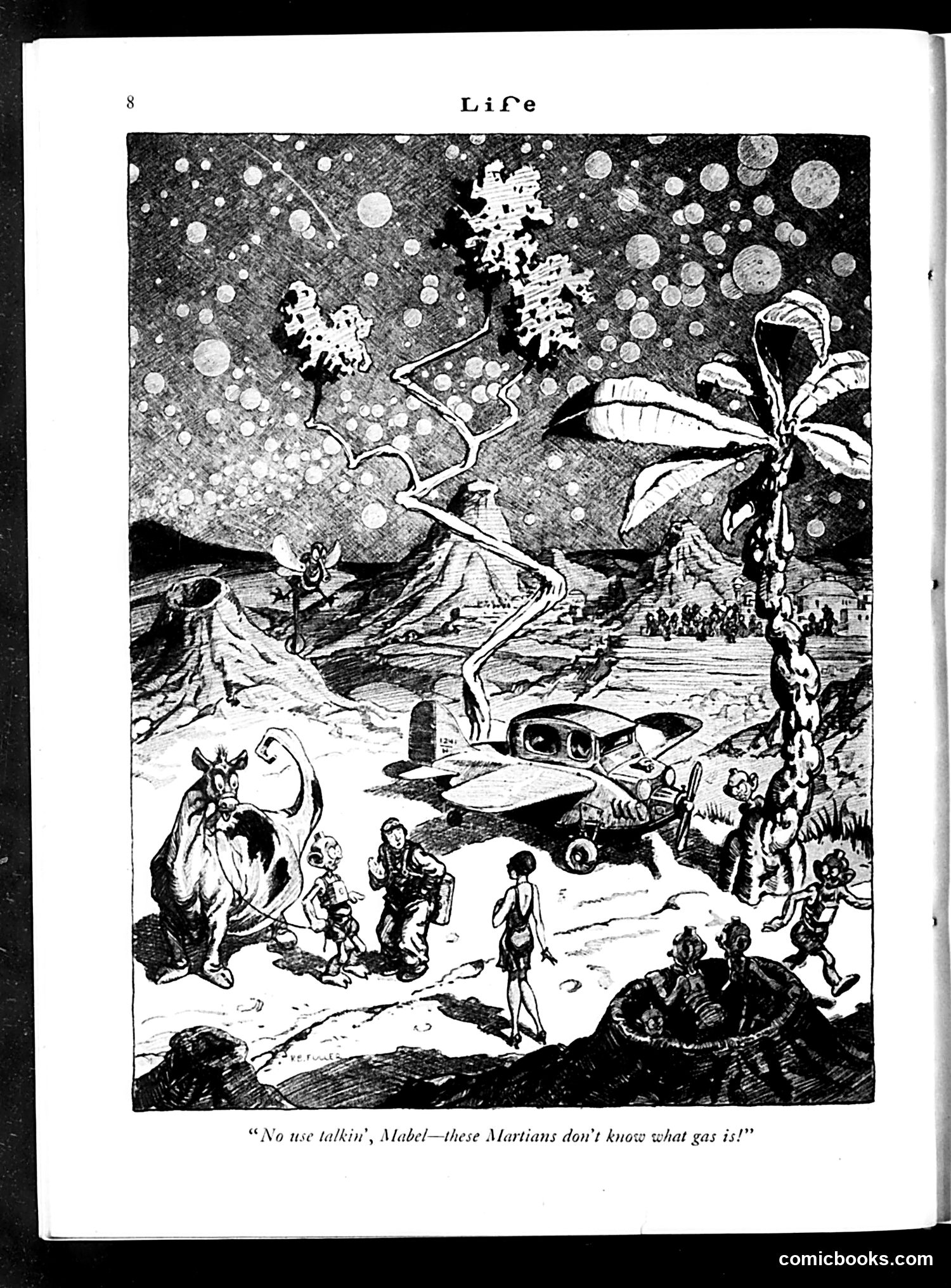
# Analysis This is a science-fiction cartoon depicting an alien landscape with Martian inhabitants and human visitors. The caption reads: "No use talkin', Mabel—these Martians don't know what gas is!" The joke satirizes early 20th-century American consumer culture and advertising. A human character (presumably "Mabel") appears to be attempting to sell or promote gasoline to Martians who have no use for it—they lack automobiles or combustion-based technology. The humor targets the absurdity of aggressive marketing and the assumption that all beings would desire mass-produced goods. It's a commentary on American commercialism's reach and presumption that modern conveniences are universally desirable, even to extraterrestrial life with completely different needs and infrastructure.
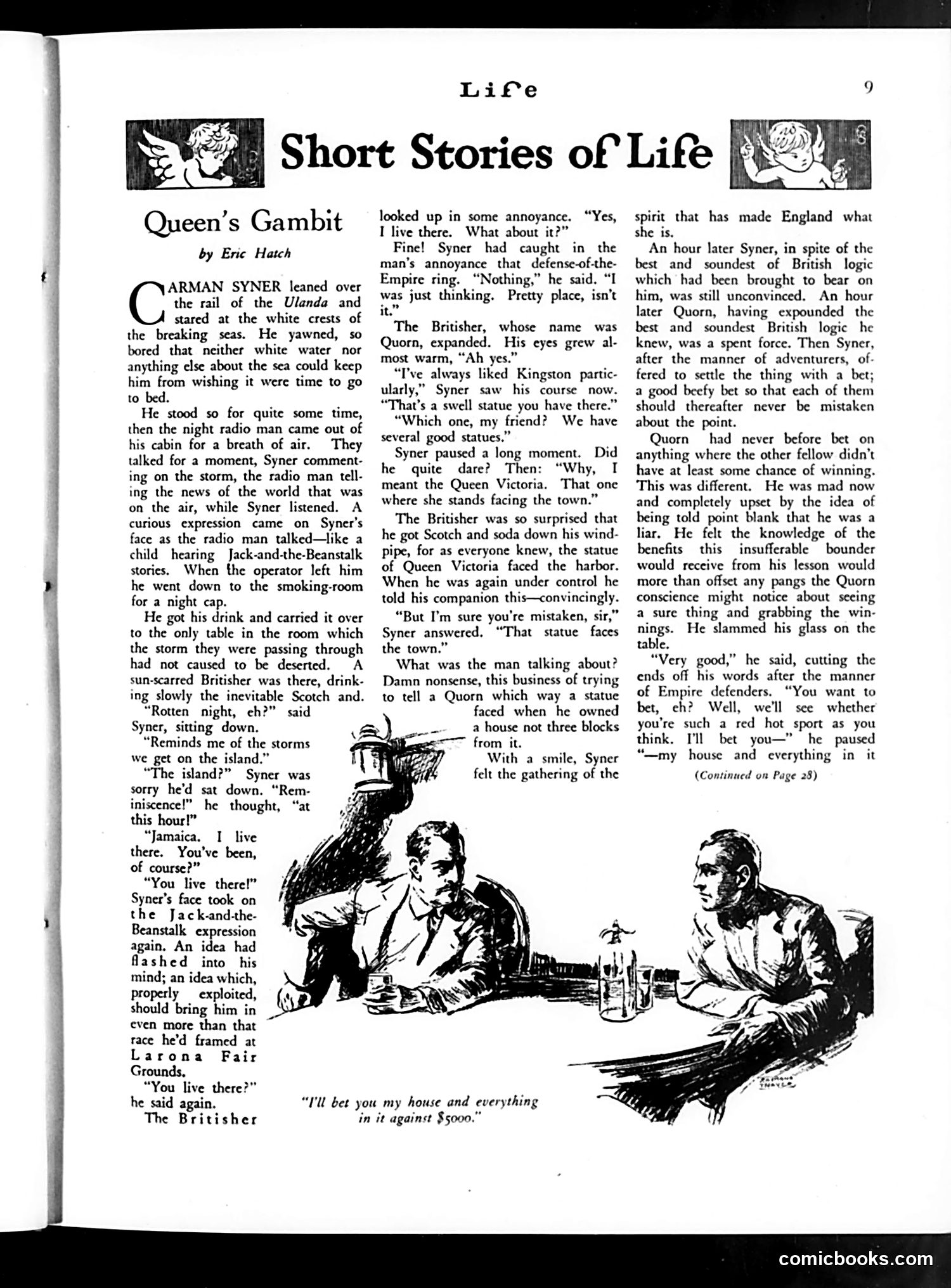
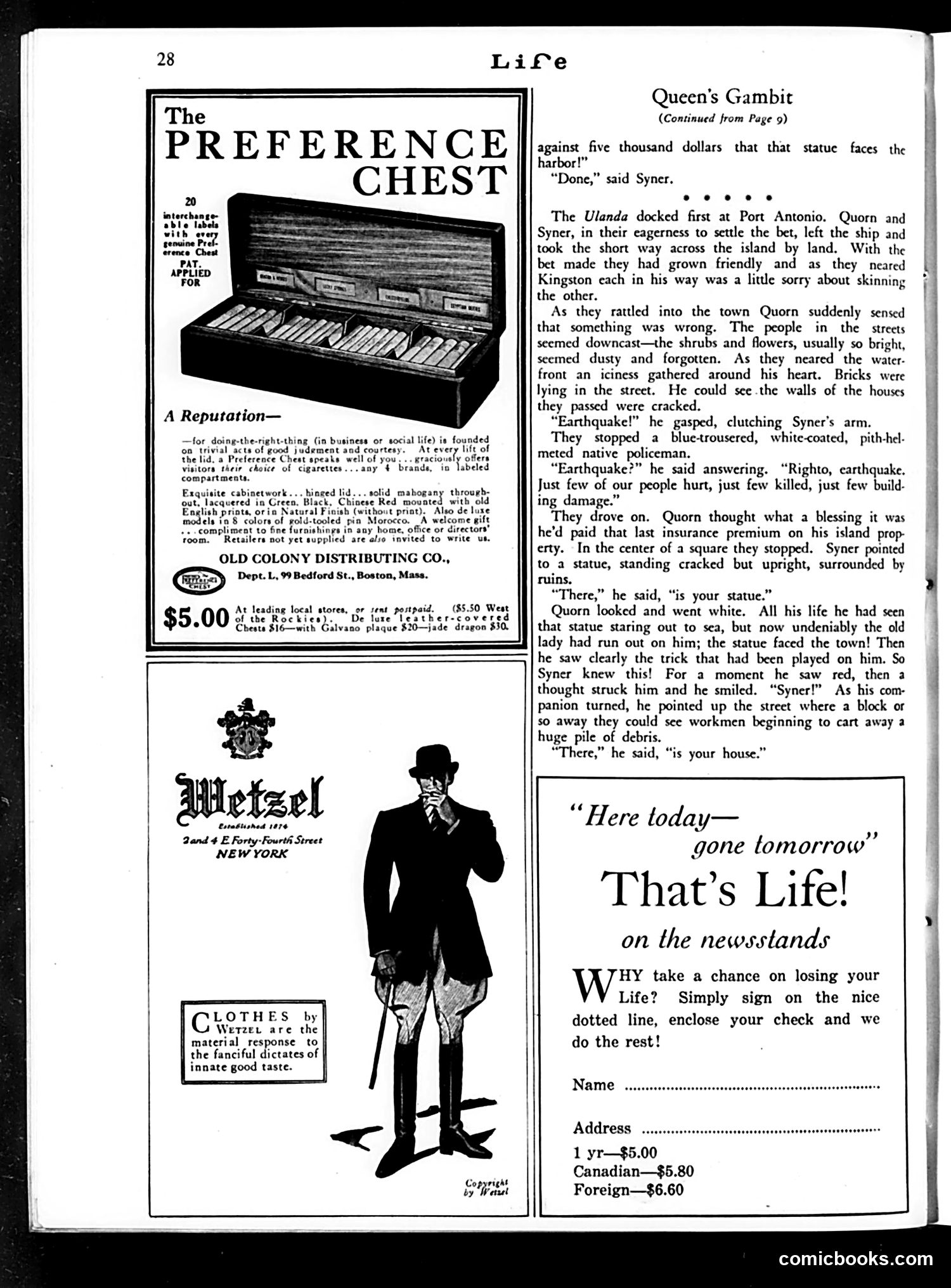
# "Queen's Gambit" by Eric Hatch - Analysis This short story satirizes British colonial attitudes and class consciousness. Two men—Carman Syner (apparently British) and an unnamed Britisher—are aboard a ship during a storm. They debate whether Syner lives in Jamaica or Kingston, with the Britisher expressing surprise and some disdain about Syner's colonial residence. The "Queen's Gambit" of the title appears to reference a bet Syner makes: wagering his house and £5,000 that he can convince someone he actually lives elsewhere—a commentary on colonial pretension and the social anxiety of maintaining respectability within the British Empire's rigid class structure. The story mocks how colonials tried to perform status and belonging within imperial hierarchies.
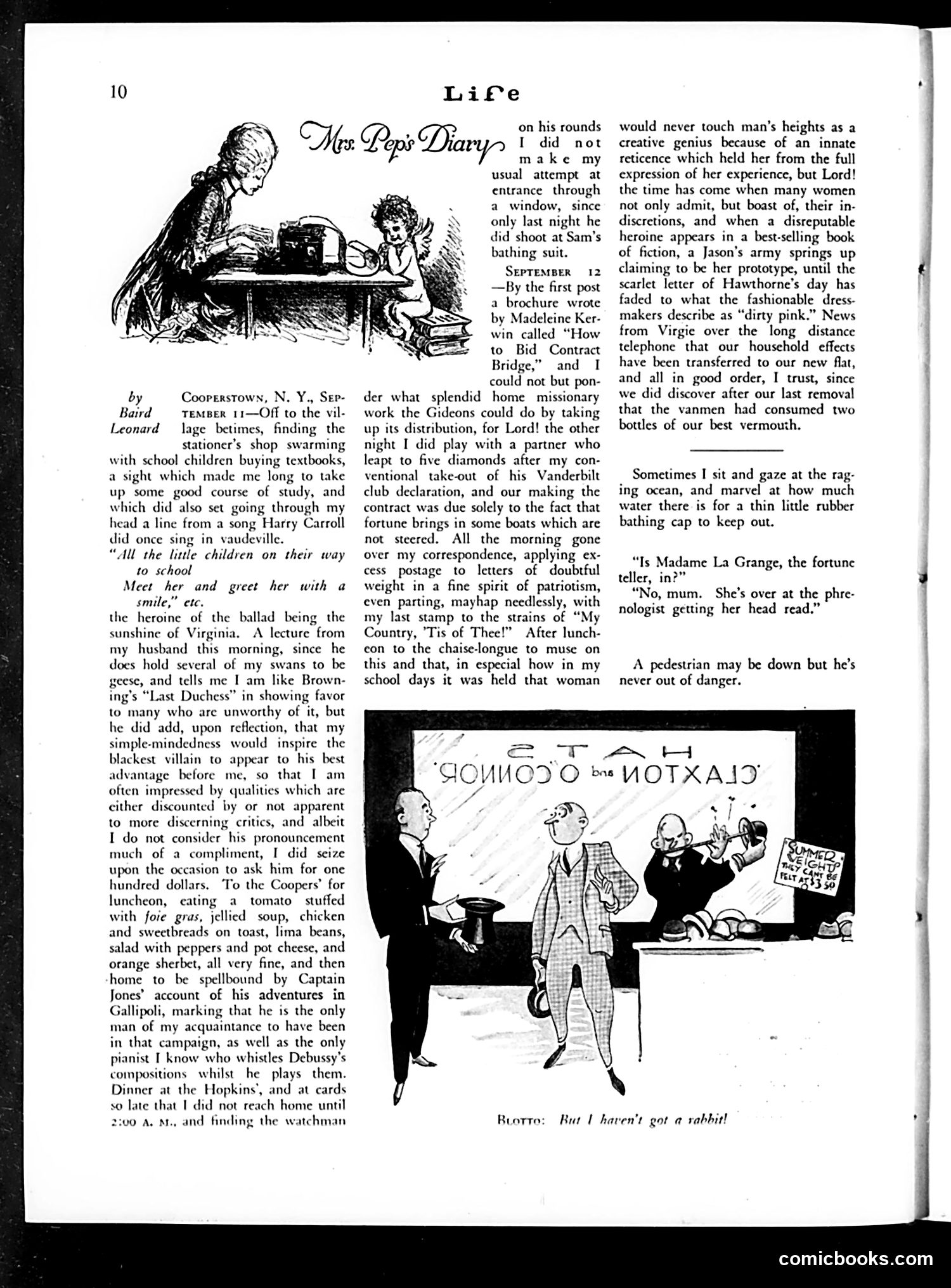
# Analysis of Life Magazine Page This page contains **"Mrs. Pep's Diary"** by Leonard, a society gossip column with accompanying illustration and cartoon. The main cartoon (bottom) shows a man in a checkered suit at what appears to be a Chinese restaurant (text reversed in background reads "CHOP SUEY CANTON"). The caption reads: "Burro: But I haven't got a rabbit!" This is a **pun-based joke** playing on the word "burro" (Spanish for donkey). The man is apparently being asked to produce a rabbit (perhaps for a magic trick or wager), but protests he only has a burro (donkey). The humor relies on the unexpected language twist and the absurdity of the situation. The diary portion discusses social events, bridge games, and society gossip typical of 1920s-30s Life magazine's satirical commentary on upper-class life.
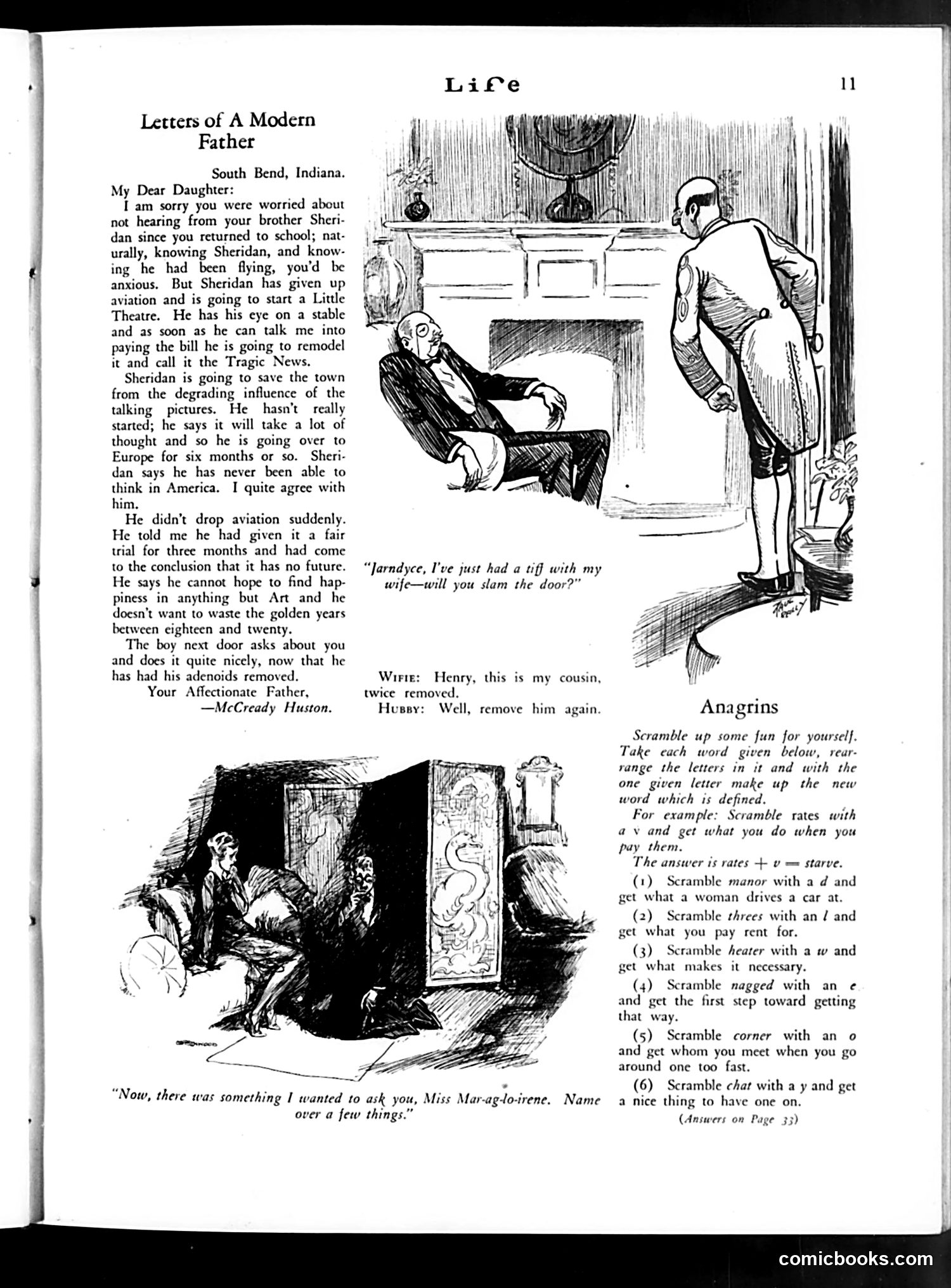
# "Letters of A Modern Father" & Social Satire This page from *Life* magazine contains two elements: **Top cartoon**: A domestic comedy showing a husband telling his wife he's had "a tiff" with her, asking her to "slam the door." The wife introduces her cousin, and the husband quips "Well, remove him again"—a joke about unwanted in-laws and marital discord. **Bottom cartoon**: Shows someone requesting information from "Miss Mar-ag-lo-irene," likely a play on a complicated or affected name, satirizing modern naming trends or pretentious affectations. The letter discusses the writer's son Sheridan, who has abandoned aviation to start a "Little Theatre" and is traveling to Europe—mocking artistic pretensions among young men of means during this era. The page uses humor to critique family dynamics, class aspiration, and bohemian artistic ambitions typical of early 20th-century American society.
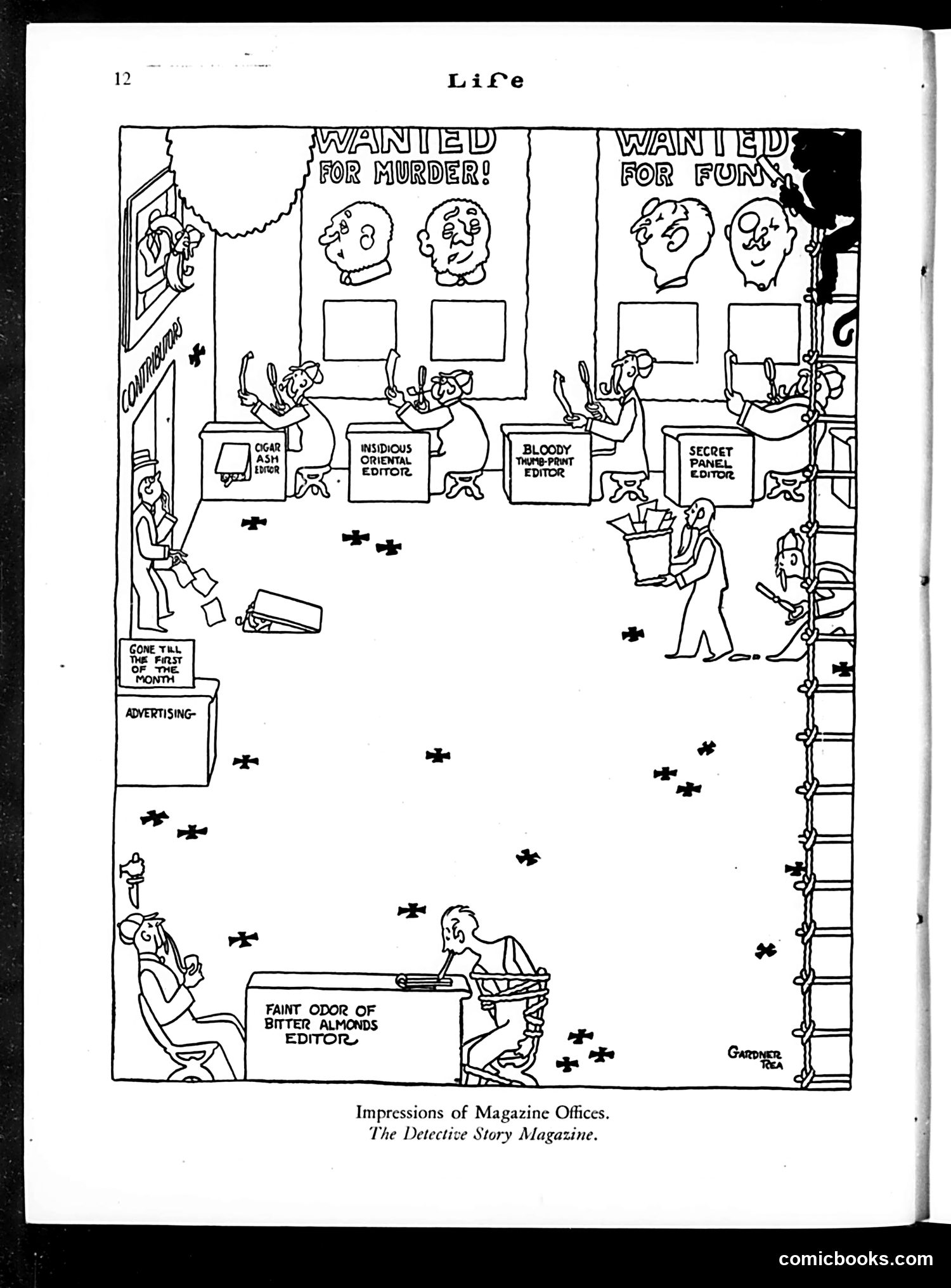
# Magazine Office Satire This cartoon satirizes *The Detective Story Magazine* office. The humor centers on the violent, sensational nature of detective fiction contrasted with the mundane reality of magazine editing. The wanted posters show "Wanted for Murder" and "Wanted for Fun" — mocking how detective magazines sensationalize crime. Below, editors work at desks labeled "Insidious Oriental Editor," "Bloody Thumb-Print Editor," and "Secret Panel Editor" — joking that specialized editors exist solely to inject melodrama. The bottom shows an editor experiencing "Faint Odor of Bitter Almonds" (likely referencing poisoning plot devices common in detective stories), while figures with guns and bodies scattered throughout suggest the violent content these editors process daily. The satire targets the formulaic, over-the-top conventions of pulp detective fiction and the specialized editorial machinery required to produce such sensational content.
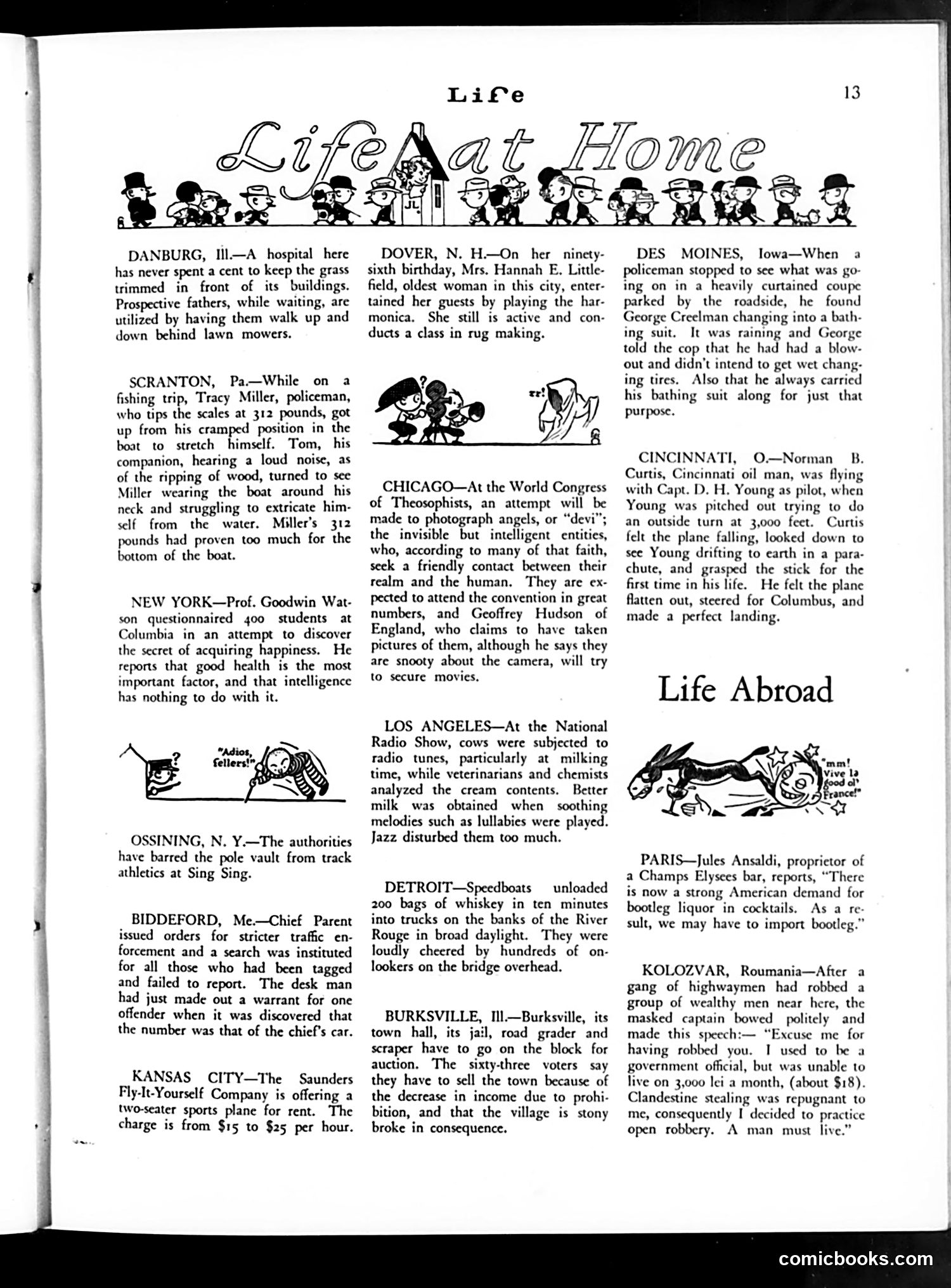
# Analysis This page from *Life* magazine presents humorous anecdotes from American life ("Life at Home") and international news ("Life Abroad"). The content is primarily text-based with minimal illustration. The cartoons appear to be small decorative vignettes rather than political commentary. One shows what appears to be a figure labeled "Miss Gillers" (unclear reference), and another depicts a cow being subjected to "radio tunes" at the Los Angeles National Radio Show—satirizing the notion that music might improve milk production. The anecdotes mock everyday absurdities: a hospital keeping grass trimmed by having fathers push mowers, professors seeking "happiness secrets," and police stopping speedboat whiskey smuggling in Detroit. The "Life Abroad" section includes a European bandit's polite apology for robbery—satire on Continental politeness. The humor relies on incongruity and mild social observation rather than sharp political critique.