
Pulp Fiction, 1909 · page 5 of 7
McClure's Magazine, November 1909 — page 5: what you’re looking at
What you’re looking at
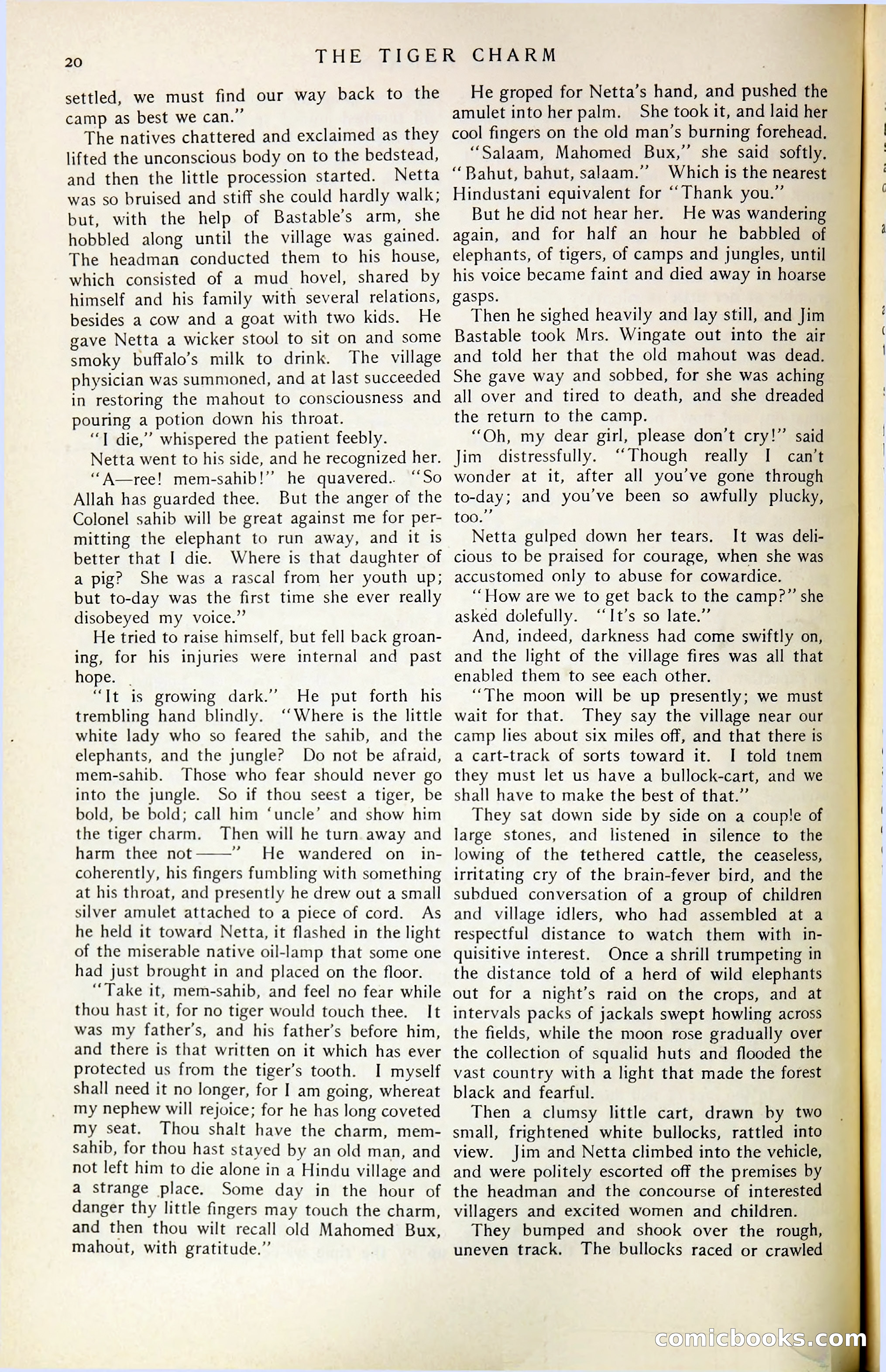
# Page Analysis This is a **story prose page** (page 20) from "The Tiger Charm," a narrative text printed in two columns. The visible text depicts a scene in an Indian village where Jim Bastable gives Netta an amulet (a tiger charm) after she has been injured and brought to the headman's house. The passage describes Netta's physical distress, Jim's attempts to comfort her, and his explanation of the charm's protective powers against tigers. The narrative concludes with Jim and Netta departing the village in a cart drawn by bullocks, escorted by villagers. The story appears to be an adventure tale set in colonial India involving wildlife danger.
📄 Transcribed text from this page (OCR, searchable)
Machine-transcribed from the original scan — historical spelling and the odd misread are preserved.
20 settled, we must find our way back to the camp as best we can.’ The natives chattered and exclaimed as they lifted the unconscious body on to the bedstead, and then the little procession started. Netta was so bruised and stiff she could hardly walk; but, with the help of Bastable’s arm, she hobbled along until the village was gained. The headman conducted them to his house, which consisted of a mud _ hovel, shared by himself and his family with several relations, besides a cow and a goat with two kids. He gave Netta a wicker stool to sit on and some smoky buffalo’s milk to drink. The village physician was summoned, and at last succeeded in restoring the mahout to consciousness and pouring a potion down his throat. “1 die,” whispered the patient feebly. Netta went to his side, and he recognized her. ‘““A—ree! mem-sahib!”’ he quavered.. “So Allah has guarded thee. But the anger of the Colonel sahib will be great against me for per- mitting the elephant to run away, and it is better that I die. Where is that daughter of a pig? She was a rascal from her youth up; but to-day was the first time she ever really disobeyed my voice.”’ He tried to raise himself, but fell back groan- ing, for his injuries were internal and past hope. . “It is growing dark.’’ He put forth his trembling hand blindly. “Where is the little white lady who so feared the sahib, and the elephants, and the jungle? Do not be afraid, mem-sahib. Those who fear should never go into the jungle. So if thou seest a tiger, be bold, be bold; call him ‘uncle’ and show him the tiger charm. Then will he turn away and harm thee not He wandered on_in- coherently, his fingers fumbling with something at his throat, and presently he drew out a small silver amulet attached to a piece of cord. As he held it toward Netta, it flashed in the light of the miserable native oil-lamp that some one had just brought in and placed on the floor. “Take it, mem-sahib, and feel no fear while thou hast it, for no tiger would touch thee. It was my father’s, and his father’s before him, and there is that written on it which has ever protected us from the tiger’s tooth. I myself shall need it no longer, for I am going, whereat my nephew will rejoice; for he has long coveted my seat. Thou shalt have the charm, mem- sahib, for thou hast stayed by an old man, and not left him to die alone in a Hindu village and a strange place. Some day in the hour of danger thy little fingers may touch the charm, and then thou wilt recall old Mahomed Bux, mahout, with gratitude.” THE TIGER CHARM He groped for Netta’s hand, and pushed the amulet into her palm. She took it, and laid her cool fingers on the old man’s burning forehead, ‘Salaam, Mahomed Bux,” she said softly, ‘‘Bahut, bahut, salaam.’’ Which ts the nearest Hindustani equivalent for “Thank you.” But he did not hear her. He was wandering again, and for half an hour he babbled of elephants, of tigers, of camps and jungles, until his voice became faint and died away in hoarse gasps. Then he sighed heavily and lay still, and Jim Bastable took Mrs. Wingate out into the air and told her that the old mahout was dead. She gave way and sobbed, for she was aching all over and tired to death, and she dreaded the return to the camp. “Oh, my dear girl, please don’t cry!” said Jim distressfully. “Though really I can't wonder at it, after all you’ve gone through to-day; and you’ve been so awfully plucky, too.” Netta gulped down her tears. It was deli- cious to be praised for courage, when she was accustomed only to abuse for cowardice. ‘““How are we to get back to the camp?” she asked dolefully. “It’s so late.” And, indeed, darkness had come swiftly on, and the light of the village fires was all that enabled them to see each other. “The moon will be up presently; we must wait for that. They say the village near our camp lies about six miles off, and that there is a cart-track of sorts toward it. I told tnem they must let us have a bullock-cart, and we shall have to make the best of that.” They sat down side by side on a couple of large stones, and listened in silence to the lowing of the tethered cattle, the ceaseless, irritating cry of the brain-fever bird, and the subdued conversation of a group of children and village idlers, who had assembled at a respectful distance to watch them with in- quisitive interest. Once a shrill trumpeting in the distance told of a herd of wild elephants out for a night’s raid on the crops, and at intervals packs of jackals swept howling across the fields, while the moon rose gradually over the collection of squalid huts and flooded the vast country with a light that made the forest black and fearful. Then a clumsy little cart, drawn by two small, frightened white bullocks, rattled into view. Jim and Netta climbed into the vehicle, and were politely escorted off the premises by the headman and the concourse of interested villagers and excited women and children. They bumped and shook over the rough, uneven track. The bullocks raced or crawled (EO) JOOKS com