
Pulp Fiction, 1909 · page 3 of 7
McClure's Magazine, November 1909 — page 3: what you’re looking at
What you’re looking at
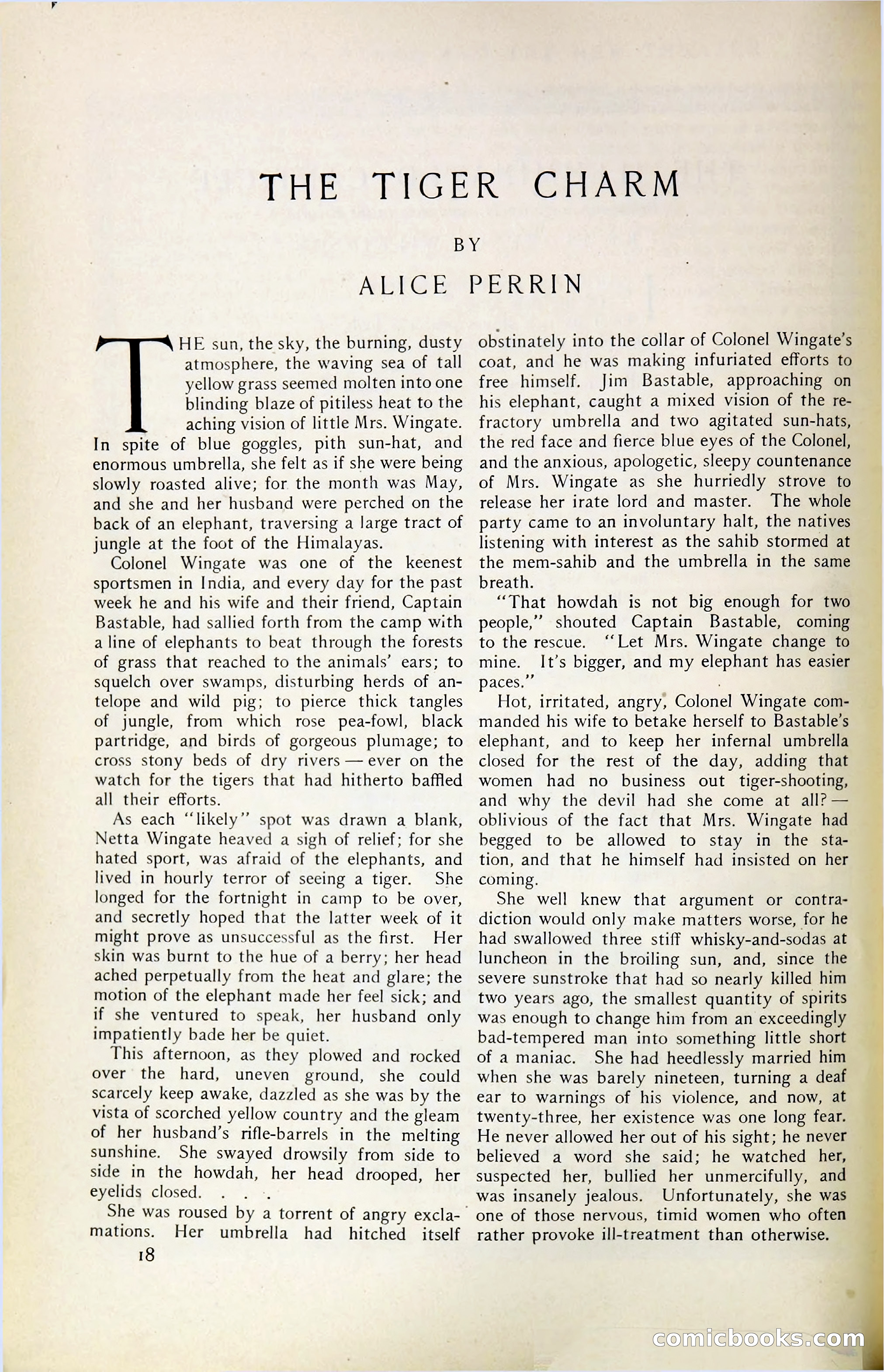
# "The Tiger Charm" by Alice Perrin This page contains story prose from a pulp fiction tale. It depicts a scene set in India during an elephant expedition through the Himalayas, where Colonel Wingate and his wife Mrs. Wingate are on a tiger-hunting expedition with Captain Bastable. The narrative describes the oppressive heat, Mrs. Wingate's exhaustion and fear, and tensions between the Colonel and Captain Bastable over whose elephant Mrs. Wingate should ride. The passage establishes Mrs. Wingate as a timid, nervous woman enduring her abusive husband's volatile temperament during what appears to be a dangerous colonial adventure.
📄 Transcribed text from this page (OCR, searchable)
Machine-transcribed from the original scan — historical spelling and the odd misread are preserved.
THE. TIGER ‘CA BY ALICE PEREIN HE sun, the sky, the burning, dusty atmosphere, the waving sea of tall yellow grass seemed molten into one blinding blaze of pitiless heat to the aching vision of little Mrs. Wingate. In spite of blue goggles, pith sun-hat, and enormous umbrella, she felt as if she were being slowly roasted alive; for the month was May, and she and her husband were perched on the back of an elephant, traversing a large tract of jungle at the foot of the Himalayas. Colonel Wingate was one of the keenest sportsmen in India, and every day for the past week he and his wife and their friend, Captain Bastable, had sallied forth from the camp with a line of elephants to beat through the forests of grass that reached to the animals’ ears; to squelch over swamps, disturbing herds of an- telope and wild pig; to pierce thick tangles of jungle, from which rose pea-fowl, black partridge, and birds of gorgeous plumage; to cross stony beds of dry rivers —ever on the watch for the tigers that had hitherto baffled all their efforts. As each “‘likely’’ spot was drawn a blank, Netta Wingate heaved a sigh of relief; for she hated sport, was afraid of the elephants, and lived in hourly terror of seeing a tiger. She longed for the fortnight in camp to be over, and secretly hoped that the latter week of it might prove as unsuccessful as the first. Her skin was burnt to the hue of a berry; her head ached perpetually from the heat and glare; the motion of the elephant made her feel sick; and if she ventured to speak, her husband only impatiently bade her be quiet. This afternoon, as they plowed and rocked over the hard, uneven ground, she could scarcely keep awake, dazzled as she was by the vista of scorched yellow country and the gleam of her husband’s rifle-barrels in the melting sunshine. She swayed drowsily from side to side in the howdah, her head drooped, her eyelids closed. She was roused by a torrent of angry excla-_ mations. Her umbrella had_ hitched 18 itself obstinately into the collar of Colonel Wingate’s coat, and he was making infuriated efforts to free himself. Jim Bastable, approaching on his elephant, caught a mixed vision of the re- fractory umbrella and two agitated sun-hats, the red face and fierce blue eyes of the Colonel, and the anxious, apologetic, sleepy countenance of Mrs. Wingate as she hurriedly strove to release her irate lord and master. The whole party came to an involuntary halt, the natives listening with interest as the sahib stormed at the mem-sahib and the umbrella in the same breath. “That howdah is not big enough for two people,” shouted Captain Bastable, coming to the rescue. ‘“‘Let Mrs. Wingate change to mine. It’s bigger, and my elephant has easier paces,” . Hot, irritated, angry, Colonel Wingate com- manded his wife to betake herself to Bastable’s elephant, and to keep her infernal umbrella closed for the rest of the day, adding that women had no business out tiger-shooting, and why the devil had she come at all? — oblivious of the fact that Mrs. Wingate had begged to be allowed to stay in the sta- tion, and that he himself had insisted on her coming. She well knew that argument or contra- diction would only make matters worse, for he had swallowed three stiff whisky-and-sodas at luncheon in the broiling sun, and, since the severe sunstroke that had so nearly killed him two years ago, the smallest quantity of spirits was enough to change him from an exceedingly bad-tempered man into something little short of a maniac. She had heedlessly married him when she was barely nineteen, turning a deaf ear to warnings of his violence, and now, at twenty-three, her existence was one long fear. He never allowed her out of his sight; he never believed a word she said; he watched her, suspected her, bullied her unmercifully, and was insanely jealous. Unfortunately, she was one of those nervous, timid women who often rather provoke ill-treatment than otherwise. (€(o) | 0)(6\(6) (C(0)