
Penny Dreadfuls, 1873 · page 31 of 118
The Arguments of the Emperor Julian Against the Christians — page 31: what you’re looking at
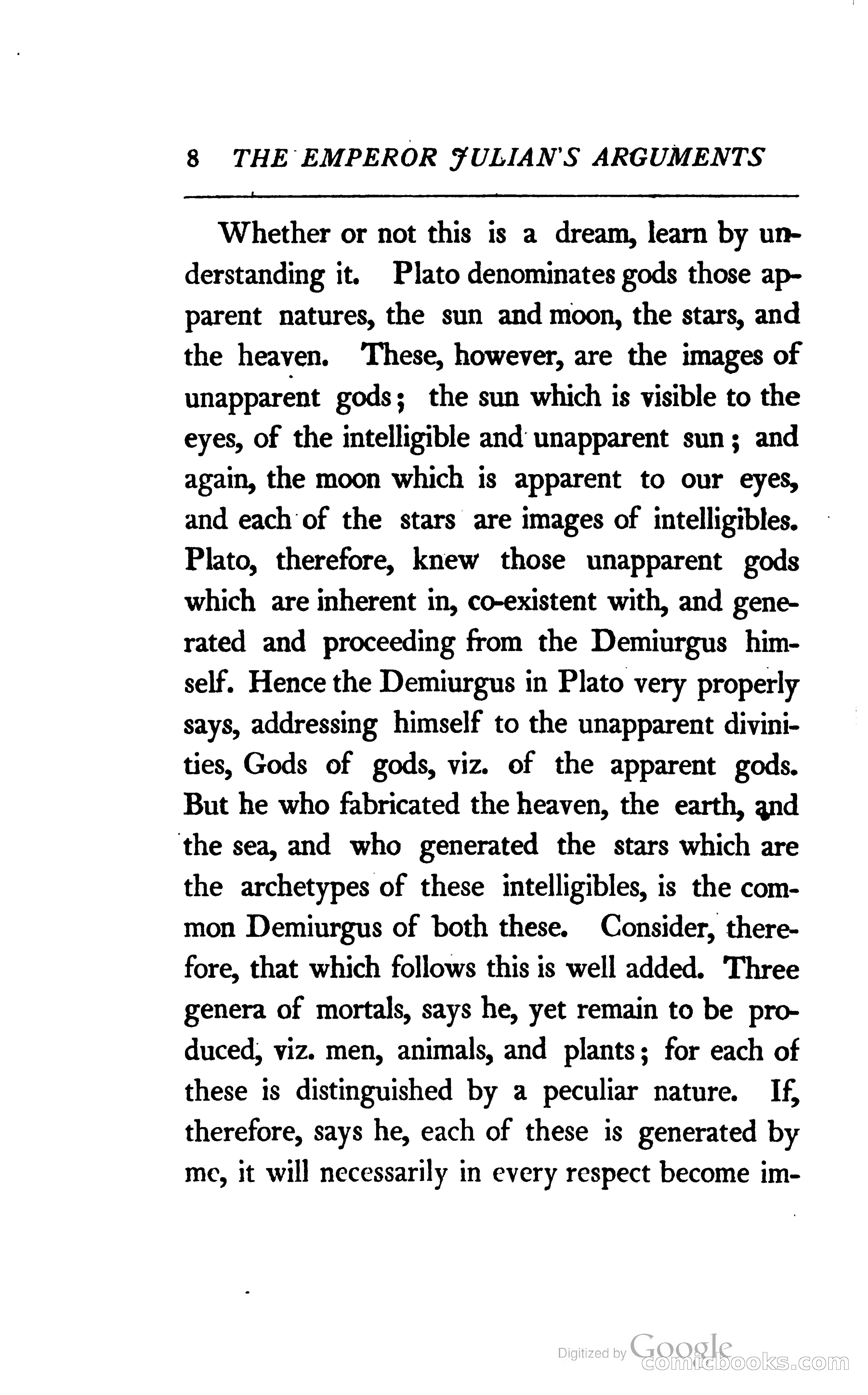
A restored page from Penny Dreadfuls, 1873. Page through the whole issue in the reader above.
📄 Transcribed text from this page (OCR, searchable)
Machine-transcribed from the original scan — historical spelling and the odd misread are preserved.
8 THE EMPEROR $ULIAN'S ARGUMENTS Whether or not this 1s a dream, learn by un- derstanding it. Plato denominates gods those ap- parent natures, the sun and moon, the stars, and the heaven. These, however, are the images of unapparent gods; the sun which is visible to the eyes, of the intelligible and unapparent sun; and again, the moon which is apparent to our eyes, and each of the stars are images of intelligibles. Plato, therefore, knew those unapparent gods which are inherent in, co-existent with, and gene- rated and proceeding from the Demiurgus him- self. Hence the Demiurgus in Plato very properly says, addressing himself to the unapparent divini- ties, Gods of gods, viz. of the apparent gods. But he who fabricated the heaven, the earth, and the sea, and who generated the stars which are the archetypes of these intelligibles, is the com- mon Demiurgus of both these. Consider, there- fore, that which follows this is well added. Three genera of mortals, says he, yet remain to be pro- duced, viz. men, animals, and plants; for each of these 1s distinguished by a peculiar nature. If, therefore, says he, each of these is generated by me, it will necessarily in every respect become im- CONNIE DOOKS.CO mn