
Penny Dreadfuls, 1839 · page 25 of 77
The Adamus exul of Grotius; or The Prototype of Paradise Lost — page 25: what you’re looking at
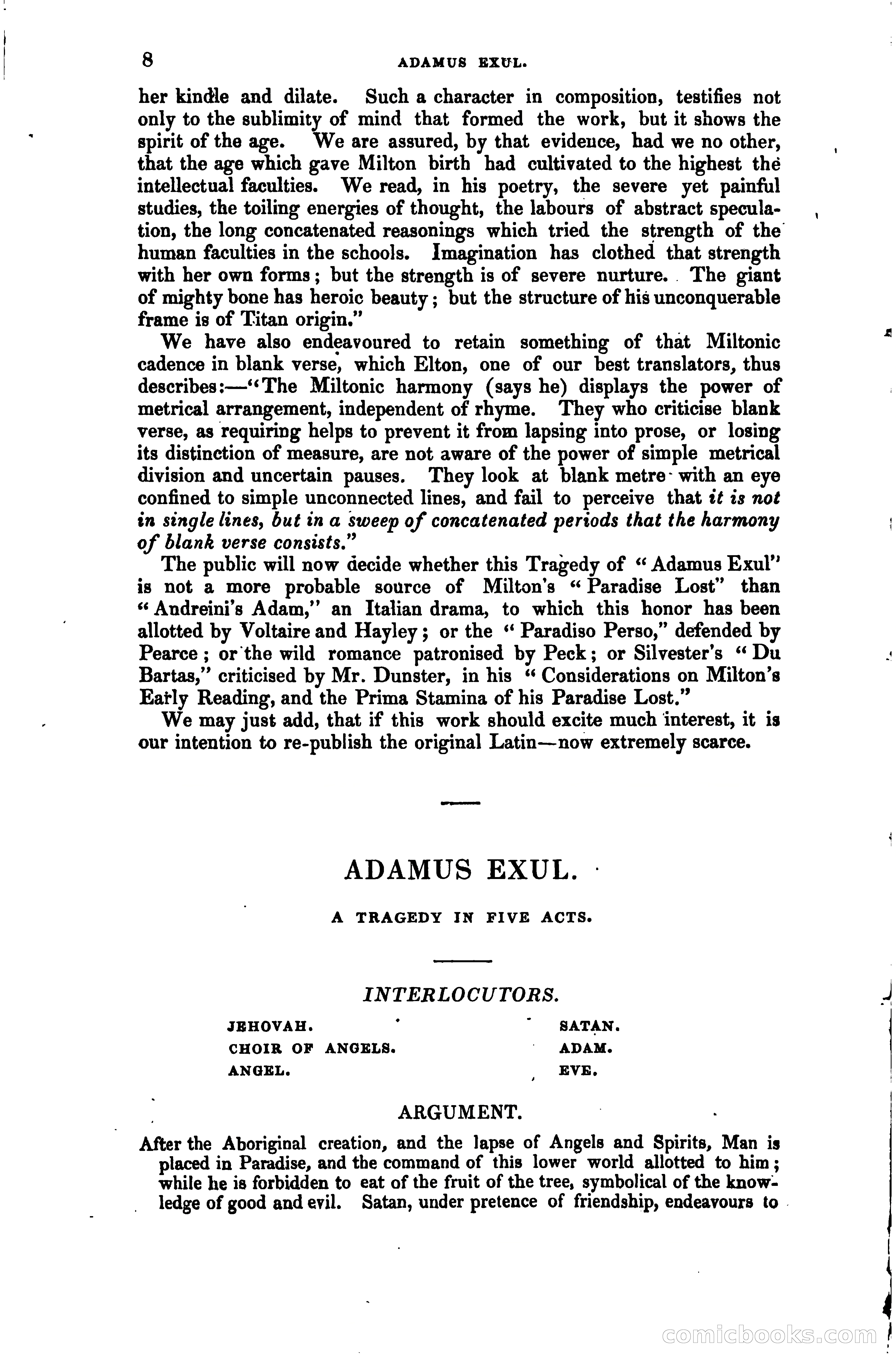
A restored page from Penny Dreadfuls, 1839. Page through the whole issue in the reader above.
📄 Transcribed text from this page (OCR, searchable)
Machine-transcribed from the original scan — historical spelling and the odd misread are preserved.
8 ADAMUS EXUL. her kindle and dilate. Such a character in composition, testifies not only to the sublimity of mind that formed the work, but it shows the spirit of the age. We are assured, by that evidence, had we no other, that the age which gave Milton birth had cultivated to the highest thé intellectual faculties. We read, in his poetry, the severe yet painful studies, the toilmg energies of thought, the labours of abstract specula- tion, the long concatenated reasonings which tried the strength of the human faculties in the schools. Imagination has clothed that strength with her own forms; but the strength is of severe nurture. The giant of mighty bone has heroic beauty; but the structure of his unconquerable frame is of Titan origin.” We have also endeavoured to retain something of that Miltonic cadence in blank verse, which Elton, one of our best translators, thus describes:—‘‘The Miltonic harmony (says he) displays the power of metrical arrangement, independent of rhyme. They who criticise blank verse, as requiring helps to prevent it from lapsing into prose, or losing its distinction of measure, are not aware of the power of simple metrical division and uncertain pauses. They look at blank metre- with an eye confined to simple unconnected lines, and fail to perceive that t¢ 23 not in single lines, but ina sweep of concatenated periods that the harmony of blank verse consists.” The public will now decide whether this Tragedy of ‘“ Adamus Exul” is not a more probable source of Milton’s “ Paradise Lost” than ‘¢ Andreini’s Adam,’’ an Italian drama, to which this honor has been allotted by Voltaire and Hayley; or the “ Paradiso Perso,” defended by Pearce ; or the wild romance patronised by Peck; or Silvester’s “ Du Bartas,”’ criticised by Mr. Dunster, in his ‘ Considerations on Milton's Eaily Reading, and the Prima Stamina of his Paradise Lost.” We may just add, that if this work should excite much interest, it is our intention to re-publish the original Latin—now extremely scarce. ADAMUS EXUL. - A TRAGEDY IN FIVE ACTS. INTERLOCUTORS. JEHOVAH. ° ' SATAN. CHOIR OF ANGELS. ADAM. ANGEL. | EVE. ARGUMENT. After the Aboriginal creation, and the lapse of Angels and Spirits, Man is placed in Paradise, and the command of this lower world allotted to him; while he is forbidden to eat of the fruit of the tree, symbolical of the know- ledge of good andeyvil. Satan, under pretence of friendship, endeavours to | COMME OOO <S