
Penny Dreadfuls, 1839 · page 22 of 77
The Adamus exul of Grotius; or The Prototype of Paradise Lost — page 22: what you’re looking at
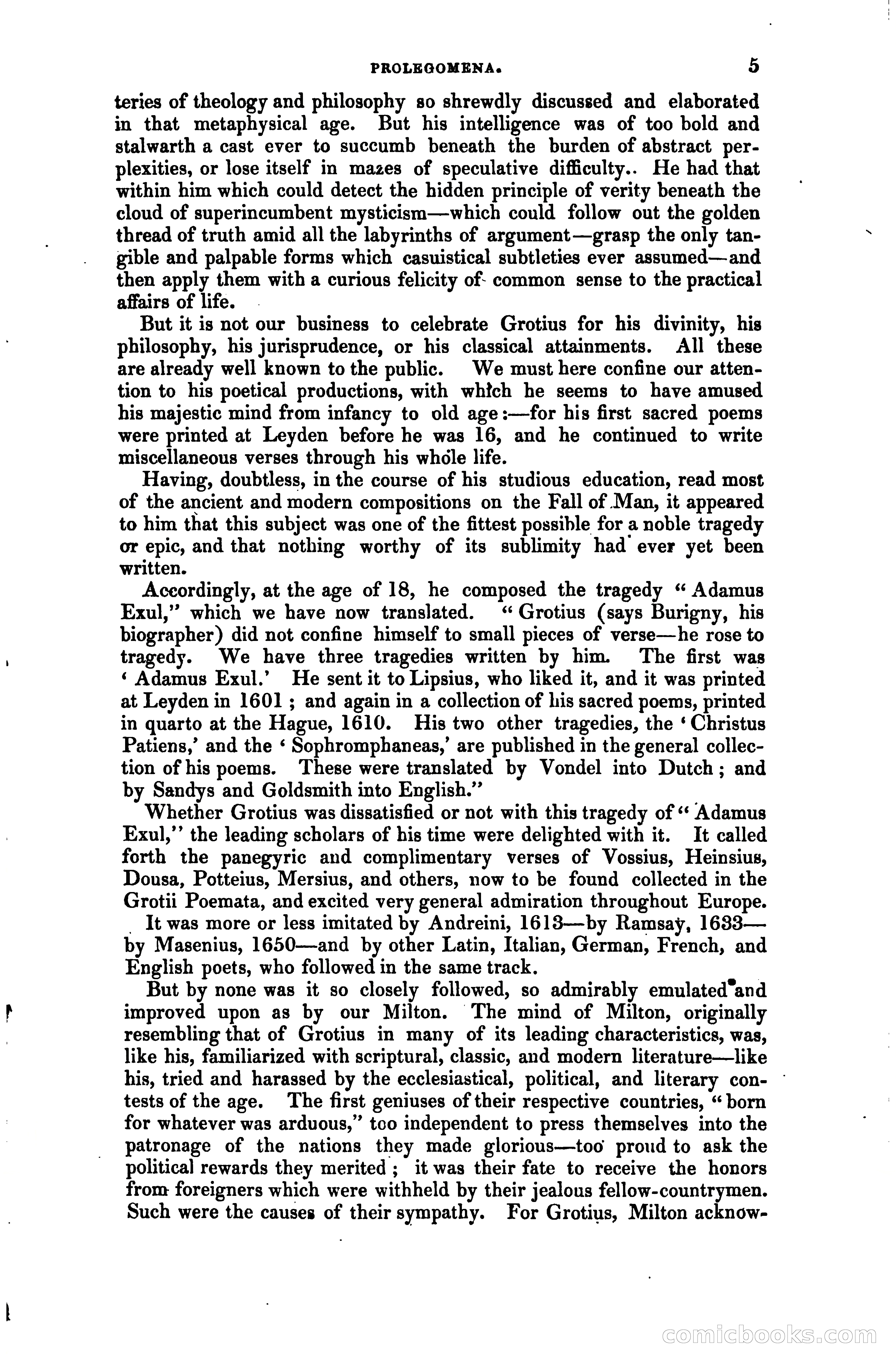
A restored page from Penny Dreadfuls, 1839. Page through the whole issue in the reader above.
📄 Transcribed text from this page (OCR, searchable)
Machine-transcribed from the original scan — historical spelling and the odd misread are preserved.
PROLEGOMENA. 5 teries of theology and philosophy so shrewdly discussed and elaborated in that metaphysical age. But his intelligence was of too bold and stalwarth a cast ever to succumb beneath the burden of abstract per- plexities, or lose itself m mazes of speculative difficulty.. He had that within him which could detect the hidden principle of verity beneath the cloud of superincumbent mysticism—which could follow out the golden thread of truth amid all the labyrinths of argument—grasp the only tan- gible and palpable forms which casuistical subtleties ever assumed—and then apply them with a curious felicity of common sense to the practical affairs of life. But it is not our business to celebrate Grotius for his divinity, his philosophy, his jurisprudence, or his classical attainments. All these are already well known tothe public. We must here confine our atten- tion to his poetical productions, with which he seems to have amused his majestic mind from infancy to old age :—for his first sacred poems were printed at Leyden before he was 16, and he continued to write miscellaneous verses through his whole life. Having, doubtless, in the course of his studious education, read most of the ancient and modern compositions on the Fall of Man, it appeared to him that this subject was one of the fittest possible for a noble tragedy or epic, and that nothing worthy of its sublimity had ever yet been written. Accordingly, at the age of 18, he composed the tragedy “ Adamus Exul,”’ which we have now translated. ‘“ Grotius (says Burigny, his biographer) did not confine himself to small pieces of verse—he rose to tragedy. We have three tragedies written by him. The first was ‘ Adamus Exul.’ He sent it to Lipsius, who liked it, and it was printed at Leyden in 1601 ; and again in a collection of his sacred poems, printed in quarto at the Hague, 1610. His two other tragedies, the ‘ Christus Patiens,’ and the ‘ Sophromphaneas,’ are published in the general collec- tion of his poems. These were translated by Vondel into Dutch; and by Sandys and Goldsmith into English.” Whether Grotius was dissatisfied or not with this tragedy of ‘*‘ Adamus Exul,’’ the leading scholars of his time were delighted with it. It called forth the panegyric and complimentary verses of Vossius, Heinsius, Dousa, Potteius, Mersius, and others, now to be found collected in the Grotii Poemata, and excited very general admiration throughout Europe. It was more or less imitated by Andreini, 1613—by Ramsay, 1633— by Masenius, 1650—and by other Latin, Italian, German, French, and English poets, who followed in the same track. But by none was it so closely followed, so admirably emulated’and improved upon as by our Milton. The mind of Milton, originally resembling that of Grotius in many of its leading characteristics, was, like his, familiarized with scriptural, classic, and modern literature—like his, tried and harassed by the ecclesiastical, political, and literary con- — tests of the age. The first geniuses of their respective countries, ‘“ born for whatever was arduous,’ too independent to press themselves into the patronage of the nations they made glorious—too proud to ask the political rewards they merited ; it was their fate to receive the honors from foreigners which were withheld by their jealous fellow-countrymen. Such were the causes of their sympathy. For Grotius, Milton acknow- COL @ DOO <S (c@