
Judge, 1930-04-19 · page 27 of 36
Judge — April 19, 1930 — page 27: what you’re looking at
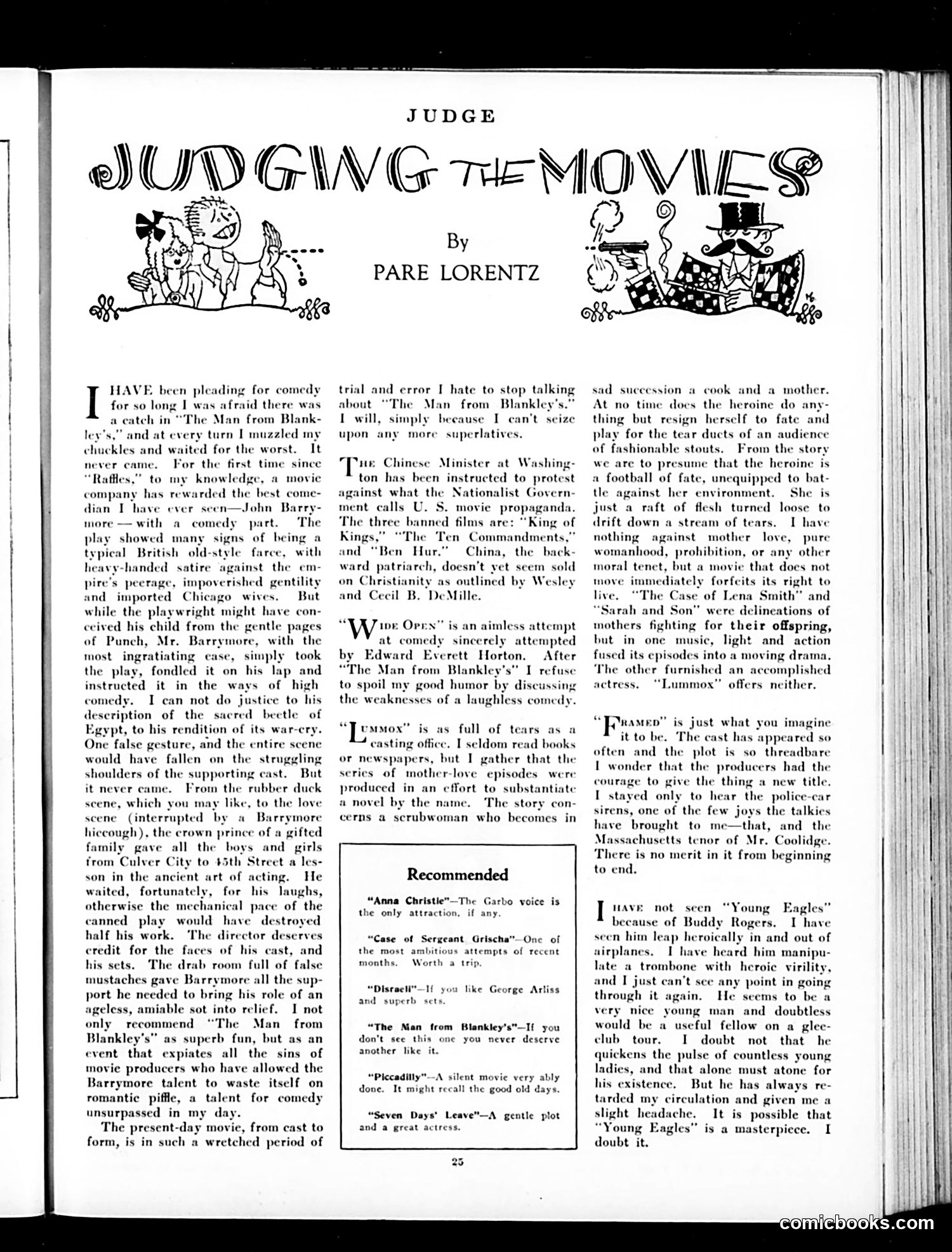
A restored page from Judge, 1930-04-19. Page through the whole issue in the reader above.
📄 Transcribed text from this page (OCR, searchable)
Machine-transcribed from the original scan — historical spelling and the odd misread are preserved.
—————————__—_I JUDGE . UDG NG He Mi JN L$ for so long I was afraid there was atch in “The Man from Blank- ; nd at every turn E muzzled my chuckles and waited for the worst. It ver came. For the first time since “Raffles,” to my knowledge, a movie I HAVE been pleading for comes company has rewarded the best come- dian I have ever seen—John Barry- more — with a comedy part. The play showed m: 1 British -handed ny signs of being a old-style farce, with satire against the em- . impoverished gentility and imported Chicago wives. But while the playwright might have con- ceived his child from the gentle pages of Punch, Mr. Barrymore, with the most ingratiating ease, simply took the play, fondled it on his lap and instructed it in the ways of high comed, I can not do justice to his description of the sacred bectle of Egypt, to his rendition of its war-ery. One false gesture, and the entire scene would have fallen on the struggling shoulders of the supporting cast. But it never came. From the rubber duck scene, which you may like, to the love scene (interrupted by a Barrymore hiccough), the crown prince of a gifted family gave all the and girls from Culver City to 45th Street a les- son in the ancient art of ng. He waited, fortunately, for his laughs, otherwise the mechanical pace of the canned would have destroyed half his work. ‘The director deserves credit for the faces of his cast, and his sets. The drab room full of false mustaches gave Barrymore all the sup- port he needed to bring his role of an ageless, amiable sot into relief. I not only recommend The Man from Blankley’s” as superb fun, but as an event that expiates all the sins of movie producers who have allowed the Barrymore talent to waste itself on romantic piffle, a talent for comedy unsurpassed in my di The present-day mo: from cast to form, is in such a wretched period of boys By PARE LORENTZ t and error I hate to stop talking about “The Man from Blankle: I will, simply beeause I can't seize upon any more superlatives. ‘Pur Chinese Minister at) Washing- ton has been instructed to protest against what the Nationalist Govern- ment calls U. movie The three banned films Kings,” “The Ten © and “Ben Hur.” China, the ba ward patriarch, doesn’t yet seem sold on Christianity as outlined by Wesley and Cecil B. DeMille. mandments,”” “Wve Ores” is an aimless attempt at comedy sincerely attempted by Edward Everett Horton, After “The Man from Blankley’s” I refuse to spoil my good humor by discussing the weaknesses of a laughless comedy. “Le wmox” is as full of tears as a casting office. I seldom read books or newspapers, but I gather that the of mother-love episodes were produced in an effort to substanti novel by the name. The story con- rns a scrubwoman who becomes in series Recommended “Anna Christie”—The the only attraction, Garbo voice is if any “Case of Sergeant Grischa"—One of the most ambitious attempts of recent months. Worth a trip. “Disracti” and superb set like George Arliss “The Man from Blankley’s"—If you don't see this one you never deserve another like it. “Piccadilly"--A silent movie very ably done. It might recall the good old days. “Seven Days’ Leave"—A gentle plot and a great actress. sad succession a cook and a mother. At no time docs the heroine do any- thing but resign herself to fate and play for the tear ducts of an audience of fashionable stouts. From the story we are to presume that the heroi a football of fate, unequipped to bat- tle against her environment. She is just a raft of flesh turned loose to drift down a stream of tears. I have nothing against mother love, pure womanhood, prohibition, or any other moral tenet, but a movie that does not nmediately forfeits its right to The © of Lena Smith” and rah and Son” were delineations of mothers fighting for their offspring, but in one music, light and action fused its episodes into a moving drar The other furnished omplish actress. offers neither. “Lummox” is just what you imagine it to be. The cast has app often and the plot is so threa I wonder that the producers had the courage to give the thing a new title. I stayed only to hear the police sirens, one of the few joys the talkie: have brought to me—that, and th husetts tenor of Mr. Coolidge. is no merit in it from beginning “Ruane” red so r There to end. I HAVE not seen “Young Eagles” because of Buddy Rogers. I have n hin leap heroically in and out of planes. I have heard him manipu- late a trombone with heroic virility, and I just can’t sce any point in going through it again. He seems to be a very nice young man and doubtless would be a useful fellow on a glee- club tou I doubt not that he quickens the pulse of countless young ladies, and that alone must atone for his existence. But he has always re- tarded my circulation and given me a slight he It is possible that “Young "is a masterpiece. I doubt it.