
Judge, 1930-04-19 · page 20 of 36
Judge — April 19, 1930 — page 20: what you’re looking at
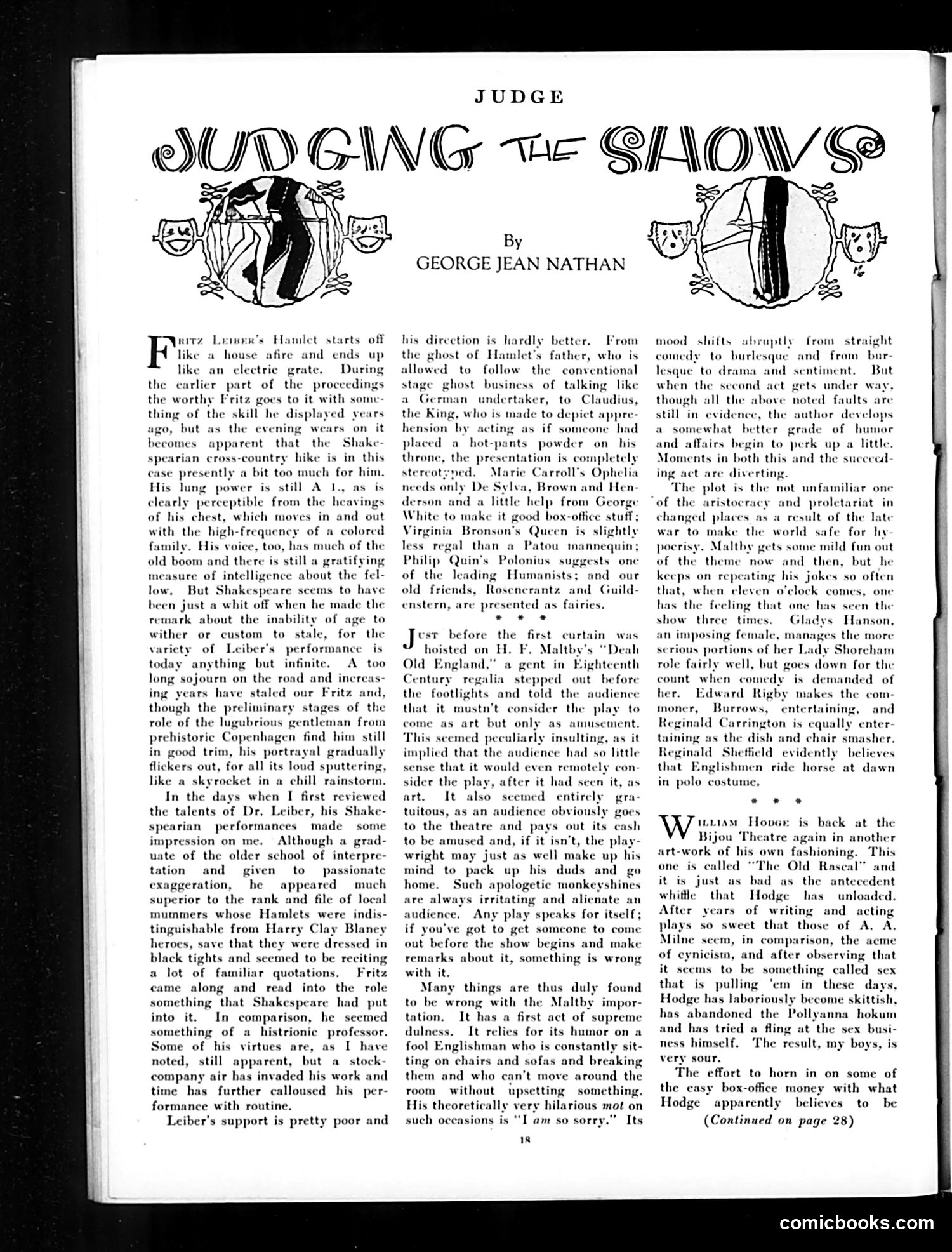
A restored page from Judge, 1930-04-19. Page through the whole issue in the reader above.
📄 Transcribed text from this page (OCR, searchable)
Machine-transcribed from the original scan — historical spelling and the odd misread are preserved.
el uirz Lemen’s Hamlet starts off like a house afire and ends up like an electric grate. During the earlier part of the proceedin the worthy Fritz goes to it with some thing of the skill he displ ago, but as the evening wears becomes apparent that the spearian cross-country hike is in this case presently a bit too much for him. His lung power is still A 1 clearly perceptible from the he of his chest, which moves in and out with the high-frequency of a colored family. His voice, too, has much of the old boom and there is still a gratifying measure of intelligence about the fel- low. But Shakespeare seems to have been just a whit off when he made the remark about the inability of age to wither or custom to stale, for the variety of Leiber’s performance is y anything but infinite. A too long sojourn on the road and inercas- ing years have staled our Fritz and, though the preliminary s of the role of the lugubrious gentleman from prehistoric Copenhagen find him still in good trim, his portrayal gradually flickers out, for all its loud sputtering, like a skyrocket in a chill rainstorm. In the days when I first reviewed 3 riber, his Shake- spearian made some impression on me. Although a grad- uate of the older school of interpre- tation and given to passionate exaggeration, he appeared — much superior to the rank and file of local mummers whose Hamlets were indis- tinguishable from Harry Clay Blaney heroes, save that they were dressed in black tights and seemed to be reciting a lot of familiar quotations. Fritz came along and read into the role something that Shakespeare had put into it. In comparison, he seemed something of a histrionic professor. Some of his virtues are, as I have noted, still apparent, but a stock- company air has invaded his work and time has further calloused his per- formance with routine. Leiber’s support is pretty poor and JUDGE By GEORGE JEAN NATHAN his direction is hardly better. From the ghost of Hamlet's father, who is lowed to follow the stage a G undertake the King, who is made to depict appre- hension by acting as if someone had nts powder on his throne, the presentation is completely stereotyped. Marie Carroll's Ophelia needs only De Sylva, Brown and Hen- derson and a little help from George White to make it good box-otlice stuff; Virginia Bronson’s Queen is slightly less regal than a Patou mannequ Philip Quin’s Polonius sug; of the leading Humanists; and our old friends, Rosen tz and Guild- enstern, are presented as fairies. ** * J’ before rman placed a hot- ests one the first curtain was hoisted on H. F. Maltby’s “Deah Old England,” a gent in Eighteenth Century regalia stepped out before the footlights and told the audience that it mustn't consider the play to come as art but only This seemed peculiar] implied that the aud sense that it would even remotely con- sider the play, after it had seen it art. It also entire tuitous, as an audience obviously goes to the theatre and pays out its cash to be amused and, if it isn’t, the play- wright may just as well make up his mind to pack up his duds and go home. Such apologetic monkeyshines are always irritating and alienate an audience. Any play speaks for itself; if you've got to get someone to come out before the show begins and make remarks about it, something is wrong with it. Many things are thus duly found to be wrong with the Maltby impor- tation. It has a first act of supreme dulness. It relies for its humor on a fool Englishman who is constantly sit- ting on chairs and sofas and breaking them and who can't move around the room without upsetting something. ly very hilarious mot on sions is “I am so sorry.” Its amusement, seemed 18 ING ee SAOW S mood shifts comedy to. burlesque sbeuptly from. straight and from bur- lesque to drama and sentiment. But when the second act gets under way. though all the noted faults are still in evider the author develops what better grade of humor and affairs begin to perk up a little. Moments in both this and the succeed ing act are diverting The plot is the not unfami of the aristocracy and proletariz changed places as a result of the late war to make the world safe for hy pocrisy. Maltby gets some mild fun out of the theme now and then, but he keeps on repeating his es so often that, when cleven o'clock comes, one has the feel show three times. Gladys Hanson, an imposing female, manages the more serious portions of her Lady Shoreham role fairly well, but es down for the count when comedy is demanded of her. Edward Rigby makes the com- moner, Burrows, entertaining, and Reginald Carrington is equally ente taining as the dish and chair smashe Reginald Sheffield evidently believes that Englishmen ride horse at dawn in polo costume. OVE a sow that one has seen the oe @ inniam Hover is back at the Bijou Theatre again in another t-work of his own fashioning. This is called “The Old Rascal” and it is just as bad as the antecedent whifle that Hodg unloaded. After years of writing and acting plays so sweet that those of A. A. Milne seem, in comparison, the acme of cynicism, and after observing that it seems to be something called sex that is pulling ‘em in these days, Hodge has laboriously become skittish, has abandoned the Pollyanna hokum and has tried a fling at the sex busi- ness himself. ‘The result, my boys, is very sour. The effort to horn in on some of the easy box-office money with what Hodge apparently believes to be (Continued on page 28) has comicbooks.com